


International industrial design registration under the Hague System from Vietnam is a mechanism that allows the owner of an industrial design to seek protection in many member countries and territories through a single international application filed with the International Bureau of the World Intellectual Property Organization (WIPO). Instead of preparing and filing a separate application in each country, the applicant may designate the countries in which protection is desired in one international application. For Vietnamese holders, this route works alongside national industrial design registration in Vietnam. In the following article, Viet An Law Firm will provide detailed advice on international registration of industrial designs under the Hague System.
What is the Hague System for international industrial design registration in Vietnam?
The Hague System is the international design registration system administered by WIPO, established on the basis of the Hague Agreement concerning the international registration of industrial designs.
This mechanism allows the owner of an industrial design to follow one centralised procedure to seek protection in several member countries or regions. According to WIPO, the Hague System allows an applicant to use one application, one language and one set of fees to seek protection in many countries or regions.
Vietnam acceded to the 1999 Geneva Act of the Hague Agreement on September 30, 2019. The Act officially took effect for Vietnam on December 30, 2019. From that time, eligible Vietnamese enterprises and individuals have been able to use the Hague System to seek design protection in the relevant members; at the same time, foreign holders may also designate Vietnam in their international applications.
Who may file a design application under the Hague System from Vietnam?
To use the Hague System, an applicant must satisfy the condition of a connection with a member of the system under the applicable Hague Act.
An individual or organisation is entitled to file a Hague application if it meets at least one of the following conditions:
- Being a national of a country that is a member of the Hague Agreement (for example, a Vietnamese national).
- Having habitual residence in a member country.
- Having a legal head office or a real and effective business establishment in a member country.
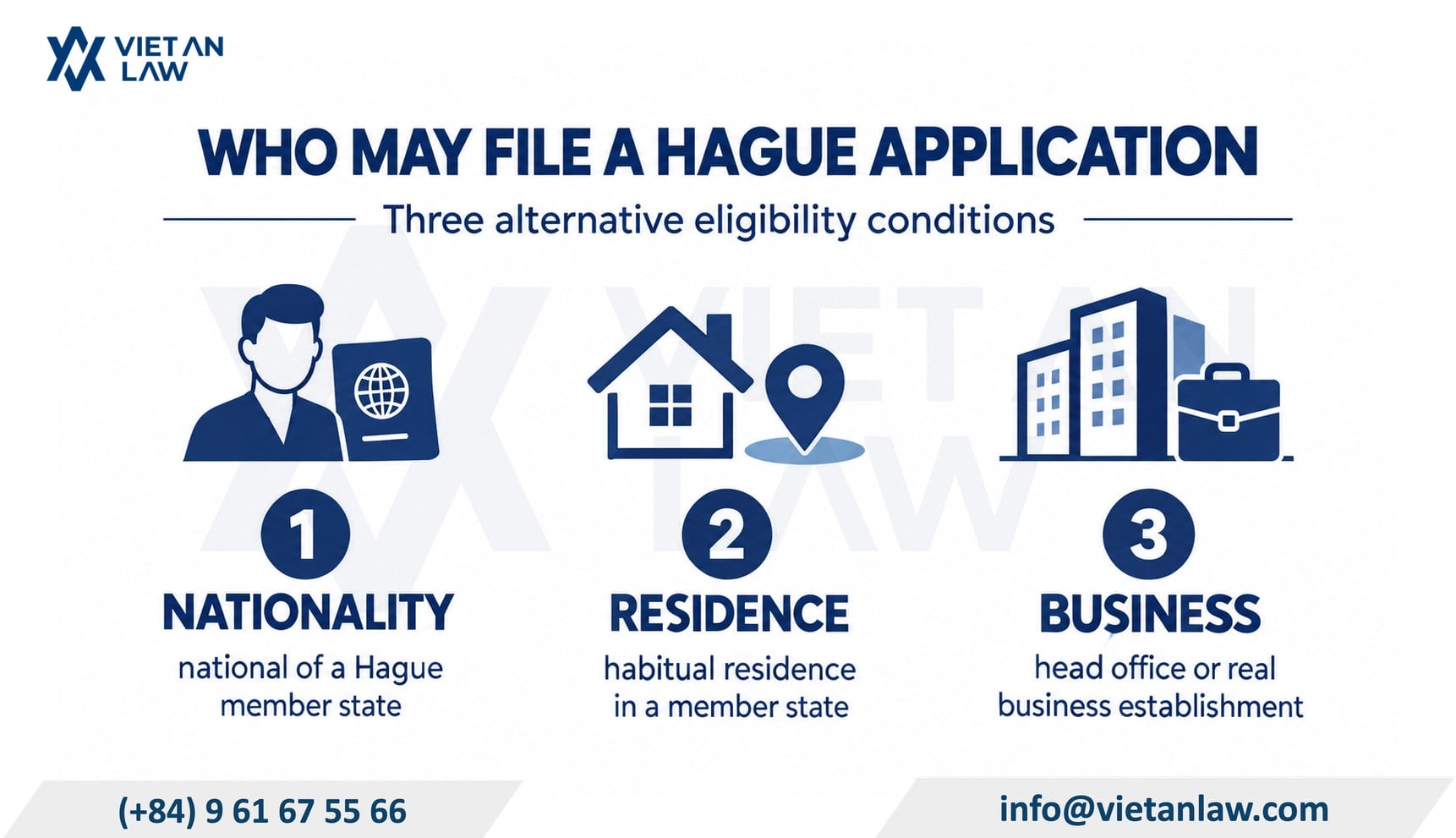
For Vietnamese holders, Vietnam’s membership of the 1999 Geneva Act provides the basis for using the Hague System under the corresponding conditions.
The applicant may be an organisation or an individual that meets the conditions under the Hague Agreement and the relevant laws.
Before filing, an enterprise should check:
- The standing of the applicant;
- The country or member with which the applicant has a connection;
- The countries expected to be designated;
- The specific requirements of each designated country.
Checking these points from the outset helps avoid situations in which an application is prepared but does not meet the conditions for filing, or protection cannot be sought in some of the intended markets.
Conditions for industrial design protection in Vietnam
Although the application is filed under the Hague System, where protection of a design is sought in Vietnam the design must still satisfy the protection conditions under Vietnamese law.
Under Article 63 of the Law on Intellectual Property, an industrial design is protected when it satisfies the following conditions:
- Being new;
- Being creative;
- Being capable of industrial application.
How are Hague applications classified in Vietnam?
Previously, Vietnamese law on international design registration under the Hague System was mainly set out in Decree 65/2023/ND-CP. However, those provisions of Decree 65/2023/ND-CP have been repealed by Decree No. 100/2026/ND-CP and are now set out in Circular No. 10/2026/TT-BKHCN, as amended and supplemented by Circular No. 20/2026/TT-BKHCN.
Under Clause 1, Article 65 of Circular No. 10/2026/TT-BKHCN, Hague applications fall into two groups:
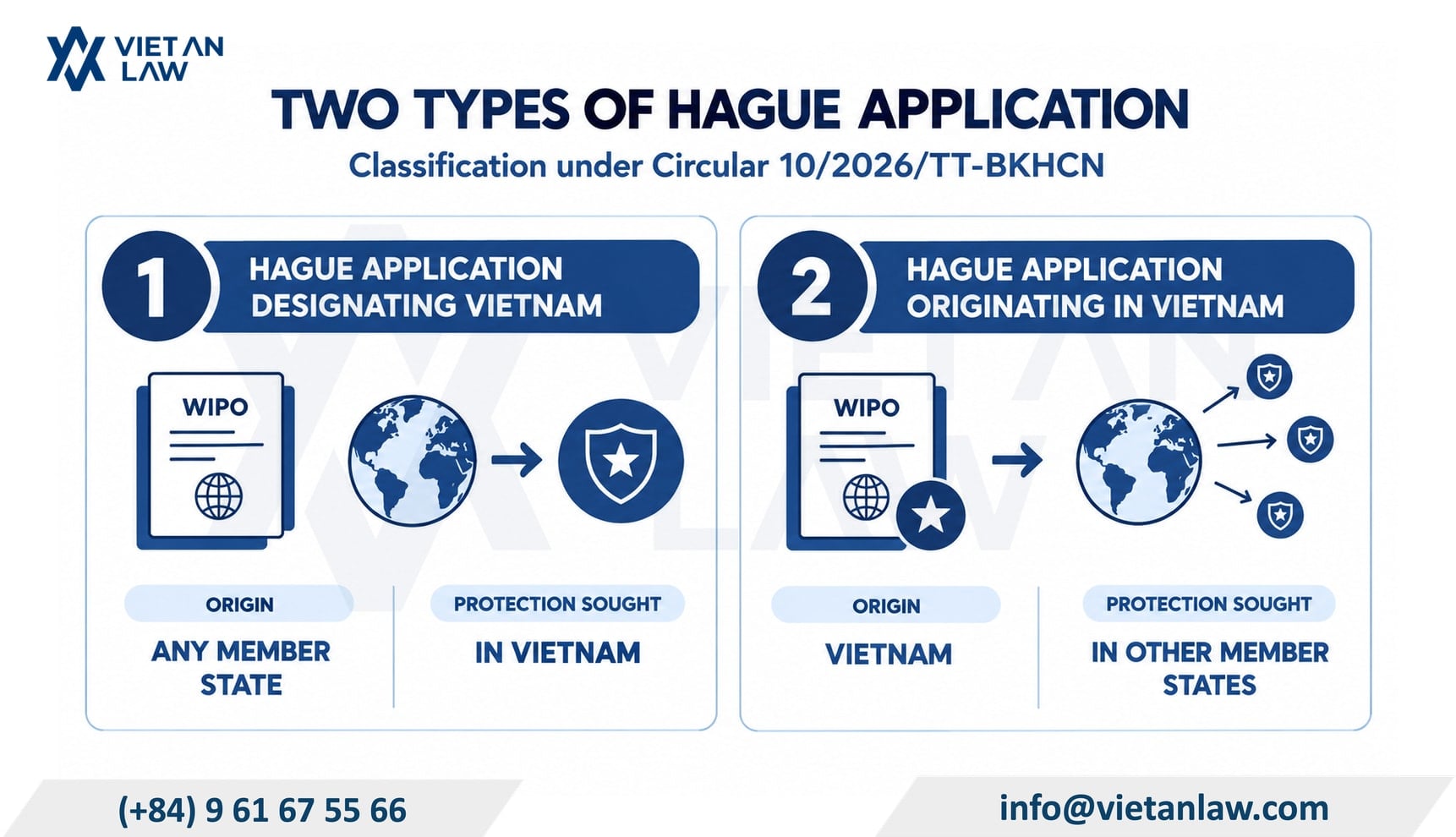
Hague applications designating Vietnam
This is an international application seeking design protection in Vietnam, originating from any member of the Hague Agreement, including Vietnam.
Hague applications originating in Vietnam
This is a Hague application filed from Vietnam that seeks design protection in any member of the Hague Agreement, including Vietnam.
The applicant may file through the National Office of Intellectual Property (NOIP) or file directly with the International Bureau.
The difference between these two types of application lies in the country from which protection is requested and the country in which protection is sought. Specifically:
| Criteria | Hague application originating in Vietnam | Hague application designating Vietnam |
| Purpose | A holder from Vietnam seeks protection abroad | A foreign or Vietnamese holder seeks protection in Vietnam |
| Place of origin | Vietnam | A member of the Hague Agreement |
| Vietnamese authority | May receive and forward the application where it is filed through the state authority in charge of industrial property rights | Receives notice from the International Bureau and carries out the processing |
| Scope of review | Preliminary check before the application is forwarded | Examination of protectability in Vietnam |
| Result | The application is forwarded to the International Bureau | Acceptance or refusal of protection in Vietnam |
How to prepare a Hague application for design protection in Vietnam
At present, a Hague application may be made in two forms: on paper or online. Where filing on paper, the applicant needs to visit https://www.wipo.int/hague/en/forms, download form DM/1 and complete all the required information. Where filing online, the applicant makes the declaration directly on the electronic Hague filing system (eHague).
Whichever form is used, a Hague application must meet the following basic requirements:
- Use the prescribed form; the declaration must not be altered at will.
- Where filed directly with the International Bureau (WIPO): the application must be made in a language prescribed by the Hague Agreement and must meet the requirements as to form and content laid down in the Hague Agreement.
- Where filed through the National Office of Intellectual Property: the language used must be English.
- The application must contain: full information about the applicant; the contact address of the applicant or its lawful representative; detailed information about the product; and the list of countries designated for protection (note: additional countries cannot be added after filing).
Procedure for international industrial design registration under the Hague System from Vietnam
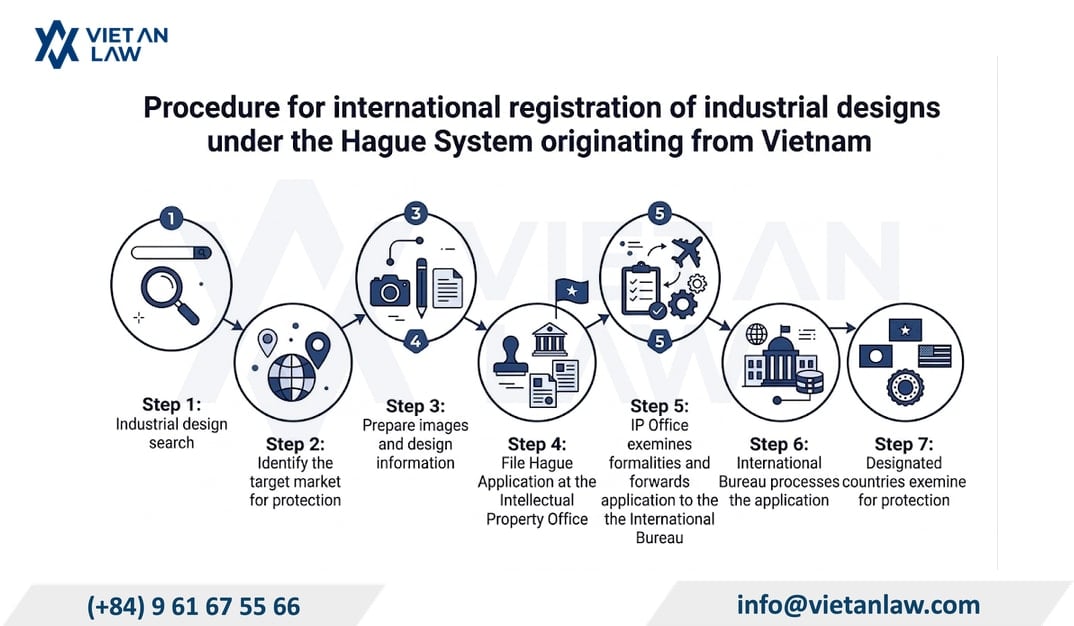
Step 1: Search for industrial designs
Before filing, an enterprise should carry out an industrial design search in Vietnam and in the countries where protection is intended.
The search helps assess the ability to meet the protection conditions, in particular novelty and creativity.
WIPO provides an international design database to support searching of design registrations in the Hague System.
Step 2: Identify the markets that need protection
An enterprise should identify the countries in which it carries out:
- Export;
- Manufacturing;
- Distribution;
- Franchising;
- Licensing;
- Trading in products bearing the design.
It is not necessary to designate every member of the Hague System. The choice should be based on business strategy and on the risk of copying in each market.
Step 3: Prepare the design images and information
The applicant needs to prepare a set of images that meets the requirements of the Hague System and to check the specific requirements of the countries expected to be designated.
Some members may make declarations or impose additional requirements. WIPO publishes members’ declarations so that applicants can check them before preparing an application.
Step 4: File the Hague application with the National Office of Intellectual Property
Under Clause 2, Article 6 of Circular No. 10/2026/TT-BKHCN, a Hague application originating in Vietnam may be filed directly with the International Bureau or through the National Office of Intellectual Property.
However, an enterprise should consider filing through the National Office of Intellectual Property in order to receive support with checking and formality examination before the application is forwarded to the International Bureau, thereby limiting errors of form, content and procedure during the registration process.
Step 5: The National Office of Intellectual Property conducts formality examination and forwards the application to the International Bureau
Under Article 66 of Circular No. 10/2026/TT-BKHCN, a Hague application originating in Vietnam that is filed through the National Office of Intellectual Property is processed as follows:
- Fee collection: the fee for forwarding an international application.
- Fee notice: notification of the fees the applicant must pay directly to the International Bureau within 20 working days from the date of receipt of the application.
- Formality examination: carried out within 12 working days. Where there are deficiencies, the applicant is notified to remedy them within 10 working days.
- Forwarding: the application is forwarded to the International Bureau within 01 month from the date of receipt.
The international filing date is the date on which the National Office of Intellectual Property receives the application, provided that the International Bureau receives the application within 01 month from the date stamped by the Office as the date of receipt.
Once a Hague application originating in Vietnam has been filed with the International Bureau, all transactions relating to the application are carried out by the applicant directly with the International Bureau or with the competent authorities of the members of the Hague Agreement designated in the application, in accordance with the Hague Agreement.
Step 6: The International Bureau processes the application
The International Bureau processes the application in accordance with the Hague Agreement and the relevant regulations.
If the application meets the requirements, the international registration is recorded and published under the mechanism of the Hague System.
Step 7: The designated countries examine protection
After the international registration has been recorded, each designated country may carry out its own examination under its national law.
Therefore, an enterprise needs to monitor the status of the application in each market rather than only monitoring the WIPO international registration number.
Procedure for processing a Hague application designating Vietnam
Under Article 67 of Circular No. 10/2026/TT-BKHCN, a Hague application designating Vietnam is examined by the National Office of Intellectual Property in the same way as a national application, and a conclusion on protection is issued within 06 months from the date on which the International Bureau publishes the application. Specifically:
Where the conditions are met and there are no deficiencies
- A decision to accept protection is issued and recorded in the National Register;
- A statement of grant of protection is sent to the International Bureau and published in the Industrial Property Official Gazette within 01 month.
Where the conditions are not met or there are deficiencies (in whole or in part)
- A notice of refusal stating the reasons is sent to the International Bureau before the 06-month time limit expires. For the part that meets the conditions, a decision to accept protection is still issued and published.
- The decision is published in the Industrial Property Official Gazette within 01 month from the date of issue.
- Time limit for response: the applicant has 03 months from the date of the notice of refusal to remedy the deficiencies or to submit counter-arguments.
- Where the remedy is satisfactory or the arguments are well founded: within 02 months the National Office of Intellectual Property issues a decision to accept protection, records it in the Register, sends a statement of grant of protection following a refusal to the International Bureau and publishes it within 01 month.
- Where no remedy is made, the remedy is unsatisfactory or no well-founded reason is given: within 15 working days from the expiry of the response time limit, the National Office of Intellectual Property issues a decision refusing protection.
Key notes when registering an industrial design internationally under the Hague System in Vietnam
File before disclosing the design
Since novelty is an important condition for design protection, an enterprise should give priority to filing before publishing the design on a website, on social networks, on e-commerce platforms, at exhibitions or on the market.
Do not rely solely on an industrial design search in Vietnam
If registration abroad is planned, international data and the data of each target market should also be searched.
Check the specific requirements of each country
Although a single international application is used, each member may have its own declarations and requirements within the scope permitted under the Hague System. WIPO currently publishes a system of members’ declarations for applicants to check.
Design images must be prepared carefully
Images that are unclear or that do not fully show the design features may directly affect protectability.
Monitor notices of refusal
If a designated country issues a notice of refusal, the owner needs to deal with it within the prescribed time limit. Failure to respond on time may result in the loss of the opportunity to protect the rights in that country.
Frequently asked questions
What are the advantages of registering a design under the Hague System?
- Simplified procedures: one international application may seek protection in many members, reducing the number of separate dossiers to be prepared.
- Convenient for exporting enterprises: Vietnamese enterprises can proactively protect their designs in foreign markets before expanding their business.
- Convenient management: information on the international registration is managed centrally through WIPO.
- Multiple markets may be designated: an enterprise can select the members that suit its business strategy instead of registering in every country.
- Reduced risk of pre-emptive registration: early registration in target markets helps an enterprise be more proactive in protecting its product designs against the risk of a competitor registering or copying them.
How much does international design registration under the Hague System cost?
The cost of registration depends on many factors, including:
- The number of designs;
- The number of designated countries;
- The fee level applicable to each member;
- The international registration fee;
- The publication fee;
- Any additional fees that may arise;
- Processing costs in each country where further procedures are required.
A fixed fee should therefore not be applied to every dossier. When planning a registration, an enterprise should first identify the markets in which protection is genuinely needed in order to optimise costs.
How long is a design protected under the Hague System?
The term and the renewal of an international registration are governed by the Hague Act and the relevant regulations.
Under the mechanism of the Hague System, an international registration is renewed in successive terms. However, the actual term of protection in each member still depends on the law of the designated member.
The owner therefore needs to monitor:
- The international registration date;
- The expiry date;
- The renewal time limit;
- The specific requirements of each country;
- The protection status in each market.
An advantage of the Hague System is that many registration management procedures are carried out centrally through WIPO.
Can several designs be registered in one Hague application?
The Hague System allows several designs to be registered in one international application, subject to the conditions and limits of the system. However, where several designs are included in the same application, an enterprise needs to check the unity requirement and the specific rules of the designated members.
Viet An Law Firm’s services for international industrial design registration under the Hague System from Vietnam
With in-depth experience in intellectual property and in the registration of industrial property rights in Vietnam and abroad, Viet An Law Firm provides advisory and representation services for international registration of industrial designs under the Hague System, supporting clients from the stage of assessing registrability through to monitoring and handling applications in the designated countries. Our intellectual property lawyers in Vietnam accompany clients throughout the process.
Viet An Law Firm’s services include:
- Advising on the conditions for registering a design under the Hague System;
- Advising on the standing and the right of Vietnamese individuals and enterprises to file a Hague application;
- Conducting preliminary searches and assessing the protectability of a design;
- Advising on the selection of suitable countries and territories to designate for protection;
- Advising on a registration strategy suited to the enterprise’s manufacturing, export, distribution and product commercialisation activities;
- Guiding the preparation of images, design representations and the information required for the application;
- Drafting, reviewing and finalising Hague applications originating in Vietnam;
- Representing or supporting clients in filing through the National Office of Intellectual Property or the WIPO International Bureau;
- Monitoring the examination and international registration process;
- Monitoring the protection status in the designated countries;
- Advising on and supporting the handling of notices of deficiency, notices of refusal or requests for additional information from the competent authorities;
- Advising on renewals, changes of information and the management of international design registrations;
- Advising on handling infringements and protecting rights in a design after protection has been granted.
For Hague applications designating Vietnam, Viet An Law Firm supports foreign applicants in monitoring the examination process at the National Office of Intellectual Property, advises on handling notices of refusal and carries out the procedures necessary to protect rights in a design in Vietnam.
International registration of a design requires not only compliance with the rules of the Hague System but also consideration of the specific requirements of each designated country. Choosing a suitable registration strategy from the outset therefore helps an enterprise limit the risk of refusal, optimise costs and improve the effectiveness of design protection in its target markets.
Clients who wish to register a design internationally under the Hague System, to register an industrial design in or to protect designs abroad, or who need advice from intellectual property lawyers in Vietnam, please contact Viet An Law Firm for advice and support from our lawyers and intellectual property specialists.