


To navigate the evolving compliance landscape, businesses and individuals must understand decree 253/2026/ND-CP: guide to Personal Income Tax Law in Vietnam 2025, which introduces critical updates to salary deductions and allowable expenses. Decree 253/2026/ND-CP is the document guiding the implementation of certain articles of the Personal Income Tax Law of 2025, promulgated by the Government on June 30, 2026, taking effect from July 1, 2026, and replacing Decree 65/2013/ND-CP. This personal income tax decree contains many important changes that directly impact the calculation, tax declaration, and payment of personal income tax. Viet An Law updates the new contents related to Decree 253/2026/ND-CP to assist enterprises, organizations, and employees in promptly grasping the new PIT regulations in Vietnam, supplementing our expert tax accounting services. Properly and comprehensively updating this guidance on PIT law is necessary for enterprises to limit legal risks while simultaneously helping employees better protect their lawful rights and interests.
New points of Decree 253/2026/ND-CP guiding the Vietnamese Personal Income Tax Law 2025
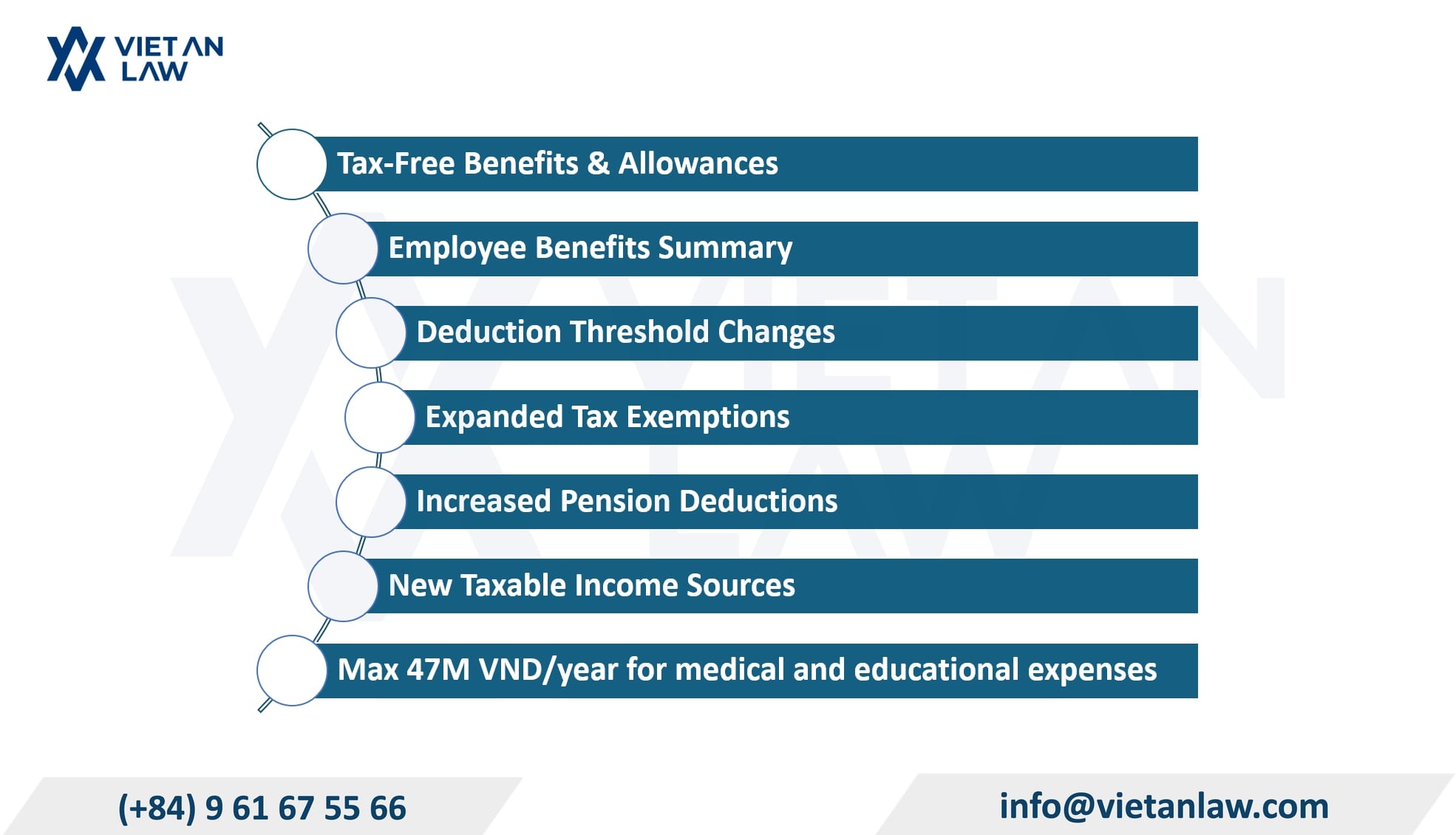
Tax-free benefits and allowances
According to Article 8 of Decree 253/2026/ND-CP, this is the largest group of changes directly impacting the actual monthly income received by employees:
- Increasing the tax exemption level for shift meals: In cases where the employer pays for mid-shift meals or lunches in cash, the expenditure portion under 1,200,000 VND per person per month is not subject to personal income tax (a sharp increase compared to the previous level of 730,000 VND). Only the expenditure portion exceeding this level is calculated into taxable income. If the enterprise directly cooks meals, provides meal vouchers, or purchases meal portions, this entire amount is not subject to tax. (Legal basis: Article 8)
- Expanding the tax exemption for housing benefits: Tax is not calculated on housing benefits (including electricity, water, and accompanying services) built and provided by the employer for employees working at the unit, regardless of the location. Previously, this incentive only strictly applied to housing in industrial zones or economic zones. (Legal basis: Point h, Clause 2, Article 8)
- Exempting tax on the severance allowance portion exceeding the statutory level: In cases where an organization has specific provisions in its financial regulations, internal regulations, or labor agreement regarding a severance or job-loss allowance level higher than the level prescribed by the Labor Code, the actual payment portion exceeding this level is also not calculated into taxable income. The old regulation mandatorily required calculating tax on all expenditure portions exceeding the statutory level. (Legal basis: Point h, Clause 3, Article 8)
Summary of beneficial changes for employees
| Item | Previously (Decree 65/2013) | New point (Decree 253/2026) |
| Mid-shift meals (paid in cash) | Tax exemption maximum of 730,000 VND per month | Tax exemption maximum of 1,200,000 VND per month |
| Withholding at source (seasonal labor) | Applied from the level of 2,000,000 VND per time | Applied from the level of 5,000,000 VND per time |
| Housing built by the company | Tax exempt if in an industrial zone or economic zone | Completely tax exempt, regardless of location |
| Severance and job-loss allowance | Tax calculated on the expenditure portion higher than the statutory level | Tax exempt on the expenditure portion exceeding the law if included in regulations |
| Salary for untaken leave days | Aggregated into taxable income | Exempt from personal income tax |
Changes in deduction thresholds for tax declaration
- Raising the 10% casual tax deduction threshold: The income level subject to a 10% tax withholding at source (for laborers not signing contracts or with contracts under 3 months) is raised to the level of 5,000,000 VND per payment (previously 2,000,000 VND per payment).
- This helps minimize the need to process tax refund procedures for seasonal workers and intern students with low income. This update simplifies the overall tax declaration process for enterprises managing short-term workforce contracts.
Expanding subjects and tax-exempt income under the personal income tax guide
Decree 253/2026/ND-CP has codified and expanded the income items that are completely tax-exempt under this personal income tax guide, specifically:
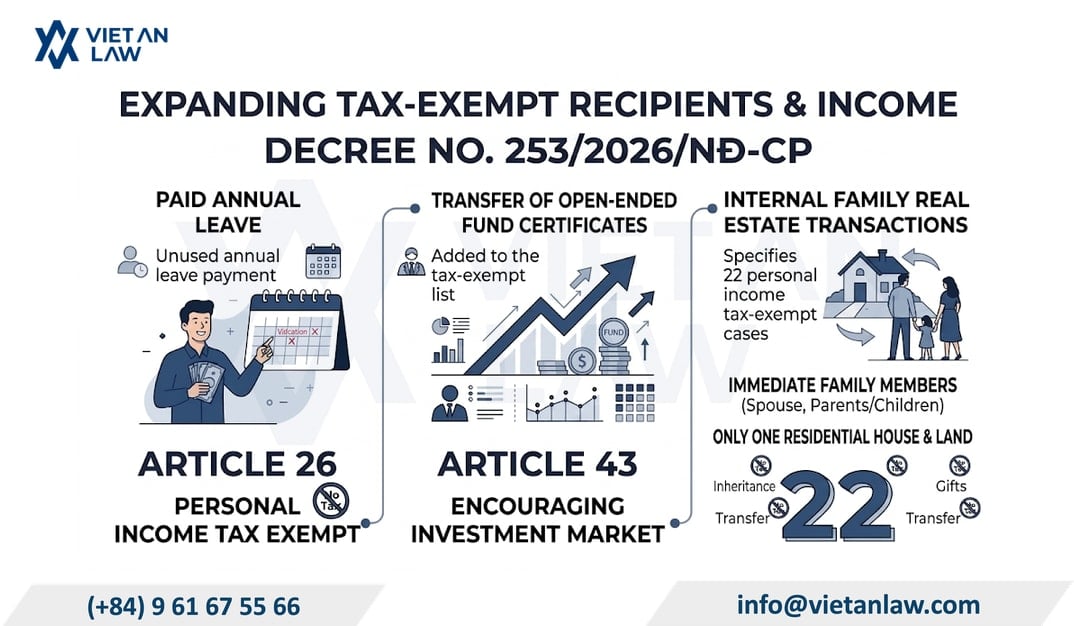
- Salary for leave days: Officially exempting personal income tax for the salary and wage amounts that enterprises pay to employees for untaken annual leave days (Article 26 of Decree 253).
- Transfer of open-ended fund certificates: Added to the list of tax-exempt income to encourage the investment market (Article 43 of Decree 253).
- Internal family real estate transactions: Detailing 22 cases of personal income tax exemption, notably the income from transferring, inheriting, or receiving gifts of real estate between direct relatives (husband and wife; biological parents and biological children); or income from transferring the sole residential house, residential land use rights, and assets attached to residential land of an individual.
Increasing the maximum deductible level for voluntary pension fund contributions
According to the provisions at Point a, Clause 2, Article 46 of Decree 253, the total income from salaries and wages is deducted by a maximum of not exceeding 3 million VND per month for these forms of insurance participation, including both the amount contributed by the employer for the employee and the amount voluntarily contributed by the employee (if any) to calculate personal income tax. Previously, Decree 65/2013 only stipulated the level of 1 million VND per month.
Adding taxable income for other income sources according to PIT regulations in Vietnam
Accordingly, Article 16 of Decree 253 provides specific guidance on these new PIT regulations in Vietnam:
- Income from the transfer of the Vietnam national domain name “.vn” is the income received from transferring the use right of the Vietnam national domain name “.vn” to other organizations or individuals.
- Income from transferring greenhouse gas emission reduction results and carbon credits of individuals owning the greenhouse gas emission reduction results and carbon credits, except for the cases prescribed in Clause 1, Article 34 of this Decree.
- Income from the transfer of auction-winning vehicle license plates according to the provisions of law.
- Income from the transfer of digital assets, including virtual assets, crypto assets, and other digital assets according to the provisions of the law on the digital technology industry.
Individuals permitted a maximum deduction of 47 million VND / year for medical and educational expenses
This is a completely new policy under this personal income tax decree in Clause 2, Article 49 of Decree 253/2026/ND-CP, specifically:
The taxpayer who is a resident individual is allowed to deduct from their taxable income before calculating tax on income from salaries and wages the expenditures for healthcare and education and training of the taxpayer and the dependents of the taxpayer, including:
- Expenditures for medical examination and treatment at domestic medical establishments within the scope of the list paid by health insurance, totaling not exceeding 23 million VND per year;
- Expenditures for education and training at domestic education and training institutions, totaling not exceeding 24 million VND per year, specifically: Tuition fees for preschool education, general education, vocational education, and higher education according to the provisions of the law on education and training and other professional skills at education and training institutions.
The expense items that the taxpayer is permitted to deduct as prescribed in Clause 2 of this Article must satisfy the following conditions:
- Having invoices and documents according to the provisions of law; separately for medical expenditures, there must additionally be a Statement of medical examination and treatment costs used at medical examination and treatment establishments according to the regulations of the Minister of Health;
- The invoices and documents for deduction must present the information of the taxpayer or the dependents of the taxpayer;
- Not being paid from other sources, including from sponsorship, support, or proxy payment sources of organizations and individuals, the state budget source, the social insurance fund, health insurance, and insurance payments under various forms.
Regulations for individual business owners wishing to transfer capital in joint-stock companies and limited liability companies
| Comparison criteria | Limited liability company (Capital contribution transfer) | Joint-stock company (Securities transfer) |
| Nature of income | Income from the transfer of the capital contribution portion | Income from the transfer of securities (shares) |
| Tax calculation basis | Based on Taxable income (Actual profit) | Based on Transfer price (Total revenue per transaction) |
| Applicable tax rate | 20% | 0.1% |
| Tax calculation formula | Personal income tax = Taxable income x 20% | Personal income tax = Transfer price x 0.1% |
| Determining income / transfer price | Taxable income = Transfer price – Purchase price – Expenses | The transfer price is the actual price recorded on the contract or the matched price on the trading floor. Regardless of whether a loss or profit arises. |
| Regulations on Transfer price | It is the actual value recorded in the contract. If the price is zero (0) or lower than the book value, the tax authority has the right to impose the transfer price based on the financial statements. | |
| Determining Purchase price (Cost price) | It is the portion of the contributed capital value forming the basis at the time of establishment or the value recorded on the contract to repurchase the previous capital contribution portion, accompanied by valid payment documents. | There is no need to determine the purchase price or related expenses because tax is calculated directly on the transfer revenue. |
| Determining reasonable expenses | Including actual expenses directly arising with invoices and documents: legal fees, appraisal fees, and charges related to the transaction. | Expense deduction is not applied. |
| Time of determining taxable revenue | It is the time the capital contribution transfer contract takes legal effect. | It is the time of completing the transfer of share ownership rights (or the transfer contract takes effect for unlisted companies). |
| Deadline for submitting tax declaration dossiers | At the latest, the 10th day from the day the transfer contract takes effect. | Before carrying out procedures to change the list of shareholders at the business registration authority. |
| Responsibility to declare and pay on behalf | The individual may declare tax themselves or the enterprise declares on their behalf. If the individual does not declare, the enterprise is responsible for declaring and paying tax on their behalf before carrying out the procedure to change members. | The enterprise is responsible for declaring and paying personal income tax on behalf of the transferring individual before recording the shareholder change in the registration book. |
Note:
- Tax imposition risk: For both types, declaring the transfer price at par value (while the enterprise has capital surplus, undistributed profits, or a large reserve fund) carries a very high risk of the tax authority re-imposing the payment value based on the owner’s equity at the time of transfer.
- Payment documents: The transfer of the capital contribution portion and shares requires non-cash payment documents (bank transfers) to ensure the validity of the purchase price and sale price when reconciled with the tax authority.
Instructions on tax declaration in Vietnam before and after July 1, 2026
Article 70 of Decree 265/2026/ND-CP provides for transitional clauses as follows:
- The deadline for registering dependents and the deadline for submitting dossiers proving dependents for the 2025 tax calculation period and earlier shall comply with the provisions in the normative legal documents on personal income tax prior to July 1, 2026.
- For cases that have carried out tax declaration and paid tax on income from salaries and wages for the 2026 tax calculation period during the time from January 1, 2026, to before July 1, 2026, according to the provisions in the normative legal documents on personal income tax applied before the time of July 1, 2026, they are not required to resubmit the monthly or quarterly tax declaration dossier but shall make adjustments in the 2026 tax finalization declaration dossier.
Related questions on the Personal Income Tax Law
From what income level are seasonal workers and those with contracts under 3 months subject to a 10% tax deduction?
From the level of 5,000,000 VND per payment and above. This level has been raised compared to the old regulation (2,000,000 VND per time), helping to minimize tax refund procedures for short-term employees.
When an employee resigns and the company pays the salary for untaken annual leave days, is this amount subject to tax?
No. The new decree officially stipulates personal income tax exemption for the salary amount paid for untaken annual leave days.
If a company pays a severance allowance higher than the level prescribed by the Labor Code, is the excess portion subject to personal income tax?
It is not subject to tax, provided that this payment level must be clearly stipulated in the financial regulations, internal regulations, or collective labor agreement of the company.
If a company builds housing for employees to use free of charge, how is this benefit taxed?
It is completely tax-exempt (including electricity, water, and accompanying services). This incentive currently applies to all locations and is no longer limited to only industrial zones or economic zones as before.
If clients have any remaining questions regarding decree 253/2026/ND-CP: guide to Personal Income Tax Law in Vietnam 2025 or need comprehensive tax accounting services, please contact Viet An Law for the best support! Ensuring adherence to this guidance on PIT law will guarantee smooth operations and strict compliance.