


The practical drafting and negotiation of business transactions continually encounter obstacles regarding financial sanction limits when partners fail to fulfill commitments. Therefore, the draft Vietnam commercial law: removal of the 8% contract penalty limit (penalty cap) is attracting special attention from the business community. As a specialized unit in commercial contract consulting and contract dispute resolution, Viet An Law synthesizes and analyzes the core changes of this draft, helping clients proactively review, adjust negotiation strategies, and prevent legal risks.
Summary of changes regarding commercial contract penalty sanctions
| Criteria | Current regulations (Commercial Law 2005) | Direction of amendment (2026 Draft) |
| Applicable legal framework | Chapter VII of the Commercial Law 2005 | Civil Code 2015 |
| Contract penalty level | Maximum of 8% of the value of the breached obligation portion | Freedom of agreement, no ceiling imposed |
| Estimated damages compensation (LD) | Lacking legal basis, risk of being declared invalid | Paving the way for application according to the freedom of agreement principle |
| Legal objective | Administrative management of commercial transactions | Respecting freedom of will, increasing financial deterrence |
| Impact on businesses | Limiting negotiation flexibility, low punishment | Proactively designing sanctions, risk of abusing position |
Legislative context and draft progress
The draft law amending and supplementing a number of articles of the Commercial Law, the Competition Law, the Law on Foreign Trade Management, and the Law on Protection of Consumers’ Rights, drafted under the prime responsibility of the Ministry of Industry and Trade, is entering a decisive stage. The government issued Resolution 141/NQ-CP on June 1, 2026, approving the core policies of the draft law, and it is expected that the dossier will be submitted to the National Assembly Standing Committee in August 2026 and submitted to the National Assembly for consideration at the 2nd session, 16th legislature (around October 2026).
The focus with the strongest impact of the draft is the abolition of the entire Chapter VII of the Commercial Law 2005, leading to the elimination of the current contract penalty ceiling.
Core contents of the draft amended Vietnam Commercial Law 2026
The draft proposes the abolition of the entire Chapter VII of the Commercial Law 2005 (from Article 292 to Article 316) regarding sanctions and contract dispute resolution.
The inevitable consequence is that the draft Vietnam commercial law: removal of the 8% contract penalty limit aims to return the right to regulate contractual relations to the Civil Code.
All disputes related to a contract penalty in commercial business will directly apply Article 418 of the Civil Code 2015, allowing the freedom to set the financial punishment level.
This change aims to limit administrative intervention in private transactions, elevating the freedom of agreement principle of the parties.
Current regulations on the 8% penalty limit and shortcomings in Vietnam
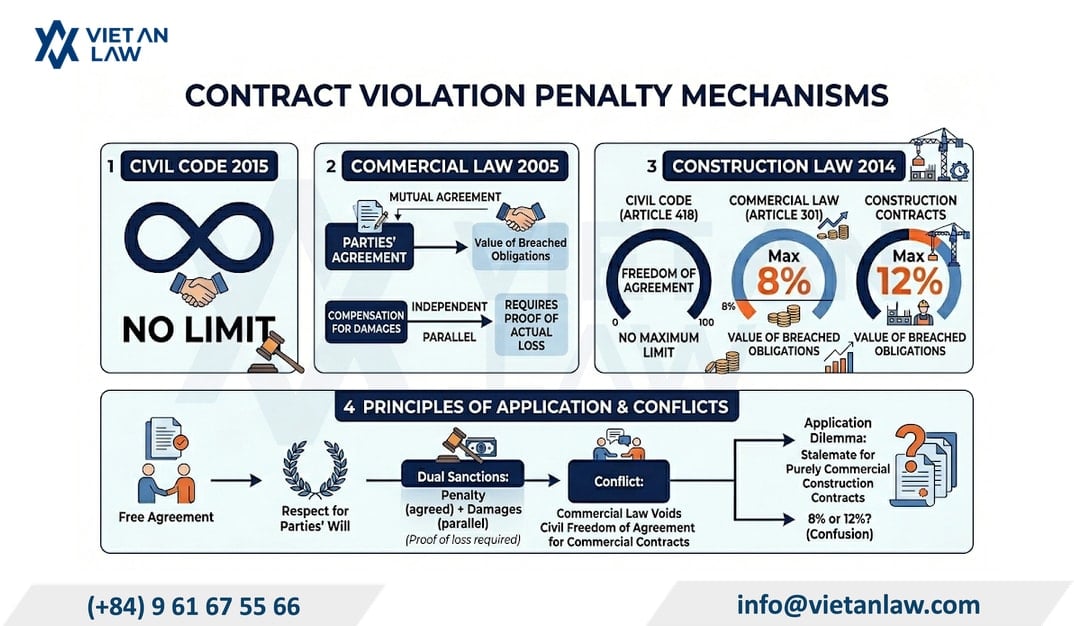
The current legal system creates fragmentation and conflict in applying a breach of contract penalty, causing great difficulties in contract dispute resolution.
Legal framework under the Commercial Law 2005
Article 300 of the Commercial Law 2005 acknowledges the right to demand payment of a penalty due to a breach of contract with the prerequisite condition that the parties have an agreement. Article 301 establishes a hard 8% penalty limit on the value of the breached contractual obligation portion:
“The penalty level for a breach of contractual obligation or the total penalty level for multiple breaches shall be agreed upon by the parties in the contract, but shall not exceed 8% of the value of the breached contractual obligation portion, except for cases specified in Article 266 of this Law.”
Article 302 stipulates that damages compensation is an independent sanction, parallel to the contract penalty, but requires the breached party to prove actual damages. These two sanctions possess different natures: the contract penalty is directed towards the purpose of deterrence and punishment, while damages compensation aims to offset financial losses.
Conflict in specialised law application
The Civil Code 2015 (Article 418) allows the parties to freely agree on the contractual penalties level without setting a maximum limit. However, according to the principle of specialized law application (Article 4 of the Commercial Law 2005), all contracts possessing a commercial nature must apply the 8% ceiling, thereby nullifying the spirit of freedom of agreement of the Civil Code.
In the construction sector, the Construction Law 2014 stipulates that the penalty level for a construction contract utilizing state capital is not to exceed 12%, creating a deadlock when determining the penalty ceiling for a purely commercial construction contract.
Analysis of adjudication practice and risks from the 8% limit of the Vietnamese Commercial Law 2005
The practice of resolving contract disputes at Courts and Arbitration centers shows that the 8% penalty limit is distorting the will of the parties and neutralizing the deterrence of the penalty clause.
Arbitration case law: High agreed levels pulled down to the statutory ceiling
In the VIAC arbitral award #054 (Source: Vietnam International Arbitration Centre (VIAC), Dispute Lesson No. 054) regarding an embroidery machine sale and purchase dispute, the parties agreed on a penalty level of 10% of the contract value upon a breach.
Context: Company S (Seller / Claimant) signed a contract to sell to Mr. C (Buyer / Respondent) 01 electronic computer embroidery machine, valued at 525,000,000 VND. The contract agreed in Article 7: if either party incorrectly executes the clauses, the breaching party must compensate 10% of the contract value to the other party. The buyer received the goods but still owed 126,000,000 VND and failed to pay despite being requested. The seller filed a lawsuit at VIAC, demanding debt payment, late payment interest, and a breach of contract penalty.
Legal issue: When a commercial contract agrees on a penalty level of 10% of the contract value, how does the Arbitral Tribunal determine the penalty level?
Legal basis: Article 300 of the Commercial Law 2005 permits a penalty if the contract contains an agreement. Article 301 of the Commercial Law 2005 limits the penalty level to “not exceeding 8% of the value of the breached contractual obligation portion.” Article 4 of the Commercial Law 2005 stipulates that commercial activities must comply with the Commercial Law first, and only when the Commercial Law does not regulate will the Civil Code apply.
The Arbitral Tribunal assessed:
- The Claimant has the right to demand a penalty because the contract contains an agreement (Article 300).
- However, the 10% level of the contract value agreed upon by the parties exceeds the 8% ceiling according to Article 301; the Arbitral Tribunal applies the maximum level of 8% of the breached obligation portion instead of the agreed 10% level.
- The breached obligation portion = 126,000,000 VND (the remaining debt amount).
- The penalty amount = 126,000,000 x 8% = 10,080,000 VND (instead of 52,500,000 VND if applying 10% of the entire contract).
Conclusion:
- The 8% ceiling in Article 301 is a mandatory norm – neither the Court nor Arbitration has the right to accept an agreed level that exceeds it, regardless of the parties’ will.
- The 10% penalty agreement is not entirely invalidated, but is reduced to the statutory ceiling.
- In this case, the seller only received a penalty amount equal to approximately 1/5 compared to the initial agreed level – showing that the 8% penalty limit can significantly neutralize the deterrent meaning that the parties desire when drafting the contract.
Court practice: Rigid application distorts agreements
In Judgment No. 02/2019/KDTM-ST dated January 11, 2019, of the People’s Court of Tan Binh District regarding the supply of hotel equipment, the parties agreed on a progressive late payment penalty of 0.5% per week, with a maximum not exceeding 5% of the contract value. Company V had paid 595,000,000 VND, still owed 747,000,000 VND, and failed to make the payment.
The Court did not apply the progressive penalty mechanism of 0.5% per week and the ceiling of 5% of the contract value agreed upon by the parties, but directly fixed the penalty level at 8% of the value of the breached obligation portion according to Article 301 of the Commercial Law 2005; the penalty amount was fixed at: 747,000,000 x 8% = 59,760,000 VND.
If applying exactly the 5% agreement on the total contract value: 1,342,000,000 x 5% = 67,100,000 VND, which is higher than the level declared by the Court.
Consequence: The jurisdictional body transformed the “not exceeding 8%” ceiling into a default application level without deeply analyzing the specific agreement between the parties.
Legal greys regarding liquidated damages in Vietnam
Liquidated damages are an extremely popular sanction in international commerce, commonly appearing in commercial contracts involving foreign elements. However, the Commercial Law 2005 currently only recognizes (i) contractual penalties – applying the 8% penalty limit, and (ii) damages compensation – requiring proof of actual damages. Liquidated damages do not belong to either of these two types of sanctions.
Vietnamese jurisdictional bodies are often confused when handling clauses on liquidated damages in commercial contracts: they cannot be classified into the penalty group (due to the entanglement with the 8% penalty limit), nor can they be applied as damages compensation (due to the lack of evidence of actual losses). Meanwhile, the Civil Code 2015 (Article 418) allowing the parties to freely agree on the contractual penalties level without setting a maximum limit is not applied due to the principle of general law versus specialized law.
The lack of a legal framework for liquidated damages reduces the competitiveness of Vietnamese law when regulating cross-border transactions.
Impacts and contract drafting consultant recommendations for Vietnamese commercial parties
Impacts and contract drafting consultant recommendations for Vietnamese commercial parties
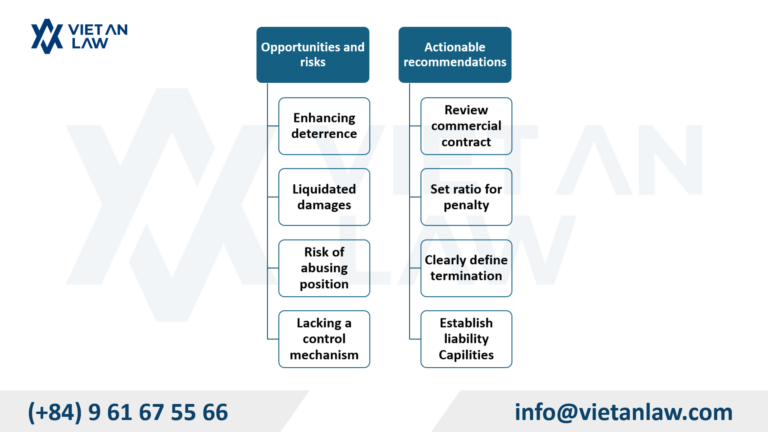
New opportunities and risks
- Enhancing deterrence: Businesses are allowed to establish high penalty levels, preventing the situation where partners are “willing to breach because bearing an 8% penalty remains profitable”;
- Paving the way for liquidated damages clauses: Creating a basis to design clauses that fix the compensation level in advance, reducing the burden of proving damages when an incident occurs;
- Risk of abusing position: Large businesses can impose massive penalty levels in template contracts and franchise contracts, creating pressure for the weaker party;
- Risk of lacking a control mechanism: The Civil Code allows the Court to cite the principle of good faith (Article 3) to reject unreasonable agreements, but currently, there are no specific case laws or guidelines regarding the reduction of an excessively high contract penalty.
Actionable recommendations for businesses
- Review all currently effective commercial contracts and reassess the breach of contract penalty clauses that were once considered invalid due to exceeding the 8% ceiling;
- For newly signed contracts, the contract drafting consultant should not abuse the ceiling removal to set unreasonable penalty levels, but rather needs to calculate a punishment ratio proportionate to the risks and the transaction value;
- Clearly distinguish using legal language between the three mechanisms: contractual penalties (punishment), damages compensation (actual offset), and liquidated damages (pre-fixed);
- Additionally design mechanisms limiting the total compensation level and breach of contract penalty to control maximum financial risks;
- Flexibly utilize a progressive penalty mechanism over time (for late payments, late deliveries) instead of applying a fixed ratio.
Frequently asked questions about breach of contract penalty in Vietnam
What is the maximum breach of contract penalty level currently?
Until mid-2026, commercial contracts will still apply the maximum ceiling of the 8% penalty limit on the value of the breached obligation portion under the Commercial Law 2005. Construction contracts utilizing state capital bear a 12% ceiling, while normal civil contracts are not limited in penalty levels.
If the commercial contract does not record a penalty level, do I have the right to demand a penalty amount?
No. Unlike damages compensation which can be demanded according to statutory law, a contract penalty is a sanction that must mandatorily be clearly agreed upon by the parties and recorded in writing in the contract before the breach occurs.
How to make a liquidated damages clause effective in Vietnam?
Currently, a liquidated damages clause is highly risky. After the draft amending the Commercial Law takes effect, businesses should design the liquidated damages clause in the form of an unlimited contract penalty agreement, or clearly bind the formula for calculating future damages to comply with the freedom of agreement principle of the Civil Code.
Commercial contract consulting services in Vietnam at Viet An Law
With extensive experience in providing legal support for the business community, Viet An Law provides specialized solutions:
- Review, assess risks, and adjust the entire template contract system of the business, updating new legal changes;
- Directly participate in commercial contract consulting, negotiating complex clauses such as penalties, liability limitations, and damages compensation;
- Represent clients to participate in contract dispute resolution at Courts and commercial Arbitration Centers;
- Provide legal opinions regarding the validity of financial sanctions in cross-border contracts.
As a major legislative update, the draft Vietnam commercial law: removal of the 8% contract penalty limit has marked a major step forward in perfecting the business environment, returning true freedom of agreement rights to commercial subjects. Although currently in the completion stage to await the National Assembly’s approval, this change requires businesses and legal teams to update their negotiation mindset early.
To build a safe contract system, optimize benefits, and minimize dispute risks, clients are kindly requested to contact Viet An Law to receive the most profound and timely legal advice.