


In the context of significant economic fluctuations, refining tax policies towards flexibility to support recovery and promote production and business activities remains a core focus of state financial and budgetary policies. On April 24, 2026, the National Assembly officially passed the new Tax Law 09/2026/QH16 in Vietnam: PIT, VAT, CIT & Tax Exemptions, amending and supplementing a number of articles of the Personal Income Tax Law, Value-Added Tax Law, Corporate Income Tax Law, and Special Consumption Tax Law. These new tax regulations in Vietnam introduce notable updates regarding the tax-exempt revenue threshold, the mechanism assigning the Government to proactively adjust tax policies, and the extension of tax incentives for battery-powered electric vehicles. Businesses requiring business registration, ongoing tax accounting services, or expert tax consulting services will find the comprehensive PIT, VAT, CIT changes 2026 highly relevant.
New Tax Law 09/2026/QH16 in Vietnam: PIT, VAT, CIT & Tax Exemptions
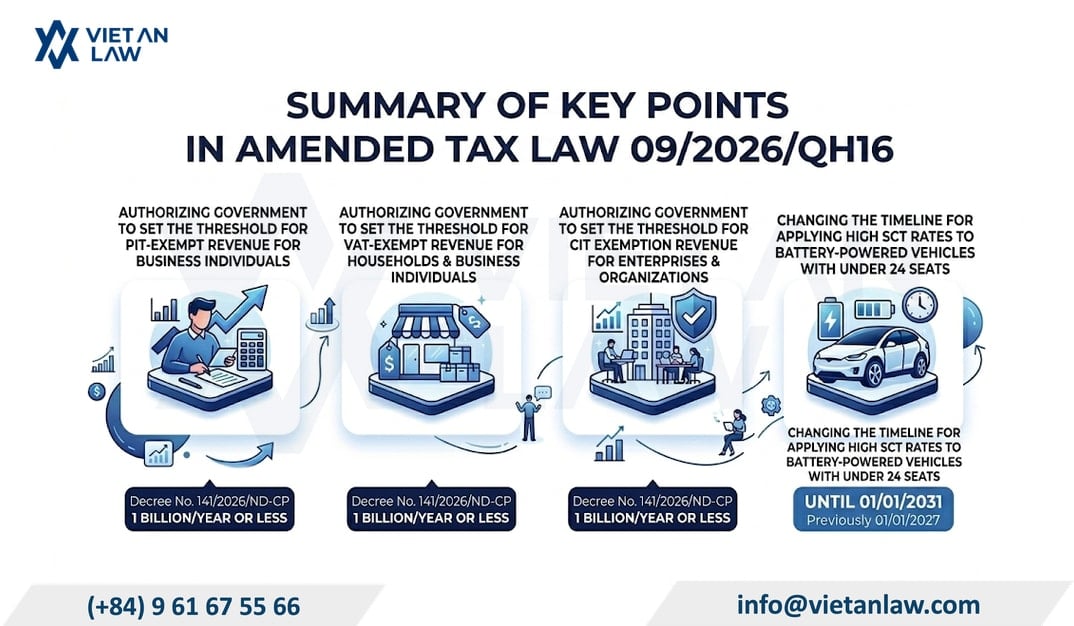
- Assigning the Government to stipulate the revenue threshold not subject to personal income tax for resident individuals engaged in production and business activities (specifically, 1 billion VND per year or less according to Decree 141/2026/ND-CP);
- Assigning the Government to stipulate the revenue threshold for household businesses and individuals engaged in production and business activities not subject to value-added tax (specifically, 1 billion VND per year or less according to Decree 141/2026/ND-CP);
- Assigning the Government to stipulate the revenue threshold for enterprises and organizations exempt from corporate income tax (specifically, 1 billion VND per year or less according to Decree 141/2026/ND-CP);
- Changing the application period of the high special consumption tax rate for battery-powered motorized vehicles under 24 seats to January 1, 2031 (previously January 1, 2027).
Primary beneficiaries of Law 09/2026/QH16
The groups benefiting the most from the Law 09/2026/QH16 updates are household business groups, individual business entities, and small-scale enterprises due to the expansion or exemption of certain tax obligations.
Low revenue household businesses and individual business entities
This is the most obvious beneficiary group. The amended law stipulates that households and individuals engaged in production and business with an annual revenue at or below the level stipulated by the Government will not have to pay personal income tax and will also be exempt from value-added tax. Previously, the threshold was rigidly stated in the law; now, it is assigned to the Government for flexible adjustment according to the economic situation. This flexible tax threshold for household businesses ensures better adaptation to market changes. For example, benefiting sectors include:
- Small grocery stores, small-scale personal services: haircutting, hair washing, skin care.
- Family-scale eateries and coffee shops.
- Low-revenue online sellers.
Micro enterprises and newly established enterprises
The law adds a corporate income tax exemption case for enterprises and organizations with a total annual revenue at or below the level stipulated by the Government.
The beneficiary group includes:
- Newly established companies in the early stages.
- Micro enterprises, family companies.
- Low-revenue local enterprises.
This helps reduce financial pressure and increases the ability to accumulate capital to expand operations, which is highly beneficial after completing business registration.
Consumers
When the tax burden on household businesses and small enterprises is reduced, operating costs can decrease accordingly, thereby contributing to:
- Limiting the price increase of goods and services.
- Stimulating consumption.
- Increasing purchasing power in the domestic market.
Private economic sector and small scale business
The law is evaluated as a policy to support the recovery and development of the private economic sector, particularly:
- Individual business households, small traders.
- Micro and small enterprises.
- New business models on digital platforms with modest revenue.
Which groups benefit the most
If considering the level of direct impact, the order of benefit is usually:
| Target group | Level of benefit |
| Low revenue household businesses | Very large |
| Small individual business entities | Very large |
| Micro enterprises | Large |
| Newly established startups | Large |
| Consumers | Indirect |
| Large enterprises | Minor impact |
Law 09/2026/QH16 is considered a significant support step for household businesses, individual business entities, and micro enterprises, as for the first time, the tax exemption mechanism is designed flexibly according to the revenue threshold adjusted by the Government for each economic period.
Government sets annual revenue threshold exempt from personal income tax for resident individuals in production and business
Previously, Clause 1, Article 7 of the Personal Income Tax Law 2025 stipulated:
“Resident individuals engaged in production and business activities with an annual revenue of 500 million VND or less are not required to pay personal income tax. The Government shall submit to the National Assembly Standing Committee to adjust the revenue threshold exempt from personal income tax to suit the socio-economic situation in each period.”
However, according to the new regulations of Article 1 of Law 09/2026/QH16, which amended and supplemented Clause 1, Article 7 of the Personal Income Tax Law 2025 as follows:
“1. Resident individuals engaged in production and business activities with an annual revenue at or below the level stipulated by the Government are not required to pay personal income tax. Based on macroeconomic indicators and budget balancing capabilities, the Government stipulates the annual revenue threshold appropriate to the socio-economic context in each period.”
Thus, instead of rigidly fixing the revenue threshold at 500 million VND per year as before, the Law 09/2026/QH16 updates have assigned the Government to proactively stipulate the revenue threshold exempt from personal income tax for resident individuals engaged in production and business. This is a crucial new point aimed at increasing flexibility in tax policy management, ensuring that the determination of the taxable threshold is appropriate for fluctuations in the socio-economic situation, inflation, the population’s standard of living, and the state budget’s balancing capability in each phase.
In the context of volatile living costs, business costs, and price levels, empowering the Government to adjust the tax-exempt revenue threshold is expected to create more favorable conditions for household businesses and individual business entities of small and micro scales.
Accordingly, on April 29, 2026, the Government issued Decree 141/2026/ND-CP amending and supplementing a number of articles of Decree 68/2026/ND-CP, which officially adjusts the personal income tax threshold to 1 billion VND for household businesses and individual business entities. This tax threshold for household businesses up to 1 billion VND applies from January 1, 2026.
Government sets revenue threshold for household businesses and individuals in production and business not subject to value added tax
Previously, according to Clause 25, Article 5 of the Value-Added Tax Law 2024:
“Goods and services of households and individuals engaged in production and business with an annual revenue of 200 million VND or less; assets sold by non-business organizations and individuals who are not value-added taxpayers; national reserve goods sold by national reserve agencies; fee and charge revenues according to the law on fees and charges.”
However, according to the new regulations of Article 2 of Law 09/2026/QH16, Clause 25, Article 5 of the Value-Added Tax Law 2024 is amended as follows:
“Goods and services of households and individuals engaged in production and business with an annual revenue at or below the level stipulated by the Government; assets sold by non-business organizations and individuals who are not value-added taxpayers; national reserve goods sold by national reserve agencies; fee and charge revenues according to the law on fees and charges. Based on macroeconomic indicators and budget balancing capabilities, the Government stipulates the annual revenue threshold in this clause appropriate to the socio-economic context in each period.”
Thus, instead of a fixed revenue threshold of 200 million VND per year as before, Law 09/2026/QH16 shifted to a mechanism assigning the Government to proactively stipulate the revenue threshold not subject to value-added tax for households and individuals engaged in production and business based on the socio-economic situation in each period.
This new regulation helps increase flexibility in managing tax policies, ensuring that the revenue threshold not subject to value-added tax can be adjusted promptly in line with fluctuations in inflation, price levels, business costs, and state budget balancing capabilities.
Currently, the revenue threshold for households and individuals engaged in production and business not subject to value-added tax is stipulated in Decree 68/2026/ND-CP, amended by Decree 141/2026/ND-CP.
Accordingly, while previously households and individuals engaged in production and business with an annual revenue of 500 million VND or less were not subject to value-added tax, from January 1, 2026, according to Decree 141/2026/ND-CP, the revenue threshold for households and individuals in production and business not subject to value-added tax has been raised from 500 million VND per year to 1 billion VND per year. This implements the much-anticipated tax exemptions for revenue under 1 billion.
Government sets revenue threshold for enterprises and organizations exempt from corporate income tax
Article 3 of Law 09/2026/QH16 added Clause 14a after Clause 14, Article 4 of the Corporate Income Tax Law as follows:
“The income of enterprises and organizations established under Vietnamese law with a total annual revenue at or below the level stipulated by the Government is exempt from corporate income tax. Based on macroeconomic indicators and budget balancing capabilities, the Government stipulates the total annual revenue threshold appropriate to the socio-economic context in each period.”
Thus, instead of rigidly stipulating the tax exemption revenue threshold directly in the law, Law 09/2026/QH16 assigns the Government to proactively determine the appropriate revenue threshold in each phase based on macroeconomic indicators, budget balancing capabilities, and the socio-economic context.
Currently, the revenue threshold for enterprises and organizations eligible for corporate income tax exemption is stipulated in Decree 320/2025/ND-CP, amended by Decree 141/2026/ND-CP. Professionals providing tax consulting services often advise clients on how to apply tax exemptions for revenue under 1 billion effectively.
Accordingly, Clause 15, Article 4 of Decree 320/2025/ND-CP, amended by Decree 141/2026/ND-CP, stipulates that the income of enterprises and organizations established under Vietnamese law with a total annual revenue of 1 billion VND or less is exempt. The specific revenue determination method is as follows:
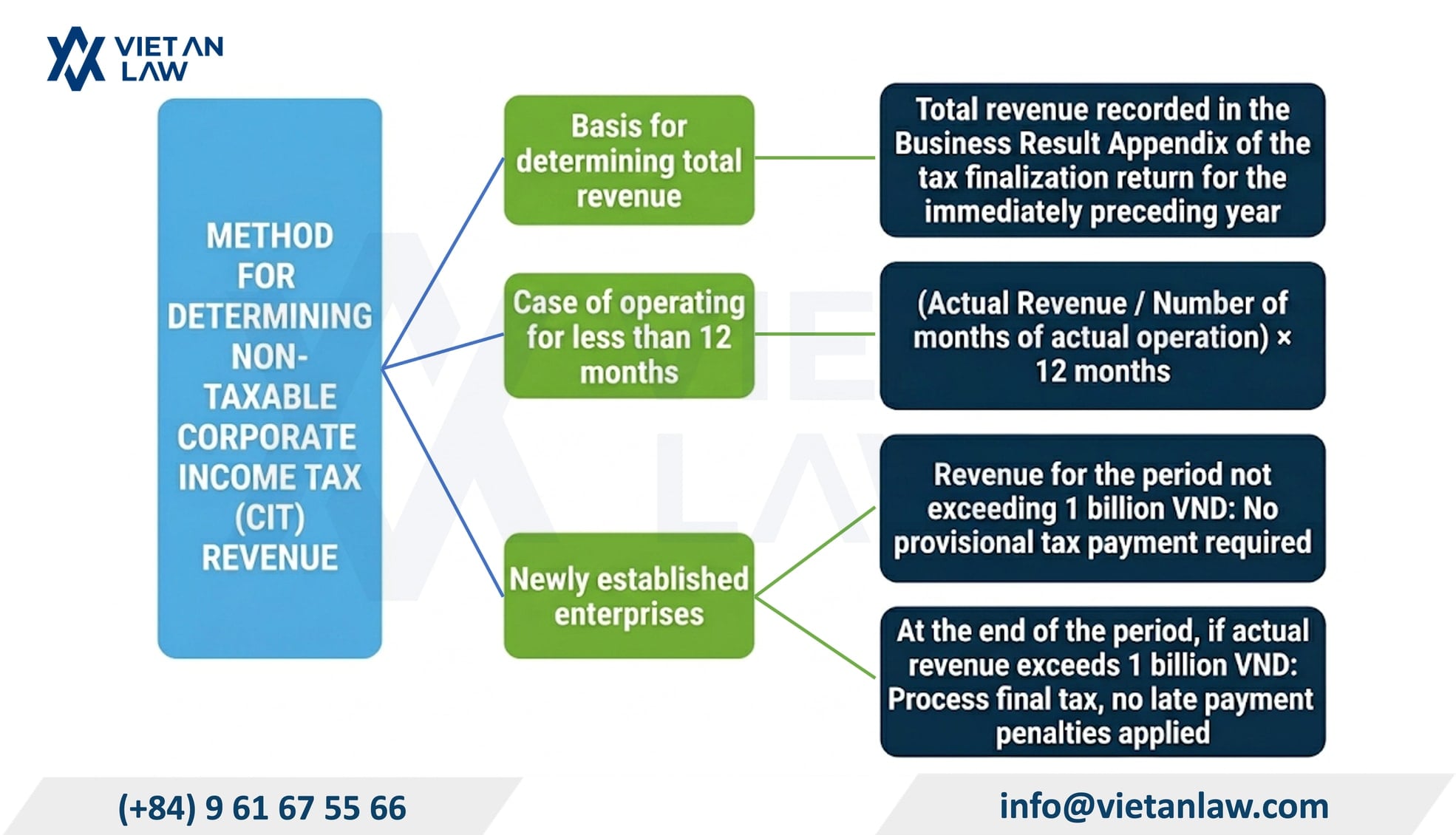
Methods to determine revenue not subject to corporate income tax
- Basis: Total revenue (sales, service provision, financial, other income) recorded on the business results appendix of the tax finalization declaration of the immediately preceding year.
- In case of operating for less than 12 months: Revenue is converted according to the formula: (Actual revenue / Actual number of operating months) x 12 months.
- Newly established enterprises: If the estimated revenue in the period does not exceed 1 billion VND, a provisional tax payment is not required. If at the end of the period the actual revenue exceeds 1 billion VND, the enterprise only performs tax finalization and is not subject to late payment interest calculation. This is a critical point for companies utilizing tax accounting services.
Modification of application period for high special consumption tax rates on battery powered motorized vehicles under 24 seats to January 1, 2031
Article 3 of Law 09/2026/QH16 amended and supplemented regulations on battery-powered motorized vehicles under 24 seats at Point g, Section 4, Part I of the Special Consumption Tax Tariff specified in Clause 1, Article 8 of the Special Consumption Tax Law 2025 as follows:
| No. | Goods and services | Tax rate (%) under Special Consumption Tax Law 2025 | Tax rate (%) under Amended Law 09/2026/QH16 |
| 4 | g) Battery-powered motorized vehicles under 24 seats | ||
| – Passenger cars and four-wheeled passenger vehicles with motors of 9 seats or fewer, passenger pick-up trucks | – From January 1, 2026: 3. – From January 1, 2027: 11 | – From January 1, 2026: 3. – From January 1, 2031: 11 | |
| – Passenger cars and four-wheeled passenger vehicles with motors from 10 to under 16 seats | – From January 1, 2026: 2. – From January 1, 2027: 7 | – From January 1, 2026: 2. – From January 1, 2031: 7 | |
| – Passenger cars and four-wheeled passenger vehicles with motors from 16 to under 24 seats | – From January 1, 2026: 1. – From January 1, 2027: 4 | – From January 1, 2026: 1. – From January 1, 2031: 4 | |
| – Double cabin cargo pick-up trucks, VAN trucks with two or more rows of seats, with a fixed partition design between the passenger compartment and cargo compartment | – From January 1, 2026: 2. – From January 1, 2027: 7 | – From January 1, 2026: 2. – From January 1, 2031: 7 |
Thus, the new regulation extends the application period of preferential tax rates for battery-powered electric cars until the end of December 31, 2030, instead of only until the end of 2026 as previously stipulated in the Special Consumption Tax Law 2025. Accordingly, the higher tax rate for electric vehicle lines under 24 seats will only begin to apply from January 1, 2031.
This is considered a vital preferential tax policy to continue encouraging the development of the electric vehicle market in Vietnam, supporting the transition to environmentally friendly transportation, and reducing greenhouse gas emissions in line with the Government’s green development orientation.
Simultaneously, this policy also helps increase the competitiveness of electric vehicles compared to internal combustion engine vehicles in the context that the electric car market in Vietnam is in its early development stages and requires additional long-term support policies.
For enterprises manufacturing and trading electric cars, extending the application period of preferential tax rates creates more room to build investment plans, expand production, develop charging infrastructure systems, and stabilize business strategies in the coming years. Among the PIT, VAT, CIT changes 2026, this SCT adjustment is equally impactful.
Related questions
When does Law 09/2026/QH16 take effect?
Law 09/2026/QH16 was passed by the National Assembly on April 24, 2026, and takes effect on May 15, 2026. Notably, certain policies regarding the tax exemption revenue threshold and preferential tax rates are applied from January 1, 2026.
Do household businesses with revenue under 1 billion VND have to pay tax?
According to Decree 141/2026/ND-CP, household businesses and individual business entities with an annual revenue of 1 billion VND or less are not required to pay personal income tax and are not subject to value-added tax. However, individual businesses still need to determine actual revenue accurately to define tax obligations per regulations. Utilizing professional tax consulting services can assist with this.
Are enterprises with revenue under 1 billion VND exempt from corporate income tax?
According to Clause 15, Article 4 of Decree 320/2025/ND-CP amended by Decree 141/2026/ND-CP, enterprises and organizations with a total annual revenue of 1 billion VND or less are exempt from corporate income tax if they meet conditions under current legal regulations.
Do the new tax policies apply to newly established enterprises?
Yes. If a newly established enterprise estimates its total revenue in the tax period will not exceed 1 billion VND, it does not have to pay provisional corporate income tax. If, at the end of the tax period, the actual revenue exceeds this level, the enterprise performs finalization per regulations without facing late payment interest.
Is revenue under 1 billion subject to tax?
No. Under Decree 141/2026/ND-CP guiding Law 09/2026/QH16, household businesses and individual business entities with an annual revenue of 1 billion VND or less enjoy tax exemptions for revenue under 1 billion for both VAT and PIT.
How does the value added tax exemption for household businesses in 2026 work?
From 2026 onwards, household businesses with an annual revenue of 1 billion VND or less are not subject to value-added tax.
How does the personal income tax exemption for household businesses in 2026 work?
Household businesses and individual business entities with an annual revenue not exceeding 1 billion VND are not required to pay personal income tax.
Are enterprises with revenue under 1 billion eligible for corporate income tax exemption?
They may be eligible for CIT exemption under the new tax regulations in Vietnam, but this must be based on specific conditions guided by the Government for low-revenue enterprises.
What is the latest taxable revenue threshold?
The new tax threshold for household businesses and individual business entities is currently raised to 1 billion VND per year. Revenue exceeding 1 billion VND is subject to tax calculation according to regulations.
Does a household business with an annual revenue of 900 million VND have to pay tax?
No. An annual revenue of 900 million VND still falls below the tax exemption threshold of 1 billion VND per year.
Does a household business with an annual revenue of 1.2 billion VND have to pay tax?
Yes. When revenue exceeds 1 billion VND per year, it is subject to taxation under VAT and PIT regulations.
The above highlights the prominent contents of Law 09/2026/QH16 regarding amendments to Personal Income Tax, Value-Added Tax, Corporate Income Tax, and Special Consumption Tax. The PIT, VAT, CIT changes 2026 relating to the tax exemption revenue threshold, preferential tax policies, and tax obligations of household businesses, individual business entities, and enterprises can directly impact production, business operations, and the financial planning of clients.
For detailed consultation, precise updates on the newest regulations, and support performing tax procedures in compliance with legal provisions, please contact Viet An Law Tax Agent.
Our team of experienced lawyers, tax experts, and legal specialists is always ready to accompany you, providing comprehensive, effective, and cost-optimizing advisory solutions for individuals, household businesses, and enterprises nationwide, including reliable tax accounting services and business registration assistance. Understanding the full scope of New Tax Law 09/2026/QH16 in Vietnam: PIT, VAT, CIT & Tax Exemptions will secure your legal and financial compliance.