


On December 31, 2025, the Government officially issued Decree 373/2025/ND-CP to amend and supplement several provisions of Decree 126/2020/ND-CP, which guides the Law on Tax Administration. This new regulation takes effect on February 14, 2026, and directly impacts various stakeholders, including enterprises, household businesses, and individual taxpayers.
The decree introduces significant changes to tax filing periods, Personal Income Tax (PIT) finalization, land-related financial obligations, and the standardized system of tax forms. In this article, Viet An Law provides a professional analysis of the Key Updates: Decree 373/2025/ND-CP Amending Decree 126 on Tax Administration to ensure your enterprise remains compliant with the latest legal requirements.
Handling cases of ineligible quarterly tax filings for taxpayers
According to the old regulations of Decree 126/2020/ND-CP, taxpayers who were required to file personal income tax returns monthly but met the conditions for quarterly value-added tax returns were allowed to choose to file quarterly and had to apply this consistently throughout the calendar year.
However, during their operations, many enterprises and individuals experience fluctuations in revenue, scale, or business conditions, leading to them no longer meeting the criteria for quarterly filing. This reality has caused considerable confusion for many taxpayers when changing their tax filing period, and they may even face the risk of administrative penalties for being considered to have filed incorrectly or submitted their documents late.
To address the above-mentioned shortcomings, Decree 373/2025/ND-CP has added a clear mechanism for handling cases where taxpayers no longer meet the conditions for quarterly tax filing:
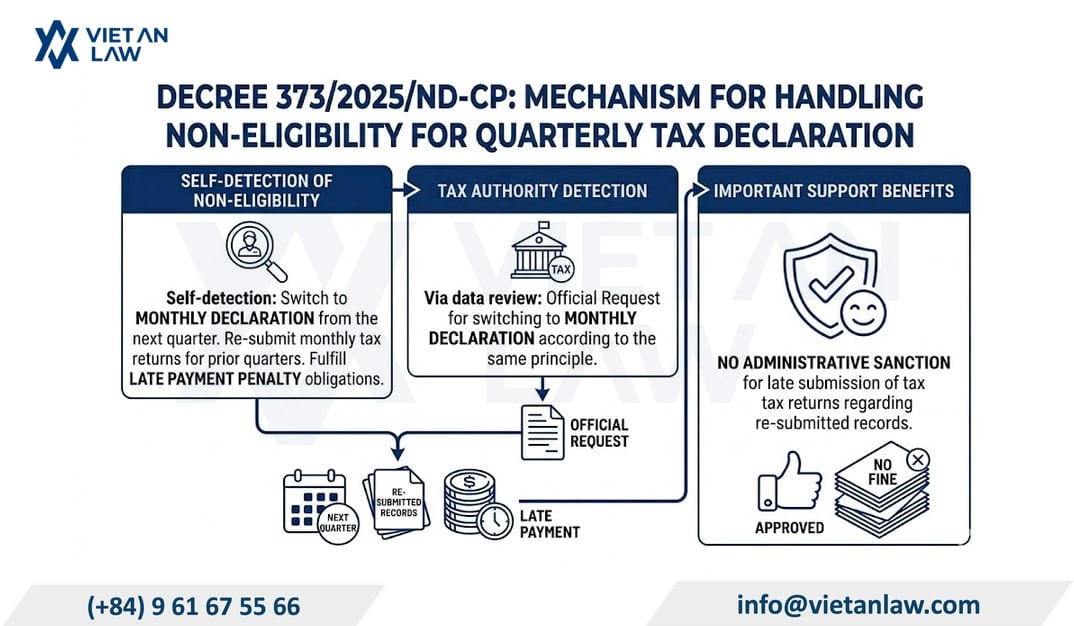
This applies to cases where taxpayers have filed quarterly tax returns but do not meet the eligibility requirements for quarterly filing
- If taxpayers discover they do not meet the eligibility requirements, they must switch to monthly filing from the first month of the following quarter, resubmit the monthly tax returns for previous quarters, and pay late payment penalties as prescribed.
- If the tax authority, through data review, discovers that the taxpayer does not meet the eligibility requirements for quarterly filing, the tax authority will issue a written request to switch to monthly filing according to the same principle as above.
- An important note when applying Decree 373/2025/ND-CP amending Decree 126 on tax administration is that taxpayers will not be subject to administrative penalties for late submission of tax returns for returns that must be resubmitted due to a change in the tax period.
This is a significant new development that considerably reduces legal risks for taxpayers in situations of fluctuating business conditions. Previously, Decree 126/2020/ND-CP did not have specific regulations on waiving administrative penalties for tax declarations that were delayed and had to be resubmitted due to changes in the tax period. Decree 373/2025/ND-CP has added this regulation to facilitate and reduce the risk of penalties due to incorrect tax periods.
New regulations on PIT finalization locations for multiple salary and wage sources
Previously, point b.2, clause 8, Article 11 of Decree 126/2020/ND-CP stipulated that individuals with salary and wage income from two or more sources would, depending on the specific case, submit their tax return to: the tax authority directly managing the organization or individual paying the income, or the tax authority where the individual resides.
Determining where to submit the return depended on many criteria, such as whether or not family allowance deductions had been calculated at the income-paying organization, employment status at the time of tax settlement, or the type of employment contract, causing many taxpayers difficulty in correctly identifying the tax authority to receive their return.
To address this situation, Decree 373/2025/ND-CP amended and supplemented point b.2, clause 8, Article 11 of Decree 126/2020/ND-CP, simplifying and unifying the regulations. Specifically:
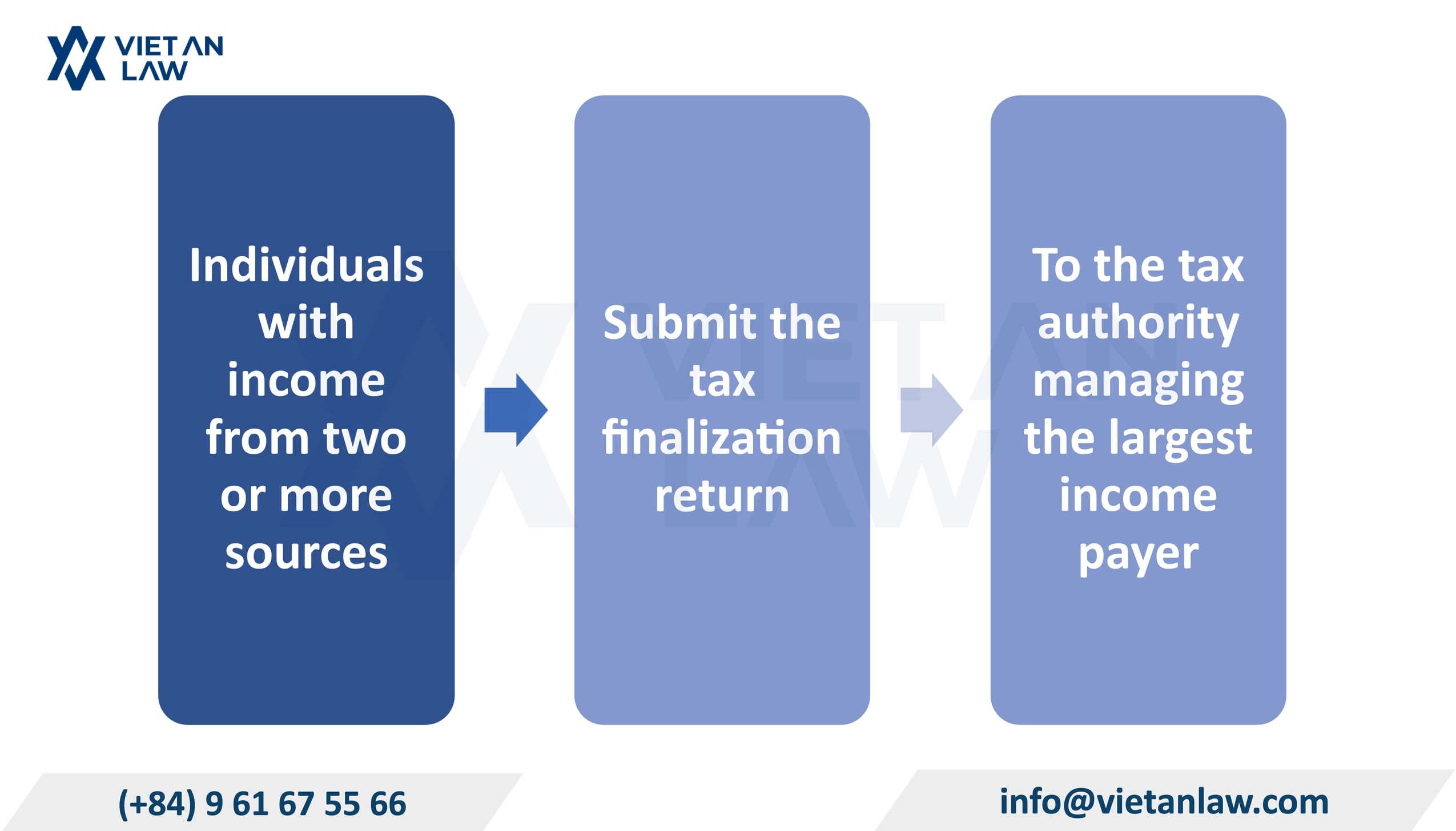
PIT settlement when having more than two sources of income
- Individuals residing in Vietnam who receive salary or wage income subject to withholding tax from two or more sources must file their tax return with the tax authority directly managing the largest income-paying organization during the year.
- In cases where an individual has multiple largest income sources during the year that are equal, the individual must file their tax return with one of the tax authorities directly managing the organizations that pay the largest income sources.
Thus, in order to facilitate taxpayers and tax authorities, while ensuring fairness in budget revenue collection among localities and improving the efficiency of tax management, Decree 373/2025/ND-CP has amended the above regulation to standardize the submission of tax finalization declarations at the tax authority directly managing the organization that pays the largest income in the year.
Another new point is that the Decree also adds a coordination mechanism between tax authorities. If an individual submits their tax finalization declaration to the wrong place, the receiving tax authority will proactively forward the declaration to the correct competent authority, instead of requiring the taxpayer to withdraw and resubmit the declaration from scratch as before. This is a significant improvement in administrative procedures, contributing to reducing compliance costs for citizens.
Deadlines for supplemental payments regarding periods of uncalculated land use fees and land rents
One of the legal loopholes in Decree 126/2020/ND-CP is the lack of clear regulations regarding the notification deadline and the deadline for paying the additional amount for the period for which land use fees or land rent have not been calculated. This leads to inconsistent interpretations and applications among localities.
To address this inadequacy, Decree 373/2025/ND-CP amends and supplements Clauses 3 and 4 of Article 18 of Decree 126/2020/ND-CP by adding a provision that the tax authority shall issue a notice and collect the additional amount that land users must pay for the period for which land use fees or land rent have not been calculated, concurrently with the notification and collection of land use fees or land rent. Specifically:
- For land leases with annual payments: The lessee must pay the land lease fee in the first installment within 30 days of receiving the notice; from the second year onwards, they may choose to pay in one lump sum or in two installments per year. For cases of adjusting financial obligations or extending the land use period, the payment deadline is clearly set at 30-day or 90-day intervals.
- For land leases with a lump-sum payment for the entire lease period: The financial obligation is divided into two installments: 50% within the first 30 days and the remaining 50% within 90 days of the notice.
- For land use fees: The payment principle is also clearly defined at two similar timeframes; however, in cases where the land use fee is recalculated more than 5 years after the date of the resettlement land allocation decision, the land user must pay 100% within 30 days.
Clearly defining these timelines helps increase transparency, reduce disputes, and enable land users to proactively plan their finances.
List of tax filing dossiers and new tax forms under Decree 373/2025/ND-CP
Decree 373/2025/ND-CP has replaced the entire list of tax declaration documents issued with Decree 126/2020/ND-CP with a new list. At the same time, many previous declaration forms and appendices stipulated in Circular 80/2021/TT-BTC have been abolished and replaced with forms issued directly with the decree.
Taxpayers should pay special attention to updating the new forms to avoid mistakenly using outdated forms.
Based on Article 10 of Decree 373/2025/ND-CP, amending and supplementing Appendix I – List of tax declaration documents attached to Decree 126/2020/ND-CP as follows:
- Replace the list of tax declaration documents in Appendix I of Decree 126/2020/ND-CP with the list of tax declaration documents in Appendix I of Decree 373/2025/ND-CP.
- Issue Form No. 01/TTDB in Appendix I of Decree 373/2025/ND-CP and abolish Forms No. 01/TTDB and 02/TTDB in Appendix II of Circular 80/2021/TT-BTC.
- Issue Form No. 01/TK-SDDPNN in Appendix I of Decree 373/2025/ND-CP and abolish Forms No. 01/TK-SDDPNN and 04/TK-SDDPNN in Appendix II of Circular 80/2021/TT-BTC.
- Issue Form No. 02/TK-SDDPNN in Appendix I attached to Decree 373/2025/ND-CP and abolish Form No. 02/TK-SDDPNN in Appendix II attached to Circular 80/2021/TT-BTC.
Impacts of Decree 373/2025/ND-CP on taxpayers and stakeholders
For e-commerce platforms
Decree 373 does not fundamentally change the obligation to provide information, but the standardization of data and tax declaration forms will make the requirements for accuracy and synchronization of transaction information stricter. Platforms need to review their reporting systems and data connectivity with the tax authorities.
For commercial banks
The Decree does not change the principle of deducting tax payments from taxpayers’ accounts, but the addition of clear deadlines for land-related financial obligations will require banks to cooperate more closely in freezing, deducting, and transferring funds as notified by the tax authorities.
For small and medium-sized enterprises
The Decree does not directly change the deadline for filing or provisional corporate income tax returns, but the new regulations on tax filing periods and tax return documents will require enterprises to review their quarterly filing conditions to avoid the risk of having to file supplementary returns for multiple periods.
Frequently asked questions (FAQ)
When does Decree 373/2025/ND-CP take effect?
Decree 373/2025/ND-CP takes effect from February 14, 2026.
In cases where taxpayers have already declared taxes using the forms prescribed in Decree 126/2020/ND-CP, they shall continue to declare and settle taxes for the 2025 tax year using the forms prescribed in Decree 126/2020/ND-CP and Circular 80/2021/TT-BTC.
Does this Decree completely replace Decree 126 or only amend it partially?
No. Decree 373/2025/ND-CP only amends and supplements some articles of Decree 126/2020/ND-CP; the contents that are not amended continue to apply.
If taxpayers have already declared taxes using the forms prescribed in Decree No. 126/2020/ND-CP, they should continue to declare and settle taxes for the 2025 tax year using the forms prescribed in Decree No. 126/2020/ND-CP and Circular No. 80/2021/TT-BTC.
Have the tax declaration forms changed according to this Decree?
Yes. Decree 373 promulgates a list of documents and many new declaration forms, while abolishing many old forms in Circular 80/2021/TT-BTC.
The above are important notes regarding the application of Decree 373/2025/ND-CP amending Decree 126 on Tax Administration. For any related questions about Vietnam tax regulations or tax consultation needs, please contact Viet An Law – Tax Agency for the best advice and support!