


The introduction of a pilot framework for crypto assets in Vietnam brings new compliance requirements for investors and exchanges alike. Along with the establishment of the pilot mechanism for crypto assets in Vietnam under Resolution 05/2025/NQ-CP and Decision 96/QD-BTC dated January 20, 2026, which announced new administrative procedures to pilot the crypto asset market, five valid applications from virtual asset service providers have been reviewed. Practical demands require specific tax management regulations applied to profits arising from cryptocurrency trading transactions during the 5-year pilot period.
Recently, on April 06, 2025, the Ministry of Finance promulgated the latest regulations on the financial obligations of individuals and organizations participating in this market. Through the article below, the legal expert team at Viet An Law would like to provide a guide to declaring tax on crypto assets under Resolution 05/2025/NQ-CP, alongside Circular 32/2026/TT-BTC and Circular 41/2026/TT-BTC guiding the declaration, deduction, payment, and finalization of taxes in the crypto asset market.
Legal basis for crypto asset tax declaration in Vietnam
The simultaneous issuance of guiding circulars may create complexities in practical application. Viet An Law summarizes the application of legal documents according to the table below:
| Document | Effective date | Content |
| Resolution 05/2025/NQ-CP | September 09, 2025 | Pilot framework – definitions, issuance conditions, investor rights, pilot duration |
| Circular 32/2026/TT-BTC | March 27, 2026 | Tax policy – tax types, tax rates, bases for calculating VAT/CIT/PIT |
| Circular 41/2026/TT-BTC | April 06, 2026 | Tax procedures – declaration, deduction, payment, finalization, voucher forms |
Who must declare tax on crypto assets?
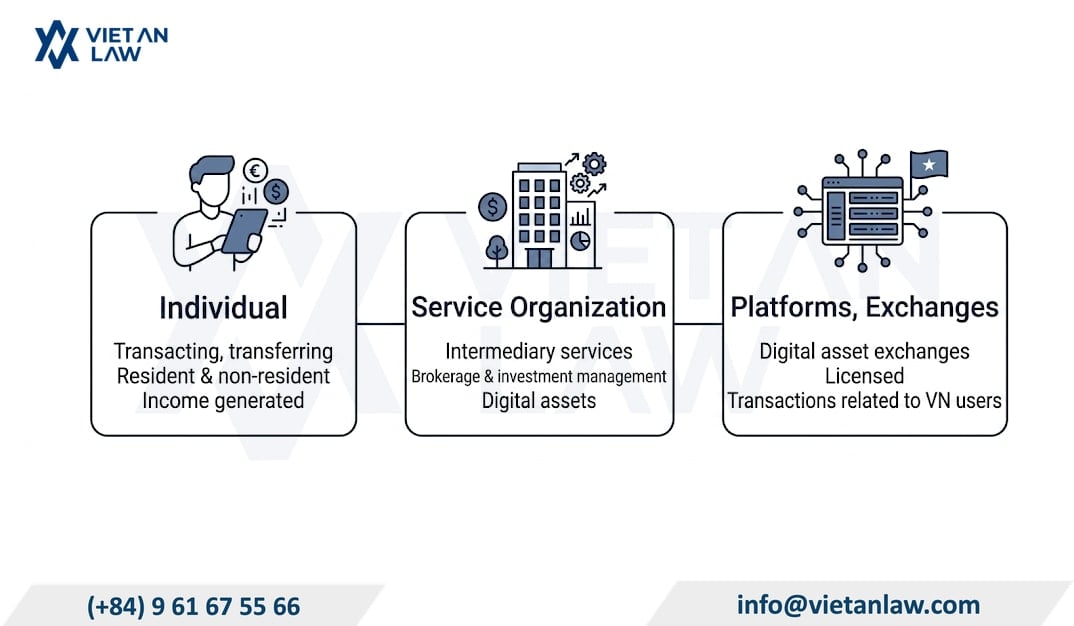
Under the new regulations, all transactions generating income from digital assets are subject to strict management by state tax authorities. The subjects governed by this legal document include:
- Individual: Resident and non-resident individuals generating income from trading and transferring crypto assets on Vietnamese or international platforms;
- Service Organization: Organizations and enterprises participating in providing intermediary services, brokerage, and portfolio management of crypto assets;
- Platforms, Exchanges: Licensed crypto asset platforms and exchanges or those with transactions involving users living in Vietnam.
Note: Tax obligations only arise when there is a licensed virtual asset service provider (VASP).
Vietnam has not officially licensed any domestic exchange; therefore, the tax deduction mechanism via VASPs only operates once a VASP is licensed. A maximum of 5 VASPs will be licensed in the initial phase of the pilot mechanism. Transactions via foreign exchanges do not fall within the scope of tax deduction at source, thus remaining outside the scope of regulation.
Principles – Each transaction constitutes an independent tax obligation.
Each transaction is considered independent, regardless of whether the investor is making a profit or a loss, meaning there is no profit-loss offsetting like corporate income tax. This is a major difference compared to the corporate income tax of Vietnamese organizations (which are allowed to deduct the purchase price and expenses).
Tax declaration and payment obligations for individual investors
Under the new management mechanism, individual investors (including both resident and non-resident individuals) are exempt from manually performing complex administrative procedures. The core principles are prescribed as follows:
- Declaration obligation: Investors do not have to self-declare taxes to state agencies for each arising transaction;
- Implementation mechanism: The calculation and collection of taxes are operated through a mechanism where the VASP deducts tax at the source and pays it into the state budget on behalf of the investor;
- Voucher rights: Investors are entitled to receive an electronic Form 01/CTKT-TSMH issued annually by the VASP for storage and reconciliation when necessary.
Individuals participating in the crypto asset market must fulfill their personal income tax payment obligations on the surplus value arising from successful transactions. The basic principles in tax declaration are determined as follows:
- Taxable income is calculated based on the difference between the selling price and the buying price, plus reasonable transaction expenses with substantiating documents;
- The tax period is applied flexibly for each arising transaction or paid under the presumptive tax method for individuals with regular trading frequency;
- Investors are responsible for preparing their own personal income tax declaration dossiers or properly authorizing the service provider to declare on their behalf;
- The deadline for submitting a tax declaration dossier is the tenth (10) day from the date the tax obligation arises for the method of declaration per arising transaction.
Responsibilities for tax deduction at source of trading platforms in Vietnam
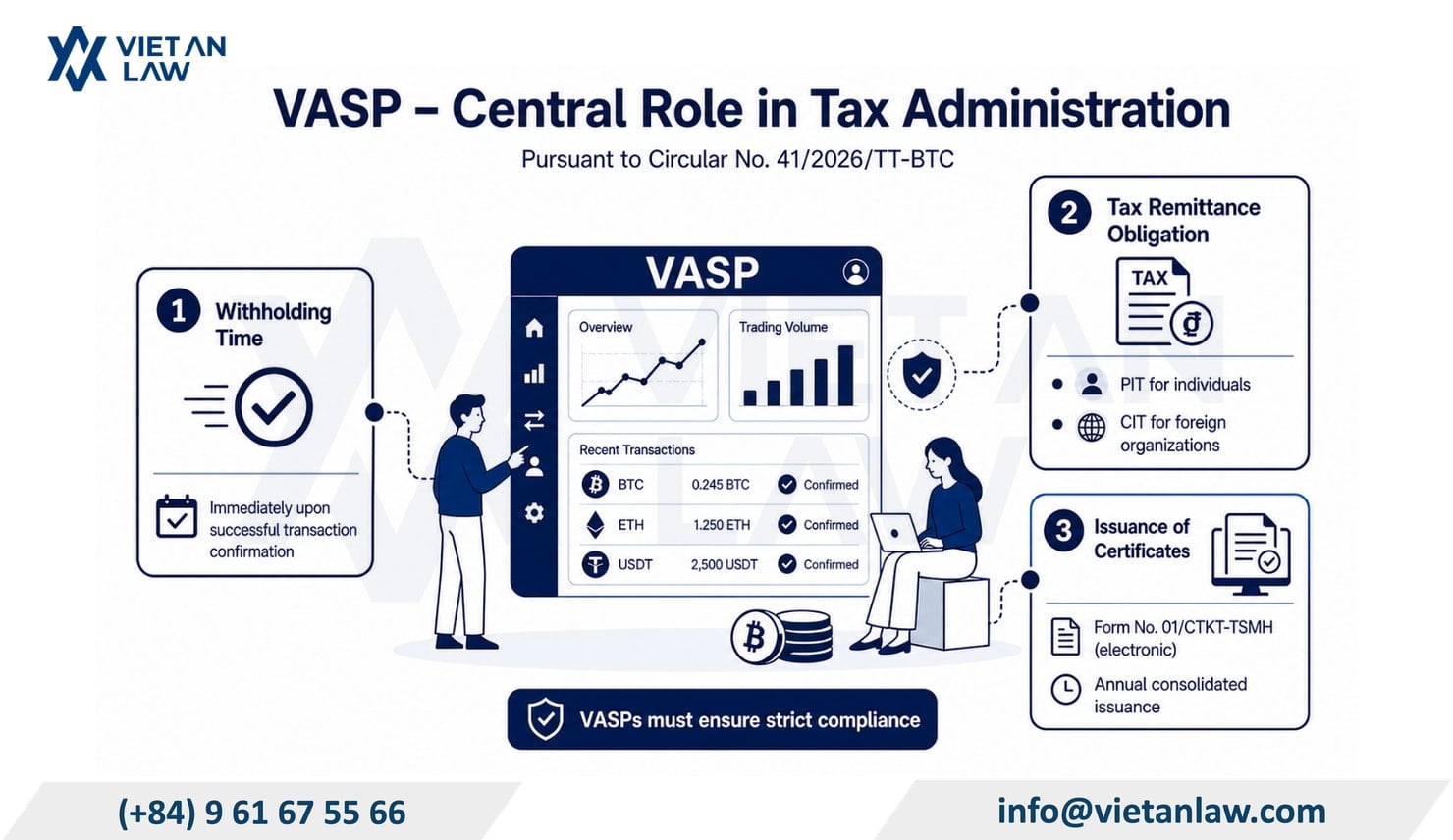
To ensure the effectiveness of tax management, the virtual asset service provider (VASP) plays a central role in the operational mechanism. Circular 41/2026/TT-BTC guiding the declaration, deduction, payment, and finalization of taxes in the crypto asset market compels VASPs to strictly implement:
- Timing of deduction: Must deduct the tax portion as soon as the crypto asset transfer transaction is successfully confirmed on the system;
- Obligation to pay on behalf: Directly declare and pay all personal income tax (for individuals) and corporate income tax (for foreign organizations trading via VASPs) on behalf of the taxpayers;
- Voucher issuance: Assume responsibility for extracting and issuing an electronic Form 01/CTKT-TSMH (Crypto Asset Tax Deduction Voucher) aggregated annually for taxpayers.
To prevent state budget revenue loss, the law sets strict requirements for intermediary service providers. Proper implementation of the tax declaration guidelines requires trading platforms to strictly comply with the following obligations:
- Register an enterprise tax code and establish an automatic data connection system with the direct managing tax authority;
- Perform tax deduction at the statutory rate on the total transaction value before paying cash or crypto assets to users;
- Issue electronic tax deduction vouchers to investors to serve as a valid legal basis for the year-end tax finalization;
- Prepare and submit detailed monthly reports on transaction status and cash flow fluctuations to state management agencies.
Summary of tax rates and tax calculation bases for crypto asset transfers
Based on the latest regulations in Circular 32/2026/TT-BTC, tax policies are applied flexibly depending on the type of investing entity. Below is a detailed summary table of tax rates and legal bases for tax calculation:
| Taxpayer | VAT | Tax rate | Tax calculation basis |
| Individuals (Resident & non-resident) | Not subject to tax | 0.1% | Transfer price per transaction |
| Vietnamese organizations | Not subject to tax | 20% | Selling price minus buying price and expenses (with valid invoices and vouchers) |
| Foreign organizations (via VASP in VN) | Not subject to tax | 0.1% | Transfer revenue per transaction |
Guidelines on the year-end tax finalization process for crypto assets in Vietnam
When the regulations take effect, the procedures for tax declaration and finalization are clearly stipulated based on the legal status of each entity participating in the crypto asset market:
- For individuals & foreign organizations: Not required to self-finalize taxes at the end of the year as the VASP has already deducted and paid all taxes on behalf of them for each transaction;
- For Vietnamese organizations (Obligation): Enterprises must self-declare and make provisional payments of corporate income tax on a quarterly basis;
- For Vietnamese organizations (Deadline): Must complete the annual tax finalization dossier no later than the last day of the third (3) month after the end of the financial year;
- Dossiers to prepare: Accounting documents, valid expense invoices to be deducted, and detailed transaction reports to prove the basis for tax calculation.
🡪 Procedure result: Pay additionally for the tax shortfall or carry out procedures to request a tax refund for overpaid amounts.
Note: Tax finalization procedures for crypto assets are carried out similarly to traditional types of income, but require a higher degree of transparency regarding documentation proving cash flows, include:
- Synthesizing the entire transaction history, e-wallet statements, and valid tax deduction vouchers arising throughout the calendar year;
- Accurately determining the total taxable income, investment losses allowed to be carried forward, and the tax amount provisionally paid by intermediary organizations.
Penalties for violations in the field of crypto asset tax in Vietnam
Acts of evading financial obligations related to digital asset transactions will be strictly handled by competent authorities to deter and protect fairness. The applied punitive measures include:
- Fining at a progressive percentage rate on the under-declared tax amount or evaded tax amount for intentional fraudulent acts;
- Calculating late payment interest according to the current prescribed interest rate based on the total number of days late in paying obligations to the state budget;
- Requiring trading platforms to freeze accounts and block e-wallets of individuals and organizations exhibiting deliberate delays in tax payment;
- Prosecuting and holding criminal liability under the Penal Code for large-scale tax evasion rings causing particularly serious consequences.
Frequently asked questions about crypto asset tax in Vietnam
Are all currently held crypto transactions required to be declared for tax under the new regulations?
No. The mandatory requirement to transfer currently held crypto to custody at licensed organizations only applies when there is a licensed virtual asset service provider. It is necessary to note the principle based on “real assets” as prescribed in Resolution 05/2025/NQ-CP. The scope of application of Resolution 05/2025/NQ-CP is also much narrower than the term “crypto” as understood according to international practices.
Are crypto assets subject to value-added tax (VAT)?
No. The transfer and trading of crypto assets are not subject to VAT (Article 3.1 of Circular 32/2026/TT-BTC). However, for other activities related to crypto assets that are not “Transfer, trading” (for example, custody services or consulting), VAT still arises as usual.
Are trading platforms legally obligated to deduct tax at the source?
Yes, trading platforms must perform the deduction prior to making payments to users.
Can investors authorize a third party to declare taxes on their behalf?
Yes, investors can properly authorize professional service providers.
Crypto asset tax accounting services in Vietnam at Viet An Law
In the context of the crypto asset market having many complex pilot regulations, utilizing professional tax accounting services in Vietnam is the optimal solution for individuals and enterprises. Viet An Law assists clients in performing the following tasks:
- Providing legal advice updating the new regulations of Resolution 05/2025/NQ-CP, guided by Circular 32/2026/TT-BTC and Circular 41/2026/TT-BTC;
- Providing detailed consultation on dossiers and administrative procedures during the pilot phase according to the new regulations;
- Guiding the collection and classification of transaction vouchers on digital asset platforms to accurately determine taxable income;
- Executing the declaration, tax payment, and periodic income tax finalization on behalf of investors and exchange enterprises;
- Representing clients in working with tax authorities to explain cash flow fluctuations and protect their legitimate rights and interests.
Proactively understanding and complying with new tax policies is a core factor in ensuring legal safety when participating in the high-tech financial market. We hope the Guide to declaring tax on crypto assets under Resolution 05/2025/NQ-CP has provided clients and investors with the most valuable and practical legal analyses.
If you encounter any difficulties during the process of performing registration, tax declaration, or tax finalization procedures for digital assets, please contact Viet An Law directly to receive in-depth consultation and prompt resolution support from our specialized legal team.