


In the context of strong global digital transformation, Vietnam is also gradually completing its legal corridor to manage and promote new fields such as digital assets, cryptocurrencies, blockchain technology, and the digital economy. The year 2025 marks a significant turning point as the first legal documents related to these fields are gradually being issued, tested, or finalized, creating a legal foundation for managing and developing business models based on new technologies. In the article below, Viet An Law will update the Legal Framework for Sandbox, Crypto and Blockchain in Vietnam 2025.
Legal documents on digital assets
A key point in the recently updated Legal Framework for Sandbox, Crypto and Blockchain in Vietnam 2025 is the Digital Technology Law 2025, issued on June 14, 2025, and effective from January 1, 2026.
Specifically, the Digital Technology Law 2025 provides concrete regulations on digital assets in Chapter V as follows:
Concept of digital asset
According to Article 46 of the Digital Technology Law 2025, digital assets are assets as defined under the Civil Code, expressed in the form of digital data, created, issued, stored, transferred, and authenticated by digital technologies in an electronic environment.
This is the first law in Vietnam to officially recognize a “digital asset” as a type of property protected by law and to legalize its ownership, transaction, and inheritance in the Civil Code.
Classification of digital assets
Digital assets include:
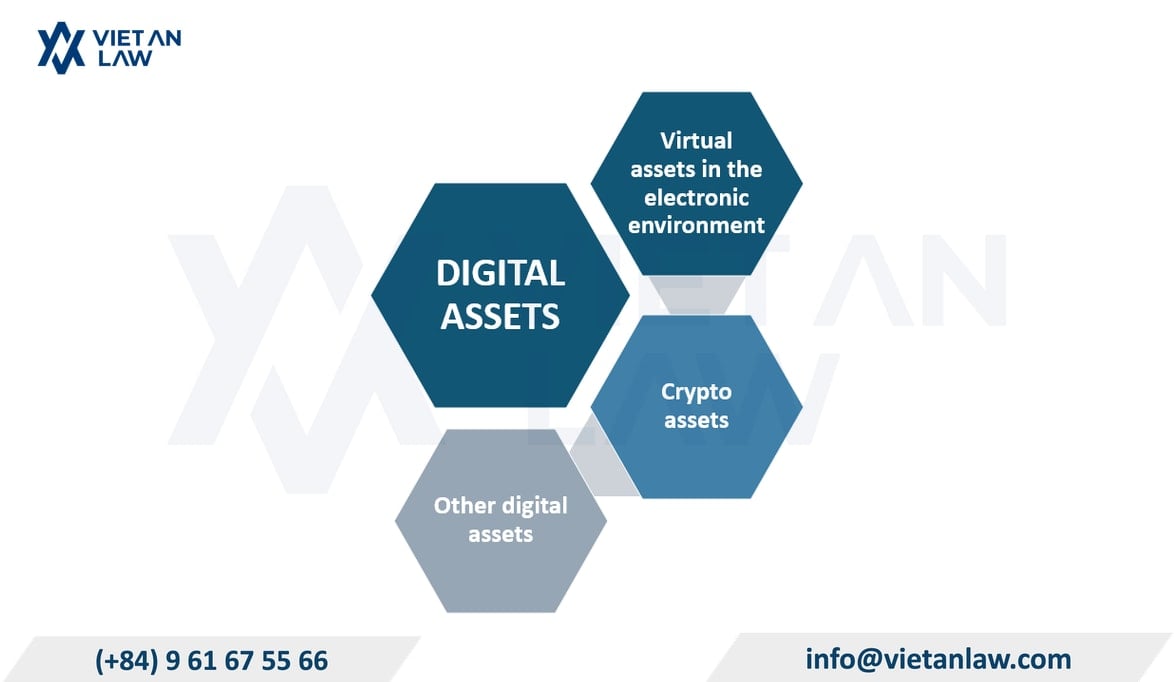
Classification of digital assets
- Virtual assets in the electronic environment refer to a type of digital asset that can be used for exchange or investment purposes. Virtual assets do not include securities, digital forms of fiat money, and other financial assets as prescribed by civil laws and financial laws;
- Crypto assets refer to a type of digital asset that uses cryptography or digital technologies with similar functions to authenticate the assets during their creation, issuance, storage, or transfer. Crypto assets do not include securities, digital forms of fiat money, and other financial assets as prescribed by civil laws and financial laws;
- Other digital assets.
Digital asset management
The content of digital asset management includes:
- Creation, issuance, storage, transfer, and establishment of ownership rights over digital assets;
- Rights and obligations of concerned parties regarding activities related to digital assets;
- Measures to ensure cyber safety and security; money laundering prevention and combat; prevention and combat against terrorism financing and proliferation of mass destruction weapons;
- Inspection and handling of law violations;
- Business conditions for the provision of crypto asset services;
- Other management contents.
Legal documents on sandbox
Regulatory sandbox – is a new and flexible approach in legislative technique that allows for direct, time-limited testing of innovations under regulatory supervision. A Sandbox allows for testing in a real-world environment, but with a defined scope and timeframe, along with appropriate protective measures to prevent any consequences of failure from affecting the national financial system too severely.
Recently, the Government issued Decree 94/2025/ND-CP, which regulates the controlled testing mechanism (sandbox) in the banking sector for the implementation of new products, services, and business models through the application of technology solutions (called financial technology solutions), effective from July 1, 2025.
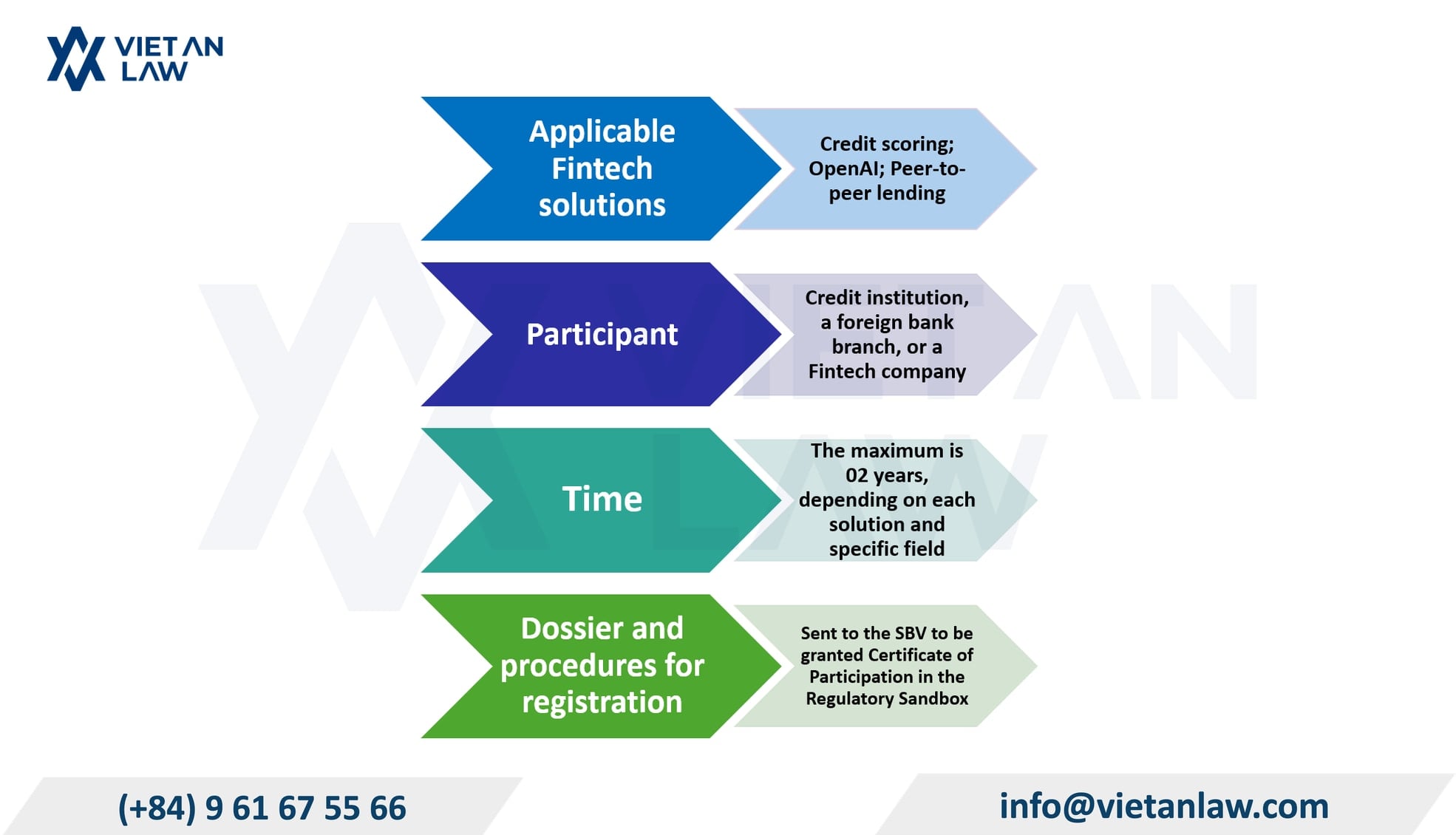
Regulations on sandbox participation
Applicable Fintech solutions
Financial technology solutions (referred to as “Fintech solutions”) in the Regulatory Sandbox include:
- Credit scoring.
- Data sharing via open application programming interfaces (Open API).
- Peer-to-peer lending.
Participant in the Regulatory Sandbox
Participant in the Regulatory Sandbox refers to a credit institution, a foreign bank branch, or a Fintech company that has been issued a Certificate of Participation in the Regulatory Sandbox by the State Bank of Vietnam (SBV).
Time of the Regulatory Sandbox
The maximum testing period of Fintech solutions testing in the Regulatory Sandbox is 02 years, depending on each solution and specific field, calculated from the issuance of the Certificate of Participation in the Regulatory Sandbox by the SBV.
Dossier and procedures for registration
The dossier for registering to participate in the testing mechanism is sent to the State Bank of Vietnam. After the appraisal period ends, the State Bank of Vietnam will grant a Certificate of Participation in the Regulatory Sandbox to organizations whose dossiers meet the specified conditions and criteria.
Legal Documents on the digital economy
The digital economy includes economic activities based on digital technology and carried out through a digital environment.
The legal framework for the digital economy is understood as the entire body of legal norms issued by the State to regulate all activities of state management agencies and the behavior of individuals and organizations that engage in transactions and conduct activities on social media platforms related to the digital economy. This includes provisions on the content and process of applying Industry 4.0 technology, regulations on ensuring security and safety for the digital economy, provisions on legal violations and legal responsibility during the digital transformation of the economy, and regulations on resolving disputes arising from digital economic transactions and activities.
The legal framework for the digital economy is not concentrated in one document but is found in various legal texts, such as:
- Resolution 198/2025/QH15 and Decree 88/2025/ND-CP continue to promote private sector innovation and investment in research and development (RandD);
- Resolution 193/2025/QH15 of the National Assembly, which allows for a pilot special mechanism for the fields of semiconductors, artificial intelligence, and digital transformation;
- Electronic Transactions Law 2023, as amended and supplemented in 2024;
- Decree 52/2013/ND-CP on e-commerce, effective from July 1, 2013, as amended and supplemented by Decree 08/2018/ND-CP and Decree 85/2021/ND-CP;
- Decree 13/2023/ND-CP on personal data protection;
Legal documents on digital and cryptocurrencies
“Digital currency” or “electronic currency” (digital currency or cryptocurrency) is broadly defined by organizations to include coins, algorithmic money, electronic money, and cryptographic money (digital money, electronic money, electronic currency, cyber cash).
The legal framework related to digital and cryptocurrencies includes:
Decree 52/2024/ND-CP dated May 15, 2024, of the Government regulating non-cash payments
Decree 52/2024/ND-CP for the first time mentions the concept of “electronic money.” Accordingly:
- Electronic money refers to the value of Vietnam Dong stored in electronic means provided based on the amount prepaid by clients to banks, foreign bank branches, and e-wallet payment intermediary service providers.
- Specifically, according to Article 3 of Decree 52/2024/ND-CP, electronic money is not considered to have the value of cash, does not replace cash, and is not recognized as a non-cash payment method.
- Currently, Vietnam only recognizes non-cash payment methods, including checks, payment orders, payment authorizations, collections, collection authorizations, bank cards (including debit cards, credit cards, prepaid cards), electronic wallets, and other payment methods as stipulated by the State Bank of Vietnam.
Decision 942/QD-TTg dated June 15, 2021, of the Prime Minister
Approving the National Digital Transformation Program until 2025, with a vision to 2030, the Government has assigned the State Bank of Vietnam to take the lead in researching, building, and piloting the use of electronic money based on Blockchain, and especially the Digital Technology Law 2025—the first legal document to officially refer to “digital assets” and their corresponding ownership rights.
Draft resolution on piloting the cryptographic asset market 2025
- Recently, the draft Resolution on piloting the cryptographic asset market has been finalized and is expected to be submitted to the Government in August 2025.
- The issuance of a legal framework for digital assets is not only an urgent management need but also opens up an opportunity for Vietnam to gradually meet international standards. This will be an important stepping stone for the Vietnamese financial market to develop more transparently and stably in the future.
Note on current recognition of virtual currency
In Official Letter 5747/NHNN-PC in 2017, the State Bank of Vietnam provided guidance: “Virtual currency in general and Bitcoin, Litecoin in particular are not currency and are not legal means of payment under Vietnamese law. The issuance, supply, and use of virtual currency in general and Bitcoin, Litecoin in particular (illegal means of payment) as currency or a means of payment is a prohibited act.”
Thus, it can be seen that virtual currency is not a currency and is not a legal means of payment under Vietnamese law.
Legal Regulations on Blockchain
Blockchain (chain-block technology) is simply understood as a technology that helps to encode all data into different blocks and simultaneously connect them to form a long chain. In case there is new information, it will be saved in a new block and connected to the old block to form a new chain. Thanks to this, old information in Blockchain technology is not lost.
Resolution 57-NQ/TW dated December 22, 2024, of the Politburo on breakthroughs in science, technology, innovation, and national digital transformation has paved the way for blockchain applications. Since then, many legal documents have been issued to develop blockchain, with recent ones including:
Decision 1236/QD-TTg in 2024
- Decision 1236/QD-TTg in 2024, dated October 22, 2024, promulgating the national strategy for applying and developing Blockchain by 2025, with an orientation toward 2030, issued by the Prime Minister.
- Accordingly, by 2030, Vietnam aims to become a leading country in the region and have an international position in the research, deployment, application, and exploitation of blockchain technology, with the capacity to master and apply blockchain technology in all socio-economic fields.
Decision 1131/QD-TTg in 2025
Decision 1131/QD-TTg in 2025 dated June 12, 2025, on the list of strategic technologies and strategic technology products issued by the Prime Minister: Officially classifies Blockchain technology as a strategic technology group, including the following products: Digital assets, digital money, cryptographic money; Blockchain network infrastructure; Traceability systems.
Above is the information on the issue of the Legal Framework for Sandbox, Crypto and Blockchain in Vietnam 2025. Clients who have related questions or need legal support, please contact Viet An Law Firm for the best support!