


Understanding the legal risks of acting as a nominee for a company in Vietnam has become an increasingly vital matter, as a growing number of individuals are agreeing to incorporate, manage, or hold capital in an enterprise on behalf of others. Although acting as a nominee may stem from various personal or practical reasons, this practice entails significant legal consequences regarding the rights and obligations of true owners, capital-contributing members, and legal representatives. Furthermore, it exposes the nominee to potential liabilities concerning corporate debts, tax obligations, and regulatory violations incurred during operations. In the article below, Viet An Law provides an in-depth analysis of the relevant legal framework and key risks to consider when acting as a nominee for a business in Vietnam, which have been banned under the latest update in Decree 296/2026/ND-CP effective from 2026.
Owners, shareholders, and members of a company must not act as nominees to contribute capital into enterprises in Vietnam
Pursuant to Clause 3, Article 8 of the Vietnam Law on Enterprises 2020:
“Be responsible for the truthfulness and accuracy of information declared in the enterprise registration dossier and reports; if declared information or reports are found to be inaccurate or incomplete, such information must be promptly amended or supplemented.”
Pursuant to Clause 1, Article 4 of Decree 168/2025/ND-CP (as amended and supplemented by Decree 296/2026/ND-CP), the principles for handling enterprise registration procedures are stipulated as follows:
“The enterprise founder or the enterprise itself shall declare the enterprise registration dossier and be legally liable for the lawfulness, truthfulness, and accuracy of the information declared in the enterprise registration dossier and reports. Company owners, shareholders, and members must fully comply with the regulations on contributed assets set forth in Clause 2, Article 34 of the Law on Enterprises and shall not act as nominees for others to contribute capital to the enterprise.”
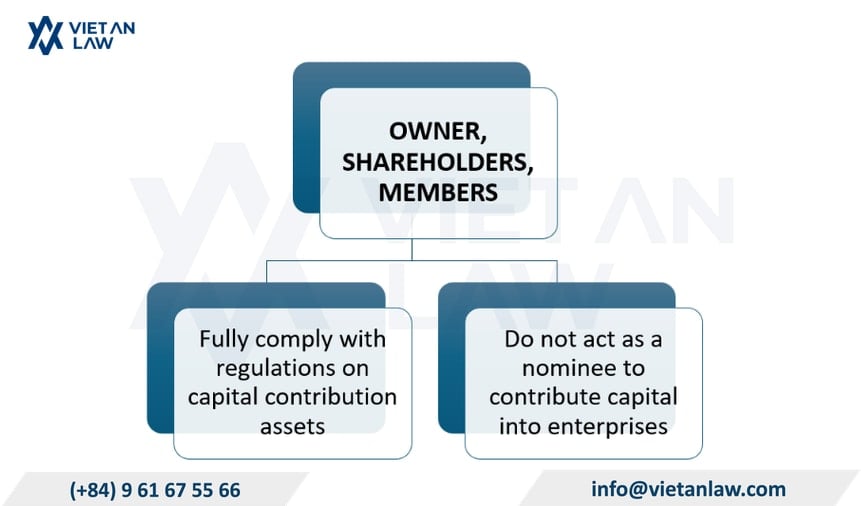
Compared to the regulations in Decree 168/2025/NĐ-CP, the new provisions introduced by Decree 296/2026/NĐ-CP add a principle stating that “owners, shareholders, or members of a company… shall not act as nominees for others when contributing capital to an enterprise”.
This provision was added to enhance transparency in enterprise establishment and to prevent the use of “nominee owners”, “nominee shareholders”, or “nominee members” to conceal the actual owners of an enterprise. Accordingly, the company name and the information regarding owners, members, and shareholders recorded in the business registration dossier must accurately reflect the actual parties contributing capital and bearing responsibility for their respective capital contributions.
Thus, current law clearly establishes the principle prohibiting individuals from acting as nominees to contribute capital to an enterprise on behalf of others. Any individual listed as an owner, member, or shareholder must personally bear responsibility for the accuracy of the registration information, as well as for the rights and obligations arising from that legal status.
Legal risks of acting as a nominee for a company in Vietnam
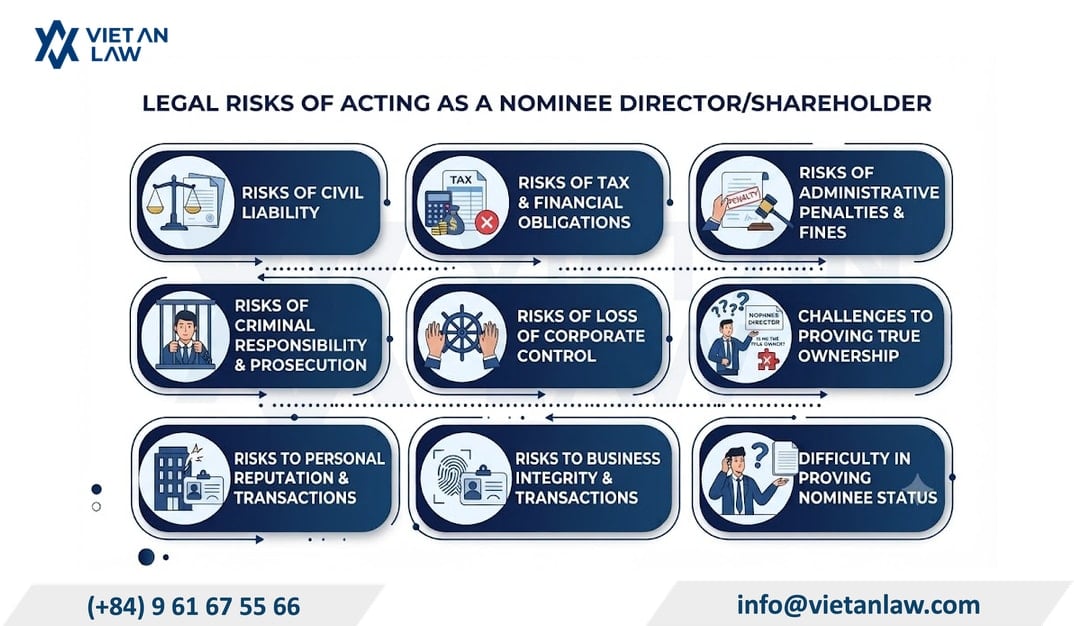
Although the law prohibits owners, members, and shareholders from acting as nominees for a company to contribute capital to a business enterprise, this practice remains quite common in reality. Acting as a nominee not only gives rise to disputes regarding ownership rights but also exposes the nominee to significant legal liabilities, even if they do not directly manage the enterprise’s operations.
Civil liability risks
- An individual acting as the named representative of a company may face civil liability corresponding to their registered legal capacity—such as owner, capital-contributing member, shareholder, or legal representative.
- In the event of disputes regarding contracts, payment obligations, or claims for damages, the named individual may be required to participate in dispute resolution, provide documentation, or fulfill obligations as prescribed by law.
- For limited liability companies and joint-stock companies, liability is, in principle, limited to the extent of the contributed capital. However, in cases involving fraud, sham transactions, or the abuse of legal personality to evade obligations, the involved individual may still be held liable in accordance with the law.
Tax and financial liability risks
Even without directly managing the business, the person named as the company representative may still be required to deal with tax authorities if the enterprise is late in paying taxes, incurs tax arrears, uses invoices improperly, or violates other financial obligations.
In many instances, competent authorities rely on business registration information to identify the individual responsible for providing explanations or documentation, or for cooperating in the resolution of any violations that arise.
Risk of administrative penalties
Pursuant to Article 43 of Decree 122/2021/NĐ-CP, a fine ranging from 20,000,000 VND to 30,000,000 VND shall be imposed for the act of providing untruthful or inaccurate information in the enterprise registration dossier or the dossier for registering changes to enterprise registration details in order to obtain an Enterprise Registration Certificate or a Certificate of Change to Enterprise Registration Details.
During the course of their operations, enterprises may face penalties for violating regulations concerning enterprise registration, accounting, taxation, labor, social insurance, the environment, or other specialized fields.
Risk of facing criminal liability
This is one of the most serious nominee business registration risks:
- If a business is exploited to commit acts such as tax evasion, illegal trading of invoices, fraudulent appropriation of property, money laundering, smuggling, or other criminal offenses, the person listed as the representative may be summoned by investigative authorities to clarify their role, extent of involvement, and liability.
- If there are grounds to establish that the listed representative knew of or participated in the violation, they may still face criminal prosecution under the 2015 Penal Code for offenses such as smuggling; illegal cross-border transport of goods or currency; or the production and trading of prohibited goods. Clause 2, Article 75 of the Penal Code 2015 stipulates that the criminal liability of a commercial legal entity does not preclude the criminal liability of individuals.
Risk of losing control of the business
- When agreeing to act as a nominee, individuals typically do not directly manage the company seal, bank accounts, accounting records, or business operations. Conversely, there are many instances where the nominee becomes the legal titleholder on paper, yet disputes subsequently arise among the parties regarding management rights, ownership of capital contributions, or profits.
- Since nominee arrangements are usually merely civil agreements between the parties and are not recorded in the business registration documents, proving actual rights and obligations in the event of a dispute is often very difficult.
Risks affecting reputation and personal transactions
- When a business or company name is associated with legal violations, outstanding tax or insurance debts, or enforcement actions, the individual named as the representative may suffer damage to their personal reputation and face obstacles regarding borrowing, investing, or participating in the management of other enterprises.
- Furthermore, under certain legal provisions, managers of a non-compliant enterprise may face restrictions on establishing new businesses or holding managerial positions for a specified period.
Risk of difficulty in proving nominee status
- Many people believe that executing a letter of commitment or a contract acknowledging that they are merely acting as a nominee will shield them from liability. In reality, however, such documents are primarily binding only between the parties involved and do not alter the information registered with state authorities.
- Consequently, in the event of a dispute or an inspection by competent authorities, the nominee must still prove that they are not the actual owner or that they did not participate in any violations. This is by no means a simple task, particularly given that the business’s transactions are all conducted in the nominee’s name.
Key considerations to establish a company in Vietnam
To mitigate legal consequences of acting as a nominee, individuals and organizations should take the following matters into account:
Do not agree to act as a nominee without directly contributing capital to the business
Individuals should only serve as owners, members, or shareholders if they are genuinely contributing capital to the business and hold corresponding rights and obligations. Acting as a nominee for another person can lead to numerous unintended legal liabilities.
Provide truthful information when establishing a business
When establishing a business, the registrant must declare information in the registration dossier truthfully, fully, and accurately. Providing false information or concealing the actual owner can result in administrative penalties or other legal liabilities.
Clearly define the rights and obligations of the parties
In cases involving multiple investors or capital contributors, the parties should clearly agree on capital contribution ratios, management rights, voting rights, profit distribution, and liability for business obligations—in accordance with the law—to minimize potential disputes.
Regularly monitor the business’s operational status
Individuals acting as owners, members, shareholders, or legal representatives should regularly monitor compliance with obligations regarding taxes, accounting, social insurance, corporate reporting, and other financial matters. Not directly managing the business does not equate to an exemption from liability in all circumstances.
Consult a lawyer before agreeing to act as a nominee
Before agreeing to act as a nominee for a company or contribute capital to a business, individuals should consult a lawyer or legal expert to fully assess the rights, obligations, and potential risks involved, thereby making a decision that complies with the law.
Some related questions
Is acting as a nominee for a company prohibited?
While the law does not specifically regulate the act of acting as a nominee for a company, Clause 1, Article 4 of Decree No. 168/2025/ND-CP (as amended and supplemented by Decree No. 296/2026/ND-CP) clearly stipulates that company owners, shareholders, and members are prohibited from acting as nominees for others to contribute capital to an enterprise. Therefore, individuals should avoid acting as nominees to prevent incurring legal liability.
Does a written commitment to act as a nominee exempt one from liability?
No. A written commitment or agreement to act as a nominee is valid between the parties only if it meets the conditions for the validity of civil transactions and does not alter the liability of the person registered with the business registration authority. In the event of a dispute or violation, competent authorities will rely on the information in the enterprise registration dossier to determine the party liable.
What are the nominee director risks for legal representatives?
A legal representative is the person who acts on behalf of the enterprise to exercise rights and fulfill obligations arising from the enterprise’s transactions. Consequently, even if an individual acts merely as a nominee without directly managing operations, they may still be required to deal with state agencies, tax authorities, courts, or investigative bodies if the enterprise commits violations or becomes involved in disputes.
Can a nominee withdraw their name after acting on behalf of a company?
A nominee can terminate their status as an owner, member, shareholder, or legal representative by carrying out procedures to change the enterprise registration in accordance with the Law on Enterprises. However, such a change only takes effect after the procedures with the business registration authority are completed and does not absolve the individual of liability for violations or obligations that arose during the period they acted as the nominee.
We hope this article has helped you understand the legal risks associated with holding shares or acting as a nominee on behalf of a company, as well as important considerations when contributing capital to a business. For detailed advice on business incorporation and related legal procedures, please contact Viet An Law for comprehensive corporate legal consultant.
Supervising and reviewing lawyer: Lawyer Trung Thi Lieu.
Hotline/ Zalo/ Whatsapp: (+84) 961 571 818
Email: info@vietanlaw.com
Hanoi Office: 3rd Floor, Hoang Ngan Plaza Building, No. 125 Hoang Ngan,
Yen Hoa Ward, Hanoi City.
Ho Chi Minh City Office: Unit 04.68, 4th Floor, Lobby A, RiverGate Residence Building, 151-155 Ben Van Don, Khanh Hoi Ward, Ho Chi Minh City.