


Before establishing a company, leasing a location, transferring capital, or signing major contracts in Vietnam, foreign investors must clarify several fundamental legal aspects: whether the intended business lines are open to foreign investment; what the maximum foreign ownership ratio is; whether the investor’s nationality impacts investment conditions; whether to invest via a 100% foreign-owned enterprise or a joint venture with a local partner; what an appropriate registered capital level is; and what post-licensing permits are required to become fully operational.
Under the Vietnamese Law on Investment 2025, effective from March 1, 2026, foreign investors are in principle subject to the same market access conditions as domestic investors, except for sectors specified in the List of restricted market access for foreign investors. Market access conditions may relate to foreign ownership limitations, forms of investment, and other requirements under Vietnamese law and applicable international treaties.
Therefore, providing comprehensive Vietnam market entry legal advisory for foreign investors extends far beyond procedural advice on company registration in Vietnam. It is a crucial process of evaluating the legal feasibility of the project, structuring the investment model, and mapping out a licensing roadmap to ensure seamless business execution in Vietnam.
Viet An Law offers end-to-end market entry advisory services – ranging from initial legal feasibility assessments and investment structuring to corporate setup, sub-licensing, and ongoing operational legal support.
What is Vietnam market entry legal advisory for foreign investors?
Market entry advisory involves a comprehensive assessment of legal conditions before a foreign investor launches business operations or an investment project in Vietnam.
Depending on the specific project, the advisory scope may include:
- Check the market access conditions for foreign investors in Vietnam regarding the intended business lines;
- Analyzing the impact of the investor’s nationality and applicable international treaties;
- Determining foreign ownership ratios;
- Selecting an appropriate investment vehicle;
- Advising on charter capital and total investment capital;
- Reviewing the project implementation site;
- Identifying requirements for the Investment Registration Certificate and Enterprise Registration Certificate;
- Determining necessary business licenses and specialized permits;
- Advising on capital accounts, capital contributions, taxation, accounting, labor matters, and work permits;
- Developing a legal roadmap spanning from the pre-investment phase to the commencement of official business operations.
The objective of market entry advisory is not merely to establish an enterprise, but to ensure that the chosen investment structure enables the actual implementation of business activities in Vietnam.
Are foreign investors permitted to invest in intended business lines in Vietnam?
This is the first issue to examine before deciding to establish a business or transfer investment capital into Vietnam.
Under the Law on Investment 2025, foreign investors are subject to the same market access conditions as domestic investors, except for sectors and trades included in the List of sectors with restricted market access for foreign investors.
In principle, the following scenarios may arise:
| Business line status | Issues for investors to consider |
| Sectors fully open to foreign investors | Check additional business conditions and sub-licenses |
| Sectors subject to conditional market access | Check ownership limits, scope of operation, investment forms, and specific conditions |
| Sectors not yet opened or with special restrictions | Evaluate implementation feasibility or select an appropriate investment structure |
| Conditional business lines | In addition to investment conditions, sector-specific operational requirements must be met |
Therefore, the fact that a business line can be registered on the ERC does not automatically mean that an FDI company is permitted to carry out all associated business activities.
Viet An Law typically conducts a simultaneous review of the following:
- The Law on Investment and relevant specialized laws;
- The list of market access restrictions;
- Vietnam’s WTO commitments;
- Relevant free trade agreements and international treaties to which Vietnam is a party;
- The investor’s nationality;
- The actual scope of products and services;
- Specialized licenses required prior to commencing operations.
Does the investor’s nationality affect investment conditions in Vietnam?
This is possible. An investor’s nationality or place of incorporation is a factor that must be considered when determining market access conditions.
Vietnam is a member of the WTO and a party to numerous free trade agreements and international investment treaties. Certain market access commitments apply to investors from countries or territories that are members of the relevant agreements.
Consequently, two investors wishing to conduct the same business activity in Vietnam but holding different nationalities may need to be assessed based on different legal grounds.
Viet An Law will examine, on a case-by-case basis:
- The nationality of individual investors;
- The country of incorporation for institutional investors;
- WTO commitments;
- CPTPP;
- EVFTA;
- UKVFTA;
- RCEP;
- Other FTAs or investment treaties to which Vietnam is a party.
For investment structures involving parent companies, holding companies, or multi-tiered ownership, the identification of the direct investor and the ownership structure must also be reviewed from the outset.
What percentage of capital can foreign investors own in a Vietnamese company?
There is no single foreign ownership ratio applicable to all business sectors.
The ownership ratio must be determined based on the business sector, market access conditions, specialized laws, and relevant international treaties.
Depending on the specific sector, investors may:
- Hold 100% ownership;
- Be subject to a specific ownership limit;
- Be required to partner with a Vietnamese entity;
- Be required to meet additional conditions regarding the investment form or scope of operations.
The Law on Investment 2025 continues to classify the foreign investor’s charter capital ownership ratio in an economic organization as a matter subject to market access conditions.
How is the foreign ownership ratio determined for companies operating in multiple business lines in Vietnam?
This is a matter requiring special attention.
A company may register multiple business lines, each subject to a different level of market openness; therefore, one should not limit the review to the primary business activity alone.
Before determining the foreign ownership ratio, it is necessary to review all planned business activities and identify the applicable conditions for each.
In some cases, adding a new business line after the company has been established may also affect its existing ownership structure.
Should investors opt for a 100% foreign-owned enterprise or a joint venture for company registration in Vietnam?
This is not merely a question of licensing procedures; it also concerns governance, control, finance, and development strategy in Vietnam.
100% foreign-owned enterprise
May be suitable when:
- The business sector allows for 100% foreign ownership;
- The investor wishes to directly control business operations;
- Technology, brand, or intellectual property are key factors;
- The investor wishes to align the management system with that of the parent company.
- Joint venture company
- May be considered when:
- Laws or market access commitments require a Vietnamese partner;
- The local partner offers advantages regarding customers, networks, or locations;
- The investor wishes to share investment costs or risks.
However, the selection of a Vietnamese partner should not be based solely on the goal of “meeting licensing requirements”.
When establishing a joint venture, Viet An Law recommends clearly defining the following from the outset:
- Ownership ratios;
- Voting rights;
- Rights to appoint managers;
- Decisions requiring special voting thresholds;
- Deadlock resolution mechanisms;
- Profit distribution policies;
- Rights to transfer capital;
- Rights of first refusal;
- Intellectual property protection;
- Non-compete clauses (where applicable);
- Exit and partnership termination mechanisms.
These matters should be reflected in the company charter, shareholders’ agreement, or joint venture agreement, as appropriate.
Which investment form should foreign investors choose in Vietnam?
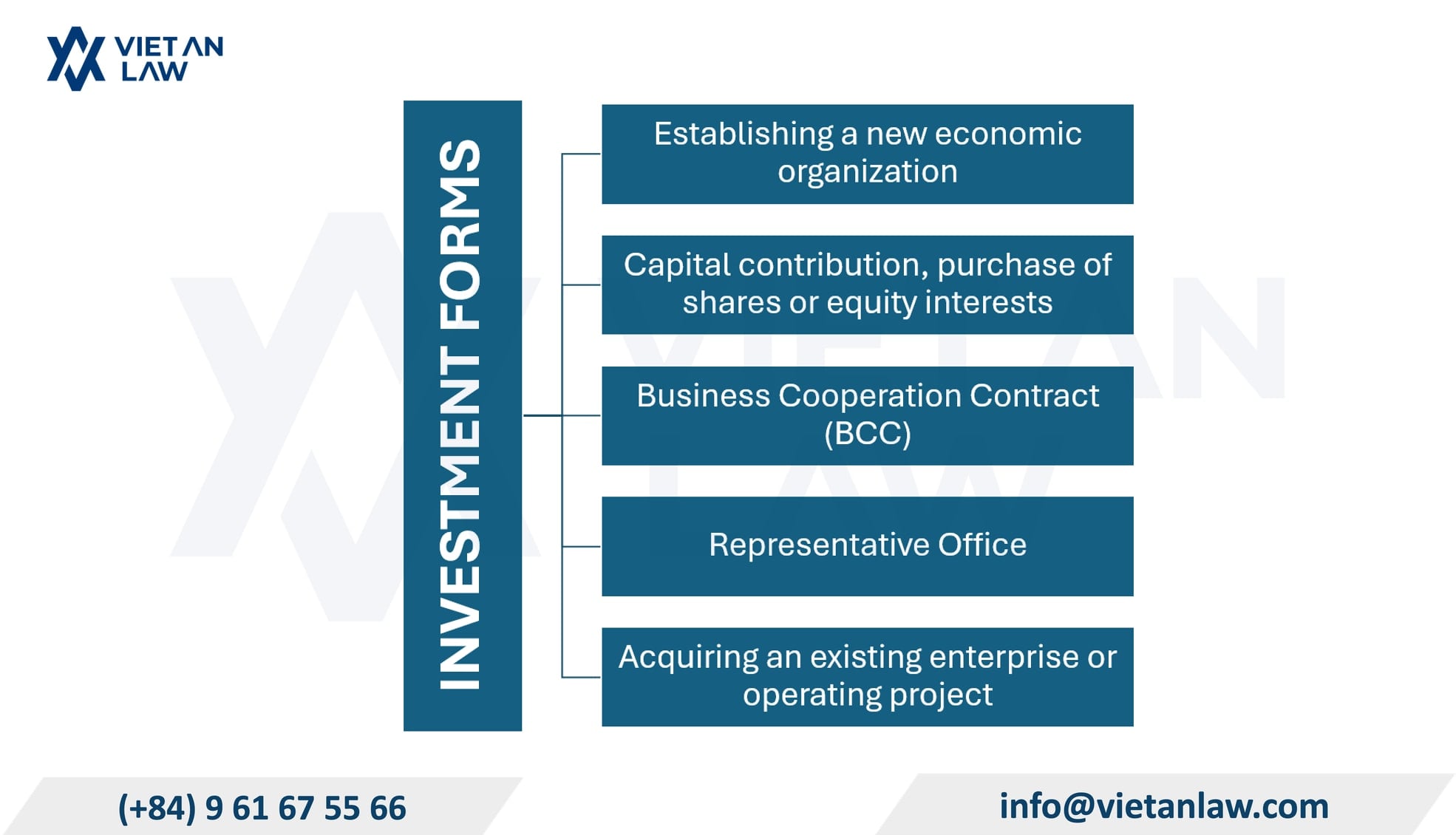
Entering the Vietnamese market is not limited to the sole option of establishing a new FDI company. Depending on business objectives, the industry, ownership ratios, and the desired level of presence, investors can choose from various forms of entry.
Option |
Suitable when |
Legal issues to verify |
|---|---|---|
Establishing an FDI company in Vietnam |
Investors want to build operations from scratch in Vietnam. |
Market access conditions, capital, location, licensing. |
100% foreign-owned enterprise |
Business sectors allow foreign investors to hold 100% equity. |
Ownership limits and sub-licensing. |
Joint venture enterprise |
Required by law or investors wish to partner with a Vietnamese counterpart. |
Governance mechanism, voting rights, capital transfer, and divestment. |
Capital contribution, share purchase, or M&A |
Investors seek to invest in an operating Vietnamese enterprise. |
Legal due diligence, transaction approval procedures, liabilities, and potential risks. |
Business Cooperation Contract (BCC) |
Parties wish to cooperate in business without establishing a new legal entity. |
Distribution of rights, profits, duties, and liabilities among parties. |
Representative Office |
Investors seek to conduct market research and trade promotion prior to direct investment. |
Scope of operation; strictly prohibited from directly conducting revenue-generating business activities. |
Establishing a new economic organization
This is suitable for investors wishing to establish operations in Vietnam from the ground up.
Notably, the Law on Investment 2025 has shifted from the previous approach, allowing foreign investors to establish an economic organization to implement a project prior to completing the procedures for the issuance or amendment of the IRC, if market access regulations and relevant legal requirements are met.
Therefore, the IRC-ERC sequence should not be viewed as a rigid model applicable to every case of foreign investment.
Capital contribution, purchase of shares or equity interests
Investors can enter the market by investing in an existing Vietnamese enterprise.
This option may be suitable when the target enterprise already possesses:
- A customer base;
- Personnel;
- Facilities/locations;
- Suppliers;
- Licenses;
- A brand or market share.
However, the transaction must be reviewed regarding market access conditions, foreign ownership limits, national defense and security implications, land-related issues, and any requirements to register the transaction prior to a change in members or shareholders.
Business Cooperation Contract (BCC)
For certain projects, parties may engage in business cooperation without necessarily establishing a new legal entity.
Representative office of a foreign trader in Vietnam
This option may be suitable when a foreign trader wishes to conduct market research, engage in trade promotion, or maintain a presence in Vietnam without directly carrying out revenue-generating activities that fall outside the scope of a representative office.
Acquisition of an operating business or project
In certain sectors, acquiring an existing business or project may be considered a viable marketing strategy.
However, investors should conduct legal due diligence prior to the transaction to assess licenses, contracts, assets, land, labor matters, tax issues, disputes, and potential liabilities.
How much investment capital is appropriate when investing in Vietnam?
One of the questions Viet An Law frequently receives is: What is the minimum capital required for a foreigner to establish a company in Vietnam?
This question should not be answered with a single figure. Viet An Law’s attorneys typically advise on capital levels based on an assessment of at least three factors:
Charter capital
The capital that members or shareholders commit to contributing to the enterprise.
Total project investment capital
This may include capital contributed by the investor as well as funds mobilized to support the project.
Capital requirements for specific business lines
Certain sectors are subject to specific capital or financial capacity requirements under specialized laws.
For sectors without a fixed minimum capital requirement, investors still need to consider a capital level appropriate for the actual scale of operations.
One should not simply ask, “What is the minimum capital?”
A project planning to lease a large office, hire a large workforce, or invest in machinery – yet registering an excessively low capital level – may fail to reasonably reflect the business plan.
Conversely, registering an excessively high capital level without a proper plan for capital contribution and utilization can create unnecessary obligations for the investor.
Viet An Law typically advises on capital levels based on:
- Premises rental costs;
- Equipment costs;
- Personnel costs;
- Marketing costs;
- Working capital;
- Scale of the factory, store, or office;
- Anticipated time before generating revenue;
- Business line requirements;
- The investor’s financial capacity.
The goal is to select a capital level that is appropriate for the project and feasible to implement, rather than simply aiming for the lowest possible amount.
Verify the location prior to signing the lease agreement in Vietnam
The investment location is a common source of risk if investors consider only commercial factors without conducting legal due diligence.
Before signing a long-term lease or making a substantial deposit, investors should verify:
- The lessor’s ownership or leasing rights;
- Land use purpose;
- Zoning and planning;
- Construction compliance;
- Fire safety compliance;
- Environmental compliance;
- Eligibility for business headquarters registration;
- Feasibility of implementing the investment project at the site;
- Industry-specific requirements for the business facility;
- Requirements applicable to industrial zones, export processing zones, or economic zones, if any.
Signing a lease agreement does not automatically guarantee that the location meets the requirements for project implementation.
In practice, conducting due diligence on the location prior to signing a contract helps investors avoid situations where they have paid deposits, carried out renovations, or purchased equipment, only to find themselves unable to obtain the necessary permits.
Which sublicenses and permits must be considered before establishing an FDI company in Vietnam?
A foreign investment project may involve multiple layers of procedures.
Therefore, Viet An Law recommends that investors pay attention to the relevant licenses right from the investment preparation stage.
| Stage | Legal matters to consider |
| Pre-investment | Market access, ownership ratio, investment structure, capital, location |
| Licensing/ Establishment | Appropriate investment and enterprise registration procedures |
| Post-licensing | Bank accounts, capital injection, tax, accounting, e-invoices |
| Pre-operation | Business licenses and sub-licenses |
| Recruitment | Labor, work permit, residency |
| Operation | Contracts, tax, accounting, intellectual property, legal compliance |
| Expansion | Project amendment, location, capital, business lines, and licenses |
Depending on the sector, investors may need to consider additional procedures such as:
- Trading and distribution: Business license;
- Retail: License to establish a retail outlet;
- E-commerce: Business license and procedures with e-commerce regulatory authorities;
- Education: License for establishment and educational operations;
- Healthcare: Operating license and professional qualification requirements;
- Logistics: Conditions and licenses specific to each type of service;
- Manufacturing: Land use, construction, environmental compliance, and fire safety;
- Tourism and hospitality: Licenses corresponding to the specific type of operation;
- Food: Food safety compliance and sector-specific requirements;
- Foreign workers: Work permit or confirmation of work permit exemption (if eligible).
Are holding an IRC and ERC sufficient to commence business operations in Vietnam?
That is not always the case. This is a common area of confusion for foreign investors entering the Vietnamese market.
The mere fact that an enterprise has been established or a project registered does not automatically mean the company has met all the requirements to commence full business operations.
Depending on the business sector, following the investment and enterprise registration phase, the company may still need to:
- Make capital contributions in accordance with regulations;
- Open and utilize appropriate bank accounts;
- Register for and fulfill tax obligations;
- Set up an accounting system;
- Obtain a business license;
- Obtain specialized licenses or permits;
- Complete labor-related procedures;
- Obtain work permits for foreign personnel;
- Ensure compliance with fire safety, environmental, and construction standards;
- Register or protect intellectual property rights;
- Finalize contracts and internal compliance procedures.
Therefore, Luat Viet An goes beyond simply advising on “how to set up a company”; we develop a comprehensive roadmap – spanning from market entry to the commencement of official operations – to enable investors to make accurate and appropriate decisions.
Key risks foreign investors should mitigate before market entry into Vietnam
Selecting the business lines before verifying market access conditions
The business sector name listed in the business registration system may not fully reflect the specific conditions applicable to foreign investors.
Checking only ownership ratios while overlooking specialized licenses
A sector might allow 100% foreign ownership, yet actual operations could still require additional licenses.
Registering capital that does not match the project scale
Capital levels that are either too low or too high relative to planned operations require careful consideration.
Signing a lease agreement before conducting a legal review of the site
This poses a risk that could directly impact the ability to obtain necessary licenses.
Selecting a Vietnamese partner without a clear governance mechanism
Joint ventures require thorough preparation regarding voting rights, governance, share transfers, and exit strategies.
Failing to account for permits required for foreign personnel
Foreign investors, directors, and experts may be subject to different requirements regarding work permits and residency.
Failure to secure trademark registration and intellectual property protection from the outset
For businesses planning to use brands, software, technology, or designs in Vietnam, an intellectual property strategy should be developed alongside the business establishment plan.
Market entry consulting process in Vietnam at Viet An Law
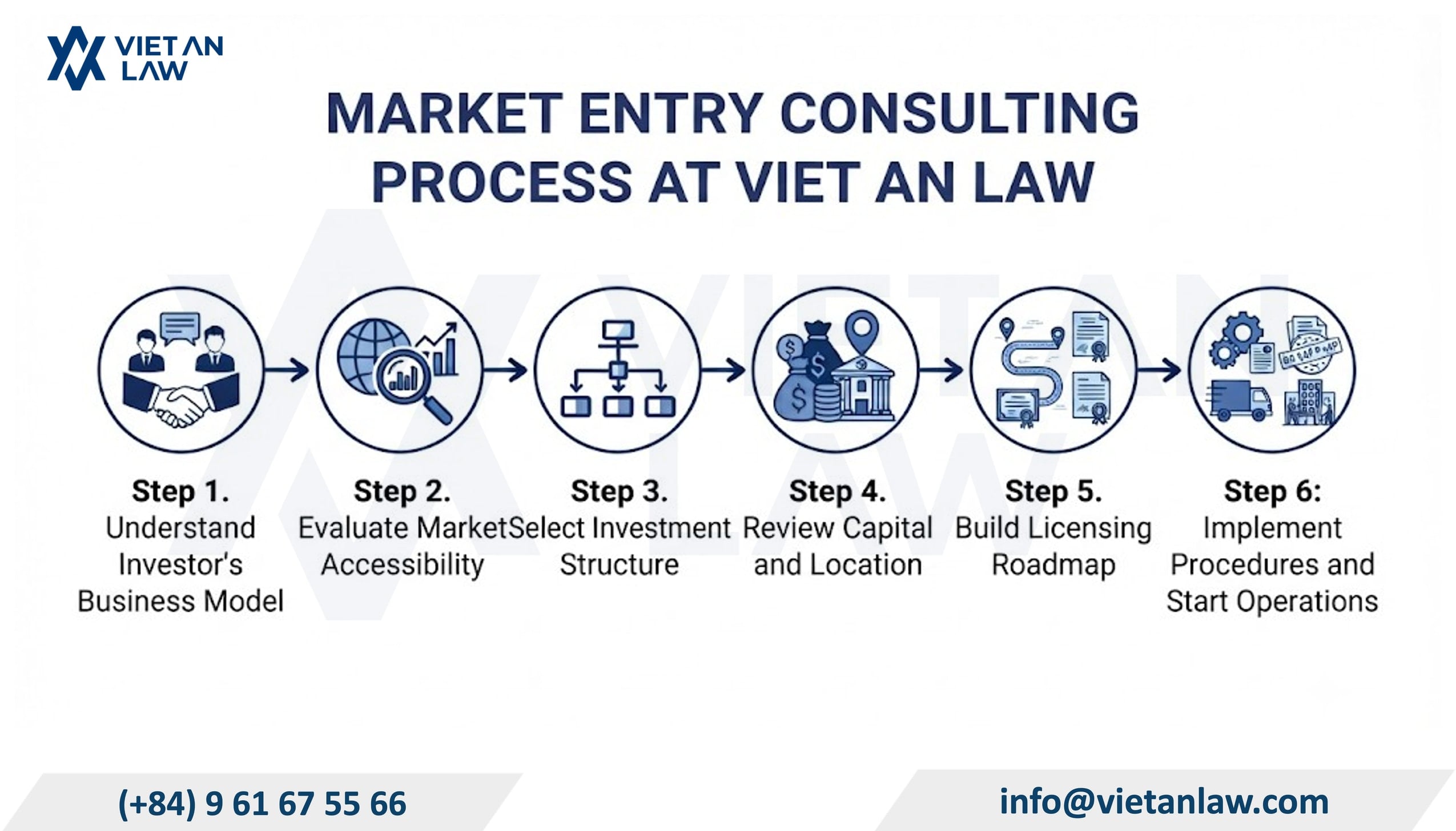
To enable investors to easily oversee the entire process, Viet An Law implements the service according to the following steps:
Step 1. Understand the investor’s business model
Viet An Law identifies:
- Products or services;
- Target customers;
- Revenue generation methods;
- Operational locations;
- Investment scale;
- Projected personnel;
- Development plan in Vietnam.
Understanding the actual business model helps prevent situations where a license is obtained, but its scope does not align with the intended operations.
Step 2. Assess market access
Viet An Law examines:
- Business lines;
- Nationality;
- International treaties;
- Ownership ratios;
- Investor eligibility criteria;
- Sector-specific conditions.
Step 3. Select an investment structure
Compare options:
- 100% foreign-owned company;
- Joint venture;
- Acquisition of equity in a Vietnamese enterprise;
- M&A;
- BCC (Business Cooperation Contract);
- Representative office;
- Other suitable structures.
Step 4. Review capital and location
Viet An Law assists in determining:
- Charter capital;
- Total investment capital;
- Capital contribution schedule;
- Location;
- Legal status of the location;
- Facility requirements.
Step 5. Develop a licensing roadmap
The investor is briefed in advance on:
- Investment procedures;
- Corporate procedures;
- Specialized licenses;
- Pre-operation conditions;
- Labor;
- Taxation;
- Accounting;
- Intellectual property.
Step 6: Implementing procedures and commencing business operations
Once the structure has been agreed upon, Viet An Law can continue to assist investors in carrying out the necessary legal procedures to implement the project in Vietnam.
What do investors gain from market entry advisory services in Vietnam?
Depending on the scope of work, the advisory deliverables may include:
- Market entry feasibility assessment;
- Identification of investment conditions;
- Assessment of nationality and applicable treaties;
- Foreign ownership ratios;
- Proposed investment structure;
- Capital recommendations;
- Legal checklist regarding the location;
- List of required licenses and permits;
- Implementation roadmap;
- Legal risks to be addressed;
- Advice on relevant licenses;
- Proposed post-establishment legal steps.
For complex projects, Viet An Law can prepare a tailored legal assessment on market entry for the investor prior to their investment decision.
Vietnam market entry legal advisory services by Viet An Law
Viet An Law provides comprehensive legal services throughout the investment lifecycle of foreign-invested enterprises, including:
- Advising on market access conditions;
- Advising on foreign ownership ratios;
- Advising on investment structures;
- Advising on establishing an FDI company in Vietnam;
- Advising on capital contributions, share acquisitions, and M&A;
- Advising on capital and contribution schedules;
- Reviewing investment locations;
- Handling investment and corporate procedures;
- Obtaining business licenses;
- Obtaining specialized licenses;
- Advising on labor matters and work permits;
- Advising on contracts;
- Advising on intellectual property;
- Coordinating tax and accounting advisory services;
- Advising on operational compliance;
- Advising on project expansion or restructuring.
- Other foreign legal services in Vietnam.
Through this approach, Viet An Law aims to assist investors not only in entering the Vietnamese market but also in establishing a suitable legal framework for long-term business operations and growth.
Frequently asked questions
Can foreign investors own 100% of a company in Vietnam?
It is possible, depending on the business sector. For sectors without restrictions on foreign ownership ratios or other specific regulations, investors may consider establishing a 100% foreign-owned enterprise.
For sectors subject to market access conditions, it is necessary to verify ownership limits and specific requirements prior to investing.
How much capital do foreigners need for company formation in Vietnam?
There is no single, standard capital amount applicable to all foreign-invested enterprises.
The required capital depends on the business sector, project scale, implementation costs, and any specialized legal requirements applicable.
Does nationality affect investment conditions?
It may. The investor’s nationality or the country of incorporation can influence the applicable international treaties and market access commitments.
Should one establish a new FDI company or acquire an existing Vietnamese business?
There is no one-size-fits-all solution for investors. Establishing a new company may be advantageous when building a system from scratch. Mergers and acquisitions (M&A) may be suitable for gaining rapid access to existing customers, assets, personnel, or licenses.
Before deciding, it is essential to compare costs, timelines, investment conditions, and the legal risks associated with the target company.
Can an FDI company commence operations immediately after establishment?
It depends on the business sector. The enterprise may still need to meet requirements regarding capital, taxation, accounting, and labor, as well as obtain business or specialized licenses before carrying out specific activities.
Viet An Law: Accompanying foreign investors from market entry to full commercial operation in Vietnam
An effective investment decision must be grounded in both commercial objectives and legal feasibility.
Assessing market access conditions, ownership ratios, nationality requirements, capital, location, and licensing from the outset enables investors to proactively plan budgets, project timelines, and investment structures.
Viet An Law supports foreign investors throughout the entire process: Market entry assessment → Investment structuring → Business incorporation → Licensing → Labor matters → Contracts → Intellectual property, as well as ongoing legal compliance – thereby helping businesses establish a solid legal foundation for launching and expanding their operations in Vietnam.
Viet An Law – Providing investment and legal consultancy for foreign investors in Vietnam.
Author: Lawyer Trung Thi Lieu
Reviewer: Lawyer Dong Van Thuc
Hotline/ Zalo/ Whatsapp: (+84) 961 675 566
Email: info@vietanlaw.com
Hanoi Office: 3rd Floor, Hoang Ngan Plaza Building, 125 Hoang Ngan, Yen Hoa Ward, Hanoi
Ho Chi Minh City Office: Units 2.26–2.27, Charmington La Pointe Building, 181 Cao Thang, Hoa Hung Ward, Ho Chi Minh City.