

FDI Company Formation in Vietnam
Viet An Law advises foreign investors on FDI company formation in Vietnam, from market entry and registration to licensing and post-incorporation compliance
Review of foreign ownership limits, permitted investment forms, business scope, investor qualifications and other market access conditions applicable to foreign investors in Vietnam.
Advising foreign investors on establishing wholly foreign-owned companies in Vietnam, including investment structure, capital, business lines, IRC/ERC procedures and post-licensing requirements.
Advising foreign investors and Vietnamese partners on establishing joint ventures, ownership structures, capital contributions, corporate governance and shareholder arrangements.
Advising and representing foreign investors in obtaining Investment Registration Certificates for investment projects in Vietnam and completing related investment procedures.
Assisting investors with enterprise registration, corporate structure, registered business information and issuance of the Enterprise Registration Certificate in Vietnam.
Supporting newly established FDI companies with capital accounts, capital contribution, tax registration, accounting, invoices, licences, investment reporting and other post-establishment compliance.
Beyond mere procedures: A strategic investment strategy
Establishing a foreign-invested company in Vietnam typically takes 25-35 days, involving two mandatory steps: securing the Investment Registration Certificate (IRC) and the Enterprise Registration Certificate (ERC). However, practical data shows that over 60% of FDI projects face delays due to incorrect business line selection, lack of sub-licenses, or inappropriate capital registration.
As Vietnam remains a top-tier FDI destination thanks to competitive costs, a strategic location, and major FTAs like the CPTPP and EVFTA, setting up a 100% foreign-owned company is no longer just a legal formality. It is an investment strategy that must be standardised from the very beginning.
This company formation in Vietnam in 2026: Complete guide for foreign investors provides insights into requirements, dossiers, IRC and ERC Vietnam workflows, costs, and risk mitigation. Our goal is to help investors implement their projects rapidly, ensure full legal compliance, and optimise business efficiency in the Vietnamese market.
| Criteria | Domestic company | FDI company |
| Investing entities | Vietnamese individuals/organisations | Foreign individuals/organisations or joint ventures |
| Licensing authorities | Business registration office | 2 steps: Business registration office + Investment registration authority |
| Required licenses | Enterprise Registration Certificate (ERC) | Investment Registration Certificate (IRC) + ERC |
| Procedure | 1 step | 2 steps (IRC → ERC) |
| Processing time | 3 – 5 working days | 15 – 30 days (may take longer for complex projects) |
| Business lines | Unrestricted (except for prohibited sectors) | Restricted; subject to WTO conditions and international commitments |
| Ownership ratio | 100% Vietnamese capital | Up to 100% foreign capital or joint venture (depending on the sector) |
| Charter capital | No minimum required (except for specialized industries) | Must prove financial capacity; capital must be reasonable for the project scale |
| Headquarters location | Flexible | Must comply with master planning; clear lease agreements are often required |
| Legal procedures | Simple | More complex; requires investment project explanation/justification |
| Capital account opening | Direct Investment Capital Account (DICA) is not mandatory | Mandatory to open a an DICA |
| Overseas profit remittance | Not applicable | Permitted, subject to foreign exchange and tax regulations |
| Post-licensing inspection | Minimal inspections | Subject to investment activity audits and inspections |
| Tax & accounting | Subject to general regulations | Similar to domestic companies, with additional investment reporting obligations |
| International market access | More limited | Higher (favorable for import-export and further FDI attraction) |
| Establishment costs | Low | Higher (due to the additional IRC step, consulting fees, and document legalization…) |
Procedure for applying for IRC + ERC for 100% foreign-owned companies in Vietnam
To establish a foreign-owned company in Vietnam, investors need to complete two core legal steps:
Not all FDI projects require this step. However, if the project:
It is mandatory to apply for investment policy approval before issuing an IRC.
| Stage | Actual timeframe |
| IRC application | 15 – 20 days |
| ERC application | 3 – 5 days |
| Post-licensing completion | 5 – 7 days |
| Total | ~25 – 35 days |
| Criteria | New establishment | M&A |
| Time | 25-35 days | 7-15 days |
| Risks | Low | Medium |
| Control | High | Dependent on the existing enterprise |
Conclusion
The IRC + ERC process in Vietnam is not complicated if done correctly from the start. Conversely, mistakes in the strategic phase can cause project delays of months and significantly increase costs.
The best solution: standardise documentation + check industry standards + seek legal advice before implementation.
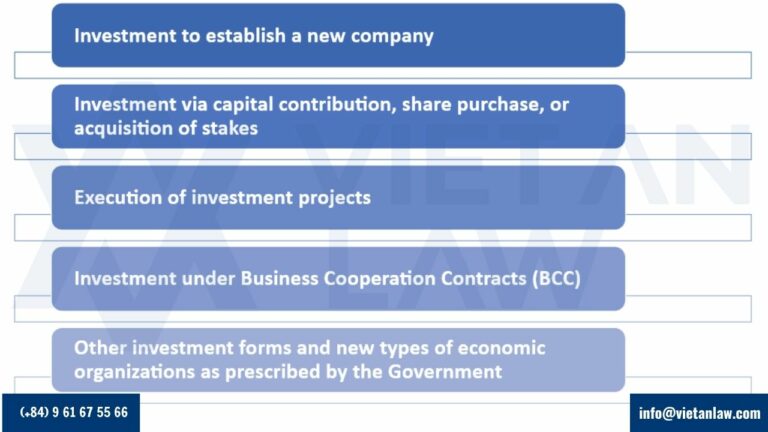
According to the Investment Law, foreign investors can choose from various forms of investment in Vietnam depending on their business objectives and specific business lines. Common forms include:
Among these options, the 100% foreign-owned company model is favoured by many investors due to its ability to control operations and business strategies in the Vietnamese market.
Therefore, before registering a foreign-invested company, investors need to check market access conditions to avoid legal risks.
During the establishment of a foreign-invested company in Vietnam, a European investor launched a commercial business project aimed at directly distributing goods to the market. However, this company failed to obtain a business license (retail) as it is a mandatory requirement for the distribution activities of FDI enterprises.
The above case shows that:
Company formation in Vietnam is not just a legal procedure, but an overall investment strategy.
Successful experience in establishing FDI companies in Vietnam
To avoid risks and optimise implementation time, investors should:
Case study 2: FDI trading company delayed opening due to a lack of a business license
A Singaporean investor established a trading company in Vietnam to sell directly to customers. After completing the IRC and ERC agreements, the business proceeded to lease premises and import goods. However, because it had not yet obtained a retail license, it was not permitted to commence retail operations.
FDI enterprises operating in distribution and retail are required to obtain sub-licenses in addition to IRC and ERC.
Case study 3: Foreign education company denied license due to lack of facilities
A South Korean investor established a training centre in Vietnam operating as a 100% foreign-owned company. Despite having IRC and ERC licenses, the application for an educational operating license was rejected due to:
The education sector is a highly demanding field, requiring preparation of infrastructure, personnel, and training programs right from the start.
Case study 4: Logistics company’s operations restricted due to incorrect capital contribution ratio
A Japanese investor established a logistics company in Vietnam with 100% foreign ownership. However, due to a lack of scrutiny of WTO commitments, this sector is subject to limitations on ownership percentage and scope of operations.
Some sectors, such as logistics and transportation, have strict regulations regarding capital ratios and the scope of operations.
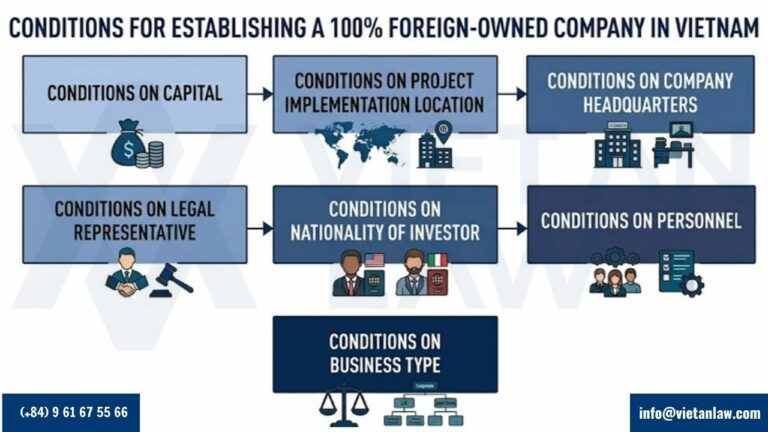
Vietnamese law currently does not stipulate a minimum capital requirement for most business lines. However, in practice:
To obtain favourable licensing and a long project duration, enterprises should register reasonable or above-average charter capital and investment capital.
The project location must conform to the planning regulations:
Note:
In the case of a representative leaving the country:
Certain nationalities may be subject to:
Investors should contact a consulting firm such as Viet An Law for an assessment tailored to their individual circumstances.
For enterprises operating in regulated sectors: Requirements regarding certificates, qualifications, and experience must be met. Examples:
Basically, foreign investors can choose from the following types of business entities:
However, in some specific fields:
| No. | Business lines | CPC code |
| 1 | Manufacturing | |
| 2 | Accounting and tax services (excluding foreign accounting service enterprises) | 862, 863 |
| 3 | Architectural services | 8671 |
| 4 | Engineering services and integrated engineering services | 8672, 8673 |
| 5 | Urban planning and urban landscape architectural services | 8674 |
| 6 | Computer and related services, business services, software production | 841-845, 849 |
| 7 | Research and development services on natural sciences | 851 |
| 8 | Market research services | 864 |
| 9 | Management consulting services | 865 |
| 10 | Services related to management consulting | 866 |
| 11 | Services related to manufacturing | 884, 885 |
| 12 | Services related to scientific and technical consulting | 86751, 86752, 86753 |
| 13 | Maintenance and repair services of machinery and equipment (excluding repair and maintenance of seagoing vessels, aircraft, or other transport vehicles and equipment) | 633 |
| 14 | Courier services | 7512 |
| 15 | Construction services and related engineering services | 511-518 |
| 16 | Import-export, wholesale, and retail distribution services | 621, 622, 631, 632 |
| 17 | Franchising services | 8929 |
| 18 | Education services | 923, 924, 929 |
| 19 | Sewage and waste treatment | 9401, 9402 |
| 20 | Hospital, dental, and medical examination services | 9311, 9312 |
| 21 | Hotel accommodation services, food and beverage catering services | 64110, 642, 643 |
| 22 | Warehousing and freight transport agency services | 742, 748 |
| 23 | Computer reservation services | |
| 24 | Aircraft repair and maintenance services | 8868 |
| 25 | Other fields |
IRC is a license for investment projects by foreign investors, while ERC is an enterprise registration license to operate in Vietnam.
The average time is 25-35 days.
Investment approval is required when the project involves land use, is large-scale, or owned by a specific industry, as stipulated by law.
The cost is usually between 1,500 and 3,000 USD, depending on the project size and consulting services, not including operating costs.
Not entirely. Enterprises may need additional sub-licenses (such as retail, education) and must complete post-establishment procedures such as opening an investment capital account.
Viet An Law provides comprehensive services for foreign investors:
Nearly 20 years of experience in supporting clients from the US, EU, Japan, South Korea, Singapore, China, India, and Australia.
Contact us for advice on establishing an FDI company in Vietnam
Receiving quick advice is the right strategy from the start, with a response within 12 hours. Avoid legal risks and save time when implementing your project in Vietnam.
Hotline/Zalo/WhatsApp: 09 61 67 55 66
Contact us now for comprehensive support, from IRC and ERC licenses to sub-licenses.

(+84) 9 61 67 55 66
(Zalo / WhatsApp / Viber)


Monday – Friday: 08:00 – 17:00
(Vietnam Time, UTC+7)