


The registration deadline for foreign loans under Circular 80/2025/TT-NHNN is usually 30 working days from the date of signing the loan agreement, signing the loan extension, or the first withdrawal date depending on each case. It applies to medium- and long-term foreign loans or short-term foreign loans converted into medium and long-term ones.
Complying with the proper deadline not only helps enterprises ensure the legality of the loan transaction but also mitigates the risk of administrative sanctions, interruption in the disbursement of foreign loans, or difficulties in the process of transferring money to repay debts via banks. In reality, many FDI enterprises and enterprises with foreign loan transactions often encounter problems related to the time when the registration obligation arises, the deadline for submitting dossiers, and procedures for adjusting loans when there are changes.
In this article, Viet An Law Firm will analyze in detail the deadline for foreign loans not guaranteed by the Government, cases where foreign loan registration with the State Bank of Vietnam (SBV) is mandatory, the time to calculate the registration deadline, and important legal notes according to the foreign loan registration deadline in Vietnam 2026: latest regulations.
Foreign loan registration deadline table in 2026
| Case | Registration deadline |
| Medium- and long-term foreign loans | 30 working days |
| Extension of short-term foreign loans exceeding 1 year | 30 working days |
| Remaining outstanding debt after 1 year | 30 days from the full year date |
| SBV processes dossier | 10 working days |
| Request to supplement dossier | 7 working days |
Regulations on loan accounts in Vietnam
Regulations on foreign currency loan accounts
To disburse and repay debts in foreign currency, enterprises need to note the newly specified groups of collection and payment transactions:
- Valid revenue sources: In addition to the disbursement money from the lender, enterprises are allowed to collect from foreign currency purchased at credit institutions to fulfill the obligations of principal, interest, and fee repayment.
- Payment regulations: The Circular supplements the right to pay to the guarantor (resident or non-resident) in case of reimbursement of incurred debt acknowledgments.
- Selling foreign currency: Enterprises are allowed to sell foreign currency to banks to perform debt repayment obligations in Vietnamese Dong (VND) if the loan agreement stipulates so.
Regulations on Vietnamese Dong (VND) loan accounts
This is a section with many changes to strictly control domestic currency flows in foreign loan transactions and the foreign loan and debt repayment account:
- Determining revenue sources: Only accepting receipts transferred from the VND payment account of the borrower itself or from the source of selling foreign currency to credit institutions.
- Handling “special” cases: Circular 80 opens a legal way out when allowing debt repayment in sensitive situations such as: Loans not eligible for confirmation of foreign loan registration or the confirmation document is terminated because the foreign loan registration dossier contains fraudulent/forged information. However, this debt repayment must have a written agreement and apply the prescribed exchange rate.
Transactions via third parties and intermediary organizations
- Disbursement via a third party: Allowing the receipt of disbursement money and debt repayment through the account of an intermediary organization (especially in the case of repurchasing international bonds before maturity).
- Lender’s account in Vietnam: If the lender uses the foreign currency account of a non-resident in Vietnam for the disbursement of foreign loans or debt recovery, it must strictly comply with regulations on restricting the use of foreign exchange in the Vietnamese territory.
- Reimbursement of debt acknowledgment: Allowed to be carried out through another foreign loan and debt repayment account at the same bank if the payment currency of the debt acknowledgment is different from the currency of the account being used.
Top 7 errors causing foreign loan registration dossiers to be rejected in Vietnam
- Scanning documents from photocopies without being the original;
- Signing the digital dossier incorrectly;
- Incorrectly identifying the first withdrawal date;
- Submitting more than 30 days late;
- Missing Swift code in the dossier;
- Missing loan contract;
- Incorrect loan repayment account.
Latest regulations on the registration deadline for foreign loans not guaranteed by the Government under Circular 80/2025/TT-NHNN
The State Bank of Vietnam issued Circular No. 80/2025/TT-NHNN amending and supplementing a number of articles of Circular No. 12/2022/TT-NHNN on foreign exchange management regarding the borrowing and repayment of foreign debts by enterprises as follows:
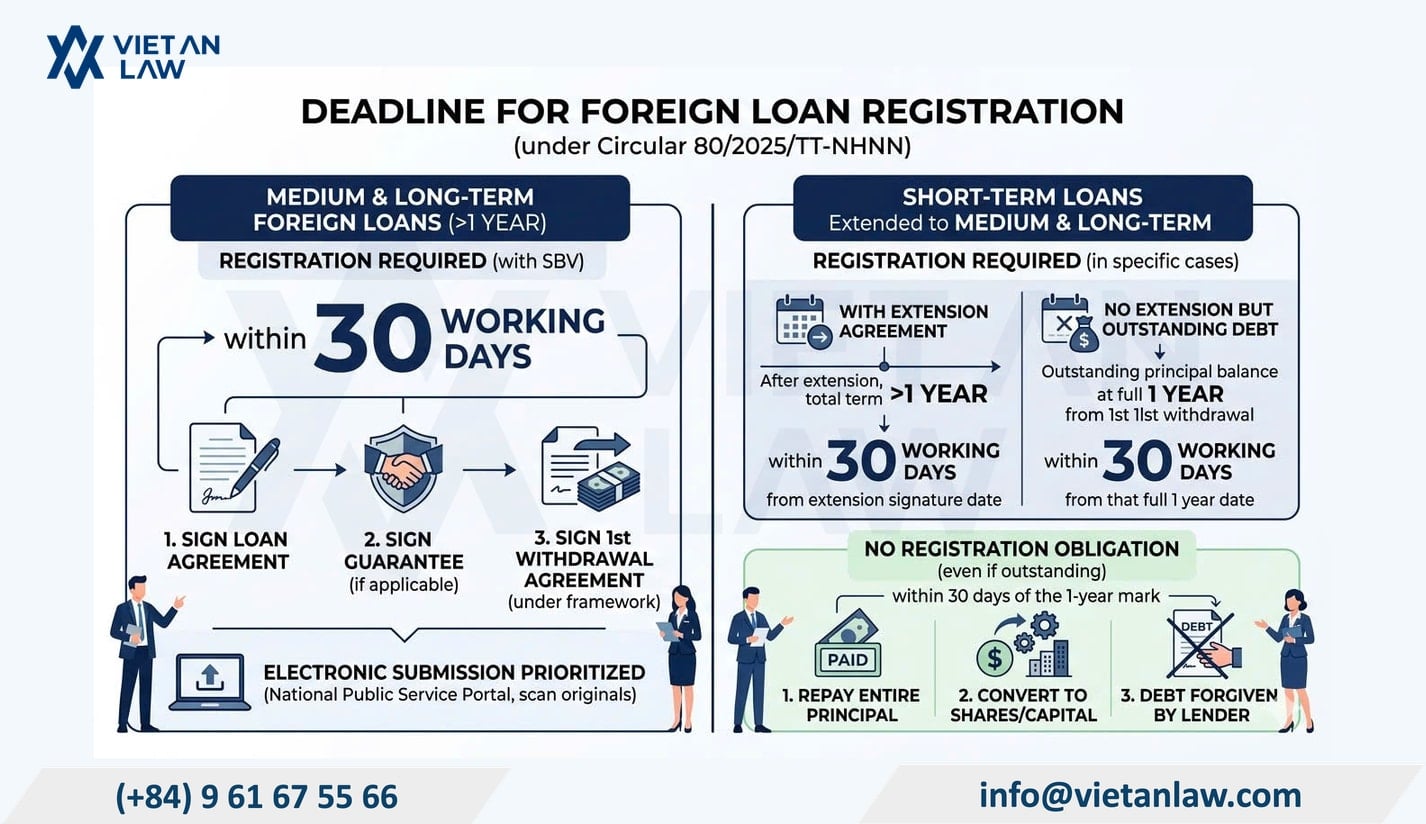
Foreign loan registration deadline
Deadline for medium- and long-term foreign loans
According to Articles 12 and 13 of the new Circular, for medium and long-term foreign credit (with a term of over 01 year), enterprises must send the dossier for foreign loan registration with the State Bank of Vietnam (SBV) within 30 working days.
This timeline is calculated from:
- The date of signing the foreign loan agreement.
- The date of signing the guarantee document in case the loan has a guarantee.
- The date of signing the first withdrawal agreement (if the parties have a withdrawal agreement based on a framework agreement).
Note: The submission of dossiers currently prioritizes the electronic form, so the dossier submission date is considered the date the enterprise finishes sending the dossier on the National Public Service Portal with full scans from the originals.
Deadline for short-term loans extended into medium and long-term ones
According to Article 11 of Circular 80/2025/TT-NHNN, enterprises need to pay special attention to 02 cases requiring registration as follows:
- Case of having an extension agreement: The registration deadline is 30 working days from the date of signing the extension agreement, if after the extension, the total loan term is over 01 year.
- Case of having no extension agreement but still having outstanding debt: If the short-term credit has no extension agreement but still has an outstanding principal balance at the time of a full 01 year from the first withdrawal date, the enterprise must register within 30 working days from that full 01 year time.
Circular 80/2025/TT-NHNN has excluded the registration obligation by adding cases that do not require registration even if there is an outstanding balance after 01 year, if within 30 working days from the full year date, the enterprise:
- Completes the payment of the entire principal outstanding balance.
- Converts the entire principal outstanding balance into shares or capital contribution portions.
- Is forgiven the entire principal debt obligation by the lender.
The exact calculation of the time of “First withdrawal” and “Signing the extension agreement”
To accurately determine the 30-day deadline, enterprises need to base it on the technical definitions in the Circular:
- First withdrawal date: Is the date money is transferred into the offshore borrowing and repayment account of the borrower or the date the borrower is recorded to have paid the beneficiary (in case of borrowing by goods or services). Enterprises need to carefully cross-check with the Telegraphic Transfer (SWIFT) or bank documents to determine this date.
- Date of signing the extension agreement: Is the date recorded on the document modifying and supplementing the loan agreement that the parties have agreed to extend the principal repayment term exceeding 01 year.
- Calculation of working days: Excluding public holidays, Tet, and weekends according to the provisions of Vietnamese law. This creates more favorable conditions compared to the usual calendar day calculation.
Dossier processing deadline of the State Bank
According to the provisions of Clause 3, Article 5 of Circular 80/2025/TT-NHNN, the State Bank shall have a written document for confirmation of foreign loan registration or refusal to confirm the registration of the loan (clearly stating the reasons) within 10 working days from the date the borrower’s dossier is received fully and validly.
The form of the written confirmation of registration for foreign loans not guaranteed by the Government is according to Appendix II issued together with this Circular.
Note:
- In case the dossier is not eligible for resolution, within 07 working days from the official receipt of the dossier, the State Bank shall have a written document requesting the borrower to supplement and clarify the contents according to the provisions of this Circular.
- After 60 days from the date of the written request for supplementation and clarification mentioned above, if the borrower does not complete the completion of the dossier, the State Bank shall close the dossier on the Information System for administrative procedure resolution according to the provisions of law on the implementation of administrative procedures under the one-stop shop, inter-connected one-stop shop mechanism at the One-Stop Shop Division and the National Public Service Portal.
Guidance on the form of documents in the electronic dossier (Scanned from the original) under Circular 80/2025/TT-NHNN
One of the most breakthrough and practical changes of Circular 80/2025/TT-NHNN is the standardization of the electronic dossier format. This regulation aims to accelerate the digitization process, helping enterprises save time on printing and delivery but also sets strict requirements on the originality of data.
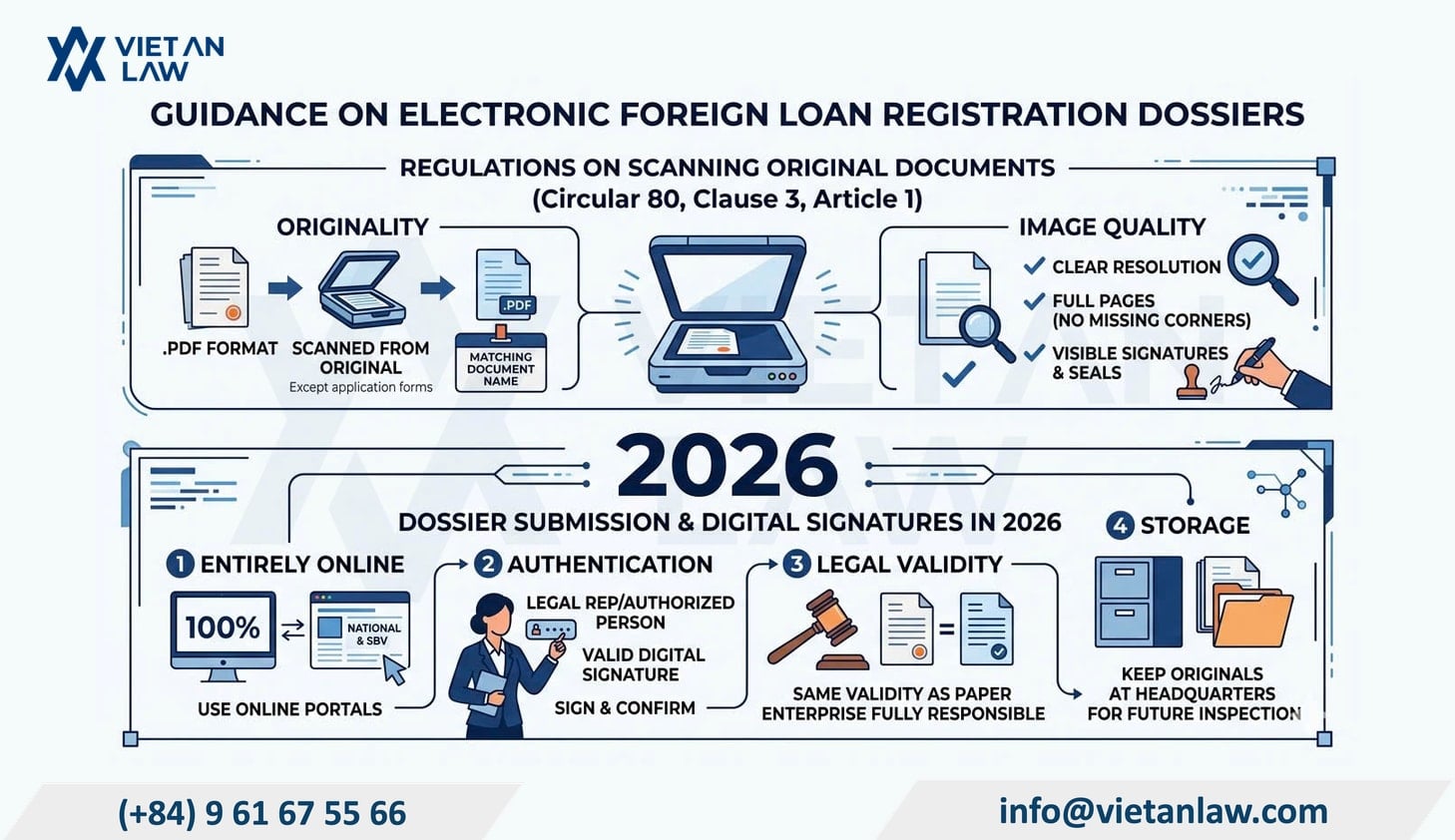
Guidance on the form of documents in the electronic foreign loan registration dossier
Regulations on scanning documents from original copies
Unlike previous periods that often accepted notarized copies or scans from photocopies, Clause 3, Article 1 of Circular 80 clearly states:
- Originality: Documents in the electronic dossier are electronic documents in “.PDF” format scanned from the original copies, except for application forms declared on the National Public Service Portal. The name of the electronic document must be set corresponding to the name of the document type according to regulations.
- Image quality: The scanned copy must ensure clear resolution, full pages, no missing corners, and clearly show the signatures and seals of the parties.
How to submit dossiers and use digital signatures in 2026
The submission of dossiers is currently carried out entirely on the National Public Service Portal or the Web portal for managing foreign borrowing and debt repayment of the State Bank:
- Authentication by digital signature: The legal representative or the authorized person of the enterprise must use a valid digital signature to sign the declaration and confirm the attached scanned copies.
- Legal validity: The electronic dossier digitally signed and scanned from the original has the same legal validity as the paper dossier. Enterprises bear full responsibility before the law for the accuracy and truthfulness of these scanned copies.
- Storage for cross-checking: Despite submitting the electronic dossier, enterprises still have the obligation to keep the originals at their headquarters to serve the future inspection and examination work of the management agency.
Consequences of not registering foreign loans on time and foreign exchange management violations
Failure to register foreign loans on time according to the regulations of the State Bank can make enterprises face many legal risks and difficulties in the process of using foreign loan capital. Some common consequences include:
- Being subjected to administrative sanctions in the field of foreign exchange management according to the provisions of Vietnamese law;
- Facing difficulties in the disbursement process of the loan, especially for medium and long-term loan transactions that require mandatory registration;
- Commercial banks may refuse to conduct transactions related to the loan, including disbursement, transfer of debt repayment money, or confirmation and registration of foreign exchange transactions;
- Unable to transfer the principal, interest, and loan fee repayment abroad according to regulations, directly affecting the enterprise’s payment obligation to the lender;
- Violating regulations on forex management and foreign borrowing and debt repayment, increasing legal risks in the enterprise’s operation process;
- Affecting the FDI compliance of foreign-invested enterprises, especially in inspection, examination, or compliance review activities by state management agencies and credit institutions;
- Giving rise to procedures for explanation, supplementation of dossiers, or registration of amendment of foreign loans, leading to prolonged processing time and increased compliance costs for enterprises.
Therefore, enterprises need to closely monitor the foreign loan registration deadline in Vietnam 2026: latest regulations and strictly follow the procedures according to the regulations of the State Bank to ensure that the activities of borrowing, disbursing, and repaying debts are carried out legally, smoothly, and with legal safety.
Frequently asked questions about foreign loan registration with the State Bank of Vietnam (SBV)
Do short-term loans have to be registered?
Normally, short-term foreign borrowings of under 01 year do not need to be registered with the State Bank. However, if the loan is extended or has an outstanding balance exceeding 01 year, the enterprise must carry out the registration procedure according to regulations.
Is there a penalty for overdue foreign loan registration?
Yes. Enterprises that fail to register foreign loans on time can be subject to administrative sanctions in the field of forex administration and face difficulties in the disbursement process or transferring money to repay debts.
Is it possible to register foreign loans online?
Yes. Currently, enterprises can carry out the online foreign loan registration procedure through the Public Service Portal or the electronic system of the State Bank.
How long does the SBV take to process the loan registration dossier?
According to current regulations, the State Bank processes the offshore loan registration file within 10 working days from the date of receiving a full and valid dossier.
Is it mandatory to use a digital signature?
Yes. When submitting an electronic dossier to register a foreign loan, enterprises must use a valid digital signature to authenticate the dossier according to regulations.
Are dossiers scanned from copies accepted?
According to Circular 80/2025/TT-NHNN, electronic files must be scanned from original copies. Enterprises need to ensure the scanned copy is clear, complete, and accurate.
Is it required to re-register when modifying a loan?
Yes. When there are changes related to a foreign loan such as the loan term, loan value, lender, or debt repayment plan, enterprises must carry out the procedure to register the amendment of foreign loans with the State Bank.
Foreign loan registration service of Viet An Law Firm
With experience in providing legal advice to many FDI enterprises and enterprises with international loan transactions, Viet An Law Firm provides foreign loan registration services, foreign exchange administration consulting, and supports enterprises in carrying out procedures with the State Bank according to the foreign loan registration deadline in Vietnam 2026: latest regulations.
The services of Viet An Law Firm include:
- Consulting and implementing the procedure to register foreign loans with the State Bank of Vietnam;
- Consulting, drafting, and submitting dossiers to adjust offshore loans when there are changes in credit limit, loan term, lender, or repayment plan;
- Consulting on regulations on foreign exchange administration, foreign borrowing, and debt repayment of enterprises;
- Supporting enterprises in carrying out the procedure to register changes to foreign loans with the SBV in accordance with the legal deadline;
- Consulting on opening and using offshore loan and debt repayment accounts suitable for each type of loan transaction;
- Consulting on reviewing and building an FDI compliance system to ensure compliance with regulations on investment, foreign exchange, and international money transfers;
- Supporting explanation and working with commercial banks and management agencies during the process of registration, disbursement, and repayment of foreign loans.
Registering foreign loans in accordance with regulations not only helps enterprises ensure the legality of loan transactions but also limits risks regarding forex control, administrative penalties, and disruptions in disbursement and debt repayment transfer activities.
If clients need advice on registering foreign loans, foreign exchange administration, or consulting on drafting foreign loan contracts for FDI companies, please contact Viet An Law Firm for the fastest and most effective support.