


According to Decree 100/2026/ND-CP and Circular 10/2026/TT-BKHCN guiding IP Law on industrial property protection related to the AI framework, industrial property objects using AI are only protected if humans make a significant contribution during the creative process. In Vietnam, artificial intelligence is strictly viewed as a supporting tool and is not recognized as an independent author. This article of Viet An Law will explore the core principles, necessary criteria, and procedural requirements for answering a common question among innovators and tech enterprises: Can AI receive industrial property protection in Vietnam?
WWhat constitutes a “significant human contribution”?
Core principles
One of the notable new points in Decree 100/2026/ND-CP is the addition of Article 10a, which regulates rights to objects of industrial property created using artificial intelligence systems, inserted immediately after Article 10.
Accordingly, industrial property rights for a patent, industrial design, or layout design created by humans using artificial intelligence systems shall only be established if humans make a significant contribution to the creation of those objects.
Therefore, this regulation affirms that AI is strictly considered a supporting tool and cannot replace the role of a human author. Unlike the open approach of certain countries (such as the UK or South Africa, which have historically accepted the protection of AI as an author), Vietnam firmly adheres to a human-centric legal doctrine.
Four criteria to determine a “significant contribution”
A human is considered to have made a significant contribution to the creation of a patent, industrial design, or layout design using an artificial intelligence system when that human performs all of the following activities:
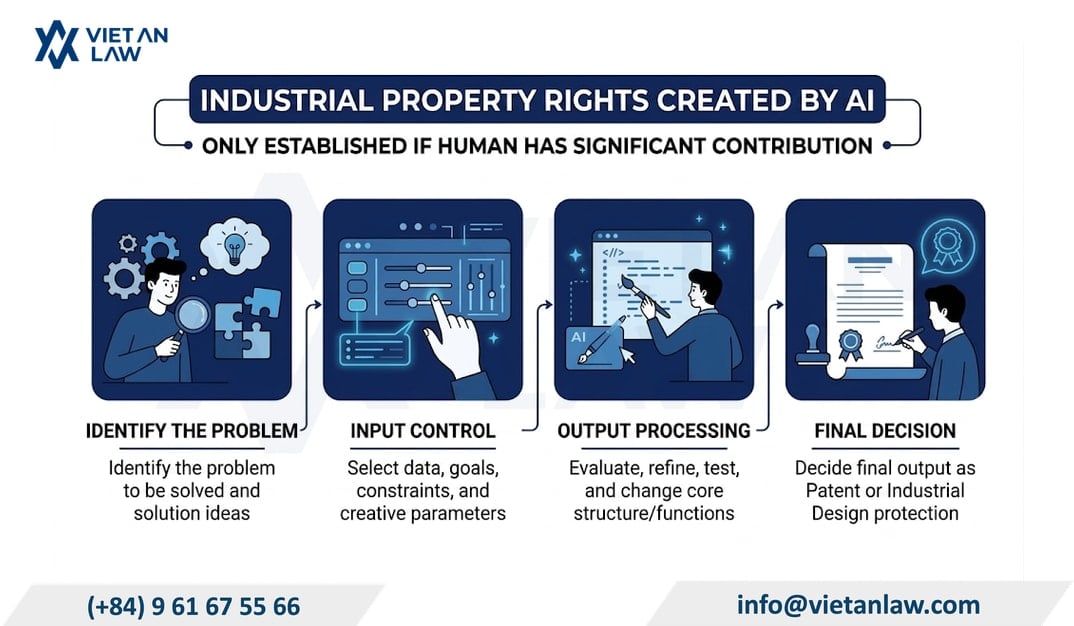
| Criteria | Detail |
| Problem identification | Proposing the creative idea and objective. |
| Input control | Selecting the data and AI parameters. |
| Result processing | Fine-tuning and evaluating the AI outputs. |
| Final decision | The human decides on the final product submitted for registration. |
Consequently, the operator is prioritized for ownership recognition if they can prove that the use of AI was a conscious process of selection and arrangement. Meanwhile, the AI system developer only holds ownership over the original algorithmic components, or when a specific civil agreement exists with the user.
This regulation helps mitigate potential legal disputes when an AI-generated work achieves commercial success, providing a clear framework for the transfer of rights and economic exploitation.
Important considerations regarding rights
- Authorship confirmation: Individuals who fulfill all the aforementioned significant contributions are recognized as the authors of the industrial property object.
- Cases failing to meet conditions: If an AI-generated product does not satisfy the criteria for a significant contribution, the creator only possesses the right to use or permit others to use it, provided this does not infringe upon the rights of third parties (no exclusive protection diploma will be granted).
- For trademark registration in Vietnam and trade secrets: Objects such as trademarks, trade names, geographical indications, and trade secrets that utilize AI remain eligible for protection if they meet the general conditions of the current Law on Intellectual Property.
What to note in patent registration dossiers using AI?
According to Form 01, Form 03, and Form 06 of Circular 10/2026/TT-BKHCN, the declaration form for registering industrial property rights for a patent, industrial design, or layout design must clearly state the origin: The patent, industrial design, or layout design utilized an artificial intelligence system, and humans made a significant contribution to its creation.
Therefore, when preparing industrial property rights registration dossiers that involve AI, individuals and businesses must note the following:
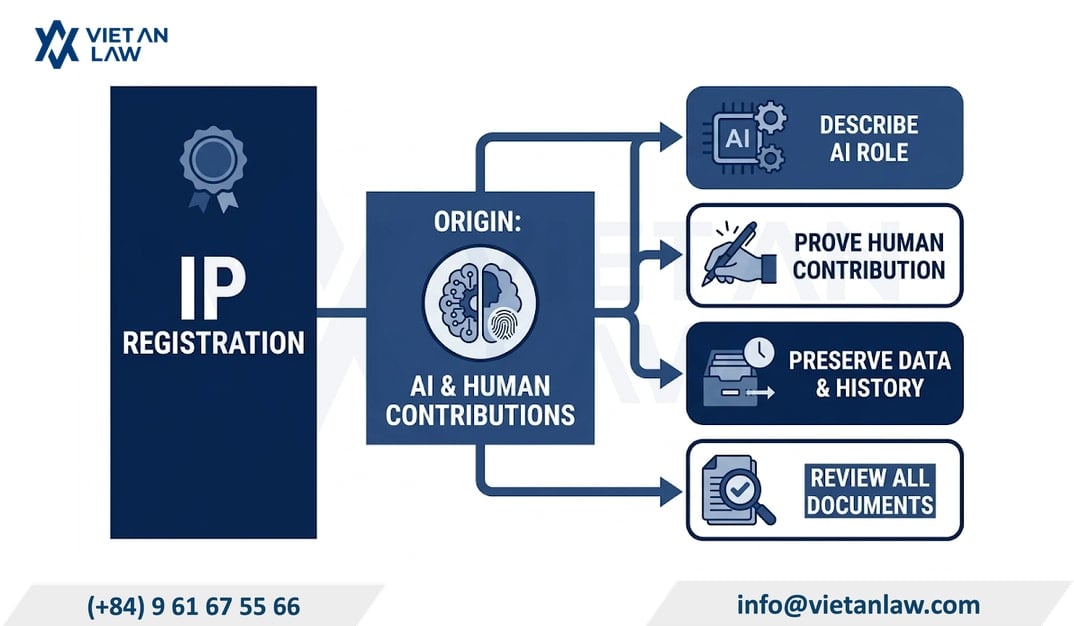
- Clearly describe the role of AI in the process of creating the registered object;
- Prove the significant human contribution regarding the idea, data selection, editing, refinement, or control of output results;
- Retain documents, data, and the history of the creative process to serve as evidentiary basis when necessary;
- Thoroughly review the accuracy and consistency between the declaration form, the description, and the accompanying documents in the registration dossier.
Opportunities and challenges in protecting AI-generated industrial property
Opportunities to promote innovation and digital transformation
The addition of regulations on industrial property rights associated with artificial intelligence in Decree 100/2026/ND-CP and Circular 10/2026/TT-BKHCN is considered a vital step in perfecting the legal framework for intellectual property in Vietnam during the digital technology era.
- First and foremost, the new regulations establish a clear legal basis for individuals and businesses applying AI in the research and development of patents, industrial designs, or layout designs. The legal recognition of industrial property rights for AI-assisted products, provided there is a significant human contribution, encourages innovation and technological investment.
- Particularly in sectors such as information technology, pharmaceuticals, mechanics, industrial design, and semiconductor chip manufacturing, AI can help shorten research time, optimize costs, and enhance creative efficiency. As a result, businesses gain more opportunities to generate intellectual property assets with high commercial value and improve their competitive edge in the market.
- Furthermore, the new regulations aid in minimizing dispute risks related to authorship or ownership of industrial property objects created by AI. Clearly defining the significant contribution criteria provides registration authorities and related parties with a basis to evaluate ownership more transparently.
Challenges in proving human contribution
Despite bringing numerous opportunities, protecting industrial property rights for products created with AI assistance also poses considerable practical challenges.
- One of the greatest difficulties is proving the element of “significant human contribution” in the creative process. In practice, the boundary between direct human creation and automated AI output is sometimes exceedingly difficult to determine, especially concerning generative AI systems capable of self-learning and proposing complex technical solutions autonomously.
- Additionally, competent authorities such as the National Office of Intellectual Property may face difficulties in examining the level of human intervention for each object seeking protection. This requires an appropriate technical appraisal mechanism as well as a team of experts possessing interdisciplinary knowledge of both law and AI technology.
Risks related to data and intellectual property infringement
- Another noteworthy issue is the risk of intellectual property infringement stemming from AI training data. During operation, many AI systems are trained on massive volumes of data, which may encompass protected works, patents, or industrial designs without the authorization of the owners.
- Consequently, if a business utilizes AI to create a new product but fails to control the input data source, the risk of legal disputes arising is highly significant. Entities registering for protection must place special emphasis on the legality of the data utilized during the training and operation of the AI system.
- Moreover, the necessity to prove data origins, the creative process, and the extent of human contribution can also increase legal compliance costs, particularly for startups or small and medium-sized technology enterprises.
Challenges in cross-border industrial property protection
AI is a technology with global reach, whereas intellectual property laws still vary significantly between nations. An object protected in Vietnam may not necessarily be recognized in another country if it fails to meet the local legal conditions.
This discrepancy can create risks in international trade, technology transfer, or the exploitation of industrial property rights in a cross-border digital environment. Therefore, businesses must construct suitable international protection registration strategies and closely monitor new legal trends regarding AI in target markets.
What should businesses do to protect industrial property rights with AI?
To mitigate legal risks and increase the likelihood of being granted a protection diploma, organizations and individuals should note the following issues:
- Fully archive documents demonstrating the process of human participation in creation;
- Clearly record the selection of data, parameter settings, and the process of fine-tuning AI-generated results;
- Verify the legality of the input data used to train or operate the AI;
- Establish clear agreements between the business, personnel, and the AI system development entity regarding ownership of the resulting output;
- Proactively execute industrial property rights registration early to avoid the risk of copying or priority rights disputes.
In the context where AI is rapidly transforming research, creation, and technological development, formulating an appropriate strategy for the Protection of AI industrial property rights in Vietnam is a crucial element for businesses to safeguard their intellectual assets and limit legal risks. Viet An Law provides consulting support for patent and industrial design registration, as well as intellectual property protection strategies involving AI applications under the latest regulations in Vietnam.
Questions related to industrial property rights with AI in Vietnam
Can AI be named as the author of a patent?
No. Under Vietnamese law, AI is only considered a supporting tool and is not recognized as an independent author.
When is a patent using AI protected?
When a human makes a significant contribution during the process of creating the patent.
Must the use of AI be declared when registering a patent?
Yes. According to Circular 10/2026/TT-BKHCN, the dossier must clearly state the use of an AI system.
Legal perspective from Viet An Law
The new regulations demonstrate that Vietnam has opted for a “human-centered AI” approach, meaning humans remain the central subjects in creative activities. This approach helps limit future ownership disputes concerning products generated by generative AI.