

As artificial intelligence continues to reshape the creative landscape, determining ownership of digital creations has become a critical compliance challenge for businesses and creators alike. On April 6, 2026, the Government issued Decree 134/2026/ND-CP, amending and supplementing several articles of Decree 17/2023/ND-CP on copyright and related rights, which took effect on April 9, 2026. Notably, this new regulation introduces pivotal frameworks to address practical demands, align with the rapid development of artificial intelligence, and ensure consistency with the Vietnam Amended Intellectual Property Law of 2025. In this article, Viet An Law will highlight the most significant legal updates under Decree 134/2026/ND-CP on AI copyright and AI-generated works.
03 conditions to establish AI copyright and related rights in Vietnam
Article 4 of the decree supplements Article 5a regarding the establishment of copyright and related rights for a subject matter created using artificial intelligence systems, inserted before Article 5 of Decree 17/2023/ND-CP. Accordingly, copyright and related rights only arise for products (works, sound recordings, broadcasts) assisted by AI when they satisfy the following three conditions:
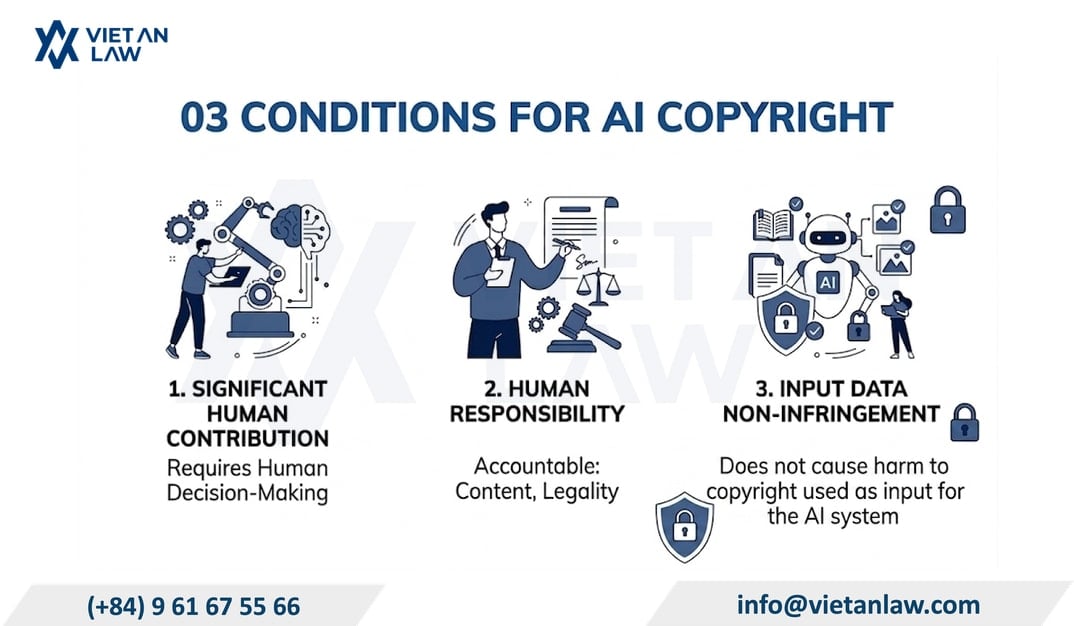
Significant and decisive human contribution
Humans must maintain the leading role in the creative process. This includes:
- Providing input data, original technical parameters, or developing software design documentation.
- Setting prompts to control the AI system.
- Directly evaluating, selecting, editing, and interpreting outputs from the AI.
- Arranging content, formats of expression, and making decisions regarding artistic or aesthetic intent.
- Deciding the final outcome, ensuring the product accurately reflects personal ideas rather than a random algorithmic arrangement.
Human responsibility for the content and legality of AI-generated works
The human must be the entity bearing the highest legal responsibility for the content of the created subject matter. Individuals or organizations cannot blame the AI if the AI-generated works violate the law or infringe upon existing regulations.
Non-infringement of rights regarding input data
Using AI for creation must not prejudice the copyright and related rights of other works or subject matters that have been utilized as input data for that AI system.
This provision specifies the principle that only humans can be authors under Article 12a of the intellectual property law, while adapting to the increasingly popular context of AI technology. Thus, human creative input remains the central condition for copyright protection. Rights are only recognized when there is decisive human involvement, including substantial intellectual contribution, control over the creative output, and responsibility for the content. The law defines AI merely as a technical tool, not a right-holding subject, thereby ensuring consistency with the fundamental principles of intellectual property law.
Proving the use of AI when protecting copyright and related rights
A notable new point in the decree is the requirement for proof when requesting rights protection or submitting an application for copyright registration of works utilizing AI.
Upon a request to protect copyright or related rights for subject matters created, fixed, or performed using artificial intelligence systems, the creator, fixer, or performer must prove their creation, fixation, or performance process. Furthermore, they must honestly declare the use of AI systems when requested by competent authorities.
Accordingly, supporting documents may include:
- Input data, technical parameters, or design documentation for computer programs, manuscripts, intermediate drafts, and edits made during the creative process;
- Prompt history, interaction data, and technical parameters;
- Documentation describing the creative process or other lawful documents demonstrating human intellectual contribution and control.
This approach shows that while the law does not automatically deny the role of AI, it demands clear evidence of the human creative footprint in each specific case.
Cases where AI-generated works are denied copyright and related rights protection
The regulation clarifies the boundary between “AI assistance” and “AI automation.” Specifically:
- Products entirely created by an artificial intelligence system or failing to fully meet the conditions for establishing AI copyright will not generate copyright or related rights under the intellectual property law.
- Conversely, if AI serves purely as an assisting tool and a human holds the decisive role, rights may still arise.
Therefore, if a system automatically generates AI-generated works without significant human intervention, adjustment, or direction, those products will not establish any copyright or related rights. This prevents the widespread abuse of technology to misappropriate intellectual property assets without relying on actual labor value.
Conditions for using texts and data protected by copyright and related rights for training AI systems in Vietnam
The amended intellectual property law of 2025 introduced new provisions allowing organizations and individuals to use texts and data concerning intellectual property rights subject matters that have been lawfully published and made accessible to the public. This usage must serve the purposes of scientific research, testing, or training AI systems, provided it does not unreasonably affect the legitimate rights and interests of the author or intellectual property rights owner.
To guide this, the new decree adds provisions to Section 3 of Chapter III regarding the “Use of texts and data protected by copyright and related rights for artificial intelligence systems.” For the first time, it provides a relatively specific regulatory framework for data mining activities serving AI research, testing, and training. Specifically:
Conditions for texts and data
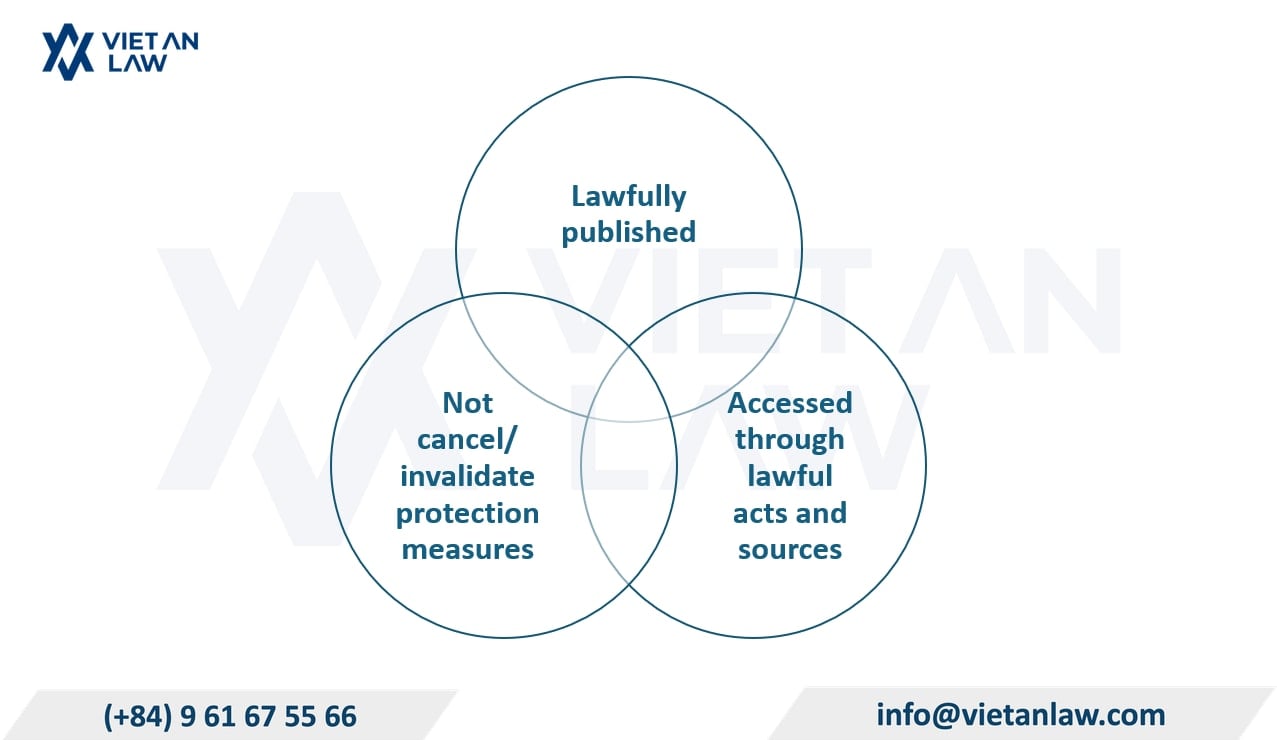
Texts and data serving as protected subject matters must satisfy the following:
- They are lawfully published in accordance with regulations;
- They are accessed through lawful acts and from lawful sources;
- The usage does not cancel or invalidate technological protection measures implemented by the rights owner to protect their copyright and related rights.
Conditions for text and data usage
The text and data usage must comply with the following:
- The usage strictly aims at scientific research, testing, and training AI systems without commercial purposes;
- The usage must not conflict with the normal exploitation of texts and data protected by copyright and related rights, nor unreasonably prejudice the legitimate interests of authors, performers, copyright owners, or related rights owners;
- The output of the artificial intelligence system does not substitute the consumption market or normal exploitation of the subject matters, nor create unfair competition against the exploitation and use of such subject matters.
Reservation of rights by authors, performers, and rights owners
Authors, performers, copyright owners, and related rights owners hold the right to:
- Reserve their copyright and related rights, prohibiting the use of their protected texts and data for scientific research, testing, or training AI systems;
- However, the reservation of rights does not apply if the use of protected texts and data fully satisfies the prescribed statutory conditions.
This reservation must manifest through clear and public mechanisms, such as machine-readable rights management information, technological protection measures, or declarations through collective representative organizations.
Responsibilities of using organizations and individuals
Organizations and individuals utilizing such data must:
- Retain technical records, training data, and usage data under artificial intelligence laws, standing ready to provide information upon request by competent state agencies for verification, dispute resolution, or handling related legal violations;
- Respect the reservation of rights exercised by authors, performers, copyright owners, and related rights owners.
Decree 134/2026/ND-CP on AI copyright and AI-generated works marks a crucial step forward in perfecting Vietnam’s legal framework for copyright and related rights amid rapid digital transformation and the widespread application of artificial intelligence.
If clients require legal advice on copyright registration, intellectual property disputes, or related compliance matters in Vietnam, please contact Viet An Law for prompt and effective assistance.