


Many businesses only discover that their trademarks have been infringed when customers report purchasing counterfeit or substandard products on Shopee, Amazon, TikTok Shop, or Facebook. In many cases, infringing products have generated thousands of sales before being detected and removed, causing substantial damage to brand reputation, revenue, and authorized distribution networks.
In practice, trademark infringement on e-commerce platforms has become increasingly sophisticated. Many infringers operate counterfeit online stores, conduct livestream sales, or advertise across multiple platforms to distribute counterfeit and imitation products while attempting to evade enforcement actions by competent authorities.
Professional e-commerce trademark protection in Vietnam platforms assist businesses in identifying infringements, collecting electronic evidence, obtaining expert assessments, submitting takedown requests, and pursuing legal remedies against acts infringing intellectual property rights on Shopee, Lazada, TikTok Shop, Facebook, and Amazon.
With extensive practical experience in intellectual property law, Viet An Law assists businesses in safeguarding their brands online, combating counterfeit goods in digital environments, and developing sustainable trademark protection strategies across both traditional markets and online marketplaces. These services form an essential part of comprehensive e-commerce trademark protection, online brand protection, trademark enforcement Vietnam, IP protection on e-commerce platforms, anti-counterfeit enforcement, and the prevention of online IP infringement.
E-Commerce platforms commonly associated with trademark infringement in Vietnam
| Platform | Common Forms of Infringement |
| Shopee | Sale of counterfeit and imitation goods; use of store names and logos likely to cause confusion with well-known trademarks |
| TikTok Shop | Livestream sales involving counterfeit trademark goods; misleading advertising regarding product origin and authenticity |
| Lazada | Unauthorized reproduction of product images and descriptions; use of signs confusingly similar to registered trademarks |
| Amazon | Cross-border intellectual property infringement; sale of products of uncertain origin across multiple jurisdictions |
| Creation of counterfeit fan pages and accounts impersonating brands; trademark-infringing advertising and sales through marketplace, livestreams, and online groups |
What is E-commerce trademark protection in Vietnam?
E-commerce trademark protection refers to the monitoring, detection, prevention, and enforcement of unauthorized use of trademarks, logos, trade names, or product images on e-commerce platforms and social media channels.
Professional IP Protection on E-commerce Platforms enables businesses to:
- Address trademark infringement on online platforms;
- Combat counterfeit goods on Shopee;
- Protect trademarks on TikTok Shop;
- File trademark complaints on Lazada;
- Detect and address trademark infringement on Amazon;
- Prevent counterfeit online stores from operating;
- Protect intellectual property rights across multiple digital platforms.
Common forms of e-commerce trademark infringement enforcement in Vietnam
| Infringing Activity | Frequency |
| Sale of counterfeit and imitation goods | Very High |
| Counterfeit online stores impersonating legitimate brands | Very High |
| Unauthorized use of trademarks and logos | High |
| Unauthorized copying of product images | High |
| Trademark-infringing livestream sales | Rapidly Increasing |
| Fake “Official Store” representations | Common |
| Trademark infringement on Amazon | Rapidly Increasing |
E-commerce trademark protection in Vietnam
E-commerce trademark protection in Vietnam
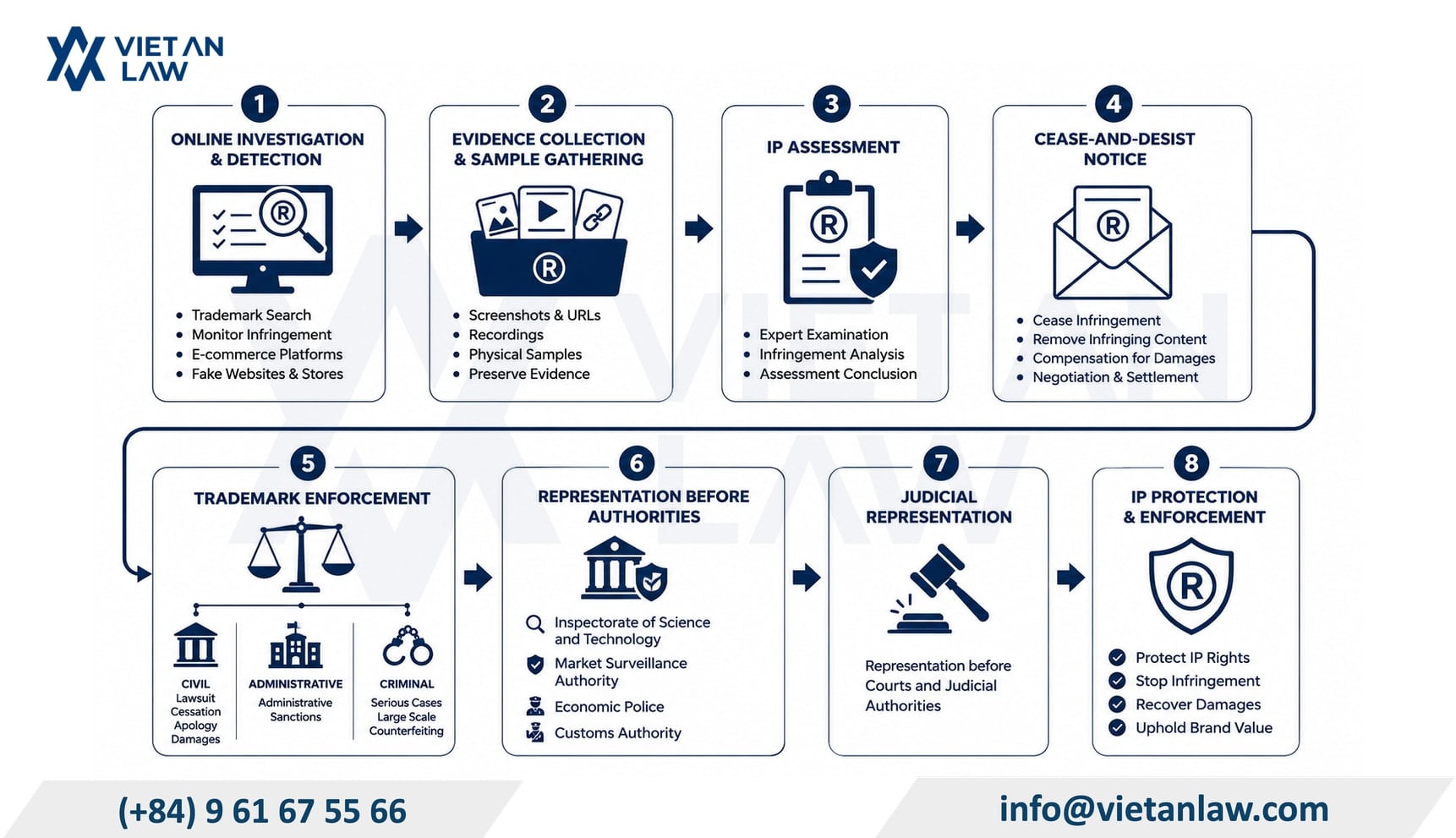
Online investigation and detection of trademark infringement
This including:
- Conducting online trademark search to identify unauthorized use of registered trademarks;
- Monitoring and reviewing potential online IP infringement activities;
- Tracking trademark infringement on major e-commerce platforms such as Amazon, Lazada, TikTok Shop, and Facebook;
- Inspecting counterfeit websites, fake fan pages, and fraudulent online storefronts;
- Monitoring intellectual property violations across e-commerce marketplaces as part of comprehensive IP protection on e-commerce platforms.
Collection of electronic evidence and physical samples
We collect and preserve evidence in accordance with applicable legal procedures, including:
- Capturing and preserving screenshots, product listings, and URLs of infringing products;
- Recording infringing livestreams, online advertisements, and promotional content;
- Collecting physical samples of goods sold online where necessary;
- Verifying trademark infringement through intellectual property assessments and comparative analysis of infringing products.
Intellectual Property Assessment
Where appropriate, infringing products are submitted to qualified intellectual property assessment organizations for expert examination and issuance of an infringement assessment conclusion. Such expert opinions serve as important evidentiary documents for subsequent enforcement proceedings.
Cease-and-Desist Notice
Our legal team prepares and issues formal cease-and-desist letters requesting the infringing party to:
- Immediately cease all trademark infringement activities;
- Remove infringing content and products from online platforms;
- Compensate for damages arising from the infringement.
Where possible, disputes are resolved through negotiation without requiring intervention from competent state authorities.
Trademark infringement enforcement
- Civil Measures: Initiating a lawsuit before the Court to request the cessation of the infringing acts, requiring a public apology, public correction, and compensation for damages.
- Administrative Measures: Requesting the competent authorities (Market Surveillance Authority, Inspectorate of Science and Technology, Economic Police) to impose administrative sanctions against the infringing acts.
- Criminal Measures: Applicable where the infringing acts are committed on a large scale or are of a serious nature (e.g., manufacturing or trading counterfeit trademark goods).
Representation Before Competent Authorities
- Inspectorate of Science and Technology;
- Market Surveillance Authority;
- Economic Police;
- Customs Authority;
- Representation before judicial authorities.
| Service | Content |
| Online infringement review | Reviewing infringing stores, websites, and social media accounts. |
| Cease and Desist Letter | Cease & Desist Letter. |
| Trademark infringement complaint with e-commerce platforms | Shopee, Lazada, TikTok Shop. |
| Online anti-counterfeit enforcement | Coordinating with competent authorities. |
| International brand protection consultancy | Trademark protection in countries that are potential markets with a large customer base. |
| Online IP strategy consultancy | Minimizing infringement risks. |
| Periodic brand monitoring | Monitoring & enforcement. |
Online trademark infringement enforcement process in Vietnam
Online trademark infringement handling
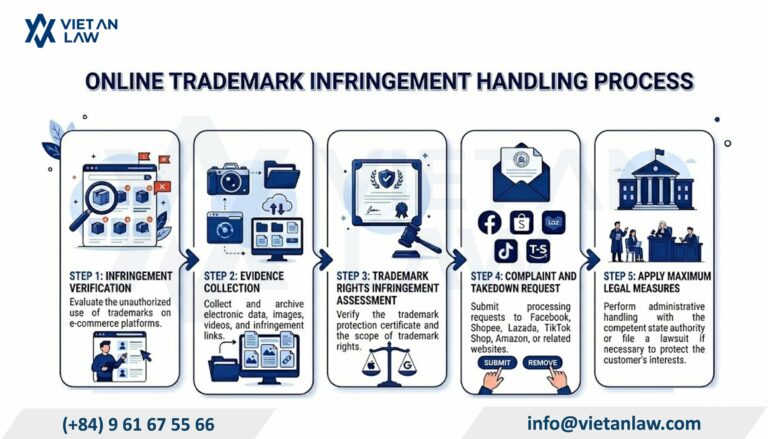
As part of comprehensive e-commerce trademark infringement enforcement services, businesses should adopt a systematic approach to identify, document, and address trademark infringement on e-commerce platforms and digital marketplaces.
Step 1: Verification of Infringement
Assess and determine whether the unauthorized use of a trademark on an e-commerce platform constitutes trademark infringement or a violation of intellectual property rights.
Step 2: Collection of Evidence
Preserve and collect relevant evidence, including:
- Electronic data and digital records;
- Images and screenshots of infringing products or content;
- Videos and livestream recordings;
- URLs and links associated with the infringement.
Step 3: Assessment of Intellectual Property Rights Infringement
Review the trademark registration certificate, scope of protection, and the extent of the trademark owner’s exclusive rights to determine whether an infringement has occurred.
Step 4: Filing Complaints and Takedown Requests
Submit infringement complaints and requests for removal of infringing content to relevant platforms, including:
- Facebook;
- Shopee;
- Lazada;
- TikTok Shop;
- Amazon; and
- Other relevant websites or online marketplaces.
Step 5: Implementation of legal enforcement measures
Where necessary, initiate administrative enforcement proceedings before competent authorities or commence legal action to protect the legitimate rights and interests of the trademark owner.
Why is online brand protection important for businesses?
Effective online brand protection provides businesses with significant benefits, including:
- Safeguarding brand reputation and goodwill;
- Minimizing revenue losses caused by counterfeit and infringing products;
- Preventing the circulation of counterfeit and imitation goods;
- Protecting consumers and authorized distribution networks;
- Enhancing the value of intellectual property assets;
- Preventing unfair competition from unauthorized sellers;
- Reducing legal and commercial risks associated with e-commerce activities.
Notable trademark infringement case on an e-commerce platform in Vietnam
A significant trademark infringement case handled by the Hanoi Market Surveillance Authority involved a business household operating the “JULIDO1” store on Shopee, which was found to be selling fashion products bearing signs that allegedly infringed a well-known trademark.
Case Summary
The Hanoi Market Surveillance Team No. 1 conducted an inspection and discovered more than 2,300 clothing products displaying the well-known “horse-and-rider” logo, which showed signs of infringing the registered trademark rights of Polo Ralph Lauren.
The business household used the “JULIDO1” Shopee store to advertise and distribute the infringing products.
According to verification data obtained from Shopee:
- A total of 1,683 infringing products had been successfully sold;
- The total transaction value was approximately VND 170 million;
- Illegal profits were determined to exceed VND 136 million.
The competent authorities ordered the destruction of all infringing products in order to protect fair competition and preserve the integrity of the legitimate market.
Expert examination conducted by the relevant authority concluded that the signs affixed to the products infringed trademark rights protected under Vietnamese law.
Handling trademark infringement in Vietnam on e-commerce platforms
- Trademark infringement on e-commerce platforms has become increasingly sophisticated, professional, and difficult to control through traditional enforcement methods.
- Many online sellers exploit digital marketplaces to distribute counterfeit trademark goods on a large scale within a short period of time, making it difficult to identify the individuals behind the infringement and trace the locations of warehouses containing infringing products.
- E-commerce platforms are increasingly becoming major distribution channels for products that potentially infringe intellectual property rights, particularly trademark rights.
- To strengthen intellectual property enforcement, competent authorities in Vietnam have intensified cooperation with e-commerce platforms to obtain seller information, transaction records, and data relating to the origin of infringing products.
- Information stored on e-commerce platforms, including product listings, images, sales records, revenue data, and electronic transaction information, is now regarded as critical evidence in trademark infringement enforcement proceedings.
Practical insights from Viet An Law’s enforcement experience
Based on Viet An Law’s practical experience in handling trademark infringement cases, many infringing online stores are able to quickly establish new accounts and continue selling infringing products under different names immediately after their products or accounts have been removed. As a result, trademark owners should implement continuous monitoring and enforcement measures rather than relying on one-time enforcement actions.
Why is anti-counterfeit e-commerce trademark protection in Vietnam becoming increasingly difficult?
Difficulty in identifying the actual infringing party
- Inaccurate personal information;
- Fictitious registered addresses;
- Infringers often use intermediary accounts;
- Warehouses are often located in multiple locations, making them difficult to identify;
- Contact information is unclear and frequently changed.
This makes it difficult to verify the actual seller and collect evidence for enforcement.
Infringements occur at a very rapid pace
- New accounts can be created within minutes;
- Store names are changed continuously;
- Products are relisted immediately after being removed.
Therefore, even after filing a trademark complaint with Shopee or taking enforcement action on TikTok Shop, the infringing acts may recur very quickly.
Counterfeit Goods are livestreamed and promoted across multiple platforms
Many infringers:
- Livestream the sale of counterfeit goods;
- Advertise on Facebook and TikTok;
- Redirect customers to Shopee or their own websites.
Based on practical enforcement experience, Viet An Law has found that infringements occurring simultaneously across multiple platforms make it difficult for both the infringed business and the competent authorities to comprehensively control the infringing activities.
Difficulty in collecting and preserving electronic evidence
- Evidence of infringement is deleted quickly;
- Infringers modify the infringing content;
- Product links are changed to evade enforcement;
- Links and posts are removed and replaced on different platforms;
- Evidence exists only during livestream sales and leaves no trace afterward.
If evidence is not preserved promptly, businesses may encounter difficulties in proving intellectual property infringement on e-commerce platforms.
Many businesses have not fully registered their trademarks
- Trademark protection has not been registered;
- The trademark has been registered under incorrect classes of goods or services;
- International trademark protection has not been extended.
This reduces the effectiveness of online brand infringement enforcement and limits the ability to request e-commerce platforms to remove infringing products.
Complaint procedures differ across platforms
- Shopee;
- Lazada;
- TikTok;
- Amazon;
- Facebook.
Each platform has its own enforcement procedures, resulting in considerable time and costs.
- Different IP enforcement procedures;
- Different documentary requirements;
- Different review mechanisms and processing times.
Businesses lacking experience often spend more time handling complaints or have their complaints rejected.
Difficulty in controlling cross-border counterfeit goods
Many counterfeit products are:
- Imported from overseas;
- Transported through intermediaries;
- Sold cross-border on Amazon or international platforms.
This creates difficulties regarding:
- Enforcement jurisdiction;
- Identification of the infringing party;
- Enforcement of intellectual property rights in each country and at the international level.
Long-term enforcement and monitoring costs
The prolonged enforcement period and high enforcement costs arise because businesses often have to:
- Continuously monitor infringements;
- Hire brand monitoring service providers;
- Handle multiple online stores simultaneously;
- Coordinate with lawyers and competent authorities;
- Register trademarks in multiple countries and territories.
As a result, the costs of trademark protection on e-commerce platforms may continue over an extended period and increase significantly.
Effective e-commerce trademark infringement enforcement services in Vietnam
To strengthen E-commerce trademark protection and reduce the risks of Online IP infringement, businesses should:
- Register trademarks at the earliest possible stage;
- Regularly monitor e-commerce platforms and social media channels;
- Collect and preserve electronic evidence in a timely manner;
- File infringement complaints immediately upon discovery;
- Develop comprehensive online brand protection strategies;
- Cooperate with experienced intellectual property professionals and legal counsel.
A proactive approach significantly increases the likelihood of successful enforcement and long-term brand protection.
Frequently asked questions regarding trademark infringement on e-commerce platforms
How can trademark owners combat counterfeit products on Shopee?
Trademark owners may submit a trademark infringement complaint to Shopee by providing a trademark registration certificate and evidence demonstrating the infringement. Upon review, Shopee may remove infringing products or suspend the seller account responsible for the infringement.
Can a brand be protected on TikTok Shop?
Yes. Trademark owners are entitled to request TikTok Shop to remove infringing videos, livestreams, product listings, and user accounts that violate intellectual property rights. Such actions constitute an important component of online brand protection and IP protection on e-commerce platforms.
Does Amazon support trademark enforcement?
Yes. Amazon provides mechanisms allowing trademark owners to report trademark infringement and request removal of products that violate intellectual property rights.
These procedures play an important role in international trademark enforcement Vietnam strategies for businesses engaged in cross-border commerce.
Can online trademark infringement be addressed without trademark registration?
Businesses may still rely on certain legal measures to protect their interests. However, trademark registration remains the most important legal basis for enforcing trademark rights and obtaining effective remedies against infringers on e-commerce platforms.
Why is trademark infringement increasing on e-commerce platforms?
Several factors contribute to the growing number of infringement cases:
- Ease of establishing online stores;
- Difficulty in monitoring sellers;
- Rapid dissemination through social media;
- High profits associated with counterfeit products;
- Consumers’ difficulty distinguishing genuine products from counterfeit goods;
- Inadequate trademark registration and protection strategies adopted by many businesses.
These factors have contributed to the rapid growth of Online IP infringement across digital marketplaces.
What should businesses do to protect their brands online?
Businesses should:
- Register trademarks as early as possible;
- Monitor Shopee, Lazada, TikTok Shop, Amazon, Facebook, and other platforms regularly;
- Collect and preserve electronic evidence;
- Submit takedown requests promptly;
- File trademark complaints with e-commerce platforms;
- Cooperate with competent authorities in combating counterfeit goods;
- Develop a long-term online brand protection strategy.
When should a business engage professional legal counsel?
Businesses should consider engaging intellectual property professionals when dealing with:
- Online trademark infringement;
- Online anti-counterfeit enforcement;
- Cross-border brand protection;
- Trademark warning notices and enforcement actions;
- Counterfeit online stores;
- Intellectual property complaints on e-commerce platforms;
- Representation before e-commerce operators and government authorities.
Proactive legal protection helps businesses reduce legal risks, preserve brand reputation, and maintain competitive advantages in online commerce.
Contact for consultation
Viet An Law is a licensed and reputable Intellectual Property Representative Organization in Vietnam.
We assist businesses with:
- E-commerce Trademark Protection;
- Online Brand Protection;
- Trademark Enforcement Vietnam;
- IP Protection on E-commerce Platforms;
- Anti-counterfeit enforcement;
- Resolution of Online IP infringement matters.
Our services cover trademark monitoring, evidence collection, Shopee trademark complaints, Amazon trademark enforcement, TikTok Shop and Facebook brand protection, and comprehensive representation in intellectual property disputes arising in digital environments.
Through a combination of legal expertise, enforcement experience, and practical industry knowledge, Viet An Law provides comprehensive e-commerce trademark infringement enforcement services to protect brands, intellectual property rights, and commercial interests in the rapidly evolving digital marketplace.