


Capital punishment is the special and most severe form of punishment in Vietnam’s criminal law system, aiming to deprive condemned individuals of their right to life. On June 25, 2025, the National Assembly passed the amended Criminal Code 2025 (Law 86/2025/QH15) with many important changes, notably the official abolition of 8 crimes previously punishable by death. Thus, from July 1, 2025, there will only be 10 crimes punishable by death. In the article below, Viet An Law will update the new regulations on the 8 crimes no longer punishable by death in Vietnam as of July 1, 2025, according to the amended Criminal Code.
Regulations punishable by death according to the Criminal Code 2015
Article 40 of the Criminal Code 2015 (amended and supplemented in 2017) stipulates that a death sentence is a special sentence imposed upon people committing extremely serious crimes that infringe national security, human life, drug-related crimes, corruption-related crimes, and some other extremely serious crimes defined by this document.
Death sentence shall not be imposed upon juvenile offenders, women who are pregnant or raising children under 36 months of age, and people 75 years of age or older when they commit the crime or during trial.
Additionally, the death sentence shall not be executed in the following circumstances:
- The convict is pregnant or a woman raising a child under 36 months of age;
- The sentenced person is 75 years of age or older;
- The person sentenced to death for embezzlement or taking bribes, after being sentenced, has returned at least three-quarters of the property embezzled or bribes taken, closely cooperates with the authorities in the process of investigation, or trial or has made reparation in an effort to atone for the crime.
8 Crimes No Longer Punishable by Death in Vietnam
The Criminal Code 2015 stipulated 18 crimes punishable by death. However, the Law amending the Criminal Code 2025 has abolished the death sentence for the following 08 crimes:
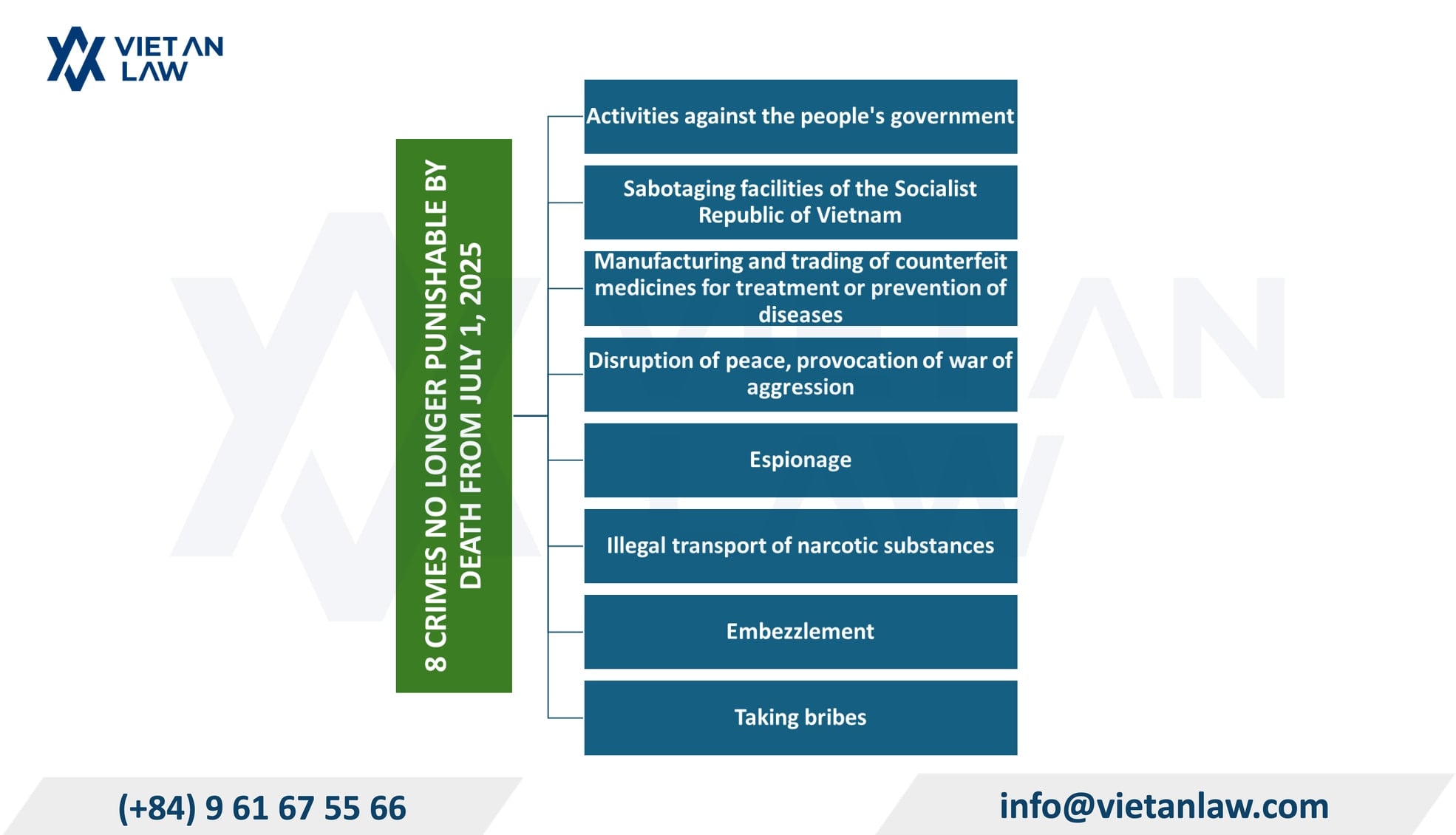
8 crimes no longer punishable by death in Vietnam
- [1] Activities against the people’s government (Article 109);
- [2] Sabotaging facilities of the Socialist Republic of Vietnam (Article 114);
- [3] Manufacturing and trading of counterfeit medicines for treatment or prevention of diseases (Article 194);
- [4] Disruption of peace, provocation of war of aggression (Article 421);
- [5] Espionage (Article 110);
- [6] Illegal transport of narcotic substances (Article 250);
- [7] Embezzlement (Article 353);
- [8] Taking bribes (Article 354).
Accordingly, the death sentence for these crimes will be replaced by life imprisonment without parole.
Particularly for the crimes of embezzlement and taking bribes, after the abolition of the death sentence, in order to ensure the recovery of assets obtained from criminal activities and to encourage offenders to actively confess during the case resolution process, the Criminal Code has amended and supplemented the provisions of Clause 1, Article 63 in the direction that:
“In the case of embezzlement and bribery, individuals sentenced to life imprisonment for these crimes will only be eligible for reduced sentences if they voluntarily return at least three-quarters of the assets involved and actively cooperate with authorities or make significant contributions to the investigation.”
Thus, officially, only 10 crimes remain punishable by death from July 1, 2025, including the following:
- [1] High treason (Article 108)
- [2] Rebellion (Article 112)
- [3] Terrorism to oppose the people’s government (Article 113)
- [4] Murder (Article 123)
- [5] Rape of a person under 16 (Article 142)
- [6] Illegal manufacturing of narcotic substances (Article 248)
- [7] Illegal deal in narcotic substances (Article 251)
- [8] Terrorism (Article 299)
- [9] Crimes against humanity (Article 422)
- [10] War crimes (Article 423)
Reasons for 8 crimes no longer punishable by death in Vietnam
According to the roadmap through various amendments, the Criminal Code 1985 stipulated 44 crimes punishable by death, reduced to 29 crimes in 1999, to 22 in 2009, and only 18 in 2015. This amendment continues to remove 8 additional crimes, which are deemed necessary, stemming from several reasons:
- Continuing to institutionalize the Party’s views and policies on further narrowing the scope of the death sentence: The abolition of the death sentence for 8 crimes aims to further institutionalize the Party’s major policy, established in Notice 13936-VC/VPTW dated March 25, 2025, of the Central Party Office, announcing the Politburo’s opinion on the direction of narrowing the scope of the death sentence.
- Based on practical and legal grounds: Based on the nature and extent of the criminal act; the importance of the protected object; the ability to remedy the consequences caused by the criminal act. Based on the results of the summary of the implementation of the Criminal Code, many crimes had provisions for the death sentence, but were not applied in practice recently.
- Conforming to global trends and international commitments: International experience shows that currently, the trend of reducing the death penalty in legal provisions as well as in actual implementation worldwide is common. Among 193 member states of the United Nations, only over 50 countries still retain the death sentence. Vietnam’s responsibility and obligations as a member of relevant international treaties, particularly Clause 2, Article 6 of the United Nations International Covenant on Civil and Political Rights, state: “In countries which have not abolished the death penalty, sentence of death may be imposed only for the most serious crimes”.
The abolition of the death sentence for 8 crimes is a step that aligns with reality, still ensures the requirements for crime prevention and combat, and at the same time demonstrates a tolerant and humane criminal policy, contributing to enhancing the image of Vietnamese law in the eyes of international friends.
Transitional provisions for death penalty sentences pronounced before July 1, 2025, related to the 8 crimes for which the death penalty has been abolished but not yet executed
Based on Clause 2, Article 4 of the Law amending the Criminal Code 2025, which stipulates transitional provisions as follows:
“2. Death sentence pronounced before July 1, 2025, for persons who committed crimes stipulated in Articles 109, 110, 114, 194, 250, 353, 354, and 421 of the Criminal Code or falling under the cases stipulated in Point c, Clause 40 of the Criminal Code as amended and supplemented in Clause 1, Article 1 of this Law but not yet executed shall no longer be carried out. The Chief Justice of the Supreme People’s Court will decide to convert the death sentence to life imprisonment.”
Thus, according to the regulation, in cases where death penalty sentences were pronounced before July 1, 2025, related to the 8 crimes from which the death penalty has been abolished but not yet executed, the Chief Justice of the Supreme People’s Court will decide to convert the death sentence into life imprisonment.
Cases where the death sentence will not be executed from July 1, 2025
Clause 1, Article 1 of the Law amending the Criminal Code 2025 has revised and supplemented Clause 3, Article 40 of the Criminal Code 2015 regarding the non-execution of the death sentence for convicted persons if they fall into one of the following cases:
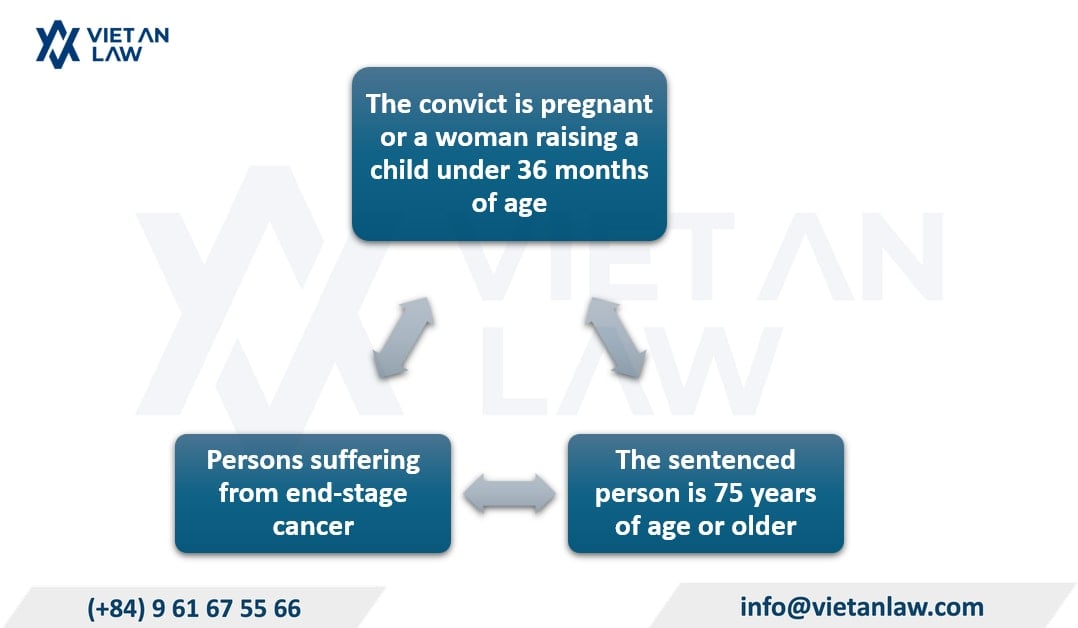
Cases where the death sentence will not be executed
- The convict is pregnant or a woman raising a child under 36 months of age;
- The sentenced person is 75 years of age or older;
- Persons suffering from end-stage cancer.
Before July 1, 2025, the Criminal Code 2015 stipulated non-execution of the death sentence for convicted persons if they fell into one of the following cases:
- The convict is pregnant or a woman raising a child under 36 months of age;
- The sentenced person is 75 years of age or older;
- The person sentenced to death for embezzlement or taking bribes, after being sentenced, has returned at least three-quarters of the property embezzled or bribes taken, closely cooperates with the authorities in the process of investigation, or trial or has made reparation in an effort to atone for the crime.
Thus, the new regulation has abolished the case of non-execution of death sentence for “In the case of embezzlement and bribery, individuals sentenced to life imprisonment for these crimes will only be eligible for reduced sentences if they voluntarily return at least three-quarters of the assets involved and actively cooperate with authorities or make significant contributions to the investigation.” and supplemented the case of “Persons suffering from end-stage cancer”.
Above is the information on the issue of 8 crimes no longer punishable by death in Vietnam. Clients who have related questions or need legal support, please contact Viet An Law Firm for the best support!