


The legal landscape for foreign direct investment is tightening, making acting as a nominee for foreign investors: risks of FDI nominee structure in Vietnam a topic of significant concern for many individuals and businesses as Decree 296/2026/ND-CP officially adds the principle of prohibiting acting as a nominee to contribute capital to establish a company or conduct a company transfer for foreign investors. In practice, the nominee structure is often used to conceal the actual owner or bypass market access conditions for foreign investors. However, acting as a nominee can lead to multiple legal risks pertaining to civil, administrative, investment, corporate, and even criminal matters. So, how do current laws regulate this, and what do investors need to note?
What is the FDI nominee structure in Vietnam?
Although the term “nominee FDI” is used quite commonly in international investment activities, Vietnamese law currently has no official regulation on this concept.
In practice, a nominee structure FDI is understood as an individual or organization in Vietnam acting as a nominee for foreign investors in the capacity of owner, capital-contributing member, or shareholder of an enterprise, while the person who actually contributes capital, controls operations, and benefits from the investment is the foreign investor.
In other words, the person named is merely the “nominal owner,” while the economic benefits and actual decision-making power belong to another person through private agreements between the parties. These agreements are often expressed in the form of nominee contracts, powers of attorney, capital transfer commitments, or other civil documents.
In practice, the nominee structure often appears in the following cases:
- Foreign investors want to invest in business lines with market access conditions but do not yet meet the conditions prescribed by Vietnamese law.
- Investors want to avoid carrying out procedures for granting an Investment Registration Certificate or procedures for foreign-invested investment.
- Investors want to maintain the ownership ratio of the enterprise at a level considered a domestic enterprise to facilitate business operations or participate in certain conditional sectors.
- Investors want to conceal information about the actual owner or the corporate ownership structure.
However, regardless of the purpose, acting as a nominee for foreign investors always entails many FDI holding-structure risks because the person recorded in the enterprise registration dossier is the subject formally recognized by law. Meanwhile, the rights of the actual investor rely primarily on civil agreements between the parties and may face many difficulties when disputes arise.
Legal alert from July 23, 2026: prohibition on acting as a nominee to contribute capital to an enterprise in Vietnam
One of the most notable contents of Decree 296/2026/ND-CP amending and supplementing Decree 168/2025/ND-CP on enterprise registration is the addition of the principle of not acting as a nominee for another person to contribute capital to an enterprise.
According to Clause 1, Article 4 of Decree 168/2025/ND-CP, amended and supplemented by Decree 296/2026/ND-CP, it stipulates:
“The owner, shareholder, or member of the company must fully comply with regulations on contributed assets in Clause 2, Article 34 of the Law on Enterprises, and shall not act as a nominee for another person to contribute capital to the enterprise“.
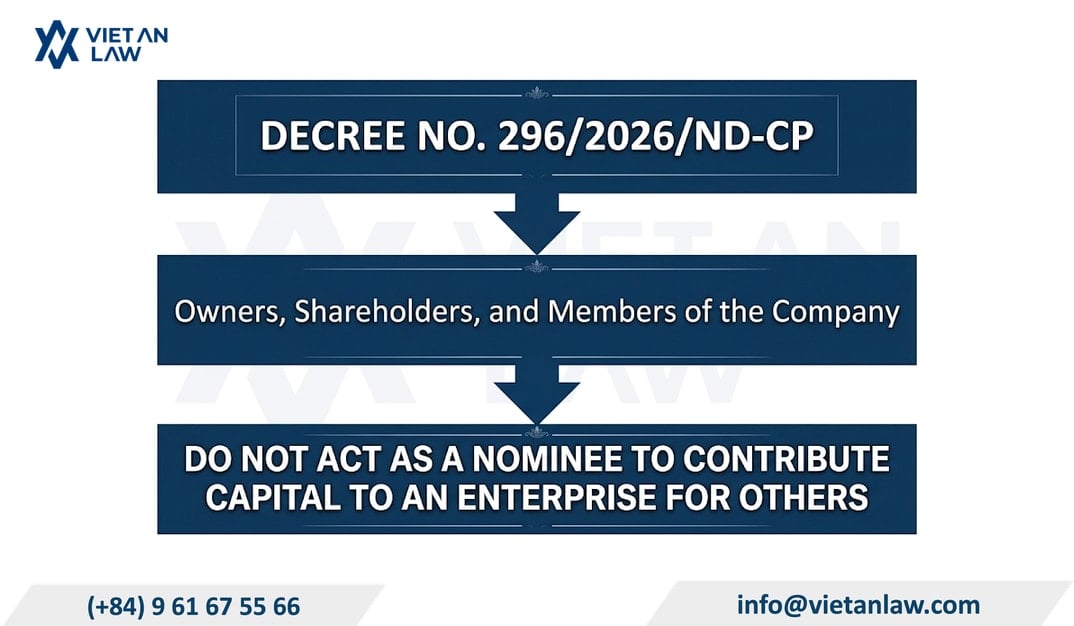
Compared to previous regulations, this is a new point of critical orientation for the entire activity of trying to establish a company, registering changes in members and shareholders, as well as capital contribution transactions into enterprises.
This regulation is evaluated as an important completion step to enhance transparency in enterprise establishment activities, control actual owners, and limit “nominal” investment structures.
For transactions involving acting as a nominee for foreign investors, this is a change of great significance because previously the law had no direct regulation prohibiting owners, shareholders, or members from acting as nominees for others to contribute capital.
The addition of these Decree 296 nominee rules shows that the State not only demands honesty in enterprise registration dossiers but also requires consistency between the person named on legal documents and the subject actually contributing capital. This contributes to limiting the situation of using a “nominal owner,” “nominal shareholder,” or “nominal member” to conceal the actual owner.
Acting as a nominee for foreign investors: risks of FDI nominee structure in Vietnam from 2026
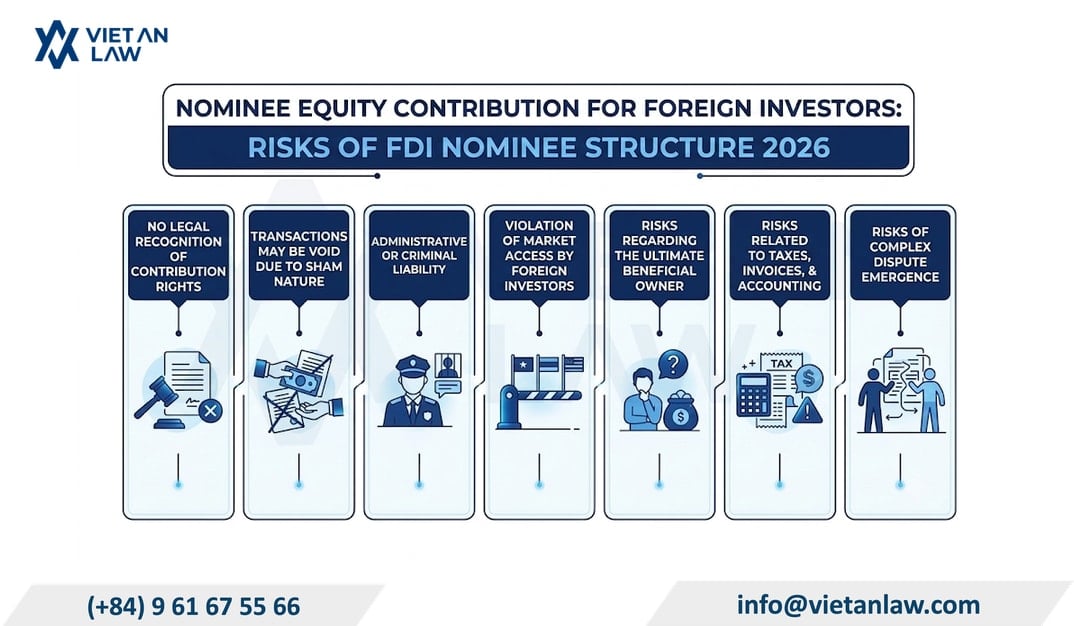
Risk of rights to capital contribution not being recognized by law
- In the enterprise registration dossier, the person named as the owner, member, or shareholder will be recognized by law as the subject with rights and obligations regarding the capital contribution. Meanwhile, foreign investors, despite being the ones directly injecting capital, are not recorded on legal dossiers and will face many difficulties in proving actual ownership.
- When disputes arise, proving the source of capital contribution money or agreements on acting as a nominee is not always sufficient to protect the investors’ rights. This can lead to the risk of losing control of the enterprise or being unable to request a company transfer of the capital contribution as agreed.
Risk of transactions being invalidated due to falsification
According to Clause 1, Article 4 of Decree 168/2025/ND-CP, amended and supplemented by Decree 296/2026/ND-CP, the owner, shareholder, or member of the company must not act as a nominee for another person to contribute capital to the enterprise.
According to Article 124 of the Vietnamese Civil Code 2015, a civil transaction established to conceal another transaction or to evade obligations to a third party may be determined as a falsified transaction and declared invalid.
If the competent authority or the Court determines that the act of acting as a nominee is merely to conceal the true owner or to evade investment conditions for foreign investors, all or part of the transaction faces the risk of being declared invalid.
Risk of bearing administrative or criminal liability
Untruthful or inaccurate declarations in the enterprise registration dossier can be handled according to the provisions of the law:
- Administrative liability: According to the provisions in Article 43 of Decree 122/2021/ND-CP, a fine ranging from 20,000,000 VND to 30,000,000 VND shall be imposed for the act of declaring untruthfully or inaccurately the contents of the enterprise registration dossier or the dossier for registering changes to enterprise registration contents to be granted an Enterprise Registration Certificate or a Certificate of changing enterprise registration contents (double with company).
- Criminal liability: In cases where acting as a nominee for foreign investors is used to conceal acts in Vietnam such as tax evasion, money laundering, smuggling, or other illegal activities, depending on the nature, extent, and role of each individual, the related parties may also be examined for criminal liability according to the provisions of the Penal Code 2015.
Risk of violating regulations on market access of foreign investors
According to the Vietnamese Law on Investment 2025, foreign investors investing in Vietnam must comply with regulations on market access conditions, including the ownership ratio of capital, investment form, scope of operation, and specialized conditions for each business sector.
- For business lines on the list of restricted market access or conditional business, foreign investors are only allowed to invest when fully meeting the conditions prescribed by law.
- In reality, some foreign investors use the nominee structure for FDI to have Vietnamese individuals or enterprises act as nominees to contribute capital to bypass ownership ratio limits or avoid carrying out mandatory investment procedures.
- Although on the enterprise registration dossier, the capital contribution belongs to the Vietnamese individual, in reality, all control, capital sources, and economic benefits belong to the foreign investor. This method may be evaluated by management agencies as an act of concealing the true investment subject and distorting the nature of investment activities.
- Upon detection, the enterprise not only faces the risk of being requested to restructure its ownership or re-execute investment procedures in accordance with regulations, but can also be administratively sanctioned under the law on investment. In serious cases, failing to meet market access conditions can also affect the validity of the investment project, specialized licenses, or transactions arising from the nominee structure.
Risks related to the beneficial owner (UBO) under the latest regime
- For the nominee structure FDI, although the Vietnamese person is named on the enterprise registration certificate, the person who actually contributes capital, operates, or benefits from the investment activity is the foreign investor. This structure will fall into the case of indirect UBO under the new law (Decree 196/2026/ND-CP guiding the Enterprise Law and Vietnamese Law on Anti-Money Laundering).
- If the enterprise declares incompletely or intentionally conceals information about the beneficial owner, business registration authorities, tax authorities, or anti-money laundering agencies may require the enterprise to provide explanations, supplement dossiers, or conduct inspections according to legal provisions.
- Besides the risk of being handled administratively, the lack of transparency regarding the UBO also significantly affects business operations. During the process of opening a bank account, raising capital, executing M&A transactions, auditing, or participating in projects with foreign elements, enterprises often have to prove their actual ownership structure. If unable to explain the relationship between the nominee and the ultimate UBO, the enterprise may face difficulties in completing transactions or be assessed as having a high level of legal risk.
Risks regarding taxes, invoices, and accounting
- The FDI holding structure risks not only generate investment and corporate risks but can also lead to many consequences regarding taxes, invoices, and accounting. Because the law determines tax obligations based on the subject recorded in the legal dossier and the nature of the transaction, the discrepancy between the nominee and the actual beneficiary can make the process of determining tax obligations complicated.
- For instance, when a capital contribution transfer activity arises, the tax authority will rely on the information of the person named on the enterprise dossier to determine the person obliged to declare and pay income tax from capital transfer.
- Meanwhile, the entire transfer amount or actual economic benefit may belong to the foreign investor according to the nominee agreement. The difference between the legal dossier and the actual transaction easily leads to disputes over tax obligations, and simultaneously increases the risk of being inspected or having taxes imposed by tax authorities.
Additionally, if payments such as nominee fees, management fees, control transfer fees, or capital refunds are not transparently recorded between the foreign investor and the nominee, the tax authority may examine the nature of the transaction to evaluate signs of transfer pricing, revenue concealment, or incorrect declaration of tax obligations.
Therefore, using the nominee structure not only increases the risk of civil disputes but can also entail legal consequences regarding taxes if the enterprise fails to build an appropriate financial and documentary management mechanism.
Risk of arising complex disputes
The nominee structure FDI harbors many disputes because the person named on the enterprise dossier and the actual capital contributor are not the same subject. When conflicts arise, determining the ownership of the capital contribution and the right to manage the enterprise is often very difficult.
Some common disputes include:
- Dispute over ownership of contributed capital: The nominee does not transfer back the capital portion or denies the nominee agreement.
- Dispute over enterprise management rights: The parties do not agree on the right to operate, vote, or decide on important issues of the enterprise.
- Dispute over profit distribution: The foreign investor and the nominee have a conflict over enjoying profits, dividends, or assets of the enterprise.
Difficulties in resolving disputes: If the nominee agreement is determined to conceal the investment subject or violate legal regulations, the Court may not recognize this agreement, increasing the risk of losing capital and prolonging the dispute resolution time.
Some related questions
Is the nominee contract between the foreign investor and the nominee recognized by law?
Vietnamese law currently does not have separate regulations on nominee contracts. When a dispute occurs, the validity of the agreement will be considered based on the Civil Code, the Law on Enterprises, the Law on Investment, and relevant legal regulations. If the content or purpose of the agreement violates prohibitions of the law or aims to conceal illegal transactions, it may not be recognized or protected according to legal provisions.
Can foreign investors reclaim the capital they had someone else act as a nominee for?
Whether foreign investors can reclaim the capital they had someone else act as a nominee for depends on each specific case, evidence proving the source of contributed capital, the content of the agreement between the parties, and the assessment of the competent authority. In reality, when the nominee is recorded as the legal owner in the enterprise registration dossier, proving the actual ownership of the investor often faces many difficulties.
Can Vietnamese people acting as nominees for foreign investors be penalized?
Yes. Depending on the nature and severity of the violation, the nominee can be administratively sanctioned for the act of making untruthful declarations in the enterprise registration dossier or must bear civil and tax responsibilities, even criminal liabilities if they are accomplices or abet illegal activities under Decree 296 nominee rules.
How should foreign investors contribute capital to comply with regulations?
To limit legal risks, foreign investors should contribute capital to the enterprise in accordance with the sequence and procedures of the Law on Investment and the Law on Enterprises, including applying for an Investment Registration Certificate (if applicable), registering capital contribution, purchasing shares, or taking steps to establish a company with foreign investment capital as prescribed. This is a solution to help ensure investors’ legal rights and interests while avoiding risks associated with acting as a nominee for capital contributions.
We hope the article on acting as a nominee for foreign investors: risks of FDI nominee structure in Vietnam has helped you understand the legal regulations and risks clearly. For in-depth consultation, please contact Viet An Law for the best support!
Lawyer in charge of the article: Lawyer: Dao My Dung
Hotline/ Zalo/WhatsApp: (+84) 961 571 818
Email: info@vietanlaw.com
Hanoi Office: 3rd Floor, Hoang Ngan Plaza Building, No. 125 Hoang Ngan, Yen Hoa Ward, Hanoi City
Ho Chi Minh City Office: Room 04.68, 4th Floor, Hall A, RiverGate Residence Building, 151-155 Ben Van Don, Khanh Hoi Ward, Ho Chi Minh City.