


Decree 296/2026/ND-CP, promulgated on July 23, 2026 (and effective on the same date), introduces fundamental changes to legal procedures by providing critical amendments to Decree 168/2025/ND-CP. From tightening the definition of the ultimate beneficial owner according to international standards to introducing mechanisms for FDI company establishment before obtaining an Investment Registration Certificate, these new regulations on enterprise registration directly impact investors’ capital structuring and operational strategies. In the following article, Viet An Law will provide an in-depth analysis of the new points of Decree 296/2026/ND-CP on enterprise registration in Vietnam to assist businesses and foreign investors in promptly grasping compliance requirements, particularly regarding company registration and business suspension.
Summary of core new points in Decree 296/2026/ND-CP
| Criteria | Notable new points (Effective July 23, 2026) |
| Ultimate beneficial owner | Mandatory identification based on a 3-level criteria process; applying aggregated ownership for family groups; all general partners |
| Foreign investment | Allowing enterprise establishment before Investment Registration Certificate; prohibiting nominee or holding structures when contributing capital |
| Business suspension | Imposing a maximum cap of 24 consecutive months; mandatory confirmation after suspension |
| Procedure digitization | Integrating VNeID; recognizing electronic data as equivalent to electronic documents; reducing digital signature procedures for certain documents |
| Processing time | Shortening multiple procedures from 03 to 02 working days |
New regulations on the ultimate beneficial owner under Decree 296/2026/ND-CP
Definition of ultimate beneficial owner (UBO) according to FATF standards
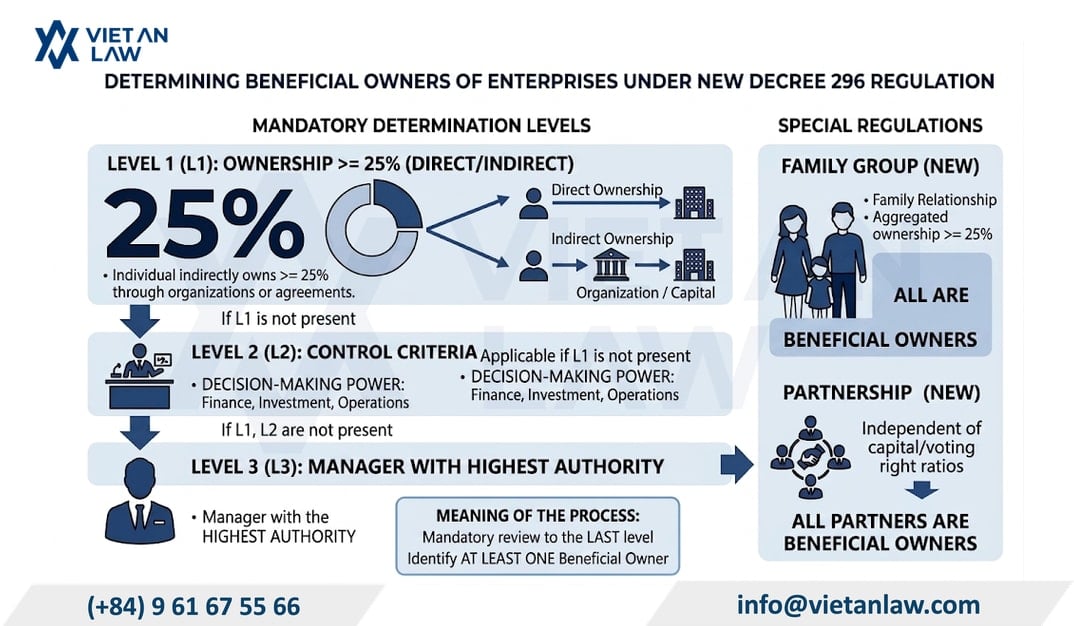
The new regulation forces enterprises not to leave UBO information blank, applying a sequential three-tier review principle:
- Level 1st (Ownership): Individuals directly or indirectly (through organizations or legal arrangements) owning 25% or more of the charter capital or total voting shares;
- Level 2nd (Control) (applied when no individual satisfies Criterion 1): Determined through the right to appoint, dismiss, or remove key personnel, amend the Charter, decide on financial policies, or reorganize the enterprise;
- Level 3rd (Highest authority): This is a new regulation regarding the final mandatory review step if both criteria 1st and 2nd are not met. The enterprise must designate the manager with the highest authority to act on behalf of the enterprise as the UBO (excluding state capital representatives).
Family group individuals jointly owning 25% or more as the ultimate beneficial owner
Decree 296/2026/ND-CP introduces for the first time the concept of aggregated ownership ratios for groups of individuals with family relationships (according to Clause 22, Article 4 of the Law on Enterprises). Accordingly, all individuals within a family group collectively owning a total capital proportion of 25% or more are determined to be the UBO.
Example: In a company, the wife owns 15% and the husband owns 15%. The total percentage of the family group is 30% (greater than 25%). Therefore, both spouses must be declared as the UBO.
- This regulation strongly impacts family businesses that are dispersing ownership structures to avoid the 25% threshold.
All general partners in a partnership are the ultimate beneficial owner
A new point mandates that all general partners of a partnership are the UBO, regardless of their capital contribution ratio or voting rights.
Legal arrangements (investment trusts)
In cases where the ownership structure involves a legal arrangement, the UBO is determined according to the provisions of the law on anti-money laundering. This requirement directly affects foreign trust structures when conducting investment activities in Vietnam, compelling the transparency of the final benefiting individuals.
Mandatory ultimate beneficial owner declaration process
Enterprises must review each tier in the ownership structure until they identify the individual with the ultimate ownership or control rights, strictly complying with the following order:
Level 1 (ownership) -> Level 2 (control) -> Level 3 (highest management authority)
New regulations directly impacting foreign investors (FDI) in Vietnam
Foreign investors are allowed to establish an FDI company before obtaining an IRC
A new mechanism supporting special investment procedures is added to the provisions in Article 24 of Decree 168/2025/ND-CP:
- The company registration dossier does not require a copy of the Investment Registration Certificate (IRC);
- It is mandatory to supplement a commitment to meet market access conditions in the Application for enterprise registration;
- Legal risk: Investors must evaluate this carefully, because if the IRC is later rejected due to failure to meet market access conditions, the established legal entity will incur complex legal liabilities.
Prohibition on acting as a “nominee for another person to contribute capital”
Decree 296/2026/ND-CP supplements the principle of prohibiting acting as a nominee to contribute capital. This creates direct legal risks for holding structures or nominee arrangements through Vietnamese individuals acting on behalf of others, which are currently quite common in enterprises that are fundamentally FDI capital in Vietnam but have not been fully declared. FDI investors must urgently review and restructure existing capital contribution trust arrangements.
Requirement to prove capital contribution when purchasing privately offered shares
The dossier notifying the change of a shareholder who is a foreign investor must be supplemented with documents proving the completion of capital contribution when purchasing privately offered shares.
New regulations on enterprise business suspension in Vietnam
Imposing a 24-month cap for the total consecutive suspension period
In order to end the situation of indefinite suspension, Decree 296/2026/ND-CP has supplemented Article 60 of Decree 168 regarding business suspension with the following regulations:
- The total period of consecutive business suspension must not exceed 24 months (including the suspension period prior to July 23, 2026);
- Enterprises that have been suspended for more than 24 months are not allowed to extend further and are forced to resume operations or dissolve.
Note on the transitional clause of Decree 296/2026/ND-CP: For dossiers of dissolution and business suspension (received but unprocessed after July 23, 2026), the new regulations on enterprise registration under Decree 296/2026/ND-CP shall apply for resolution.
New obligations during the suspension period
During the business suspension period, if there are changes to the enterprise registration contents, the enterprise must still perform the procedures for registering or notifying the changes.
Mandatory confirmation of continued business operations
A new management process aimed at avoiding the situation of enterprises absconding, specifically:
- Within 05 working days from the expiration of the business suspension period, the enterprise must confirm the continuation of business;
- If more than 10 working days pass without confirmation, the business registration authority will request a supplementary report;
- If there is no report after 06 months, the enterprise faces the risk of having its Enterprise Registration Certificate revoked.
New regulations on enterprise dissolution and enterprise bankruptcy in Decree 296/2026/ND-CP
- Unlisted joint-stock companies: Mandatory submission of a copy of the shareholder register enclosed in the dissolution dossier, and simultaneous mandatory retention of shareholder information for 06 years after dissolution;
- Changing bankruptcy status: Updating procedures according to the Law on Rehabilitation and Bankruptcy No. 142/2025/QH15. Supplementing the situation of suspending bankruptcy procedures (reverting to the status prior to the time of opening procedures) and canceling the decision declaring bankruptcy (changing to undergoing bankruptcy procedures).
New regulations on household businesses in Vietnam
Synchronizing 05 new points applied to household businesses: clearly delineating the responsibilities of the communal-level business registration authority; regulating authorization and electronic authentication; the obligation to register changes during business suspension; and the sequence of submitting dossiers via VNeID.
New regulations on company registration procedures under Decree 296/2026/ND-CP
- Reducing digital signature requirements: Many applications and notices declared directly on the System no longer require digital signatures and no longer require uploading soft copies to the system;
- Narrowing the scope of electronic authentication: Level 2 VNeID authentication for authorized persons only applies to certain procedures requiring verification of the authorized person, such as establishment, changing the legal representative, owners, or founding members, shareholders, and FDI shareholders;
- Recognizing electronic data: Holding equal legal validity to electronic documents, paving the way for the method of submitting dossiers via API.
Interconnected data exploitation mechanism
- Proactive data exploitation: The business registration authority exploits the national database instead of requiring enterprises to submit copies of legal documents (applied to 07 types of documents, including: Enterprise Registration Certificate, Investment Registration Certificate, M&A approval documents, Court decisions). The enterprise is only required to submit copies if the data has errors;
- State-owned enterprises: Single-member limited liability companies with 100% charter capital held by the State update the owner’s documents according to the Law on Management and Investment of State Capital.
Shortening the time limit for company registration procedures from July 23, 2026
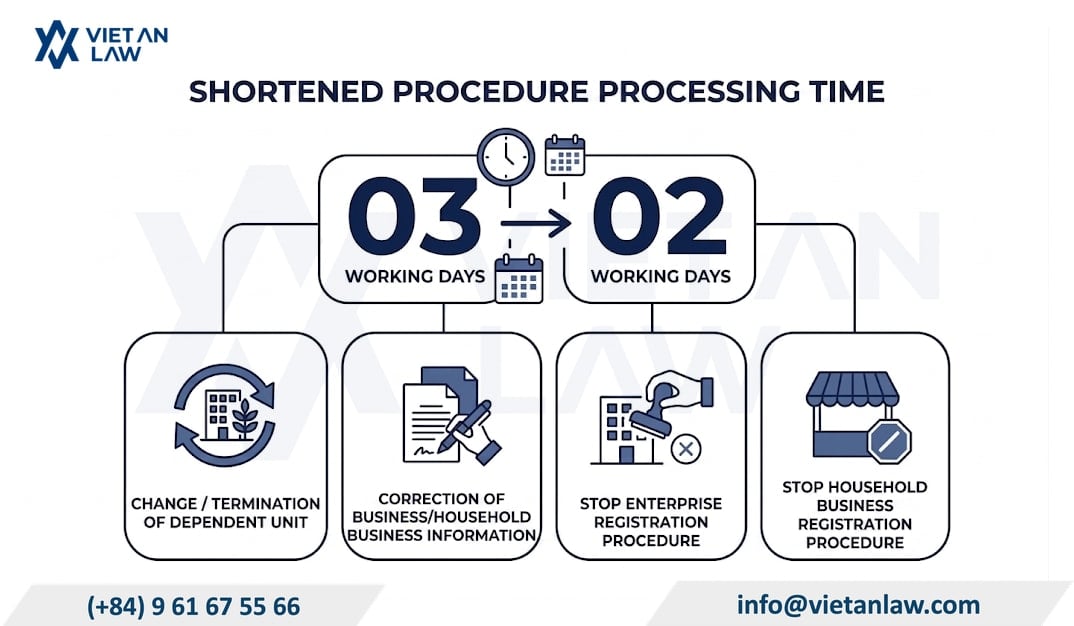
Decree 296/2026/ND-CP stipulates shortening the resolution time limit from 03 working days to 02 working days for the following procedures:
- Stopping the company registration procedure;
- Changing contents or terminating the operation of dependent units;
- Correcting information of enterprises or household businesses;
- Stopping the household business registration procedure.
Note on the transitional clause: Other enterprise and household business registration dossiers (received but unprocessed) will continue to apply Decree 168/2025/ND-CP for resolution.
Actionable recommendations for businesses – Compliance checklist for the new Decree 296 on enterprise registration
| Tasks to be done | Applicable subjects | Priority level |
| Reviewing and re-declaring the ultimate beneficial owner according to the new criteria | Operating enterprises | 🔴High |
| Evaluating and restructuring investment trust agreements, avoiding violations of the prohibition on acting as a nominee | Foreign investors, FDI enterprises | 🔴High |
| Reviewing multi-layered ownership chains to determine the final benefiting individuals | Foreign investors | 🔴High |
| Recalculating the 24-month cap for companies currently undergoing business suspension | Operating enterprises | 🔴High |
| Considering the mechanism for enterprise establishment before the Investment Registration Certificate, evaluating risks regarding market access conditions | Foreign investors in the planning stage | 🟡Medium |
| Updating the shareholder register (unlisted joint-stock companies) in preparation for dissolution risks | Operating enterprises | 🟡Medium |
Frequently asked questions about the new points of Decree 296/2026/ND-CP
My company has two biological brothers, each contributing 15% of the capital, so do we have to declare the ultimate beneficial owner?
Yes. According to the new regulations on enterprise registration, groups of individuals with family relationships jointly owning 25% or more will be aggregated. Because the total percentage of the two brothers is 30%, both must be declared as the UBO of the enterprise.
If the enterprise cannot determine who owns more than 25% or holds control, how is it handled?
The decree stipulates a mandatory review mechanism. If Criterion 1 (ownership) and Criterion 2 (control) are not satisfied, the enterprise is forced to apply Criterion 3: designating the enterprise manager with the highest authority to stand as the UBO. The law mandates that this information is not allowed to be left blank.
My company previously underwent business suspension for 2 consecutive years, so can it be further extended according to the new regulations?
No. Decree 296/2026/ND-CP imposes a maximum cap of 24 months for the total consecutive business suspension period (including the time prior to July 23, 2026). The enterprise is forced to choose to continue business operations or implement dissolution procedures.
Corporate legal advisory services in Vietnam at Viet An Law
- Evaluating ownership structures: In-depth review of multi-layered capital charts to accurately determine the UBO according to the new regulations, particularly with family structures and investment trusts;
- FDI company establishment: Advising on the optimal roadmap for establishing foreign-invested enterprises, including the mechanism for establishing legal entities before obtaining an Investment Registration Certificate;
- Restructuring and compliance: Assisting in implementing procedures for business suspension and enterprise dissolution, ensuring compliance with the 24-month time cap and new reporting obligations.
The amendments to Decree 168/2025/ND-CP mark a strong reform step in data governance, ownership transparency, and the digital transformation of legal procedures. For detailed advice on applying these new points of Decree 296/2026/ND-CP on enterprise registration in Vietnam into practice, clients are welcome to contact Viet An Law to receive the most comprehensive and optimal legal solutions.