


As Vietnam continues to improve its position as an attractive destination for foreign capital, planning to open FDI company in Vietnam has become a strategic move for international investors. However, to obtain licensing and operate legally, investors must not only prepare financial resources but also satisfy a series of stringent legal conditions concerning business lines, investment forms, ownership ratios, and procedural documentation. So, what should investors note when they set up an FDI company in Vietnam in 2026. What requirements must be met to mitigate risks, save time, and streamline the company registration in Vietnam?
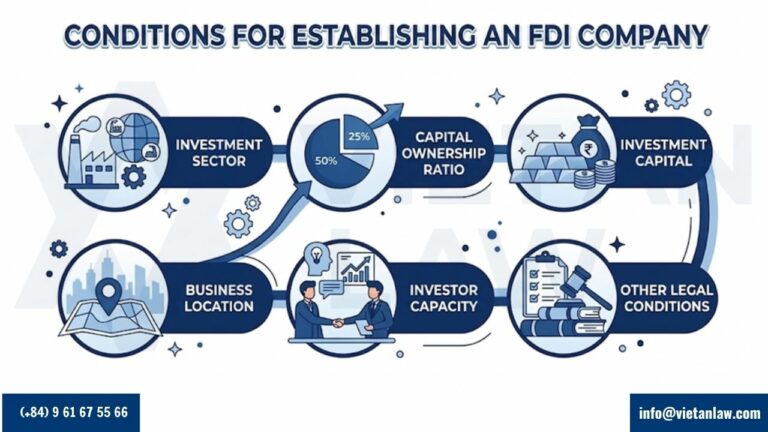
Summary table of conditions for establishing an FDI company in Vietnam in 2026
| Condition | Requirement | Important note |
| Investment business lines | Must not belong to the banned list and must comply with market access conditions | Check WTO/FTA commitments prior registration |
| Capital ownership ratio | Comply with international commitments and specialized laws | Certain industries are capped at 49% – 51% |
| Investment capital | No general minimum requirement | Must be commensurate with project scale |
| Business location | Must possess lawful use rights | Cannot be located in standard residential apartments |
| Investor capacity | Financial proof (financial statements, commitments, etc.) | Deficiencies easily lead to application rejection |
| Other legal conditions | Compliance with laws on enterprises, investment, and specialized fields | Sub-licenses may be required |
Quick summary
To ensure successful company registration in Vietnam, investors must guarantee:
- Accessible business lines
- Clear financial capacity
- Lawful business location
- Compliance with capital and ownership ratio conditions
Conditions on investment business lines in Vietnam
The first and most important condition is determining whether the intended investment business line is accessible to foreign investors. According to the Law on Investment 2025, investment business lines are classified into three groups:
Banned investment business lines
Banned investment business lines are those in which foreign investors are prohibited from conducting business activities. The banned investment business lines are stipulated under Article 6 of the Law on Investment 2025 and guided by Article 10 of Decree 96/2026/ND-CP, including:
- Prostitution business;
- Buying or selling humans, tissues, corpses, human body parts, or human fetuses;
- Business activities related to human cloning;
- Firecracker business;
- Debt collection services;…
Conditional investment business lines
Conditional investment business lines are those conducted within Vietnamese territory where the investment activity must satisfy necessary conditions for reasons of national defense, national security, social order and safety, social morality, or public health.
- The list of conditional investment business lines is provided in Appendix IV attached to the Law on Investment 2025 and guided by Articles 11, 12, 13, and 14 of Decree 96/2026/ND-CP.
- Business investment conditions are applied in the following forms: Licenses, certificates, credentials, written confirmations or approvals from competent authorities…
Market access conditions for foreign investors
Market access conditions and business lines for foreign investors encompass:
- Business lines for which market access is not yet allowed;
- Business lines with conditional market access.
Specifically, market access conditions for foreign investors are outlined in the List of business lines with restricted market access for foreign investors under Appendix I of the Decree 96/2026/ND-CP.
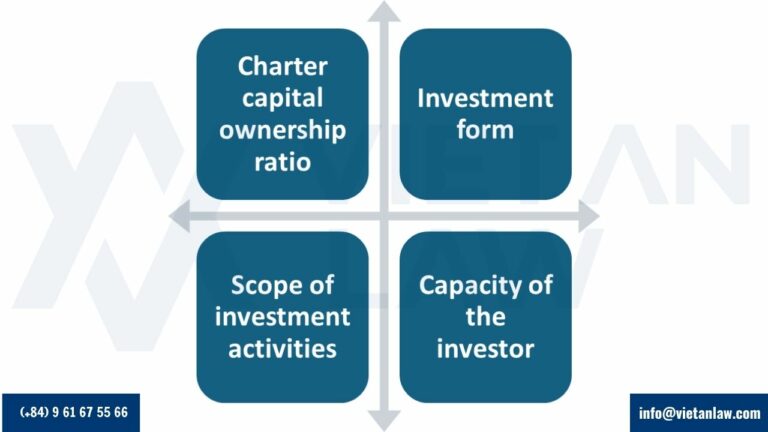
Market access conditions include:
- Charter capital ownership ratio of the foreign investor in the economic organization,
- Investment form,
- Scope of investment activities,
- Capacity of the investor and partners participating in the investment activity.
Notably, the market access of foreign investors is also contingent upon international commitments (WTO, FTA). Specific examples:
- Logistics: A conditional industry, subject to limitations on capital ratio or service scope.
- Education: Must satisfy conditions regarding minimum capital, physical facilities, and obtain an operating license.
- Trade (retail distribution): Must apply for a Retail Business License and may be required to undergo an Economic Needs Test (ENT).
Conditions on capital ownership ratio in Vietnam
Under Clause 10, Article 17 of Decree 96/2026/ND-CP, restrictions on the ownership ratio of foreign investors according to international treaties on investment are applied as follows:
When there are multiple foreign investors
- From multiple countries or treaties: The total ownership ratio must not exceed the highest limit prescribed in the international treaties applicable to that specific business line.
- From the same country or territory: The total ownership ratio must not exceed the limit specifically prescribed for that country or territory.
When engaging in multi-industry business
If an economic organization engages in multiple business lines with varying regulations on ownership ratios, the maximum ownership ratio shall be determined by the industry with the lowest (most stringent) cap.
Priority of specialized laws (securities)
For public companies, securities companies, fund management companies, or investment funds: If the Law on securities has specific regulations on foreign ownership ratios, such regulations shall take precedence.
Specifically:
- For public companies, the capital ownership ratio for foreign investors is 50% according to Clause 1, Article 139 of Decree 155/2020/ND-CP.
- For securities companies, securities investment companies, and securities investment funds, the capital ownership ratio for foreign investors can reach up to 100% according to Article 77 of the Law on Securities 2019.
Examples:
- Advertising services: Generally, require a joint venture.
- Certain logistics services: Subject to foreign ownership limits.
Conditions on investment capital in Vietnam
The law does not prescribe a fixed minimum capital for all FDI projects; rather, it requires the investment capital to be appropriate for the scale and nature of the project. According to Clause 1, Article 29 of Decree 96/2026/ND-CP, the registered investment capital for implementing a project is determined based on:
- The investor’s contributed capital in cash, machinery, equipment, value of intellectual property rights, technology, technical know-how, value of land use rights, and other assets under the civil law and international treaties on investment;
- Capital mobilized to implement the investment project;
- The investor’s retained earnings for reinvestment (if any).
The implemented investment capital of a project is determined based on the capital the investor has actually contributed, mobilised, and retained for reinvestment during the project’s execution. The investor self-determines the value of the implemented investment capital after the project is put into operation and exploitation. Practical examples:
- F&B sector (food and beverage services): Typically requires 100,000 -300,000 USD to ensure operational viability.
- Manufacturing sector: Requires higher capital due to machinery and factory costs.
Conditions on business location of investment in Vietnam
The investor must prove lawful use rights over the location where the project is implemented. After completing the procedures to obtain an Investment Registration Certificate (IRC), a foreign-invested economic organization may establish branches, representative offices, or business locations outside its head office without necessarily requiring a new investment project. However, foreign investors must note:
- The investor must prove lawful use rights over the project implementation location;
- The enterprise may only establish business locations within the province or the city where its head office or branch is located;
- Procedures to notify the establishment of a business location must be submitted to the Business Registration Office where the location is situated;
- The enterprise’s head office must have a specific address according to administrative boundaries. The head office cannot be located in a standard residential apartment.
Specific industry requirements:
- Manufacturing: Must possess a factory or be within an industrial zone.
- Education: Must satisfy physical facility standards.
- F&B: Must guarantee food safety and hygiene conditions.
Conditions on investor capacity in Vietnam
In the application dossier for the investment license, the investor must attach documents proving their financial capacity.
The supporting documentation must include at least one of the following:
- Financial statements of the investor for the last two years;
- Financial support commitment from the parent company;
- Financial support commitment from a financial institution;
- Guarantee of the investor’s financial capacity;
- Other documents proving the investor’s financial capacity.
Other legal conditions for investment in Vietnam
Beyond the specific conditions outlined above, investors must also satisfy other legal requirements, including:
- Conditions regarding the company name, founding entities, business line codes are under the Law on Enterprise 2020, amended in 2025
- Conditions comply with the national laws of the investor and international commitments (WTO, FTA)
- Satisfying conditions set forth by specialized laws
Common mistakes when establishing an FDI company in Vietnam
In practice, many foreign investors face application rejections due to:
- Selecting business lines that do not align with market access conditions
- Registering capital that does not correspond with the project scale
- Failing to adequately prove financial capacity
- Selecting business locations that violate regulations
Making errors from the outset can result in the entire dossier needing to be redone, extending the timeline by 1-2 months and incurring significant additional costs.
Procedure to establish an FDI company in Vietnam
When deciding to open FDI company in Vietnam, the establishment process generally encompasses two main steps:
Step 1: Apply for the Investment Registration Certificate (IRC)
- Evaluate the investment project
- Determine business lines, capital, and location
- Timeframe: 15 – 30 days
Step 2: Establish the enterprise
- Apply for the Enterprise Registration Certificate (ERC) to register the corporate legal entity
- Publicize corporate information
- Timeframe: 3 – 7 days
This is a mandatory procedure for foreign investors.
Company registration cost in Vietnam
The actual costs involved include:
- State fees: 1 – 3 million VND
- Legal services: 1,000 – 2,000 USD
- Investment capital (industry-dependent): From 50,000 USD and above.
Costs are subject to change depending on the specific business line and project scale.
Frequently asked questions (FAQ) on the conditions to establish an FDI company in Vietnam
Are foreign investors free to choose any business line in Vietnam?
No. Investors must cross-reference the list of business lines with restricted market access under the law on investment and international commitments. If the industry falls into the conditional group, the investor must satisfy additional requirements such as capital ratios, sub-licenses, or appropriate investment forms. If it belongs to the banned category, implementation is prohibited.
Is 100% foreign ownership allowed in all industries?
No. Only “open” industries permit 100% foreign ownership. For conditional industries, the law may:
- Restrict the ownership ratio (e.g., 49%, 51%…)
- Mandate a joint venture with a Vietnamese partner
- Limit the scope of business operations non-compliance will result in application rejection or require a restructuring of the investment.
Does the law prescribe a minimum capital when establishing an FDI company?
There is no minimum capital applied to all cases. However, the investment capital must be appropriate for the project scale, industry, and implementation location. The licensing authority will evaluate the project’s feasibility based on the registered capital. If the capital is too low, the project may be deemed unfeasible. If it is excessively high but not fully contributed, the investor may face penalties.
Can an FDI company head office be located in an apartment building?
Generally, this is not permitted. The enterprise’s head office must be a location with a designated commercial function according to regulations. Apartment buildings can only be utilized if they have a designated commercial-service function. Additionally, certain industries require highly specific standalone locations (e.g., manufacturing requires factories, education requires standardized training facilities).
If all legal conditions are not met, will the license still be granted?
No. The investment registration authority will request supplements and amendments to the application. If the investor fails to satisfy the conditions (e.g., incorrect business lines, insufficient financial capacity, inappropriate location), the application for the IRC will be rejected. In several instances, initial preparation errors compel investors to rebuild the entire application from scratch, drastically prolonging the timeline and escalating costs.
Understanding how to set up an FDI company in Vietnam in 2026 is not just about paperwork because it involves foundational elements such as investment business lines, capital ownership ratios, financial capabilities, and practical implementation parameters. Fulfilling these conditions from the beginning help investors to expedite the licensing phase, curtail legal risks, and optimise operational expenditures.
Given the legal frameworks and market access conditions in Vietnam, selecting professional FDI company establishment services serve as the optimal solution for investors to save time and mitigate legal exposure.
Backed by practical expertise, Viet An Law provides comprehensive support ranging from investment condition assessment, dossier preparation, and obtaining the IRC and ERC, to post-establishment compliance advisory. Simply provide your project information to receive:
- Upfront assessment of licensing feasibility
- Consultation on optimal investment structuring (capital, business lines, ownership ratios)
- Transparent quotation on costs and execution timelines
Contact us immediately for a free consultation and a roadmap to establish your FDI company in Vietnam: (+84)9 61 37 18 18 (Zalo / WhatsApp).