


Circular 91/2026/TT-BTC on electronic invoices in Vietnam guides the Tax Administration Law and Decree 254/2026/ND-CP on e-invoices and e-documents, taking effect from July 1, 2026. The Circular focuses on guiding the practical implementation of regulations on the registration, use, error handling and management of e-invoices. In addition, Circular 89/2026/TT-BTC guiding the Law on Tax Administration and Decree 252/2026/ND-CP also applies from this time, setting out several new requirements that enterprises should note. In the article below, Viet An Law Firm will help clients better understand this topic.
Overview of Circular 91/2026/TT-BTC guiding the Tax Administration Law and Decree 254/2026/ND-CP on e-invoices and e-documents in Vietnam
- Circular No. 91/2026/TT-BTC was issued by the Minister of Finance on June 30, 2026 and takes effect from July 1, 2026. The Circular consists of 05 chapters, 25 articles and 05 appendices, focusing on guiding the implementation of electronic invoice and electronic document regulations, as well as the lookup and use of e-invoice information.
- Decree No. 254/2026/ND-CP was issued by the Government on June 30, 2026 and officially takes effect from July 1, 2026, detailing a number of articles and measures to implement the Law on Tax Administration regarding e-invoices and e-documents. The Decree adjusts and updates many important regulations to improve the efficiency of tax administration in the context of digital transformation.
Invoice template symbols and e-invoice symbols from July 1, 2026 in Vietnam
One of the Circular 91 tax administration points that enterprises need to update immediately when switching to the new system is the template symbol and the e-invoice symbol.
According to Appendix I of Circular No. 91/2026/TT-BTC, the e-invoice template symbol is a single digit from 1 to 9 reflecting the type of invoice, in which:
| Template symbol | Invoice type |
| 1 | Value-added tax (VAT) invoice |
| 2 | Sales invoice |
| 3 | Invoice for the sale of public assets |
| 4 | Invoice for the sale of national reserve goods |
| 5 | Other types of e-invoices such as electronic stamps, tickets, cards and receipts |
| 6 | Warehouse release note cum internal transportation note; warehouse release note for goods sent to sales agents |
| 7 | E-commerce invoice |
| 8 | VAT invoice integrated with tax, fee and charge receipts |
| 9 | Sales invoice integrated with tax, fee and charge receipts |
Notably, the e-invoice symbol consists of 06 characters, reflecting whether the invoice is coded or non-coded, the year of issuance and the invoice type.
For example, the symbol 1C26TAA means a VAT invoice with the tax authority’s code, issued in 2026 and belonging to the type of invoice registered by the enterprise. The symbol 1K26TYY indicates a VAT invoice without the tax authority’s code issued in 2026.
Enterprises need to update their invoicing software and internal management systems to ensure that symbols are generated correctly under the new regulations.
Regarding the timing of invoice issuance, enterprises comply with Decree No. 254/2026/ND-CP. For details, clients may refer to the article: Timing of issuing invoices under Decree 254/2026/ND-CP – https://vietanlaw.com/timing-of-issuing-invoices-under-decree-254-2026-nd-cp/
Registration and change of information on the use of electronic invoices in Vietnam
Circular No. 91/2026/TT-BTC provides specific guidance on registering and changing the registered information for e-invoice use.
Accordingly, economic organizations, other organizations, business households and business individuals required to use e-invoices register or change their registration information through e-invoice service providers.
Where coded e-invoices of the tax authority are used free of service charge, registration may be made via the tax administration information system or a service provider entrusted by the Department of Taxation.
In practice, enterprises need to re-check:
- The form of invoice currently in use;
- The registered invoice type;
- Enterprise information on the system;
- The invoice data transmission method;
- The connection status between the invoicing software and the tax administration system.
Changing the software system without updating the registration information may lead to discrepancies in invoice issuance and data transmission.
When is an enterprise suspended from using e-invoices in Vietnam?
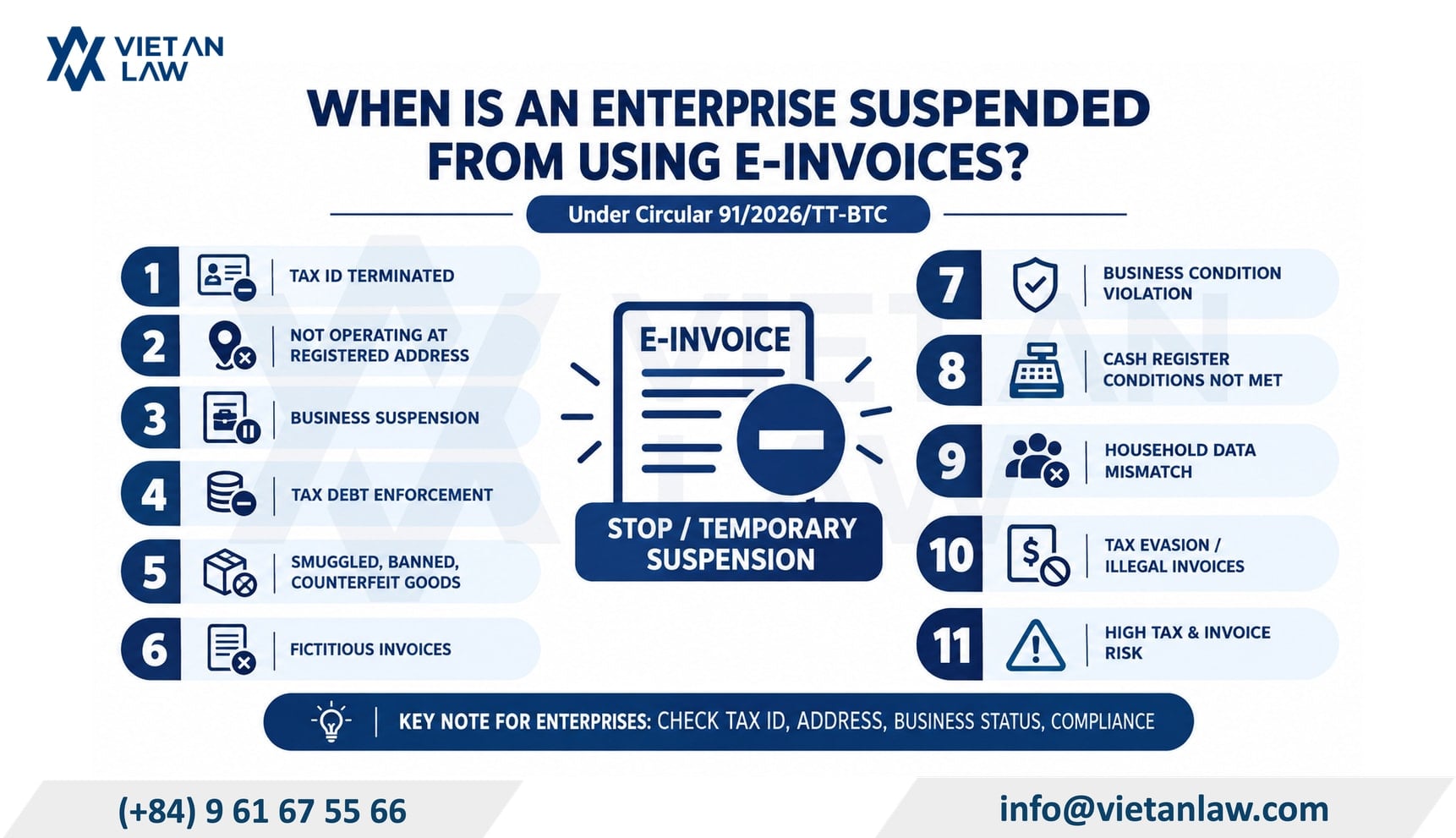
Circular No. 91/2026/TT-BTC specifies the cases of stopping or temporarily suspending the use of electronic invoices.
Some notable cases include:
- Termination of the tax identification number;
- Not operating at the registered address;
- Business suspension;
- Being subject to tax debt enforcement by suspending the use of invoices;
- Using invoices to sell smuggled goods, prohibited goods, counterfeit goods or goods infringing intellectual property rights;
- Issuing invoices for fictitious sales of goods or provision of services to appropriate money;
- Violating business conditions, leading to a suspension request;
- No longer meeting the conditions for using e-invoices generated from cash registers;
- Information of business households or individuals does not match the national population database and is not supplemented upon request;
- Committing tax evasion or illegally using e-invoices;
- Falling into the high-risk group for tax and invoices under risk management regulations.
This is especially important for enterprises, because suspension of invoice use can directly affect sales, service provision and tax declaration.
Enterprises should proactively check their tax identification number status, registered address, business operations and compliance level before issuing invoices, in line with tax management electronic invoices requirements.
New regulations in Vietnam on authorizing the issuance of e-invoices
- Circular No. 91/2026/TT-BTC allows sellers of goods and service providers to authorize an eligible third party to issue e-invoices.
- The authorization must be made in writing, through a contract or agreement between the authorizing party and the authorized party, except for special cases as prescribed.
- At the same time, the authorization must be notified to the tax authority when registering for e-invoice use.
- Invoices issued by the authorized party must show the information of both the authorizing party and the authorized party. The two parties must also publicly disclose the authorization on their website, store interface, platform system or mass media so that buyers are aware.
- This regulation is of practical significance for enterprises using sales platforms, agents or models in which another entity directly issues invoices.
Cases in Vietnam where e-invoices are not required from July 1, 2026 under Decree No. 254/2026/ND-CP
Article 7 of Decree No. 254/2026/ND-CP sets out 08 cases in which e-invoices are not required from July 1, 2026, as follows:
- Business households/individuals preparing lists
- Business households/individuals with special revenue sources
- Agents subject to tax withholding at source
- Special financial and insurance activities
- Capital contribution in assets
- Internal asset transfer/restructuring
- Borrowing assets for processing
- Internal consumption and revenues unrelated to sales
Clients may refer to Viet An Law Firm’s article on Decree No. 254/2026/ND-CP at https://vietanlaw.com/decree-254-2026-nd-cp-on-electronic-invoices-in-vietnam/
Handling erroneous e-invoices from July 1, 2026 in Vietnam
Circular 91/2026/TT-BTC on electronic invoices in Vietnam provides case-by-case guidance on handling incorrectly issued e-invoices instead of applying a single general approach.
Basically, enterprises need to classify errors before deciding how to handle them:
Case 1: Errors that do not affect material contents
If an invoice contains errors in the name, address, amount in words or other contents but not in the tax identification number, amount, tax rate, tax amount or goods, the seller notifies the buyer and notifies the tax authority using the prescribed form; the invoice does not need to be re-issued.
Case 2: Errors in the tax identification number, goods, amount, tax rate or tax amount
- The seller may choose to issue an adjustment invoice or a replacement invoice as prescribed.
- For certain special cases, the Circular requires the use of a replacement invoice. Notably, e-invoices generated from cash registers, or invoices for sales of goods that are assets subject to registration of ownership or use rights, are handled under the replacement invoice mechanism if issued incorrectly.
- In addition, in some cases, enterprises are not required to make a written agreement with the buyer before adjusting or replacing invoices, such as sales of goods on e-commerce or digital platforms, or data transfer by summary table as prescribed.
- This is one of the points that enterprises’ accounting departments should pay special attention to when handling erroneous invoices from July 1, 2026.
Switching between coded and non-coded e-invoices in Vietnam
- Circular No. 91/2026/TT-BTC also guides the switching of invoice forms.
- Enterprises using e-invoices without the tax authority’s code that wish to switch to coded e-invoices shall change their e-invoice registration information as prescribed.
- Conversely, enterprises eligible to use non-coded invoices but identified by the tax authority as high-risk may be required to switch to coded e-invoices.
- Therefore, enterprises should not rely solely on the invoice form used before July 1, 2026, but should regularly check their eligibility and compliance status to determine the appropriate invoice form.
Key notes when applying Circular 89/2026/TT-BTC in Vietnam
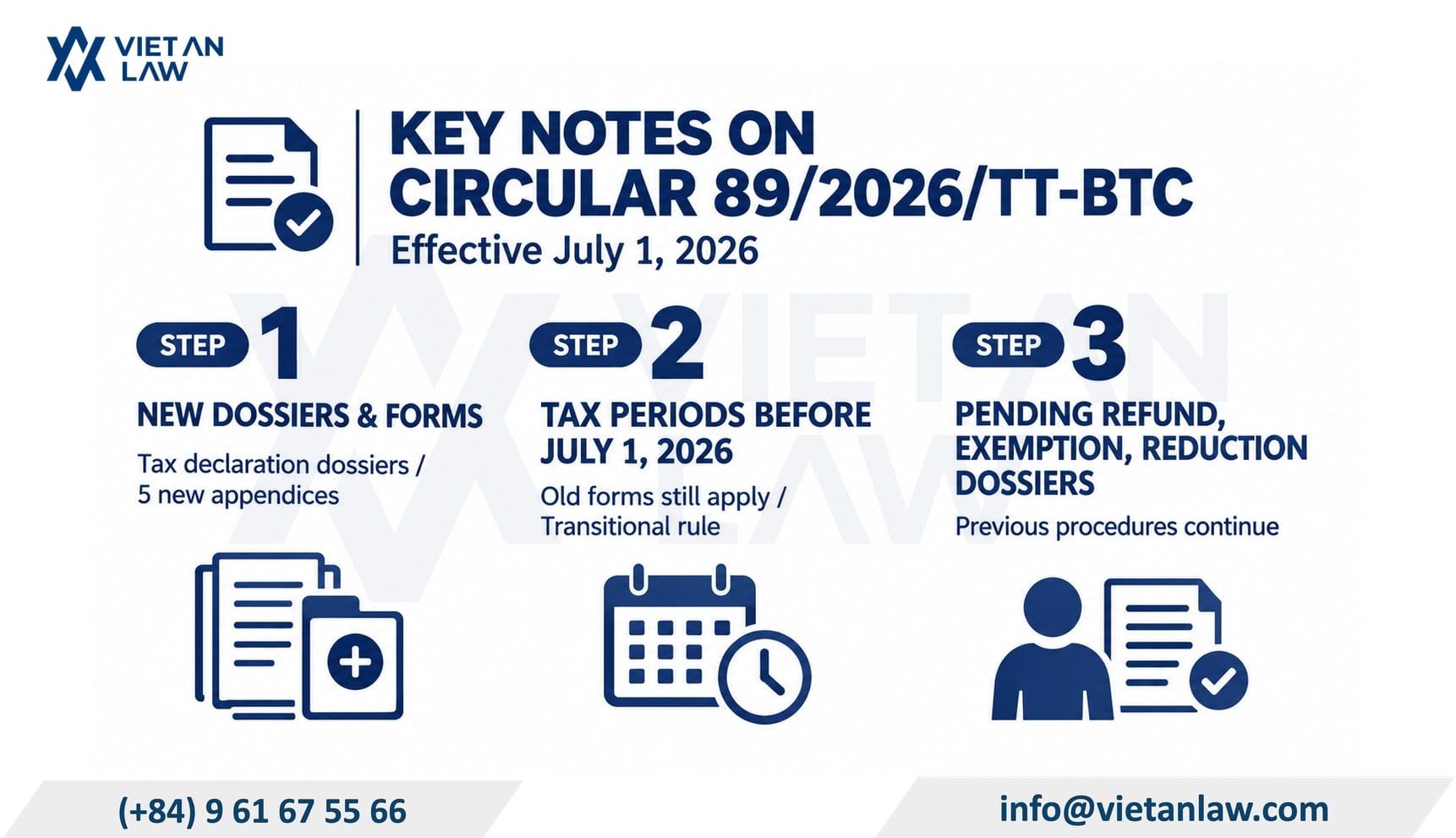
Three transition points: new dossier forms, pre-July 2026 tax periods and pending refund dossiers
Besides e-invoices, Circular 89/2026/TT-BTC has direct implications for enterprises’ tax, accounting and payroll activities.
The Circular takes effect from July 1, 2026, guiding many aspects of implementing the Law on Tax Administration and Decree 252/2026/ND-CP, focusing on electronic transactions, tax declaration, tax calculation and allocation, tax payment, tax refund, tax exemption and reduction, handling of tax amounts and tax inspection.
Changes to tax declaration dossiers and forms
Circular 89/2026/TT-BTC issues a new system of appendices on tax administration dossiers and forms, including:
- Appendix I: List of tax declaration dossiers;
- Appendix II: Method of making supplementary tax declarations;
- Appendix III: List of forms for tax administration procedures;
- Appendix IV: List of forms of tax authorities;
- Appendix V: List of notices of tax administration authorities.
Therefore, enterprise accountants need to update their declaration software and the set of forms in use instead of mechanically continuing to use pre-July 1, 2026 forms.
Tax declaration dossiers for tax periods before July 1, 2026
This is a transitional point that requires special attention.
For tax declaration dossiers with tax periods before July 1, 2026, taxpayers continue to use the forms applicable before Circular 89/2026/TT-BTC took effect. Decisions and notices issued by tax authorities before July 1, 2026 continue to be implemented until their expiry or until they cease to be effective.
Thus, not all tax dossiers arising in 2026 must switch to the new forms from July 1, 2026.
Pending tax refund, exemption and reduction dossiers
For dossiers for tax refund, exemption, reduction or cancellation of tax debts received before July 1, 2026 but not yet fully resolved, competent authorities basically continue to follow the order and procedures applicable before Circular 89/2026/TT-BTC took effect, except for separately prescribed transitional cases.
This regulation helps avoid a situation where dossiers being processed must change their entire process simply because the new legal framework has come into effect.
Frequently asked questions
From July 1, 2026, do enterprises already using e-invoices have to re-register under Circular 91/2026/TT-BTC?
From July 1, 2026, enterprises lawfully using e-invoices are not required to re-register from scratch, unless there are changes in information or they are subject to updates or supplements under the new management requirements of Circular No. 91/2026/TT-BTC and Decree No. 254/2026/ND-CP.
E-invoices issued incorrectly after July 1, 2026: when can they be adjusted and when must a replacement invoice be issued?
Depending on the error and the invoice type, enterprises may notify the error, issue an adjustment invoice or issue a replacement invoice. Certain special cases are required by Circular No. 91/2026/TT-BTC to be handled with a replacement invoice. Therefore, enterprises need to accurately identify the error before choosing a handling option, avoiding arbitrarily cancelling or re-issuing invoices in violation of regulations.
Will an enterprise that files tax declarations using old forms after July 1, 2026 be considered to have made incorrect declarations and be penalized?
Whether an enterprise using old forms is wrong cannot be concluded based solely on the filing date; the tax period of the dossier must be determined. For tax declaration dossiers with tax periods before July 1, 2026, the transitional provisions allow continued use of the forms applicable before Circular 89/2026/TT-BTC took effect. For dossiers belonging to tax periods subject to the new regulations, enterprises must use the corresponding correct forms.
Which forms apply to tax declaration dossiers with tax periods before July 1, 2026?
Dossiers with tax periods before July 1, 2026 continue to use the forms applicable before Circular 89/2026/TT-BTC took effect, under the transitional provisions.
Should enterprises use Viet An Law Firm’s services when updating tax and e-invoice regulations?
If an enterprise has multiple invoice types, uses sales platforms, authorizes third parties to issue invoices or frequently adjusts or replaces invoices, professional advisory services can help review processes, limit errors and ensure compliance with the new rules on tax management electronic invoices.
Tax and accounting service and payroll services of Viet An Law Firm in Vietnam
- The simultaneous changes to the Circular 91 tax administration framework, e-invoice rules and electronic document regulations require enterprises not only to update legal documents but also to adjust their practical implementation processes.
- Viet An Law Firm’s tax and accounting service and payroll services support enterprises in reviewing tax obligations, tax declaration dossiers, e-invoice processes and compliance issues arising during their operation.
- Enterprises may contact Viet An Law Firm for advice on applying Circular 89/2026/TT-BTC and Circular 91/2026/TT-BTC on electronic invoices in Vietnam in line with their business model, accounting system and actual invoice usage.
Clients who wish to receive more detailed advice on the above content, please contact Viet An Law Firm for the best support!