


Circular 87/2026/TT-BTC guiding the Personal Income Tax Law and Decree 253 in Vietnam was issued by the Ministry of Finance on June 30, 2026, took effect on July 1, 2026, and replaces Circular 111/2013/TT-BTC, which had been applied for more than a decade. It is the final piece completing the 2026 legal framework on personal income tax, alongside the Law on Personal Income Tax 2025 (No. 109/2025/QH15) and Decree 253/2026/ND-CP. In the article below, Viet An Law Firm analyzes the new points, compares them directly with the old regulations, and identifies what enterprises, accountants, and taxpayers need to handle immediately.
Overview of Circular 87/2026/TT-BTC in Vietnam
Legal basis and scope of regulation
Circular 87/2026/TT-BTC details a number of contents assigned under the Law on Personal Income Tax 2025 (No. 109/2025/QH15, as amended and supplemented by Law No. 09/2026/QH16) and Decree No. 253/2026/ND-CP of the Government. Issuing the Circular on the same day as the Decree reflects the policy of synchronizing the entire system of personal income tax guidelines from July 1, 2026.
The Circular focuses on four groups of content: the income threshold for determining dependents; dossiers for determining dependents; tax on the transfer of derivative securities; and the responsibilities of tax authorities and taxpayers regarding dependent information.
Position of the Circular in the tax legal system
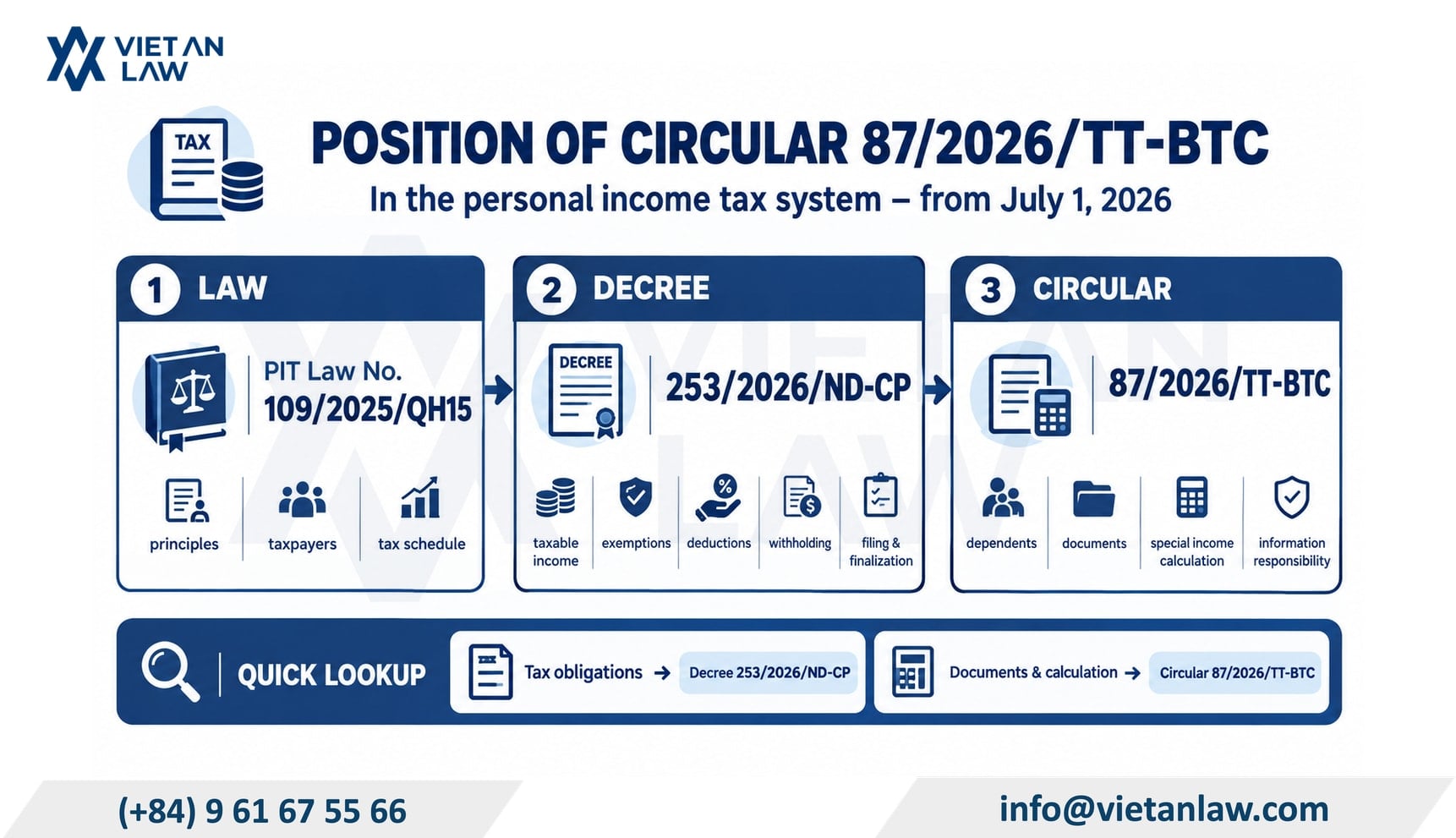
Three-tier framework: the Law sets principles, the Decree sets the rules, the Circular sets the details
| Tier | Document | Role |
| Law | Law on Personal Income Tax No. 109/2025/QH15 | Principles, taxpayers, tax schedule |
| Decree | Decree No. 253/2026/ND-CP | Residents, taxable and tax-exempt income, tax calculation bases, family circumstance deductions, withholding, declaration – finalization – refund |
| Circular | Circular 87/2026/TT-BTC | Dependent income threshold, dossiers and documents, calculation for special types of income |
To determine whether tax must be paid, refer to Decree No. 253/2026/ND-CP, which provides guidance on Personal Income Tax Law. To know which dossiers to submit and how to calculate tax in each case, refer to Circular 87/2026/TT-BTC.
When does Circular 87/2026/TT-BTC replace Circular 111/2013/TT-BTC in Vietnam?
Under Article 6, the Circular takes effect from July 1, 2026. In particular, provisions on business income and income from salaries and wages of residents apply from the 2026 tax period. At the same time, Circular 87/2026/TT-BTC replaces Circular 111/2013/TT-BTC guiding the Law on Personal Income Tax 2007 and Decree No. 65/2013/ND-CP.
This is a point accountants should pay special attention to. Although the Circular only takes effect from July 1, 2026, the provisions on salaries and wages cover the entire 2026 tax period, including the period from January 1, 2026. Any differences are therefore handled at finalization rather than by re-declaring each past month. Along with Circular 111, the documents amending it – notably Circular 79/2022/TT-BTC – also cease to apply.
New points of Circular 87 on personal income tax compared with Circular 111/2013/TT-BTC in Vietnam
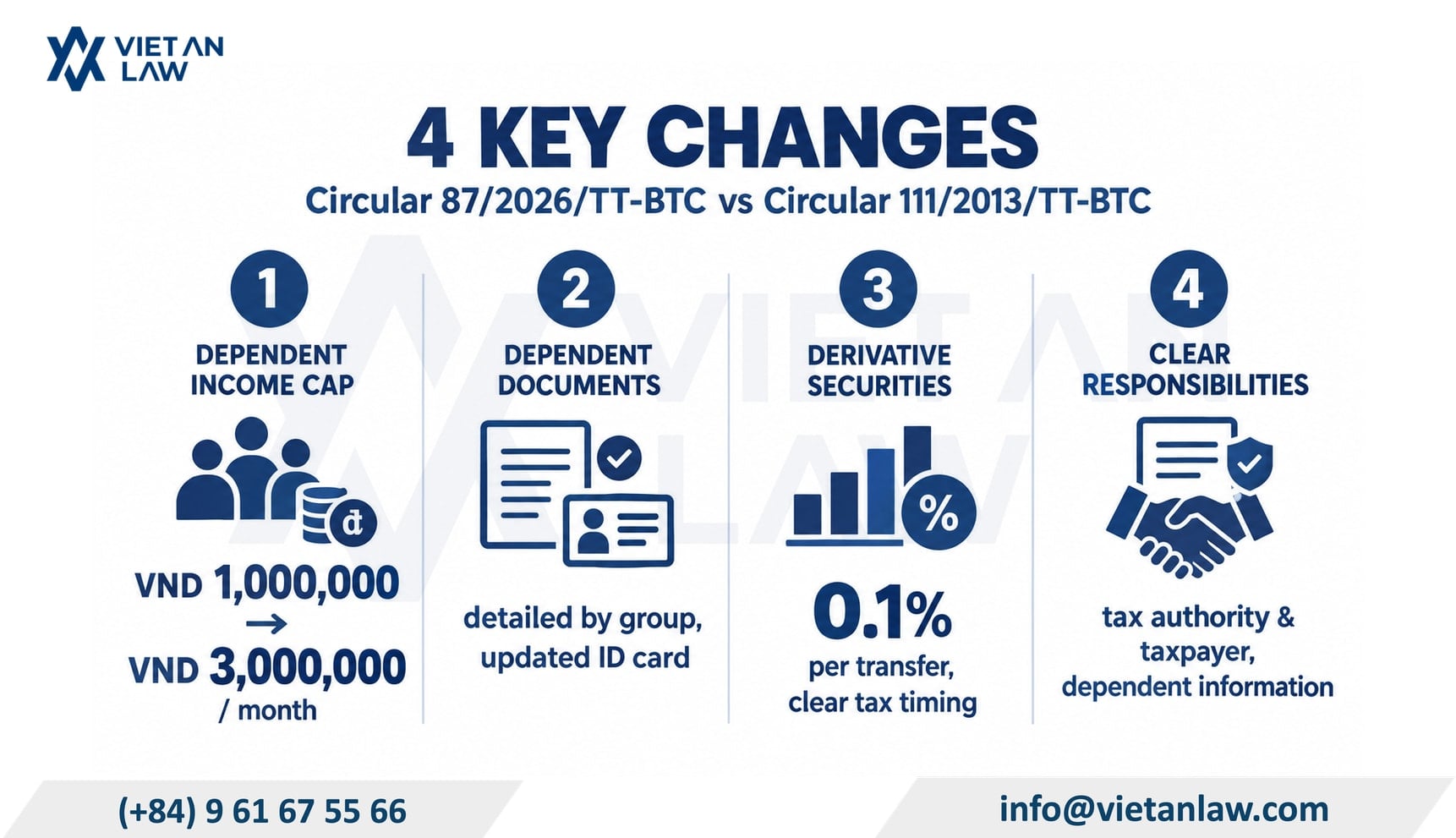
From a higher dependent income cap to a 0.1% levy on derivatives trades: four notable changes
Raising the cap: dependent income not exceeding VND 3 million
Clause 1, Article 3 of Circular 87/2026/TT-BTC provides that the average monthly income in a year from all income sources of a dependent must not exceed VND 3,000,000. Previously, Point dd, Clause 1, Article 9 of Circular 111/2013/TT-BTC set this threshold at only VND 1,000,000 per month – a figure that had become outdated compared with current pension and allowance levels.
The new threshold applies to the registration of deductions for a spouse, parents, children over 18 years old, other relatives without support, or persons unable to work.
Example: Mr. B’s mother receives a pension of VND 2,500,000 per month. Under the old regulations, this exceeded the VND 1,000,000 threshold, so Mr. B could not register his mother as a dependent. From the 2026 tax period, with the dependent income cap of VND 3,000,000, Mr. B’s mother is eligible and Mr. B is entitled to one more family circumstance deduction.
This change significantly expands the group of eligible dependents, meaning enterprises applying the new dependent deduction regulations will receive a considerable number of new registration dossiers in the second half of 2026.
Detailed dependent proof documents from July 1, 2026
Article 4 of the Circular specifies the dossiers for each group of dependents, replacing the scattered wording used previously. For children as dependents, the Circular clearly distinguishes the following cases: biological children, adopted children, stepchildren, children with disabilities or who have lost civil act capacity, and children studying at educational institutions.
| Case | Dossier under Circular 87/2026/TT-BTC |
| Biological child | Copy of the birth certificate and copy of the identity card (if issued) |
| Child aged 18 or older with a disability and unable to work | Copy of the birth certificate, copy of the ID card or citizen identity card (if any) and copy of the disability certificate under the law on persons with disabilities |
The improvement lies in updating the correct names of identity documents under the law on identification, while adding the condition “if issued” to avoid problems with children who are not yet old enough to be issued a card. On that basis, taxpayers and income-paying organizations need to standardize the collection, storage and cross-checking of dependent proof documents to ensure they are complete and valid when inspected by the tax authority.
First guidance on derivative securities tax
Article 5 adds an entirely new provision: personal income tax on income from the transfer of derivative securities equals the transfer price multiplied (x) by a tax rate of 0.1% per transfer. For futures contracts, the transfer price is the transfer price of each futures contract transfer.
Regarding the time of tax calculation, Clause 3, Article 5 defines it as the time when the investor’s buy or sell order for futures contracts is matched on the trading system of the Stock Exchange, or the time the futures contract matures.
Circular 111/2013/TT-BTC only provided guidance on tax on securities transfers in general, without specific provisions on derivatives or guidance on determining the transfer price, tax rate and time of tax calculation for futures contracts. This gap once carried the risk of disputes during finalization.
Clarifying the responsibilities of tax authorities and taxpayers
The Circular adds provisions on the responsibilities of tax authorities and taxpayers regarding dependent information. As population data and tax data become interconnected, duplicate registration of a dependent will be detected automatically, so responsibility for explanation and adjustment under the dependent deduction regulations must be transparent from the outset.
Summary comparison table
| Criteria | Circular 111/2013/TT-BTC | Circular 87/2026/TT-BTC |
| Dependent income threshold | Not exceeding VND 1,000,000/month | Not exceeding VND 3,000,000/month |
| Documentation for dependents | Scattered, citing documents under old regulations | Detailed by group, updated with identity cards |
| Derivative securities | No specific provisions | Tax rate of 0.1% per transfer, clear time of tax calculation |
| Responsibility for dependent information | Not clearly separated | Clearly defined two-way responsibilities |
| Guided original documents | Law on Personal Income Tax 2007, Decree No. 65/2013/ND-CP | Law on Personal Income Tax No. 109/2025/QH15, Decree No. 253/2026/ND-CP |
Circular 89/2026/TT-BTC guiding the Law on Tax Administration in Vietnam
What is Circular 89/2026/TT-BTC?
On the same day, June 30, 2026, the Ministry of Finance issued Circular 89/2026/TT-BTC detailing a number of articles of the Law on Tax Administration 2025 (No. 108/2025/QH15) and Decree No. 252/2026/ND-CP, effective from July 1, 2026. The document governs tax declaration, tax payment, tax exemption and reduction, handling of violations and the system of forms for tax administrative procedures.
Division of roles between the two Circulars
The two documents do not overlap but complement each other on the principle: calculate correctly under Circular 87, declare correctly under Circular 89.
| Group of tasks | Applicable document |
| Taxable income, family circumstance deductions, dependents | Circular 87/2026/TT-BTC |
| Tax calculation for derivative securities | Circular 87/2026/TT-BTC |
| Tax registration, declaration, payment and refund | Circular 89/2026/TT-BTC |
| Tax declaration forms and tax notices | Circular 89/2026/TT-BTC |
| Electronic transactions in tax administration | Circular 89/2026/TT-BTC |
A common mistake during the transition period is calculating the correct tax amount but filing the wrong form, or vice versa – both lead to the risk of administrative penalties for tax violations.
Changes in Circular 89 affecting personal income tax
First, from July 1, 2026, monthly personal income tax declaration for income from salaries and wages is abolished.
Second, under Article 99 of Circular 89/2026/TT-BTC, a number of tax declaration forms for business households and individual businesses are replaced with new forms; the forms under Circular 50/2026/TT-BTC and Circular 18/2026/TT-BTC cease to be effective and are replaced by the forms in Appendix I.
Third, the Circular fully or partially repeals many previous documents, including Circular 80/2021/TT-BTC, Circular 19/2021/TT-BTC, Circular 103/2014/TT-BTC and Circular 92/2015/TT-BTC. Fourth, it adds provisions on electronic transactions in tax administration.
Effectiveness and transitional provisions in Vietnam
The common effective date of both Circulars is July 1, 2026. Income from salaries and wages and business income of residents are subject to the new rules for the entire 2026 tax period.
Where tax on salaries and wages for the 2026 tax period was declared and paid between January 1, 2026 and the effective date, taxpayers do not have to resubmit monthly or quarterly tax declaration dossiers but make adjustments in the finalization dossier.
A technical note that is often overlooked: transitional provisions on procedures are in Circular 89/2026/TT-BTC, while transitional provisions on policy are in Decree No. 253/2026/ND-CP and Circular 87/2026/TT-BTC. Looking up the wrong document is a common cause of misapplication during the transition period.
What should enterprises and taxpayers in Vietnam do now?
- Review stored dependent dossiers, compare them with the list of documents in Article 4 and supplement any missing items.
- Filter the group of dependents with income of VND 1,000,000 – 3,000,000 per month and notify employees to register them additionally.
- Update the configuration of payroll and accounting software according to the new threshold.
- Standardize welfare policies: review mid-shift meal allowances, housing paid on behalf of employees, life insurance and voluntary pension contributions to determine the portion included in taxable income as guided by Decree 253/2026/ND-CP.
- Replace the set of tax declaration forms with the forms in Appendix I of Circular 89/2026/TT-BTC.
- Derivatives investors should cross-check the tax withheld by securities companies at 0.1% per transfer.
- Establish a document storage process, ready for tax inspections and audits.
Personal income tax consulting services at Viet An Law Firm in Vietnam
Circular 87/2026/TT-BTC guiding the Personal Income Tax Law and Decree 253 in Vietnam creates a considerable review workload right in the 2026 finalization period. Viet An Law Firm provides the following services:
- Reviewing and standardizing dependent dossiers and family circumstance deduction dossiers;
- Advising on personal income tax finalization for the 2026 tax period during the transition;
- Advising on tax obligations for non-residents and foreigners working in Vietnam;
- Supporting explanations and working with tax authorities during tax inspections and audits.
Frequently asked questions
When does Circular 87/2026/TT-BTC take effect?
From July 1, 2026. The provisions on business income and salaries and wages of residents apply from the 2026 tax period. The Circular replaces Circular 111/2013/TT-BTC guiding the Law on Personal Income Tax 2007 and Decree No. 65/2013/ND-CP.
How is the time of tax calculation for futures contracts determined?
It is the time when the buy or sell order for futures contracts is matched on the trading system of the Stock Exchange, or the time the contract matures. This is the basis for applying derivative securities tax at 0.1% per transfer.
How do Circular 87 on personal income tax and Circular 89/2026/TT-BTC differ?
Circular 87 provides personal income tax guidelines on tax policy, while Circular 89/2026/TT-BTC guides the Law on Tax Administration and Decree No. 252/2026/ND-CP, governing procedures for tax registration, declaration, payment and refund as well as forms.
Do taxpayers who declared tax under the old regulations for the first months of 2026 have to re-declare?
No. Taxpayers make adjustments in the finalization dossier for the 2026 tax period instead of resubmitting monthly or quarterly tax declaration dossiers.
Does the new Circular change the income threshold at which tax starts to arise?
No. This threshold is determined by the tax schedule and family circumstance deduction levels under the Law on Personal Income Tax and Decree No. 253/2026/ND-CP.
If clients need detailed advice on Circular 87/2026/TT-BTC guiding the Personal Income Tax Law and Decree 253 in Vietnam or any other guidance on Personal Income Tax Law, please contact Viet An Law Firm for the quickest and most accurate support.