


Circular 89/2026/TT-BTC was issued by the Ministry of Finance on June 30, 2026, and takes effect on July 1, 2026, detailing certain articles of the Tax Administration Law No. 108/2025/QH15 and Decree 252/2026/ND-CP. The new circular simultaneously replaces the previous tax administration guidelines system, creating a new legal framework for electronic tax transactions, tax declaration, payment, refund, tax risk management regulations, and tax inspection. For enterprises, accountants, and business individuals, the point of concern is not only the change of forms but also how tax authorities classify risks, receive electronic dossiers, inspect taxes, and process tax obligations from July 1, 2026. In the article below, Viet An Law will help you better understand Circular 89/2026/TT-BTC guiding the Tax Administration Law and Decree 252 in Vietnam.
What is notable about Circular 89/2026/TT-BTC guiding the Tax Administration Law?
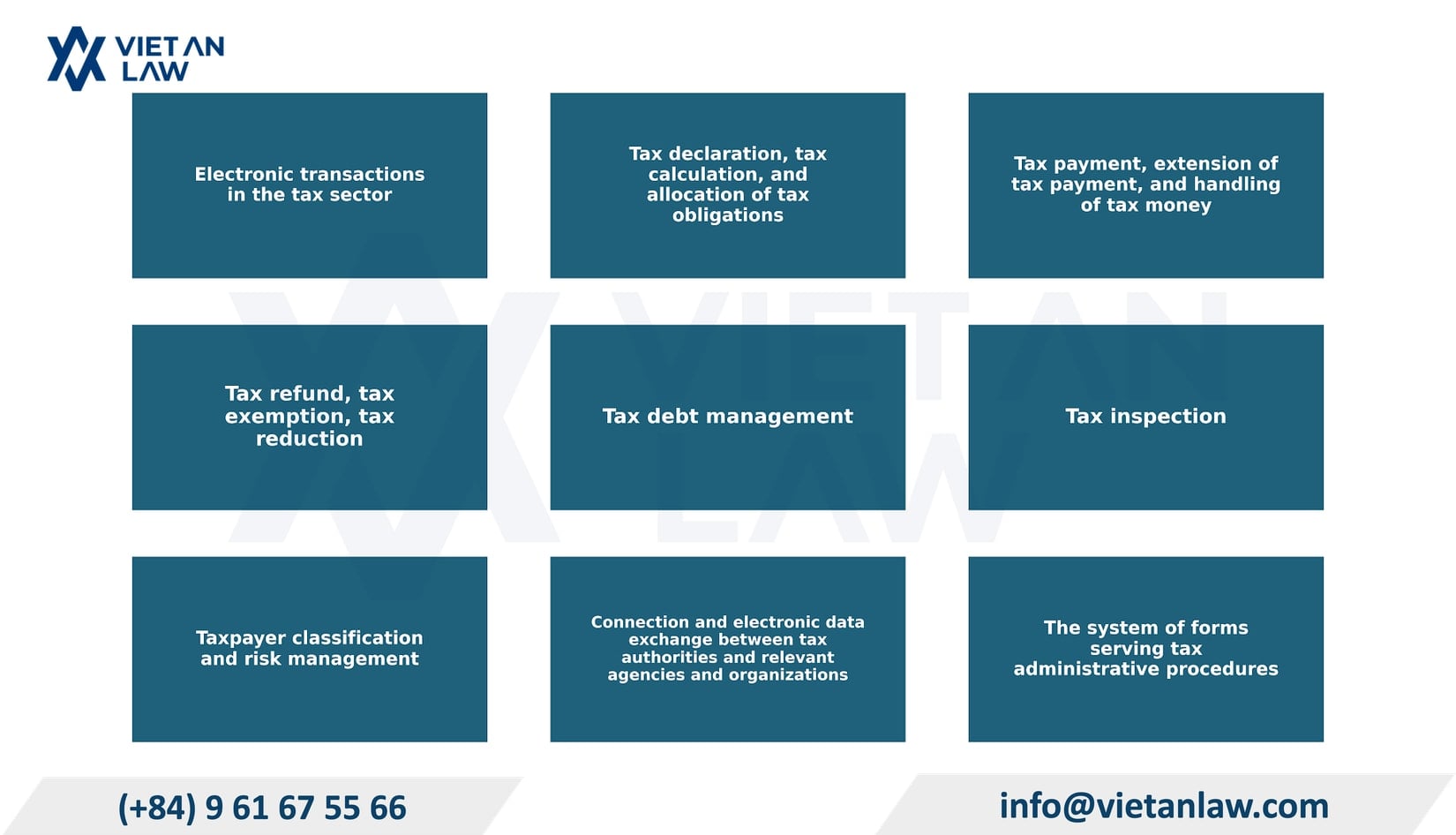
Circular 89/2026/TT-BTC provides guidance on Tax Administration Law and Decree 252/2026/ND-CP across various groups of contents assigned, including:
- Electronic transactions in the tax sector;
- Tax declaration, tax calculation, and allocation of tax obligations;
- Tax payment, extension of tax payment, and handling of tax money;
- Tax refund, tax exemption, tax reduction;
- Tax debt management;
- Tax inspection;
- Taxpayer classification and risk management;
- Connection and electronic data exchange between tax authorities and relevant agencies and organizations;
- The system of forms serving tax administrative procedures.
A systematic change is that Circular 89 on tax administration replaces Circular 80/2021/TT-BTC and certain previous documents on tax administration guidelines starting from July 1, 2026. Therefore, enterprises should not continue to use the old form system for dossiers arising under the new regulations.
Additional documents you should consult when reading along with Circular 89/2026/TT-BTC to understand taxes
- Circular 89/2026/TT-BTC is an implementing guideline document; therefore, when carrying out tax administration procedures, enterprises should not solely rely on the circular but must cross-reference relevant legal documents.
- Decree 252 on tax administration is an important document detailing and guiding the implementation of certain articles of the Tax Administration Law. The contents regarding the scope of tax administration, tax declaration, tax payment, tax refund, debt management, and specific cases must be considered simultaneously with Circular 89/2026/TT-BTC. Enterprises can view details in the article on Decree 252/2026/ND-CP guiding the Tax Administration Law by Viet An Law.
Furthermore, for enterprises with related party transactions, special attention must be paid to Decree 255/2026/ND-CP on tax administration for enterprises having related party transactions. This is a group of regulations with separate requirements for determining related party transactions, declaration, and related dossiers, so the general tax administration guidelines in Circular 89 should not be applied alone.
- Regarding the Tax Administration Law of 2025, this is the direct legal basis for promulgating Circular 89/2026/TT-BTC. Changes in the rights and obligations of taxpayers, risk management, electronic transactions, and tax administration must be cross-referenced with the provisions of the law before being applied to each specific case.
New points enterprises need to pay attention to from July 1, 2026 in Vietnam
| Content | Regulations to note according to Circular 89/2026/TT-BTC |
| Tax transactions | Continue to be standardized regarding transaction accounts, electronic signatures, electronic dossiers, and the receipt and processing of dossiers |
| Risk management | Taxpayers are categorized based on location, scale, business line, compliance level, and tax risk |
| Tax inspection | Enhance the application of management methods based on data and risk |
| Tax declaration and payment | More specific guidance on dossiers, procedures, and implementation methods |
| Tax refund | Dossiers are processed in association with classification criteria and risk management |
| Forms | Change and supplement the system of forms to align with the Tax Administration Law 2025 and Decree 252/2026/ND-CP |
| Tax data | Enhance the connection and sharing of electronic data between tax authorities and relevant agencies and organizations |
Thus, the most notable change does not lie in a single procedure but in the strong shift toward tax administration using data and risk levels.
Tax risk management in Vietnam
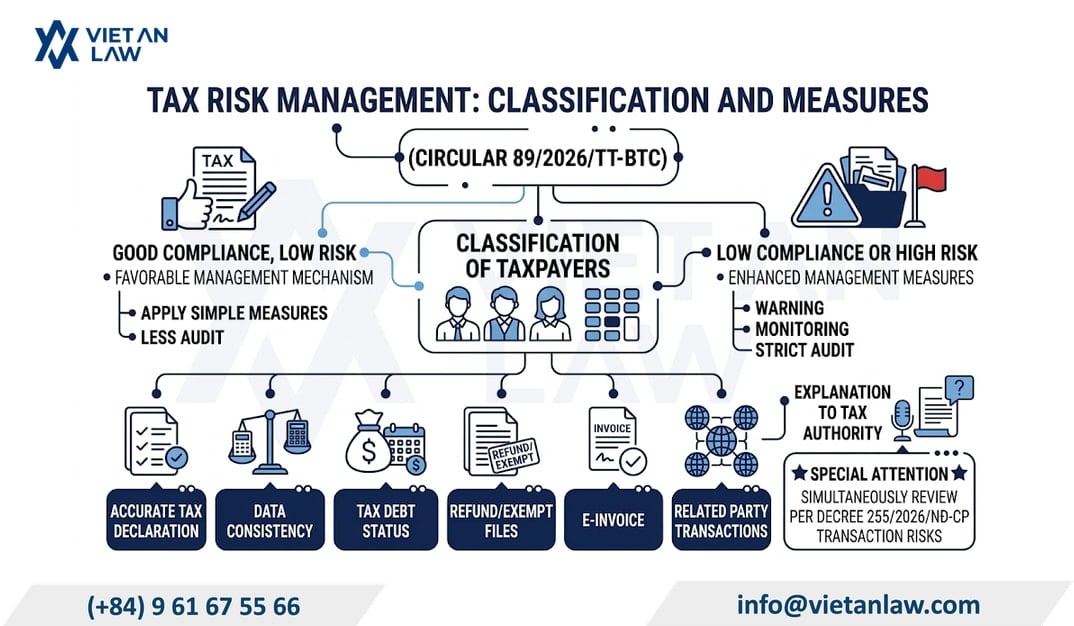
Circular 89/2026/TT-BTC specifies criteria for categorizing taxpayers based on multiple factors such as location, scale, business line, payable tax amount, number of dependent units, compliance history, and risk level.
Tax authorities may classify taxpayers according to different compliance levels, from good compliance to non-compliance. On that basis, management measures are also differentiated.
Enterprises with a good compliance level and low risk may be subject to a more favorable management mechanism. Conversely, taxpayers with a low compliance level or high risk may fall under the category of warning, supervision, inspection, or the application of enhanced management measures.
This requires enterprises to pay more attention to:
- The accuracy of tax declaration dossiers;
- The consistency between accounting data and tax dossiers;
- Tax debt status;
- Tax refund, tax exemption, and tax reduction dossiers;
- Electronic invoices;
- Dossiers for related party transactions;
- Providing explanations when requested by tax authorities.
In particular, enterprises with related party transactions must simultaneously review the tax risk management regulations concerning related party transactions under Decree 255/2026/ND-CP, instead of merely checking ordinary declaration obligations. Clients can learn more about the new regulations on tax administration for related party transactions in the respective article by Viet An Law: https://vietanlaw.com/latest-updates-on-tax-administration-for-associated-transactions-in-vietnam/
Electronic tax transactions are more standardized in Vietnam
Circular 89/2026/TT-BTC dedicates a separate group of regulations to electronic transactions in tax administration.
The guided contents include registering and using electronic tax transaction accounts, electronic signatures, preparing and sending electronic dossiers, receiving dossiers, as well as exchanging information with tax authorities.
- Electronic tax transaction accounts operate normally;
- Authorized persons perform correctly within their scope;
- Electronic signatures remain valid;
- Electronically submitted dossiers follow the correct form;
- Regularly checking notifications from tax authorities;
- Archiving electronic dossiers and relevant documents to serve explanation purposes.
Failing to monitor the electronic tax account may cause the enterprise to miss explanation requests or notifications from tax authorities.
Tax declaration, tax refund, tax inspection, and tax evasion in Vietnam
Circular 89 not only guides how to submit declaration forms but also specifies many contents related to tax declaration, tax allocation, tax refund, tax exemption and reduction, and tax inspection.
Notably, inspection activities are placed within the risk management mechanism. Cases showing signs of violation, having high risks, or falling under planned or thematic inspections may be inspected by tax authorities at the taxpayer’s headquarters in accordance with regulations.
For cases showing signs of tax evasion, the Tax Administration Law of 2025 also establishes a mechanism allowing tax authorities to collect information and access data from accounting software, electronic invoices, and cash registers within the scope permitted by law.
Therefore, enterprises should not merely focus on submitting on time but must ensure that the dossiers are capable of proving the legality of the transactions.
Dossiers to prepare:
- Economic contracts;
- Invoices;
- Payment documents;
- Goods receipt and delivery notes;
- Handover minutes;
- Acceptance dossiers;
- Labor and salary records;
- Dossiers for related party transactions if applicable;
- Accounting books and data;
- Explanation dossiers for tax authorities.
Additionally, the Tax Administration Law of 2025 clearly stipulates behaviors considered tax evasion from July 1, 2026, such as: failing to submit tax registration dossiers or tax declaration dossiers, using illegal invoices and documents. This regulation is guided by Viet An Law through our article on the law, which clients can access to learn more.
How does Circular 89/2026/TT-BTC guiding the Tax Administration Law change the forms?
One of the issues accountants must handle right from July 1, 2026, is updating the system of forms.
Circular 89/2026/TT-BTC issues a system of forms serving procedures for tax declaration, tax refund, tax exemption and reduction, and other tax administration procedures.
Enterprises need to review their accounting software, declaration software, and internal dossiers to avoid situations of:
- Mistakenly using old forms;
- Incorrectly declaring indicators;
- Submitting dossiers improperly against regulations;
- Failing to update new forms in the accounting process;
- Using instructional documents that have expired.
This is an especially important point for enterprises with multiple branches, business locations, or those incurring various types of tax obligations.
Frequently asked questions
When does Circular 89/2026/TT-BTC take effect?
Circular 89/2026/TT-BTC takes effect on July 1, 2026, and replaces the previous tax administration guidelines regulations within the scope regulated by the circular.
Do enterprises using old tax declaration forms have to switch to new forms?
Yes. Enterprises must review each type of dossier and use the forms according to the system issued with Circular 89/2026/TT-BTC for dossiers falling within the application scope from July 1, 2026.
Does Circular 89 change the tax obligations of enterprises?
The circular primarily guides and specifies the provisions of the Tax Administration Law 2025 and Decree 252/2026/ND-CP. Therefore, it is necessary to distinguish the tax obligations stipulated in the law and decree from the method of implementing procedures guided in the circular.
Do enterprises having related party transactions only need to comply with Circular 89/2026/TT-BTC?
No. Besides the general regulations on tax administration, enterprises having related party transactions must separately review the regulations in Decree 255/2026/ND-CP and related guiding documents.
Should we hire a tax and accounting service when Circular 89/2026/TT-BTC takes effect?
For enterprises with multiple types of taxes, multiple branches, related party transactions, or frequently incurring tax refunds, using a tax and accounting service can help review dossiers, update forms, and limit risks when tax authorities manage based on data and compliance levels.
Tax consulting services in Vietnam by Viet An Law
The transition to the new tax administration system from July 1, 2026, forces enterprises to simultaneously update the Tax Administration Law 2025, Decree 252/2026/ND-CP, Circular 89/2026/TT-BTC, and relevant specialized regulations.
Viet An Law provides enterprise support services such as:
- Consulting and reviewing tax dossiers;
- Tax and accounting service;
- Tax declaration and finalization;
- Reviewing accounting books and documents;
- Tax refund consulting;
- Tax administration consulting for related party transactions;
- Supporting enterprises in explaining and working with tax authorities within the service scope.
Enterprises should review their accounting and tax processes early to limit risks from using incorrect forms, missing dossiers, or failing to meet explanation requirements when tax authorities conduct risk-based management.
For more detailed advice on the above, please contact Viet An Law for the best support regarding Circular 89/2026/TT-BTC, which guides the Tax Administration Law and Decree 252 in Vietnam!