


From July 1, 2026, tax administration in Vietnam will officially enter a new stage with the issuance of Decree 252/2026/ND-CP. This document serves as the key law on tax administration guidance, detailing the Law on Tax Administration 2025 and bringing major changes to the declaration mechanism, tax allocation and risk management for enterprises, notably the termination of a series of old decrees (such as Decree 126/2020/ND-CP). For enterprises, a professional tax accounting service is an effective way to keep up with these changes. The article below summarizes in detail the new points of Decree 252/2026/ND-CP guiding the Law on Tax Administration in Vietnam, effective from July 1, 2026.
Overview of Decree 252/2026/ND-CP guiding the Law on Tax Administration in Vietnam
From July 1, 2026, Decree 252/2026/ND-CP, which sets out the latest tax administration guidelines, replaces the following documents:
- Decree No. 126/2020/ND-CP dated October 19, 2020 detailing a number of articles of the Law on Tax Administration.
- Decree No. 91/2022/ND-CP dated October 30, 2022 amending and supplementing a number of articles of Decree No. 126/2020/ND-CP.
- Decree No. 49/2025/ND-CP dated February 28, 2025 on the thresholds for applying exit suspension.
- Decree No. 117/2025/ND-CP dated June 9, 2025 regulating tax administration for business activities of households and individuals on e-commerce and digital platforms.
- Decree No. 373/2025/ND-CP dated December 31, 2025 amending and supplementing a number of articles of Decree No. 126/2020/ND-CP.
Documents that remain in effect:
- Decree No. 125/2020/ND-CP dated October 19, 2020 on administrative penalties for violations related to taxes and invoices (as amended and supplemented by Decree No. 102/2021/ND-CP;
- Decree No. 310/2025/ND-CP) continues to be effective from July 1, 2026 until it is replaced by a new document.
- Transitional provisions: The provisions on the allocation of payable value-added tax (VAT) at Points a.2, a.3, a.4, a.5 and a.6, Clause 2, Article 15 of the Decree (except for the allocation of input VAT) shall apply until December 31, 2026.
- Application of referenced documents: Where the legal documents referenced in this Decree are amended, supplemented or replaced, the new amended, supplemented or replacing documents shall apply.
6 breakthrough changes of the new tax administration decree in Vietnam
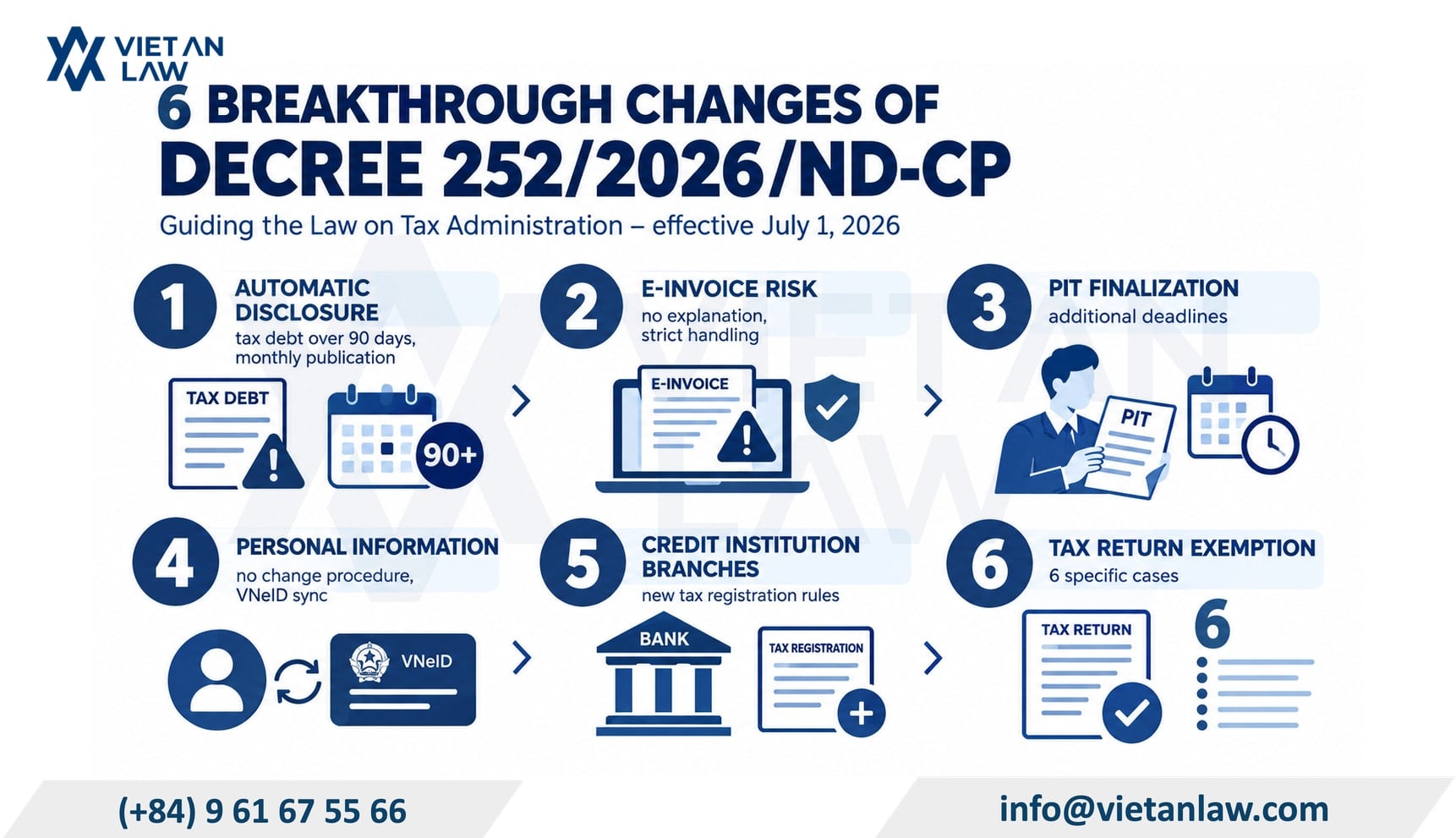
Automatic disclosure of information when tax debts are overdue by more than 90 days
Article 4 of Decree 252/2026/ND-CP (effective from July 1, 2026) specifies the cases in which tax authorities are permitted to disclose taxpayer information in order to enhance the transparency and effectiveness of tax administration.
The new point of this regulation under the decree on tax administration is the shift from manual processing to full automation on the data system of the tax sector:
- Triggering condition: The system records a violation when a taxpayer or guarantor is more than 90 days past the deadline for paying taxes, other revenues, late payment interest or fines, or past the deadline for complying with an administrative decision on tax administration, without voluntarily complying.
- Automatic operating mechanism: Unlike before, when tax authorities had to review and decide on disclosure case by case, Decree 252/2026/ND-CP provides that the tax administration information system will automatically disclose information on a monthly basis. This is done immediately after the 90-day overdue milestone without waiting for any decision or paperwork from the management authority.
Strict handling of failure to explain e-invoice risks
Under the new law on tax administration guidance, delays or refusals to provide explanations when the system issues e-invoice risk warnings will be subject to direct and automatic sanctions, no longer stopping at reminders. The handling measures include:
| Handling measure | Details | Legal basis (Decree 252/2026/ND-CP) |
| Suspension of e-invoice issuance | Suspension of the right to issue invoices if no explanation is provided by the deadline or the explanatory documents are invalid. | Point a, Clause 2, Article 16 |
| Unscheduled inspection | Inclusion in the very high risk list for unscheduled inspection and audit at the head office. | Clause 3, Article 18 and Point c, Clause 1, Article 22 |
| Handling of administrative violations | Making a penalty record, collecting tax arrears or transferring the case to the investigation agency in case of non-cooperation in explaining fictitious invoices. | Clause 1, Article 45 and Article 47 |
| Public disclosure of information | Publishing information on enterprises with blocked invoices on the web portal of the General Department of Taxation. | Clause 4, Article 29 |
Removal of the procedure for notifying changes in personal information to tax authorities
- Decree 252/2026/ND-CP exempts individuals (taxpayers) from the obligation to submit a dossier notifying changes in tax registration information where such information has been automatically shared and updated from the National Population Database to the database of the tax sector.
- This is based on the regulations on electronic data interconnection and sharing between the Ministry of Public Security (the agency managing population data and the VNeID application) and the Ministry of Finance (General Department of Taxation) under the Law on Tax Administration 2025. Accordingly, the personal identification number is officially used as the tax code, completely replacing the previous mechanism of issuing separate tax codes.
Note: The Decree still retains the requirement to update information manually (within 20 working days) for groups that cannot be interconnected automatically, including:
- Foreign individuals (changes in passport, visa or residence document information).
- Individuals who have not yet been synchronized with level-2 electronic identification on VNeID, or cases where the national data system encounters technical problems preventing automatic synchronization.
Additional PIT finalization deadlines
Change in calculating the first-year finalization deadline for foreigners (≥ 183 days)
- The new regulation completely replaces the method of calculating the tax return deadline as “90 days from the date of completing 12 consecutive months” for foreign individuals working in Vietnam. This change applies to foreign individuals present in Vietnam for 183 days or more in the first year under Article 10 of Decree 252/2026/ND-CP.
- This updated calculation helps income-paying enterprises, HR departments and their PIT finalization service providers avoid determining the finalization deadline incorrectly.
Additional timeline for individuals present for less than 183 days
Addressing the limitations of previous documents, Decree 252/2026/ND-CP adds clear provisions on the tax finalization deadline for individuals present in Vietnam for less than 183 days.
Reaffirming deadline classification by finalization subject
- For income-paying organizations (enterprises finalizing on behalf of employees): The deadline for submitting the tax finalization dossier is no later than the last day of the 3rd month from the end of the tax finalization period under Point a, Clause 5, Article 10 of Decree 252/2026/ND-CP.
- For individuals finalizing directly: The deadline for individuals who finalize by themselves is extended to no later than the last day of the 4th month from the end of the calendar year.
- Example: For the 2025 tax finalization period carried out in 2026, since April 30, 2026 and May 1, 2026 are public holidays, the deadline is moved to the next working day. Therefore, the exact deadline for individuals to finalize their taxes by themselves is May 2, 2026.
New regulations on tax registration for branches of credit institutions
The new tax administration decree brings systemic changes to reduce administrative procedures for the banking and finance sector, shifting from decentralized to centralized management of the network of branches and affiliated transaction offices.
- Unlike ordinary enterprises, under Vietnam tax administration decree 252, branches or dependent units of credit institutions may complete tax registration within 10 working days at the latest from the date of commencement of operations (instead of from the date of issuance of the certificate of operation registration/establishment license).
- Centralized tax code integration: Branches and transaction offices of credit institutions that do not directly and independently declare and pay taxes are no longer required to register for separate tax codes with local tax authorities as before.
- Electronic interconnection mechanism: The tax administration system allows the use of dependent tax codes (13-digit tax codes) that are automatically issued and interconnected via the National Business Registration Portal or the system of the State Bank of Vietnam, linked to the tax code of the head office.
Exemption from submitting tax returns in 6 specific cases
The new regulation at Article 11 of Decree 252/2026/ND-CP continues the existing cases of exemption from submitting tax returns and, under the updated tax administration guidelines, adds 6 new cases, including:
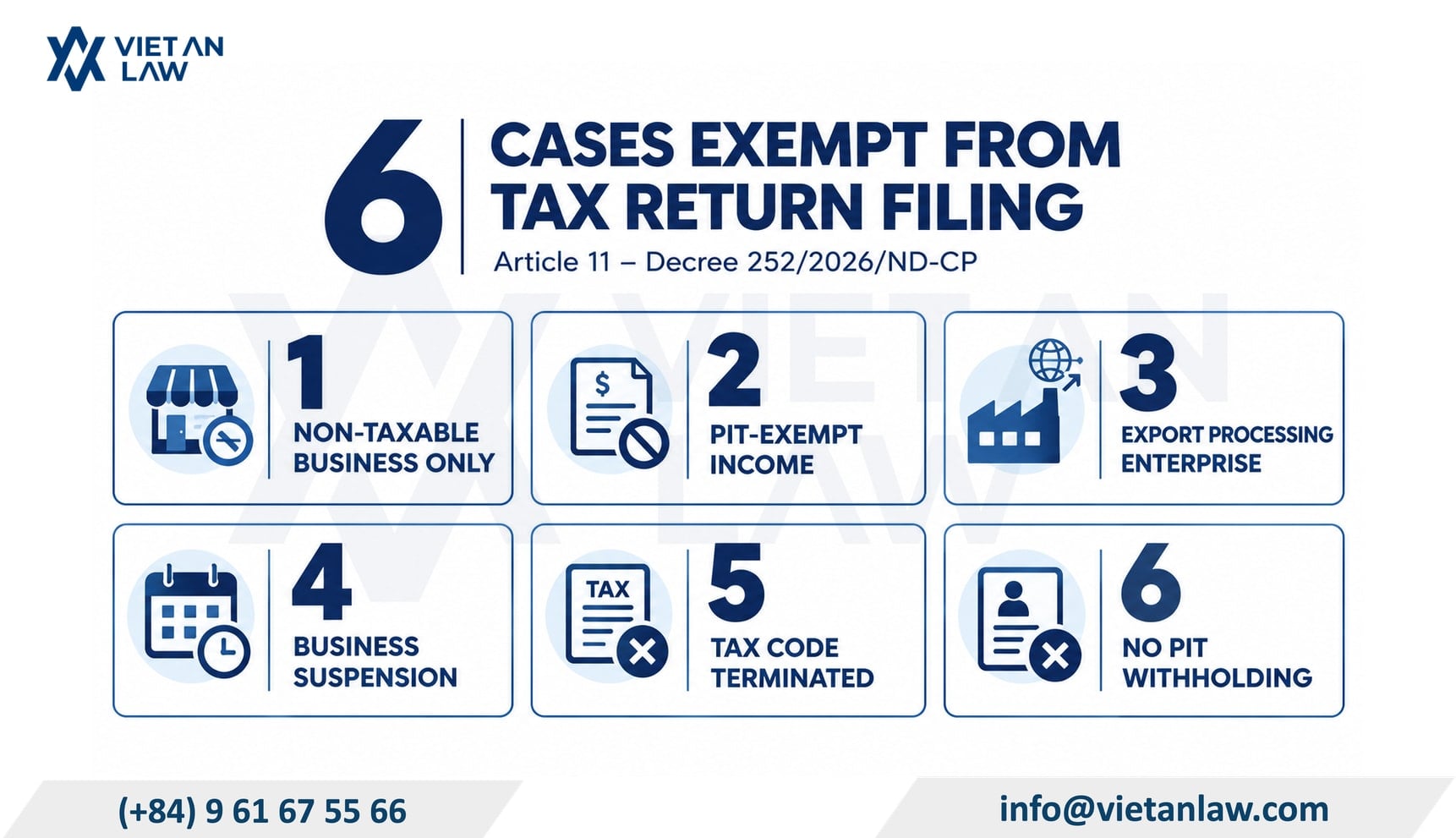
Taxpayers with only non-taxable business activities
- Taxpayers that only carry out activities or business not subject to tax as prescribed.
- Except for business households/individuals with revenue not subject to VAT and not required to pay PIT (this group follows separate regulations under Decree No. 141/2026/ND-CP).
PIT-exempt income (conditional)
- Income-paying organizations/individuals and individuals declaring tax directly are not required to submit PIT returns for tax-exempt income (as prescribed in Articles 4 and 5 of the Law on Personal Income Tax).
- Except for income from real estate transfers, transfers of a sole residential house, and inheritances/gifts of real estate; income of experts from innovative start-up projects; and certain other specific exemptions involving foreign elements/remittances.
Export processing enterprises
- Export processing enterprises that only carry out pure export processing activities are completely exempt from submitting value-added tax (VAT) returns.
Units in the period of business suspension
- Taxpayers that have completed the procedures and are in the period of lawful suspension of operations or business under Point c.1, Clause 1, Article 7 of Decree 252/2026/ND-CP.
Units whose tax codes have been terminated
- Taxpayers that have completed the submission of the dossier for termination of their tax codes.
- Organizations must still submit tax finalization dossiers up to the time of termination and tax returns for obligations arising after the time of filing the termination request.
No PIT withholding in the period (month/quarter)
- Income-paying organizations and individuals declaring PIT by period (monthly or quarterly) that have no PIT withholding from any income recipient in that period are not required to submit the tax return for that period.
- Important note: However, for the last month/quarter of the year, or a period in which a division, separation, merger, dissolution, bankruptcy or termination of operations occurs, the organization must still submit the tax finalization dossier even if no tax is withheld.
Comparison of Decree 126/2020/ND-CP and Decree 252/2026/ND-CP guiding the Law on Tax Administration in Vietnam
| Criteria | Decree 126/2020/ND-CP (expired) | Decree 252/2026/ND-CP (from July 1, 2026) |
| Legal basis | Guiding the Law on Tax Administration No. 38/2019/QH14. | Guiding the Law on Tax Administration No. 108/2025/QH15. |
| Exit suspension | Focused on individuals and legal representatives of Vietnamese nationality. | Clearly adds foreign individuals with overdue tax debts. |
| Declaration of changes in information | The timeframe had not been digitized or uniformly standardized for all groups. | No later than 10 days for cooperation contracts; 20–30 days for identification information. |
| PIT return exemption | No clear automatic classification for periods without withholding. | Exemption from monthly/quarterly returns if no tax is withheld (except the year-end finalization period). |
| E-invoice risks | Mainly reminders, manual handling and post-inspection. | Automatic suspension of invoice issuance if risks are not explained on time. |
| Tax authority system failures | No mechanism for automatic exemption from legal liability when e-Tax fails. | Exemption from late payment interest in case of system errors; tax authorities are responsible for withdrawing incorrect notices themselves. |
| Tax refund conditions | General provisions on tax refund request dossiers. | Organizations and individuals must have a tax code before carrying out refund procedures. |
Notes on tax finalization in Vietnam to avoid penalties in 2026
Late submission of tax returns or late tax payment will be penalized according to the severity of the violation
- CIT and PIT finalization (for the part paid by enterprises): No later than the last day of the 3rd month from the end of the calendar year (usually March 31).
- Individuals finalizing PIT directly with tax authorities: No later than the last day of the 4th month from the end of the calendar year (usually April 30).
- Note: If the last day falls on a day off or public holiday as prescribed, the deadline will be moved to the next working day.
Strict control of e-invoice risks
In 2025–2026, under the decree on tax administration, tax authorities are tightening checks on fictitious invoices through automated systems.
- Regular reconciliation: Review all input/output invoices on the system of the General Department of Taxation. Ensure that invoices are obtained from suppliers that are operating normally and are not on the “list of enterprises with high tax risk”.
- Prepare explanatory dossiers in advance: Upon receiving a notice from the tax authority on abnormal invoices, immediately prepare supporting documents (contracts, warehouse receipts/delivery notes, handover records, bank payment documents) to provide timely explanations.
Review of personal income tax (PIT) and salaries
- Tax on overtime and night work: The portion of salary paid in excess for overtime/night work compared to normal working hours is exempt from PIT. However, to qualify for the exemption, the unit must have full overtime timesheets, clear salary regulations and a payment rate in compliance with the Labor Code.
- Family deduction dossiers: Ensure that all employees who have registered dependants have complete and valid supporting documents before finalization.
- Personal income tax finalization authorization letter: Collect all tax finalization authorization letters (Form 02/UQ-QTT-TNCN) from eligible employees before submitting the dossier.
- Holiday and Tet bonuses (December 22 bonus, New Year/Lunar New Year): Bonuses of a salary or wage nature must be added to the taxable income of the month of payment and tax must be withheld as prescribed.
Synchronizing accounting data and archived records
- Matching figures: Figures in the financial statements, tax finalization returns and general ledger accounts (revenue, expenses, salaries) must match completely.
- Organized archiving: Arrange documents by month/quarter, with all contracts, payment documents and customs declarations (if any) attached, ready to be provided upon an inspection or audit decision from state authorities.
Frequently asked questions about Decree 252/2026/ND-CP and the Law on Tax Administration
Do business households have to apply e-invoices under the new law right from July 1, 2026?
There is no need to wait until July 1, 2026. Business households (paying tax under the declaration method) have been required to use e-invoices according to the roadmap since January 1, 2026. The new Law on Tax Administration, effective from July 1, 2026, only inherits and further tightens the risk management regulations for this group.
How can an enterprise know whether it has received an invoice risk warning?
Check on the e-Tax system. The tax authority will automatically send a “Notice requesting explanation” or a risk warning directly to the enterprise’s e-tax account (Thuedientu.gdt.gov.vn) and the registered email of the legal representative. The unit should proactively log in regularly to review the notifications section.
What are the benefits of interconnecting population and tax data for employees?
Using the citizen ID card instead of a tax code and automating procedures. Employees only need to use their personal identification number (on the ID card) for all tax transactions. This synchronization eliminates the submission of copies of identity documents and automatically updates dependant information when calculating family deductions.
When will an enterprise’s right to issue e-invoices be automatically suspended by the tax authority?
When the enterprise fails to provide an explanation by the notified deadline, or provides an explanation but fails to supply sufficient documents proving the legality of the goods and services, under Point a, Clause 2, Article 16 of Vietnam tax administration decree 252.
What are the consequences of not cooperating when requested to explain invoices showing signs of being fictitious?
The enterprise will be put on the very high risk list and subject to unscheduled inspection, administrative penalty records, tax arrears collection, or transfer of the case to the criminal investigation agency.
Where can partners look up information on enterprises whose invoices have been blocked due to violations?
Information on violating enterprises will be automatically published by the system on the web portal of the General Department of Taxation to warn of transaction risks.
Tax accounting service in Vietnam – Viet An Law Firm
Viet An Law Firm is one of the reputable providers on the market offering a “dual” solution that combines legal consulting and tax agent services. Having the function of a licensed tax agent allows Viet An not only to advise but also to directly sign tax returns, represent enterprises and provide explanations to state management authorities.
Viet An Law Firm’s tax services, including tax finalization service and PIT finalization service, are designed according to the life cycle of an enterprise:
- Initial tax declaration service
- Periodic all-inclusive tax accounting
- Review and completion of accounting books
- Value-added tax (VAT) refund
Advantages of using the service:
- Minimizing legal risks
- Optimizing time
- Saving costs
- Ensuring fast and compliant procedures
Viet An Law Firm provides tax finalization service, tax declaration and tax agent services with a fast, compliant process and confidentiality of client information.