


Decree 254/2026/ND-CP on electronic invoices replacing Decree 123 from July 1, 2026, has supplemented many new provisions to complete the legal framework for electronic invoices and documents according to the Law on Tax Administration 2025. In the article below, Viet An Law Firm will summarize and analyze the notable points of Decree 254/2026/ND-CP on Electronic Invoices in Vietnam from July 1, 2026 so that taxpayers can easily apply the correct regulations. One of the main concerns is the timing of issuing invoices, alongside other new e-invoice regulations 2026.
Overview of new points in the electronic invoices decree 123 replacement from July 1, 2026 in Vietnam
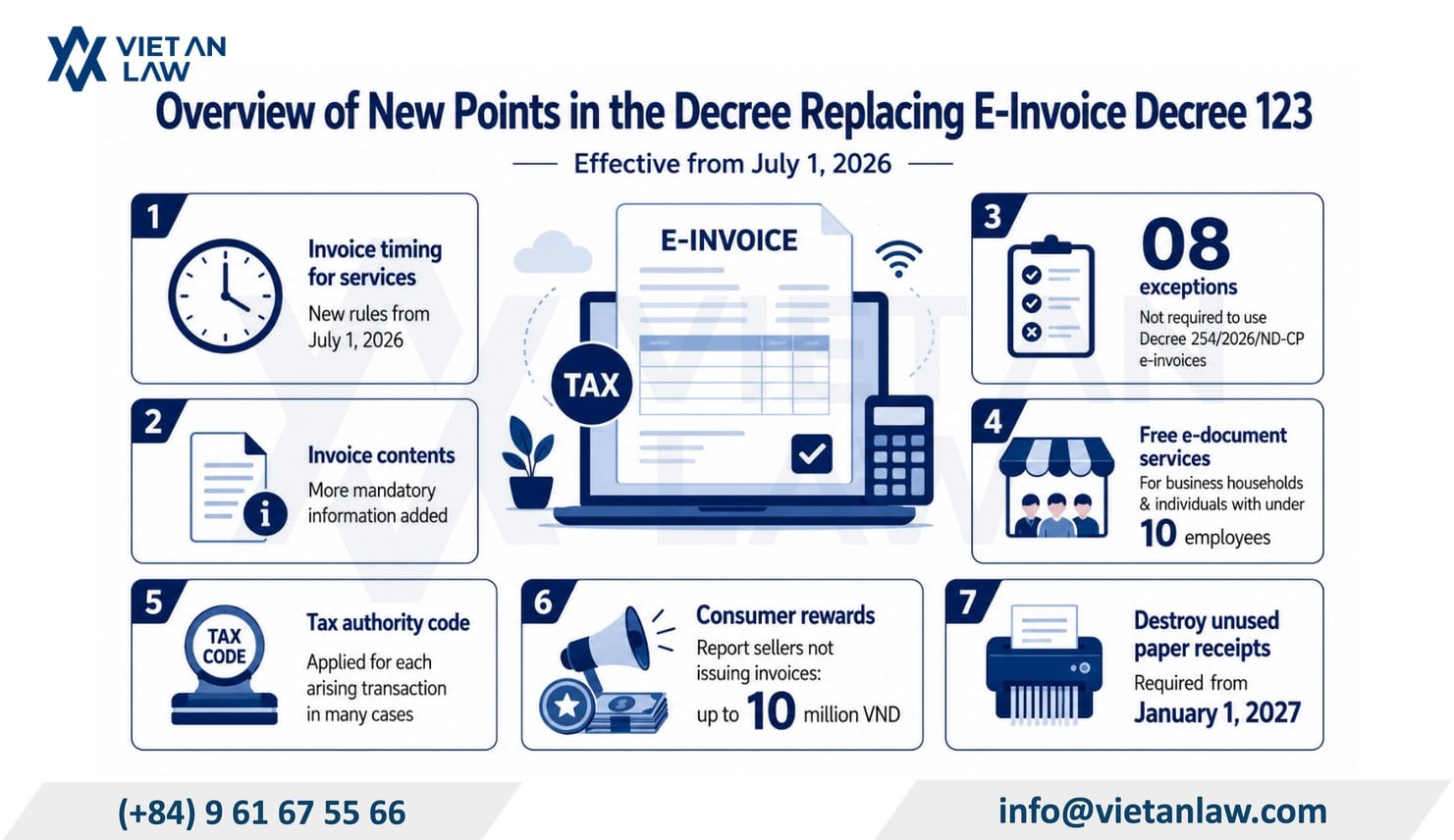
- New provisions on the timing of issuing invoices for service types from July 1, 2026;
- Adding many new contents required in invoices;
- 08 cases not required to use decree 254/2026/ND-CP e-invoices from July 1, 2026;
- Business households and individuals employing under 10 employees can use electronic document services for free;
- Many cases are granted electronic invoices with the tax authority’s code for each arising time;
- Consumers reporting sellers for not issuing invoices can be rewarded up to 10 million VND;
- From January 1, 2027, all unused paper receipts must be destroyed;
New regulations on the time of invoice issuance for service types from July 1, 2026 in Vietnam
According to Clause 2, Article 9 of Decree 254/2026/ND-CP on Electronic Invoices in Vietnam from July 1, 2026, the time of invoice issuance for service provision is the time of completing the service provision (including service provision for foreign organizations and individuals), regardless of whether money has been collected or not. In which, it is necessary to note:
Receiving deposits to perform service contracts does not require issuing invoices yet
In case the service provider collects money before or during the service provision, the time of invoice issuance is the time of collecting money (excluding the case of collecting deposits according to the Civil Code to secure the performance of the service provision contract).
Thus, the time of invoice issuance when providing services is the time of completing the service provision, regardless of whether money has been collected or not. In case the service provider collects money before or during the service provision, the time of invoice issuance is the time of collecting money.
However, this regulation does not include the case of collecting deposits according to the Civil Code 2015 to secure the performance of the service provision contract.
Meanwhile, according to the old regulation at Point a, Clause 6, Article 1 of Decree 70/2025/ND-CP amending Clause 2, Article 9 of Decree 123/2020/ND-CP, this time of invoice issuance does not include the case of collecting deposits/advances to secure the performance of service contracts for specific services:
- Accounting, auditing, financial consulting, tax accounting services;
- Appraisal;
- Surveying, technical design;
- Supervision consulting;
- Making construction investment projects.
Therefore, when an enterprise only receives a deposit to secure the conclusion and performance of a contract, it is not yet required to issue an invoice at the time of receiving the deposit, and this is not only applicable to specific services as before.
Services requiring a reconciliation period for issuing invoices after 7 days
Point a, Clause 4, Article 9 of the e-invoicing Decree 254 Vietnam has added services with large quantities, arising frequently, requiring time to reconcile data between enterprises selling goods, providing services, and clients, partners including:
- Maritime pilotage services;
- Advertising services on electronic newspapers;
- Digital technology and digital platform services;
- Information technology services including payment intermediary services used on telecommunications and information technology platforms;
- Crypto asset services;
- Services supporting transactions on carbon trading platforms;
- Insurance services;
- Security services.
The decree for the first time includes new industry groups subject to the use of electronic invoices without the tax authority’s code, including crypto asset services; services supporting transactions on carbon trading platforms,…
Medical examination and treatment facilities can issue aggregated electronic invoices at the end of the day
According to Point m, Clause 4, Article 9 of Decree 254/2026/ND-CP, it has supplemented the case where medical examination and treatment facilities can aggregate and issue electronic invoices for medical services performed during the day when the person coming for medical examination and treatment performs services with printed receipts such as scanning and screening.
Accordingly, conditions for aggregating and issuing electronic invoices at the end of the day for medical services performed during the day include:
- Being a medical examination and treatment facility using medical examination and treatment management software;
- Managing hospital fees, each medical examination and treatment transaction, and performing services with printed receipts;
- Stored on the information technology system;
- Persons coming for medical examination and treatment do not have the demand to get invoices.
Conversely, if the client has the demand to get an invoice, the medical examination and treatment facility shall issue an electronic invoice and give it to the client.
Adding many new contents required in invoices in Vietnam
Based on the appendix on invoice contents issued with the e-invoicing Decree 254/2026/ND-CP, some new regulations on electronic invoices are prescribed as follows:
Supplementing invoice contents of business households and business individuals subject to using electronic invoices and using the tax code of business households and business individuals for all stores
Invoice contents must have: Name, code, address of the business location.
- Petroleum trading enterprises: Code, address of the business location granted by the competent authority of each business location on the invoice.
- Commissioned electronic invoices: Name, address, tax code of the commissioning party and name, address, tax code of the commissioned party.
- Asset auction for judgment execution: Name, address, tax code of the agency assigned to auction the asset and name, address, tax code of the seller.
Supplementing instructions on how to write the buyer on the invoice if the buyer is a consumer who does not provide a name, address, and personal identification number
According to the new provision at Point b, Clause 4 of the Appendix issued with Decree 254/2026/ND-CP, in this case, the seller must not leave the buyer information blank but must clearly write on the invoice as “Sold to consumers”.
Conversely, if the buyer provides a name, address, and personal identification number, the invoice must show the name, address, and personal identification number. For buyers who are foreigners, the information on the passport number/immigration documents and nationality of the client must be shown.
Annual revenue over 1 billion VND or selling assets requiring registration of ownership and use rights must apply electronic invoices in Vietnam
According to Article 6 of Decree 254/2026/ND-CP detailing subjects using decree 254/2026/ND-CP e-invoices, including:
- Economic organizations, other organizations, business households, business individuals, and cases with a high risk of tax: Must use electronic invoices with the tax authority’s code when selling goods, providing services, except for cases allowed to use electronic invoices without a code or electronic invoices initialized from cash registers.
- Enterprises doing business in the fields of electricity, petroleum, postal services, telecommunications, clean water, finance and banking, securities, crypto assets, services supporting transactions on carbon trading platforms, insurance, healthcare, e-commerce business, supermarket business, commerce, air, road, rail, sea, and inland waterway transport.
- Economic organizations that have or will conduct transactions with the tax authority by electronic means, build information technology infrastructure, have accounting software systems, electronic invoice issuing software meeting the requirements for issuing, searching for electronic invoices, and storing electronic invoice data as prescribed.
- Business households, business individuals with an annual revenue of over 1 billion VND or selling assets requiring registration of ownership and use rights are strictly required to apply electronic invoices with the tax authority’s code or electronic invoices initialized from cash registers connected with the tax authority’s data.
Thus, the new regulation has added the case of business households and business individuals with an annual revenue of over 1 billion VND or selling assets requiring registration of ownership and use rights strictly applying electronic invoices with the tax authority’s code or electronic invoices initialized from cash registers connected with the tax authority’s data. This regulation is to align with Decree 68/2026/ND-CP, amended and supplemented by Decree 141/2026/ND-CP.
For business households and business individuals with a revenue of 1 billion VND or less, if they meet the conditions and have the demand, they are allowed to register to use electronic invoices with the tax authority’s code or electronic invoices from cash registers connected with data.
08 cases not required to use electronic invoices from July 1, 2026 in Vietnam
Article 7 of Decree 254/2026/ND-CP stipulates 08 cases not required to use electronic invoices from July 1, 2026, as follows:
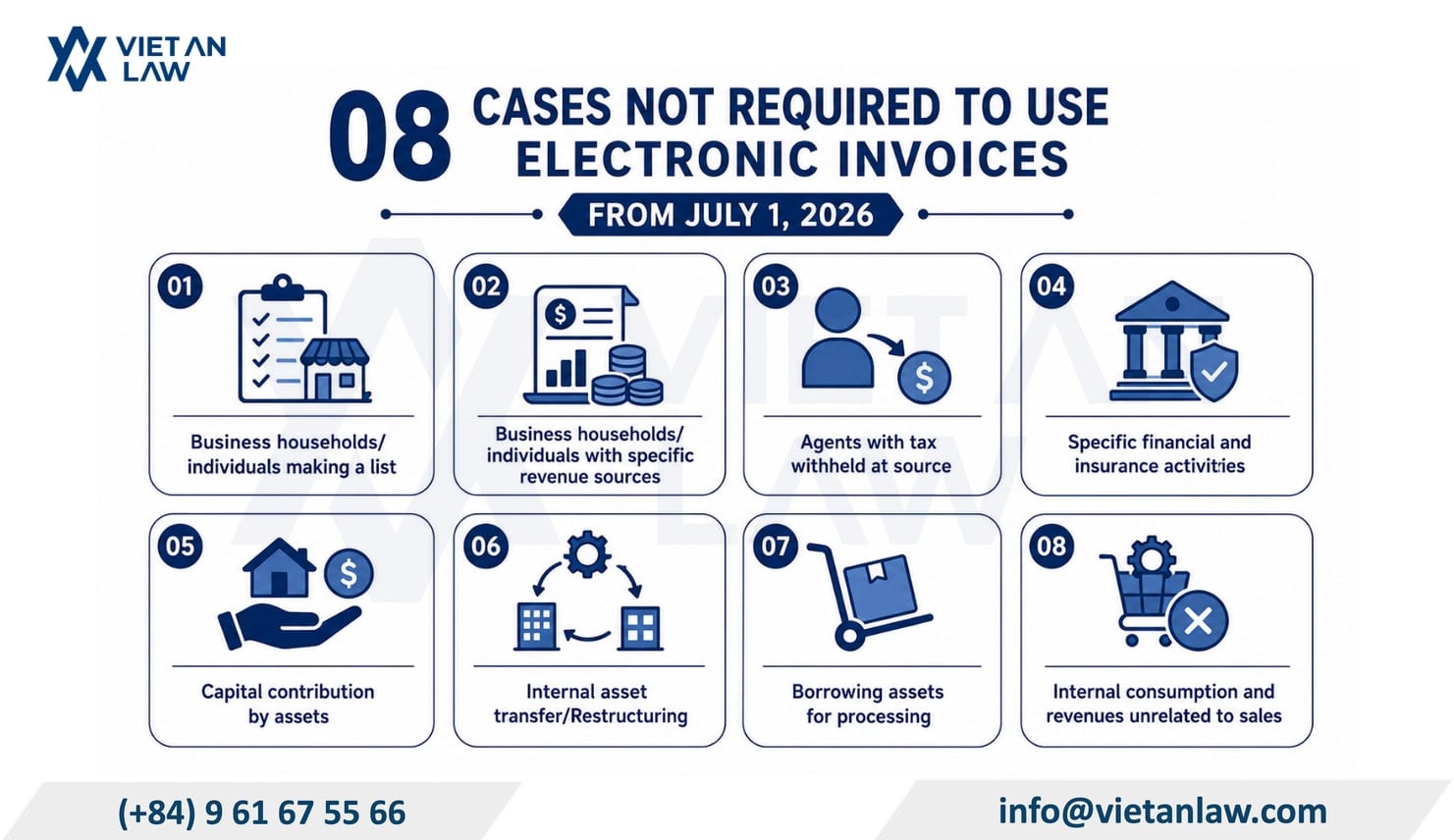
Business households/individuals making a list
Selling goods, services subject to making a purchase list (according to the Law on Corporate Income Tax), unless registered to use electronic invoices.
Business households/individuals with specific revenue sources
Leasing real estate or providing digital information content products/services (entertainment, games, movies, music, advertising…) to foreign organizations and individuals.
Agents with tax withheld at source
Households/individuals acting as agents for lotteries, insurance, multi-level marketing whose tax has been withheld by the managing enterprise.
Specific financial and insurance activities
Fees/income from reinsurance, accepting deposits, debt sales, foreign exchange transactions, and derivative products. Issuance: certificates of deposit, primary securities, valuable papers. (Particularly for selling foreign currency: make a detailed summary table at the end of the month to present when requested by the tax authority).
Capital contribution by assets
Business organizations and individuals contributing capital by assets into economic organizations.
Internal asset transfer/Restructuring
Asset transfer between the parent company and dependent units, or among dependent units. Asset transfer upon division, splitting, consolidation, merger, or conversion of enterprise types.
Borrowing assets for processing
Machinery, equipment (fixed assets), tools, and instruments lent without charge, without transferring ownership for processing purposes.
Internal consumption and revenues unrelated to sales
- Goods and services internally transferred to warehouses, materials, semi-finished products exported to continue production and business.
- Goods and services self-serving production and business activities (including self-constructed and self-produced fixed assets).
- Non-commercial revenues: Compensation in cash, bonuses, recovery from a third party (insurance), collection/payment on behalf of state agencies, financial revenues.
These new regulations on electronic invoices help reduce administrative procedures for transactions that do not have the nature of buying and selling goods, providing services, or transactions that already have separate management mechanisms, thereby saving compliance costs for enterprises, organizations, and business households and individuals.
However, falling into the case of not having to issue an electronic invoice does not mean being exempt from all obligations regarding documents, accounting, and tax. Taxpayers must still compile and fully retain records, lists, and proving documents as prescribed to serve the management and inspection work of the tax authority when necessary.
Business households and individuals employing under 10 employees can use electronic document services for free in Vietnam
According to Clause 1, Article 28 of Decree 254/2026/ND-CP, cases of using electronic document services for free include:
- Business households, business individuals employing under 10 employees and not falling into the cases of using electronic invoices; business households, business individuals falling into the cases of using electronic invoices entitled to free services;
- In case income-paying organizations and individuals are not subject to applying electronic invoices; income-paying organizations and individuals using electronic invoices entitled to free services are allowed to use electronic personal income tax withholding documents for free through the Tax Management Information System or an electronic invoice service provider entrusted by the Tax Department.
Thus, compared to Article 34 of Decree 123/2020/ND-CP amended and supplemented by Decree 70/2025/ND-CP, the new regulation has supplemented the content that business households and business individuals employing under 10 employees and not falling into the cases of using electronic invoices can use it for free to support small business households and individuals in using electronic invoices.
Many cases are granted electronic invoices with the tax authority’s code for each time in Vietnam
Clause 2, Article 6 of Decree 254/2026/ND-CP stipulates that the tax authority grants electronic invoices with a code for each arising time for some cases, such as:
Sales invoices
Non-business organizations: Having transactions of selling goods and services subject to tax.
Business households, individuals, or organizations paying tax by the direct method falling into the categories of:
- Ceasing business (tax code not yet closed) but need to liquidate assets and goods.
- Temporarily suspending business but need to issue invoices for contracts signed previously.
- Being enforced to stop using invoices.
- Undergoing bankruptcy procedures but still doing business under the supervision of the Court.
- During the period of explanation or supplementing documents as prescribed.
Value-Added Tax (VAT) invoices
Organizations paying tax by the deduction method but falling into 05 special cases (similar to the above):
- Ceasing business (tax code not yet closed) needing to liquidate assets.
- Temporarily suspending business needing to execute previously signed contracts.
- Being enforced to stop using invoices.
- Undergoing bankruptcy procedures under the supervision of the Court.
- During the period of explanation or supplementing documents.
State organizations and agencies (not paying deductive tax) auctioning assets: When the approved winning auction price is the price including VAT (excluding public assets).
Invoices for selling public assets
Applicable when the agency assigned to handle public assets is a VAT payer but is being enforced by the measure of stopping the use of invoices.
Consumers reporting sellers for not issuing invoices can be rewarded up to 10 million VND in Vietnam
This is a completely new point stipulated in Article 41 of Decree 254/2026/ND-CP adding specific regulations on considering rewards for consumers who report sellers for not issuing and handing over electronic invoices when buying and selling goods and services.
Reward conditions
- Providing truthful, accurate, and timely information; having grounds to determine the time, place, and person committing the violation;
- The content of the reported information correctly reflects the arising reality, with enough basis for the tax authority to determine the nature and severity of the violation and conduct inspection and verification;
- Based on the reported and provided information, the tax authority has issued a decision on sanctioning administrative violations in tax and invoices according to the law on tax administration.
Reward payout level
People providing accurate information, helping the tax authority issue a sanctioning decision, will be rewarded no more than 10% of the fine amount, up to a maximum of 10,000,000 VND/case.
Previously, Decree 123/2020/ND-CP did not have a separate regulation on this direct financial reward mechanism for consumers.
From January 1, 2027, all unused paper receipts must be destroyed in Vietnam
According to Article 44 of Decree 254/2026/ND-CP, paper receipts in the form of self-printing or ordered printing according to the provisions in Decree 123/2020/ND-CP that have not been fully used can continue to be used until the end of December 31, 2026.
From January 1, 2027, all unused paper receipts must be destroyed. Organizations using paper receipts must convert to apply electronic receipts according to the standard data format.
The above are the new points in Decree 254/2026/ND-CP on Electronic Invoices in Vietnam from July 1, 2026. If you have any problems or need detailed advice on applying the new regulations or using tax accounting services, Viet An Law Firm is always ready to accompany and provide appropriate and timely legal solutions for our clients.