


In the context of the Law on Tax Administration 2025 officially taking effect from July 1, 2026, many new regulations on tax administration and enforcement have been issued to enhance the efficiency of tax debt recovery, improve taxpayer compliance, and definitively handle prolonged debts. Notably, for the first time, tax administration agencies are empowered to file a petition requesting the Court to open bankruptcy procedures for enterprises and cooperatives in certain cases such as prolonged tax debt or no longer operating at the registered address. In the following article, Viet An Law Firm will update the new regulations regarding forced bankruptcy for tax debt and abandoning registered address in Vietnam 2026.
Filing a petition to apply bankruptcy procedures is one of the enforcement measures for administrative decisions on tax administration in Vietnam
According to point g, clause 1, Article 49 of the Law on Tax Administration 2025, it is stipulated as follows:
“Article 49. Enforcement measures for administrative decisions on tax administration
The enforcement measures for administrative decisions on tax administration include:
[…] g) Filing a petition to apply bankruptcy procedures;”
This marks a significant change in the mechanism for handling tax debts. Previously, tax authorities mainly applied measures such as deducting money from accounts, deducting a portion of income, distraining assets, or stopping customs procedures. However, from July 1, 2026, requesting the Court to open bankruptcy procedures will become a stronger legal tool against enterprises that intentionally fail to fulfill their tax obligations. This process acts as a form of tax debt enforcement bankruptcy.
Expected regulations on forced bankruptcy for tax debt and abandoning registered address in Vietnam 2026
According to clause 1, Article 72 of the Draft Decree detailing several articles and measures to organize and guide the implementation of the Law on Tax Administration, it is stipulated as follows:
“Article 72. Enforcement by the measure of filing a petition to apply bankruptcy procedures
The tax administration agency files a petition to apply bankruptcy procedures as prescribed at point g, clause 1, Article 49 of the Law on Tax Administration for enterprises and cooperatives falling into one of the following conditions:
a) The enterprise or cooperative has not operated at the registered address for more than 03 years from the date the tax authority issues a notice that the taxpayer is not operating at the registered address, and the taxpayer does not submit a dossier to request the restoration of the tax code or the termination of the tax code’s validity;
b) The enterprise or cooperative is subject to enforcement of administrative decisions on tax administration, the tax administration agency has applied enforcement measures for administrative decisions on tax administration as prescribed for a period of 03 years or more but cannot collect the tax debt.”
Accordingly, the tax administration agency has the right to file a petition to apply bankruptcy procedures for enterprises and cooperatives falling into one of the following cases:
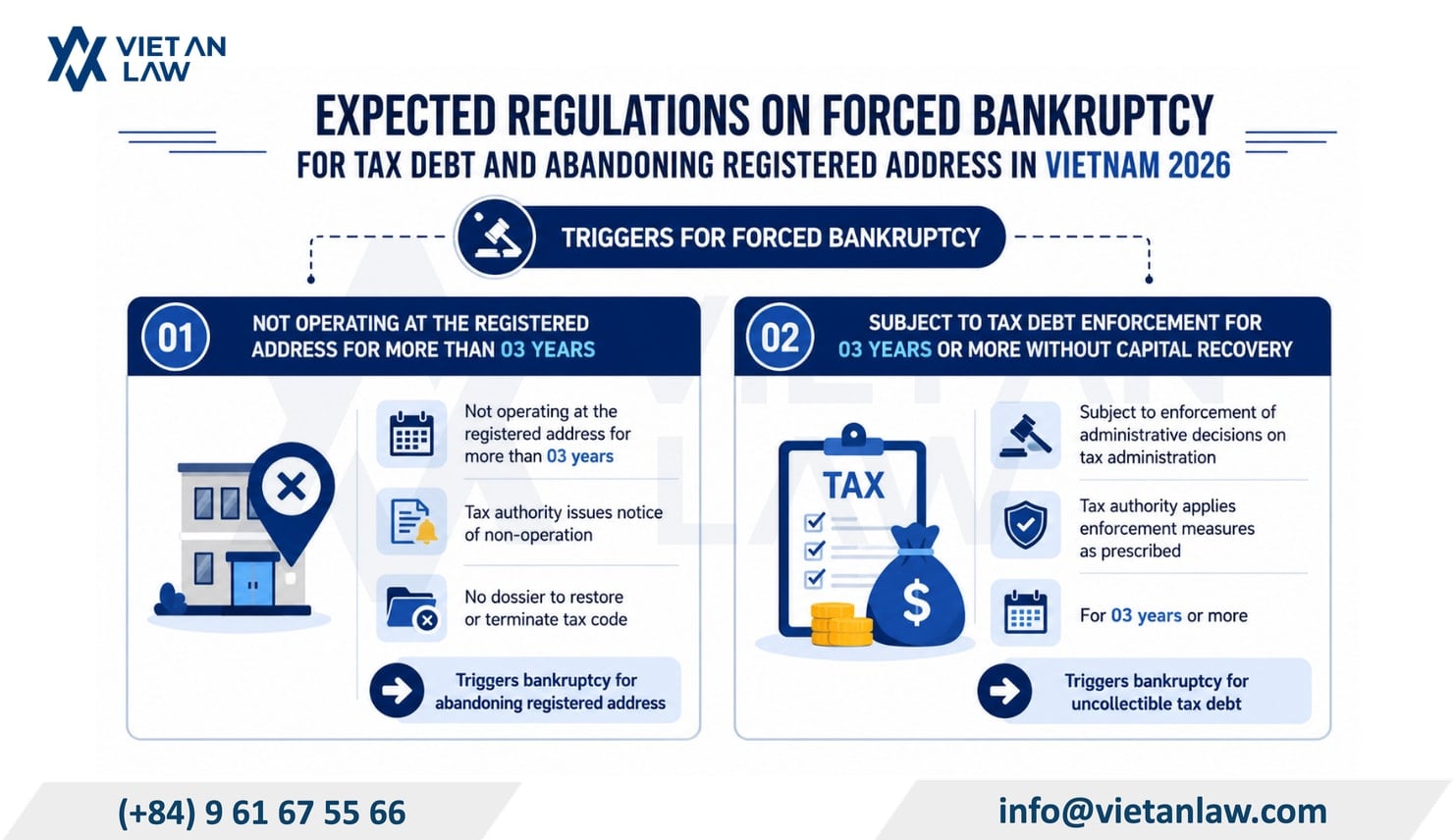
Not operating at the registered address for more than 03 years
Applied to enterprises and cooperatives from the date the tax authority issues a notice that the taxpayer is not operating at the registered address, and concurrently, the taxpayer does not submit a dossier requesting the restoration of the tax code or the termination of the tax code’s validity. Failing to do so triggers an abandoning registered address bankruptcy.
Subject to tax debt enforcement for 03 years or more without capital recovery
Applied to enterprises and cooperatives falling into the case of being subject to enforcement of administrative decisions on tax administration, even though the tax administration agency has applied enforcement measures as prescribed for a period of 03 years or more but cannot collect the tax debt.
Thus, filing a bankruptcy petition is not applied immediately when an enterprise incurs a tax debt but is only implemented after the tax authority has applied other enforcement measures for a long time without effect, or the enterprise has “disappeared” from the registered address for many years. This introduces the reality of forced bankruptcy due to tax debt.
Impacts of the regulations on forced bankruptcy for tax debt and abandoning registered address in Vietnam 2026
The addition of the enforcement measure through bankruptcy procedures shows the orientation to tighten the management of Tax debt and definitively handle enterprises that are no longer able or willing to fulfill their obligations to the State.
Instead of just stopping at traditional enforcement measures, tax authorities can proactively request the Court to open bankruptcy procedures for enterprises with prolonged tax debts or intentionally “missing”. This is considered a radical solution to handle tax debts outstanding for many years, often resulting in tax debt enforcement bankruptcy.
After the enterprise is declared bankrupt, the tax obligation will be resolved according to the asset distribution order of the bankruptcy law. The tax obligation portion is paid corresponding to the remaining asset value of the enterprise, thereby contributing to definitively handling debts that are no longer collectible and improving the efficiency of state budget management.
The new regulation also helps prevent the situation where some business owners take advantage of legal loopholes by establishing enterprises, incurring tax debts, and then abandoning the registered business address to continue establishing new legal entities, causing state budget revenue loss and creating an unequal competitive environment. This aims to curb instances leading to abandoning registered address bankruptcy.
According to data from tax authorities, there are currently nearly 1 million taxpayers no longer operating at their registered addresses, including more than 325,000 enterprises and about 638,000 business households. This is the group of subjects predicted to be directly impacted by the new regulations when the policy is officially implemented, facing potential tax arrears forced bankruptcy.
Are managers of bankrupt enterprises restricted from the right to manage enterprises in Vietnam?
According to Article 84 of the Law on Rehabilitation and Bankruptcy 2025, managers of an enterprise that is declared bankrupt may be restricted from the right to manage enterprises in the following cases:
- Persons holding positions such as Chairman, General Director, Director, or members of the Members’ Council of an enterprise with 100% charter capital held by the State that is declared bankrupt will not be allowed to continue holding similar managerial positions in any state-owned enterprise for a period of 03 years from the date the Court issues the decision declaring bankruptcy.
- For the representative of state capital in a state-invested enterprise, if the enterprise is declared bankrupt, that individual is also not allowed to hold a managerial position in any state-invested enterprise for a period of 03 years.
- For other types of enterprises, if the Judge determines that the manager has intentionally violated the law leading to the enterprise’s bankruptcy, that person may also be prohibited from establishing or managing an enterprise for a period of 03 years from the date of the Court’s decision. This is a serious consequence of forced bankruptcy due to tax debt.
These regulations contribute to enhancing the responsibility of enterprise managers in fulfilling financial obligations, especially tax obligations to the State, effectively serving as a deterrent similar to a mandatory bankruptcy for tax debtors.
04 cases eligible for tax debt write-off from July 1, 2026 in Vietnam
In parallel with strict enforcement measures, the Law on Tax Administration 2025 also clearly stipulates the conditions for tax debt write-off to ensure the humanity and practicality of the law.
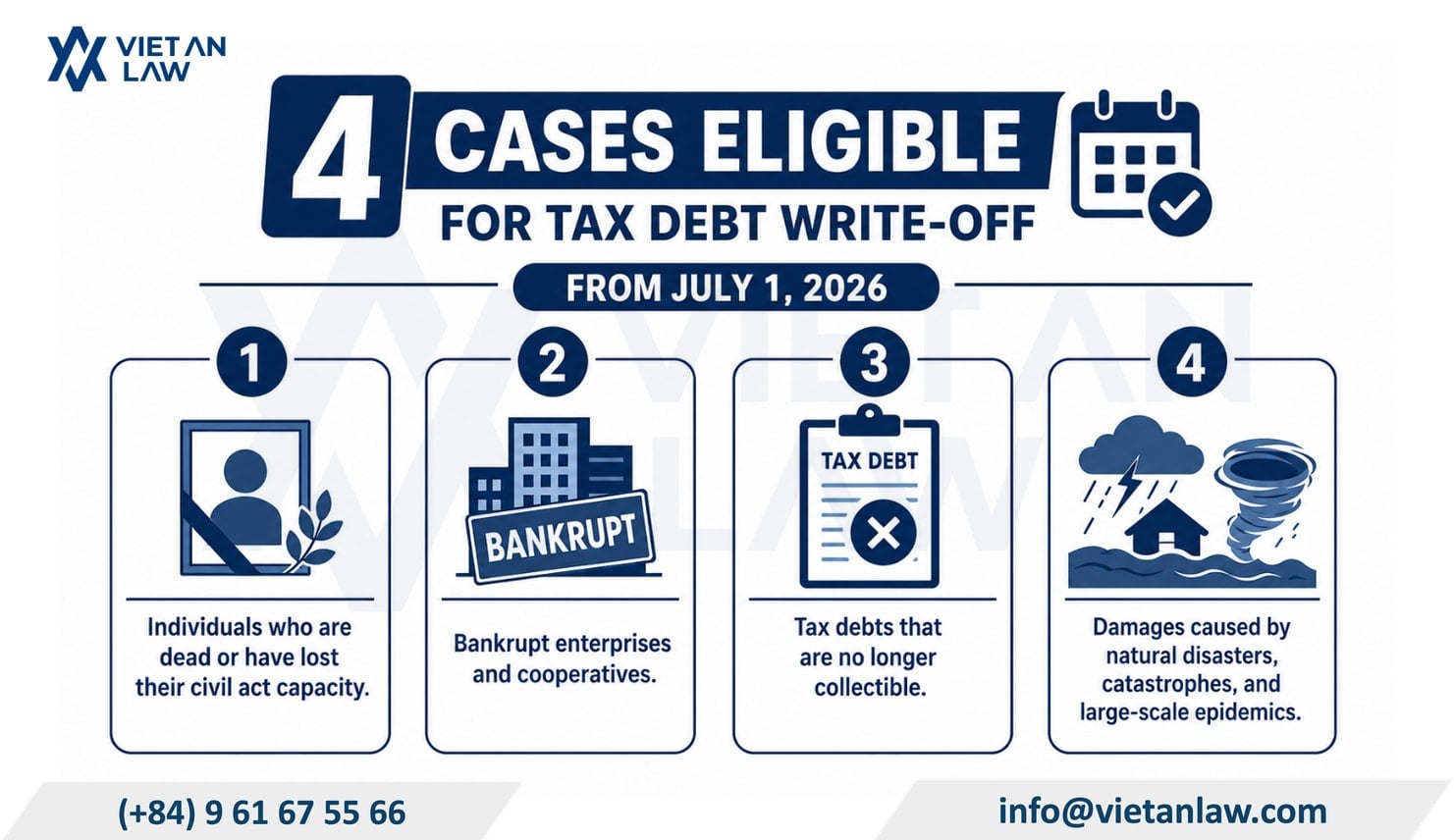
From July 1, 2026, there are 4 cases of tax debt write-off according to clause 1, Article 29 of the Law on Tax Administration 2025, including:
- Individuals who are dead or have lost their civil act capacity: Individuals who are dead, declared dead by the Court, or have lost their civil act capacity and have no remaining assets, including inherited assets.
- Bankrupt enterprises and cooperatives: Enterprises, cooperatives, and unions of cooperatives declared bankrupt by the Court, have paid their debts in accordance with the law on rehabilitation and bankruptcy, and have no remaining assets. The general bankruptcy law governs this procedure.
- Tax debts that are no longer collectible: The tax authority has applied enforcement measures according to point h, clause 1, Article 49 of the Law on Tax Administration 2025, and the debt has been overdue for 10 years from the expiration date for payment but cannot be collected. This is an alternative to tax arrears forced bankruptcy.
- Damages caused by natural disasters, catastrophes, and large-scale epidemics: Taxpayers who have been granted exemption from late payment interest, extension of time for tax payment, late payment interest, and fines but are still unable to restore production and business and are unable to pay the tax debts.
However, the law also sets binding conditions for individuals, business household owners, or sole proprietorship owners who have had their debts written off. If these subjects want to resume production and business activities or establish new facilities, they are obliged to fully refund to the State the entire tax debt that was previously written off. This is a regulation to ensure the fairness and strictness of the tax administration system in the new period.
Some related questions
How long must an enterprise owe taxes to be required to open bankruptcy procedures?
Not all cases of owing taxes will be required to open bankruptcy procedures. According to the draft decree guiding the Law on Tax Administration 2025, tax authorities are only allowed to file a petition to open bankruptcy procedures when the enterprise has been subject to enforcement measures for administrative decisions on tax administration for a period of 03 years or more but still cannot recover the tax debt, or the enterprise has not operated at the registered address for more than 03 years as prescribed. This clarifies the scope of mandatory bankruptcy for tax debtors.
Will an enterprise abandoning its business address be declared bankrupt immediately?
No. Abandoning a business address does not mean the enterprise is declared bankrupt immediately. The tax authority only has the right to file a petition requesting the Court to open bankruptcy procedures when all prescribed conditions are met. The decision to open procedures and declare bankruptcy falls under the jurisdiction of the Court after reviewing the dossier and carrying out procedures according to the law on bankruptcy.
Which subjects have the right to file a petition to apply bankruptcy procedures?
According to Article 38 of the Law on Rehabilitation and Bankruptcy 2025, persons having the right to file a petition to apply bankruptcy procedures when an enterprise or cooperative loses its solvency include:
- Unsecured creditors, partially secured creditors;
- Employees, grassroots trade unions have the right to file a petition to apply bankruptcy procedures upon the expiration of 06 months from the date of having to perform the obligation to pay salaries and other due debts to employees that the enterprise or cooperative fails to pay;
- A shareholder or a group of shareholders owning 20% or more of ordinary shares or a smaller percentage in cases stipulated by the company’s Charter;
- A member or a group of members owning 65% or more of the total charter capital of a multiple-member LLC or a smaller percentage in cases stipulated by the company’s Charter;
- Tax administration agencies must file a petition to apply bankruptcy procedures for enterprises and cooperatives according to the provisions of the Law on Tax Administration.
- Social insurance agencies have the right to file a petition to apply bankruptcy procedures for enterprises and cooperatives when the social insurance agency has issued notices urging the late payment or evasion of compulsory social insurance, unemployment insurance, and health insurance but received no response for 03 consecutive years as prescribed by the law on social insurance, unemployment insurance, and health insurance.
What can enterprises do to avoid being subject to the measure requesting to open bankruptcy procedures?
Enterprises need to fully perform tax obligations on time, maintain operations at the registered address, promptly update enterprise registration information when there are changes, and proactively work with tax authorities if financial difficulties arise.
Remedying tax debts early will help enterprises minimize the risk of being subject to strict enforcement measures, including the tax authority filing a petition to open bankruptcy procedures.
In the context that regulations on tax administration are becoming increasingly strict, enterprises need to proactively review the performance of tax obligations, operational status, and legal dossiers to limit the risk of being subject to enforcement measures, including the tax authority filing a petition to open bankruptcy procedures. In case you need advice on tax obligations, handling tax debts, bankruptcy legal consultancy, or legal issues related to the enterprise’s operations, Viet An Law Firm, is ready to accompany and provide comprehensive legal solutions, helping enterprises prevent risks and best protect their legitimate rights and interests.