


In the context of the constantly fluctuating economy, it is not uncommon for businesses to incur tax debts. Tax debts not only affect the reputation and ability of businesses but also cause loss of revenue to the state budget. Therefore, the development and implementation of an effective tax debt handling process is an urgent requirement, in order to ensure compliance with the law, financial stability for businesses and contribute to a healthy business environment. This article will analyze in detail the steps in the process of handling tax debts, from determining debts, working with tax authorities, to handling options suitable for each specific situation.
What is a tax debt of a business?
Tax debt of an enterprise is a tax amount that an enterprise is obliged to pay to the State but has not yet paid, paid improperly or infully in accordance with the tax law. These may refer to:
- Principal tax: the amount of tax payable according to the declaration or finalization
- Fines: due to tax administrative violations (e.g. late submission of tax declaration dossiers, incorrect declaration, …)
- Late payment interest: incurred due to failure to pay tax on time
Tax debts can arise from different taxes such as: value-added tax, corporate income tax, personal income tax (when the enterprise is the deduction unit), import and export tax, special consumption tax. Tax debts, if not handled in a timely manner, may lead to tax enforcement, administrative sanctions or in serious cases, prosecution for penal liability in accordance with the Law on Tax Administration.
Causes of tax debt in Vietnam
The reasons for a business’s tax debt can come from many different aspects, including subjective factors and customers. Here are the common causes:
- Financial difficulties: When businesses face cash flow difficulties due to declining revenue or rising costs, they can no longer afford to pay taxes on time. This is a common cause, especially in times of economic upheaval.
- Weak internal management: The lack of financial planning, failure to closely monitor tax obligations or an inadequate accounting system make businesses prone to incurring tax debts that are not handled in a timely manner.
- Errors in tax declaration: Enterprises may declare wrong revenues and expenses, apply the wrong tax rate or delay in submitting dossiers, leading to arrears and incurring tax debts.
- Subjective psychology, deliberate delay in payment: Some businesses underestimate tax obligations or deliberately delay payment to retain cash flow for business activities, leading to fines or tax enforcement.
- Delayed tax refund from the tax authority: The prolonged tax refund causes businesses to lack finance to fulfill other tax obligations, leading to unintended debts.
- Changes in legal policies: Tax policies are constantly changing, making businesses unable to update in time, leading to the wrong application of regulations and unforeseen tax obligations.
- Impact from the market and customers: Market fluctuations, customers owe money and lose class contracts, affecting the cash flow of the business, leading to late tax payment.
Tax debt settlement process in Vietnam
According to Clause 2, Article 59 of the Law on Tax Administration 2019, enterprises that are late in paying taxes will bear late payment interest, specifically as follows:
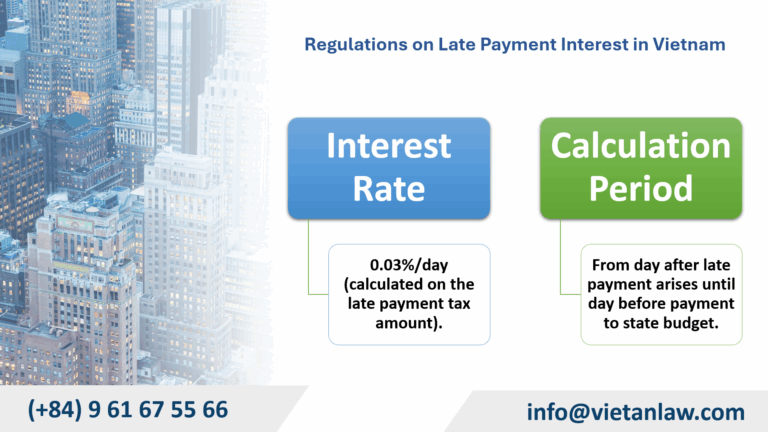
At the same time, the General Department of Taxation issued Official Letter 1498/TCTC-QLN in 2023 on implementing measures to recover and handle tax arrears. Accordingly, the recovery and settlement of tax arrears includes the following contents:
- Classification of tax debt
- Debt Enforcement and Enforcement
- Expedited processing of pending debts and pending taxes
- Tax authorities shall apply measures to urge and enforce in accordance with regulations to promptly recover into the state budget tax and land rents that have expired the tax payment deadline
- Strengthen the application of exit suspension measures for individuals and individuals who are legal representatives of enterprises that have not fulfilled their tax payment obligations to improve the efficiency of debt collection management
- Implementing debt freezing and debt cancellation
- Tax authorities shall review and accurately determine the amount of money owed by taxpayers to the state budget; fully accounting and monitoring debts on the centralized tax management application system. In case of any problems, the Department of Taxation shall assume the prime responsibility for, and coordinate with relevant agencies in the locality, reporting to the People’s Committee of the province or city or a competent agency for definitive settlement of the debt of land use levy, land rent or mineral exploitation right grant
- Tax authorities urgently apply urgent and coercive measures to recover environmental protection tax debts into the state budget in accordance with the guidance in Official Letter 689/TCT-QLN in 2023 of the General Department of Taxation, so as not to incur new debts
- Report
Thus, if the enterprise owes tax, it will be urged and coerced by the tax authority. At the same time, they must bear the late payment interest rate as prescribed by law
Coercive measures for businesses that owe taxes in Vietnam
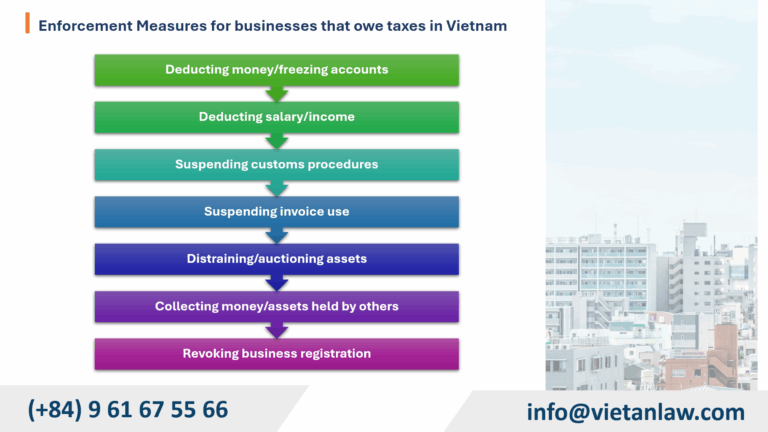
According to Clause 1, Article 125 of the Law on Tax Administration 2019, measures to enforce tax debts in 2023 include:
- Enforcement measure: Deducting money from accounts, requesting the freezing of taxpayer accounts opened at the State Treasury, commercial banks, and other credit institutions.
- Enforcement measure: Deducting a portion of salary or income.
- Requesting the customs authority to enforce measures by suspending customs procedures for import and export goods.
- Enforcement measure: Suspending the use of invoices.
- Enforcement measure: Distraining assets, auctioning distrained assets.
- Enforcement measure: Collecting money and other assets of the taxpayer subject to enforcement that are being held by other organizations or individuals.
- Enforcement measure: Revoking the business registration certificate.
Enterprises that owe taxes for less than 90 days, according to Section 2 of Official Letter 3658/TCT-QLN in 2023, for taxpayers who only owe taxes for less than 90 days: immediately take measures (phone calls, texts, emails, invitations to work, issue notices of tax debts) urge taxpayers to pay taxes into the state budget, do not let melon tax debts be prolonged, limit new debts arising.
Enterprises owe tax for more than 90 days, according to Section 2 of Official Letter 3658/TCT-QLN in 2023:
- For taxpayers with tax arrears of more than 90 days or tax debts subject to enforcement: immediately apply coercive measures to recover tax debts into the state budget.
- In case the enforcement decision expires but the taxpayer has not yet paid or has not fully paid the enforced tax debt into the state budget, it must promptly switch to applying appropriate and prescribed enforcement measures.
Thus, enterprises that owe taxes for less than 90 days will not be subject to coercive measures, but enterprises that owe taxes for more than 90 days will be subject to coercive measures.
At the same time, according to Section 3 of Official Letter 3658/TCT-QLN in 2023, the General Department of Taxation requests the Tax Departments of provinces and centrally-run cities to publicize information of taxpayers with overdue tax debts in accordance with the law, especially focusing on taxpayers with large and prolonged tax debts.
If you have any difficulties or questions related to the process of handling tax debts of your business, please contact Viet An Tax Agent for the most specific advice.