


Does a company with no revenue have to pay tax in Vietnam? According to Vietnamese tax law in 2026, an enterprise that has not yet generated revenue is not entirely exempt from tax obligations. Depending on its operational status, an enterprise may not yet incur output value-added tax and corporate income tax payables, but it must still fulfill tax declaration obligations, prepare financial statements, and finalize taxes as prescribed. Notably, from January 1, 2026, the business license tax has been abolished, and eligible small and medium-sized enterprises can be exempt from corporate income tax for the first 03 years. Viet An Law guides the important tax obligations, declaration deadlines, and legal risks to avoid for newly established enterprises with no revenue, which is essential information for anyone undergoing company registration in Vietnam or seeking comprehensive tax accounting services in Vietnam.
Does a company with no revenue have to pay tax in Vietnam?
A company with no revenue may still have to fulfill tax obligations according to legal regulations. However, enterprises need to clearly distinguish between two issues: the obligation to pay taxes and the obligation to declare taxes.
- Tax payment obligation: If the enterprise has not yet engaged in sales, service provision, or generated taxable income, it typically does not incur output value-added tax and corporate income tax payables from business operations. However, other taxes may still arise depending on actual transactions.
- Tax declaration obligation: An active enterprise must still fulfill the obligations of tax declaration, tax finalization, and the preparation of financial statements as prescribed, except for cases exempt from submitting tax declaration dossiers.
- Accounting obligation: The enterprise needs to organize accounting work, record contributed capital, assets, liabilities, and incurred expenses right from the initial stage of operation.
For an enterprise newly completing company registration in Vietnam, not having customers or not issuing invoices does not automatically terminate its legal and tax obligations.
The regulations applicable from July 1, 2026, must be considered in accordance with the Law on Tax Administration No. 108/2025/QH15, Decree 252/2026/ND-CP, Circular 89/2026/TT-BTC, and relevant tax legal documents.
Taxes a company must pay when it has no revenue in Vietnam
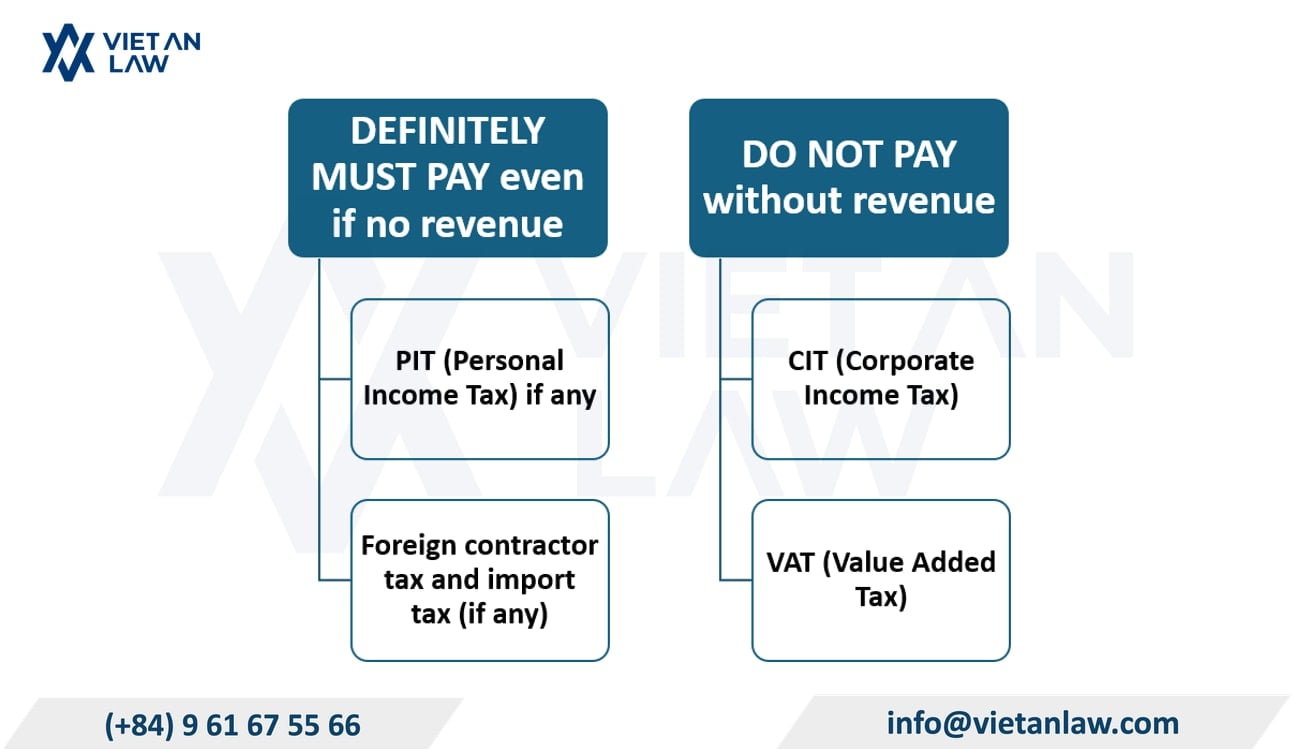
Value-added tax when a company has no revenue
Value-added tax is an indirect tax applied to goods and services subject to tax according to regulations.
In case the enterprise has not yet engaged in sales or provided services subject to value-added tax, it typically does not incur corresponding output value-added tax.
However, enterprises need to note:
- Not generating revenue does not mean being exempt from the value-added tax declaration obligation in all cases.
- If there are invoices for purchasing goods and services serving business operations, the enterprise needs to record and declare them according to the tax calculation method being applied.
- Input value-added tax is only deducted or carried forward to the next period when fully meeting the deduction conditions according to regulations.
- Goods import transactions or specific transactions can still trigger value-added tax obligations even if the enterprise has no sales revenue.
For example, a company is established in August 2026, has not yet signed a contract with a customer, but has purchased computers and rented an office. The enterprise has not yet generated sales revenue but must still record expenses, input invoices, and fulfill declaration obligations as prescribed.
Corporate income tax when no revenue is generated
Corporate income tax is determined based on taxable income according to legal regulations, not solely based on total revenue.
In case the enterprise has no revenue and generates no other taxable income, it typically will not incur a corporate income tax payable amount in the period.
If the enterprise has deductible expenses greater than its revenue and incurs a taxable loss, the determination and carrying forward of the loss must comply with the conditions and deadlines under the corporate income tax law.
It is necessary to note that an enterprise with no revenue from its main business operations may still generate other income, such as financial income or income from asset transfers. In such cases, the corporate income tax obligation must be determined according to the nature of each income item.
3-year corporate income tax exemption policy for small and medium sized enterprises in Vietnam
According to Clause 4 Article 10 of Resolution 198/2025/QH15 and Clause 3 Article 7 of Decree 20/2026/ND-CP, small and medium-sized enterprises registering for business for the first time, meeting legal conditions, are exempt from corporate income tax for 3 years from the time they are granted the Enterprise Registration Certificate for the first time.
The exemption period is calculated continuously from the first year of being granted the Enterprise Registration Certificate for the first time according to regulations.
Enterprises need to note:
- Must meet the criteria for identifying small and medium-sized enterprises.
- Must meet the conditions to enjoy incentives and not fall into the excluded cases.
- Not all newly established enterprises are automatically exempt from corporate income tax.
- The tax exemption policy does not mean an exemption from accounting, declaration, and tax finalization obligations.
- Enterprises need to review their legal status, ownership structure, and incentive conditions before application.
Personal income tax when the company pays salaries
An enterprise that has not generated revenue can still recruit employees, pay salaries to managers, or hire individuals to perform work.
In case the enterprise pays income subject to personal income tax withholding, the enterprise is responsible for withholding, declaring, and paying the tax as prescribed.
Specifically:
- No income payment arises: The enterprise typically does not incur the personal income tax declaration obligation for wages and remuneration in the period.
- Income payment arises but no tax withholding arises: The enterprise needs to determine the declaration obligation according to the regulations applicable to the corresponding tax declaration period.
- Tax withholding amount arises: The enterprise withholds, declares, and pays the tax as prescribed.
Regarding year-end personal income tax finalization, the enterprise needs to determine the finalization obligation based on the actual income payment situation, employees, and cases exempted by law.
Foreign contractor tax and import tax if transactions arise
Having no revenue does not preclude the possibility that an enterprise incurs tax obligations from transactions with foreign partners.
- Foreign contractor tax: In case the enterprise purchases services from a foreign supplier, such as advertising, software, or consulting services, it must determine the applicable tax mechanism and the responsibility to withhold, declare, and pay on behalf of the contractor if it falls under the mandatory scope. Not all payments to Google, Meta, or foreign suppliers automatically trigger the obligation to pay the foreign contractor tax on their behalf.
- Import tax: If the enterprise imports machinery, equipment, raw materials, or assets serving its operations, the import tax and value-added tax on imported goods are determined according to each type of goods, tax regime, and applicable exemption or reduction policies.
Therefore, the enterprise needs to review all input transactions instead of only relying on sales revenue.
Business license tax abolished from 2026
One of the important changes for enterprises is the policy to terminate the collection and payment of the business license tax.
According to Clause 7 Article 10 of Resolution 198/2025/QH15, from January 1, 2026, the collection and payment of the business license tax are officially terminated.
Accordingly:
- Enterprises do not have to pay the business license tax amount for 2026 and subsequent years.
- Enterprises established from 2026 do not have to fulfill the business license tax declaration obligation for 2026 under the abolished mechanism.
- Outstanding obligations from previous years, if any, need to be handled according to legal regulations and transitional provisions.
This is a change that helps reduce compliance costs for enterprises, especially for newly established companies that have not yet generated revenue.
Tax declaration regulations for companies with no revenue in Vietnam
Monthly or quarterly value-added tax declaration
An enterprise that is subject to value-added tax declaration must carry out the declaration according to the tax calculation period determined by legal regulations.
If no purchasing or selling activities arise in the period, the enterprise declares using the applicable form and truthfully reflects the status of no activities arising in the period.
The value-added tax declaration period can be monthly or quarterly depending on the conditions applicable to each enterprise.
Regarding basic deadlines:
- For monthly declaration: No later than the 20th day of the following month.
- For quarterly declaration: No later than the last day of the first month of the following quarter.
Determining the declaration period, forms, and cases exempt from submitting dossiers requires comparison with the Law on Tax Administration No. 108/2025/QH15, Decree 252/2026/ND-CP, and Circular 89/2026/TT-BTC.
Enterprises should not assume that all newly established companies must declare quarterly or that all cases with no revenue must submit a zero value-added tax return.
Annual corporate income tax finalization
Regarding corporate income tax, enterprises do not have to submit a quarterly provisional corporate income tax return under the normal mechanism. However, the obligation for provisional payment of corporate income tax, if it arises, must still be considered according to regulations.
At the end of the financial year, enterprises subject to corporate income tax finalization must prepare and submit the finalization dossier as prescribed, even when no revenue is generated or no tax payable amount arises.
The finalization dossier must truthfully reflect revenue, expenses, other income, adjustments, and losses if any.
The deadline for submitting the annual corporate income tax finalization dossier is normally no later than the last day of the third month from the end date of the calendar year or financial year.
For example, if an enterprise has a financial year ending on December 31, 2026, the normal deadline to submit the 2026 corporate income tax finalization dossier is March 31, 2027.
Preparation and submission of annual financial statements
An enterprise that has not generated revenue must still organize accounting work and prepare financial statements according to the applicable accounting regime, except for cases otherwise prescribed by law.
Financial statements serve the role of reflecting the situation of assets, capital sources, liabilities, expenses, and operational results of the enterprise.
Even when no goods have been sold or services provided, the enterprise may still incur transactions such as:
- Contributing charter capital and receivables from owners.
- Renting an office and paying operating expenses.
- Purchasing machinery, equipment, and tools.
- Paying wages, insurance, and management expenses.
- Incurring liabilities with suppliers or partners.
Therefore, enterprises should not understand that having no revenue naturally means the financial statements have no data.
To mitigate risks, enterprises should organize their tax accounting work right from the initial stage instead of waiting until revenue is generated.
Summary table of tax obligations when a company has no revenue in Vietnam
| Tax or report type | Is tax payment required? | Declaration and reporting obligation |
| Value-added tax | Typically no output value-added tax arises if there are no taxable output transactions | Declare according to the prescribed period, except for cases exempt from submitting dossiers |
| Corporate income tax | Typically no payment is required if there is no taxable income | Annual finalization if subject to finalization |
| Personal income tax | Depends on the paid income and the tax amount to be withheld | Follow corresponding withholding, declaration, and finalization obligations |
| Foreign contractor tax | May arise | Based on transactions and applicable tax payment mechanisms |
| Import tax | May arise | Based on customs dossiers and procedures |
| Business license tax | Not collected from January 1, 2026 | No declaration for business license tax obligations from 2026 |
| Annual financial statements | Not a tax | Prepare and submit according to the applicable accounting regime |
Note: The table is a general summary for ordinary enterprises and does not replace the determination of tax obligations for each specific case.
Penalties for late submission of tax declaration dossiers in Vietnam
An enterprise that has not yet generated revenue but is still required to submit a tax declaration dossier can be administratively sanctioned if it fails to fulfill the obligation on time.
According to Article 13 of Decree 125/2020/ND-CP, as amended and supplemented by Decree 310/2025/ND-CP, the act of violating the deadline for submitting tax declaration dossiers is handled based on the nature and severity of the violation.
For organizations, the basic penalty levels are as follows:
| Violation | Penalty level |
| Late submission from 01 to 05 days with mitigating circumstances | Warning |
| Late submission from 01 to 30 days, not subject to a warning | 2 to 5 million VND |
| Late submission from 31 to 60 days | 5 to 8 million VND |
| Late submission from 61 to 90 days | 8 to 15 million VND |
| Late submission of 91 days or more but no tax payable amount arises | 8 to 15 million VND |
| Failing to submit the tax declaration dossier but no tax payable amount arises | 8 to 15 million VND |
| Late submission of over 90 days, a tax payable amount arises, and legal conditions are met for cases where tax and late payment interest have been fully paid | 15 to 25 million VND |
The above penalty levels apply according to regulations for organizations. The specific penalty level also depends on the specific act, aggravating or mitigating circumstances, and relevant regulations.
Particularly, enterprises need to note that some acts of not submitting tax declaration dossiers or submitting dossiers past the deadline can be considered under regulations on tax evasion if all legal signs are fully met.
The fact that no revenue is generated or no tax payable amount arises is not an automatic basis for being exempt from penalties for the act of late submission of tax declaration dossiers.
Common mistakes when a company has no revenue in Vietnam
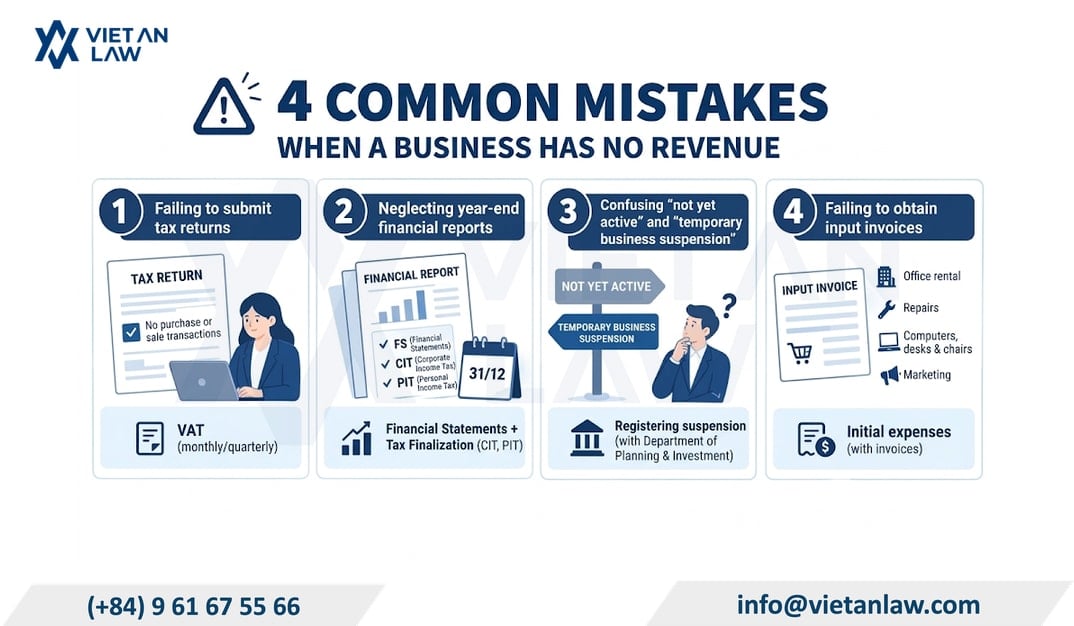
Not submitting tax declaration dossiers because of no business transactions
Many enterprises assume that if they have not yet generated revenue and have not issued invoices, they do not need to declare taxes.
This is an incomplete understanding. If the enterprise is required to submit a tax declaration dossier, it must still fulfill this obligation on time even if the incurred tax amount is zero.
Enterprises need to check their tax declaration period, tax registration status, and cases exempted from submitting dossiers according to regulations.
Not preparing annual financial statements
A common mistake is not preparing financial statements because the enterprise has not generated significant business activities.
However, financial statements not only reflect revenue but also reflect capital, assets, liabilities, expenses, and other economic transactions.
Enterprises need to maintain a system of books and accounting documents and fulfill the obligation to prepare financial statements according to the applicable accounting regime.
Confusing not yet operating with suspending business operations
An enterprise that has not found customers, has no contracts, or has not deployed actual operations does not mean it has completed the procedures for suspending business operations.
If an enterprise wishes to suspend operations, it must carry out the procedure to notify the suspension of business operations according to the laws on business registration.
During a valid suspension period, the enterprise may fall under the case of not having to submit tax declaration dossiers for the suspended period if it meets legal conditions. However, outstanding obligations or those arising outside the scope of the exemption must still be handled.
Particularly, if the suspension period does not cover a full tax declaration period, the enterprise needs to check the declaration obligation for that specific period.
Not keeping input invoices and documents
In the newly established phase, enterprises often incur expenses for office rental, equipment purchases, advertising, recruitment, or legal consulting.
If they do not retain valid documents, enterprises may face difficulties when recording expenses, determining taxable income, or carrying out value-added tax deductions.
Enterprises should:
- Request legal invoices for purchased goods and services.
- Retain contracts, payment receipts, and related documents.
- Classify expense items according to the applicable accounting regime.
- Check deduction conditions and the calculation of deductible expenses.
- Reconcile books, invoices, and documents before preparing year-end reports.
Tax accounting services for companies with no revenue in Vietnam
For a newly established enterprise, organizing the accounting apparatus and fulfilling tax obligations right from the beginning plays a crucial role in controlling costs, minimizing risks, and ensuring the transparency of financial records.
Viet An Law provides comprehensive tax accounting services in Vietnam for newly established enterprises, enterprises that have not yet generated revenue, and enterprises in the preparatory stage of operation.
The scope of support from Viet An Law includes:
- Consulting on tax obligations for newly established enterprises.
- Checking tax registration status, declaration periods, and tax dossiers.
- Consulting on the application of tax exemption and reduction policies according to regulations.
- Declaring value-added tax, personal income tax, and other taxes if they arise.
- Recording documents, organizing, and completing accounting books.
- Preparing annual financial statements and tax finalization dossiers.
- Reviewing invoices, expenses, liabilities, and related accounting obligations.
- Assisting with explanations and working with tax authorities within the agreed service scope.
With the combination of corporate legal consulting and specialized tax accounting services in Vietnam, Viet An Law assists clients in building an appropriate compliance system right from the business startup phase.
Frequently asked questions about tax obligations of enterprises
Does a newly established company with no revenue have to declare taxes?
It is possible. If the enterprise is required to submit a tax declaration dossier, it must still declare on time even if no revenue has been generated or the tax payable amount is zero. It is necessary to check the cases exempted from submitting dossiers according to current regulations.
Does a company that has not issued invoices have to pay value-added tax?
If no output transactions subject to value-added tax have occurred, the enterprise typically does not incur output value-added tax. However, the enterprise may still have tax declaration obligations or other tax obligations from import operations and specific transactions.
Does a company with no revenue have to finalize corporate income tax?
An enterprise subject to corporate income tax finalization must still prepare and submit a finalization dossier as prescribed even if it has no revenue or incurs no tax payable, except for cases excluded by law.
Does an enterprise with no revenue have to submit financial statements?
Typically yes. The enterprise must prepare financial statements according to the applicable accounting regime, unless otherwise prescribed. Financial statements still need to reflect capital, assets, liabilities, and actual transactions.
Does an enterprise established in 2026 have to pay the business license tax?
No. According to Resolution 198/2025/QH15, the collection and payment of the business license tax are terminated from January 1, 2026.
Is a company with no revenue exempt from corporate income tax for 3 years?
Small and medium-sized enterprises registering for business for the first time can enjoy the corporate income tax exemption policy for 3 years under Resolution 198/2025/QH15 and Decree 20/2026/ND-CP if they meet the conditions and do not fall into the excluded cases.
Should an inactive company register for business suspension?
If the enterprise has no plans to deploy operations for a certain period, registering for business suspension is an option to consider. However, the enterprise needs to review existing tax, labor, contract, and legal obligations before proceeding.
How much is the fine for not submitting a tax return when there is no revenue?
The penalty level depends on the late submission time and the nature of the violation. For cases of failing to submit a tax declaration dossier where no tax payable amount arises, the monetary fine according to regulations for organizations can range from 8 million to 15 million VND.
Conclusion
A company that has not generated revenue may still have to fulfill the obligations of tax declaration, tax finalization, and the preparation of financial statements as prescribed, even though no tax payable amount has arisen. Enterprises need to clearly distinguish between the obligations regarding value-added tax, corporate income tax, personal income tax, and the taxes arising from each specific transaction.
For a newly established enterprise that has not yet deployed business operations, organizing the accounting system and fulfilling tax obligations from the outset will help minimize the risk of penalties, ensure transparency, and create a foundation for long-term operations.
Viet An Law provides corporate legal consulting and tax accounting services in Vietnam, supporting clients throughout the process of establishment, declaration, tax finalization, and compliance with relevant legal regulations.