


When dealing with missed tax filing deadlines in Vietnam, enterprises must first identify unsubmitted tax returns, relevant tax categories, and any arising financial obligations to ensure proper regulatory remediation. Forgetting to file Value Added Tax (VAT), Personal Income Tax (PIT), Foreign Contractor Tax (FCT), or missing annual tax finalization dossiers commonly occurs when a business undergoes accounting personnel changes, generates zero revenue, misidentifies tax filing periods, or fails to adequately monitor notifications on the e-Tax system.
Upon discovering that a tax return was not submitted on time, enterprises should not automatically carry figures forward to the current period or file supplementary declarations before verifying the status of the overdue return. In this guide, Viet An tax agency provides actionable instructions on how to inspect, categorize, and resolve missed tax filing periods to prevent cascading errors and minimize additional tax liabilities.
How should enterprises handle missed tax filing deadlines in Vietnam?
First, businesses need to distinguish between filings that have never been submitted, filings that contain errors, and instances where tax payment obligations have not yet been fulfilled.
| Filing status | Remediation action |
| Tax return for a single period not yet submitted | Prepare and submit an initial tax declaration dossier for the missing period |
| Tax return submitted but rejected by the system/authority | Check rejection notices, rectify errors, and resubmit a valid dossier |
| Tax return submitted but certain transactions were omitted | Consider filing a supplementary declaration in accordance with regulations |
| Tax declared but tax payable not yet remitted | Determine outstanding tax liabilities and late payment interest (if any) |
| Multiple monthly or quarterly filing periods missed | Determine tax obligations for each period and assess impacts on subsequent periods |
| Annual tax finalization dossier not yet submitted | Prepare the corresponding annual finalization dossier; do not substitute with periodic returns |
Note: An initial tax return filed past the deadline is different from an amended tax return. Selecting the correct procedure helps businesses avoid submitting the wrong type of document and having to make multiple subsequent adjustments.
Common taxes frequently missed by enterprises and how to fix them in Vietnam
Depending on their industry, scale, and operational status, businesses may incur various tax filing obligations. Situations that typically require review include:
Failure to file Value Added Tax (VAT) returns
Businesses may overlook the submission of monthly or quarterly VAT returns, or fail to fully address errors related to invoices within a given period.
Corrective measures:
- Determine the applicable VAT calculation method and tax filing period;
- Check the submission status for the missed period;
- Reconcile input and output invoices along with relevant supporting documents;
- Prepare and submit an initial tax return if no filing was previously made;
- Assess the need for a supplementary tax return if the original filing contained errors;
- Evaluate the impact on the VAT amount eligible for carry-forward to the subsequent period.
For businesses using the tax credit (deduction) method, it is essential to consider the interdependencies between tax periods. Adjusting the VAT credit carried forward from a prior period may alter the figures that need to be addressed in subsequent periods.
Failure to file Personal Income Tax (PIT) returns
Omissions in filing PIT returns often arise when data regarding wages, salaries, other taxable income, or tax withholdings has not been fully consolidated.
Corrective measures:
Businesses should review payroll records, payment vouchers, and the amounts of tax withheld for each period. Based on this, identify the periods in which tax filing obligations arose, then prepare and submit any missing returns or file supplementary returns where applicable.
In cases where no PIT was withheld, verify the specific filing requirements for the relevant period; do not automatically assume that a “nil” (blank) return must be filed.
If year-end PIT finalization filings have been omitted, the business must address them in accordance with the regulations governing finalization returns—these cannot be substituted with monthly or quarterly tax returns.
Omission of Corporate Income Tax (CIT) obligations
Regarding CIT, it is important to distinguish between quarterly provisional tax payment obligations and the annual final tax return.
Under the standard regulatory framework, enterprises are not required to file quarterly provisional CIT declarations. Therefore, the failure to make a provisional tax payment does not equate to an omission of a quarterly tax filing.
Corrective measures:
- Verify the amount of CIT already paid on a provisional basis;
- Reconcile actual tax liabilities for the relevant tax period;
- Determine any outstanding tax balance and applicable late payment interest (if any);
- Check the status of the annual final tax return;
- Submit supplementary declarations or file any missing documentation in accordance with regulations.
For incomplete annual final tax returns, enterprises may consider the article on Corporate tax finalization services in Vietnam by Viet An Law.
Failure to declare foreign contractor tax
When a business makes payments to foreign organizations or individuals, it may incur an obligation to declare and pay foreign contractor tax, depending on the nature of the transaction, the applicable tax payment method, and relevant regulations.
Corrective measures:
- Review the contract and the nature of the services, goods, or rights being provided.
- Determine whether the transaction is subject to foreign contractor tax in Vietnam.
- Verify the timing when the tax obligation arose, as well as the payment documentation and any taxes already withheld.
- Identify any missing tax filings and determine the appropriate declaration method.
- Prepare the necessary tax filings, fulfill tax obligations, and address any late payment penalties, if applicable.
For FDI enterprises, particular attention should be paid to payments made to parent companies, related parties, or foreign service providers. Note that not all outward remittances to foreign entities trigger a foreign contractor tax obligation.
Failure to declare specific types of taxes
Businesses operating in certain sectors may incur liabilities for special consumption tax, natural resource tax, or other types of levies.
Addressing such omissions requires an assessment based on the taxable items, the timing when the liability arose, and the corresponding tax declaration documentation. Regarding import and export duties, businesses must review the relevant customs procedures rather than mechanically applying the processes used for domestic tax declarations.
As of January 1, 2026, the license fee has been abolished. Businesses are no longer required to declare or pay this fee for 2026 and subsequent years. However, any outstanding obligations from prior years must still be reviewed and resolved.
Process for auditing and rectifying missed tax filling periods in Vietnam
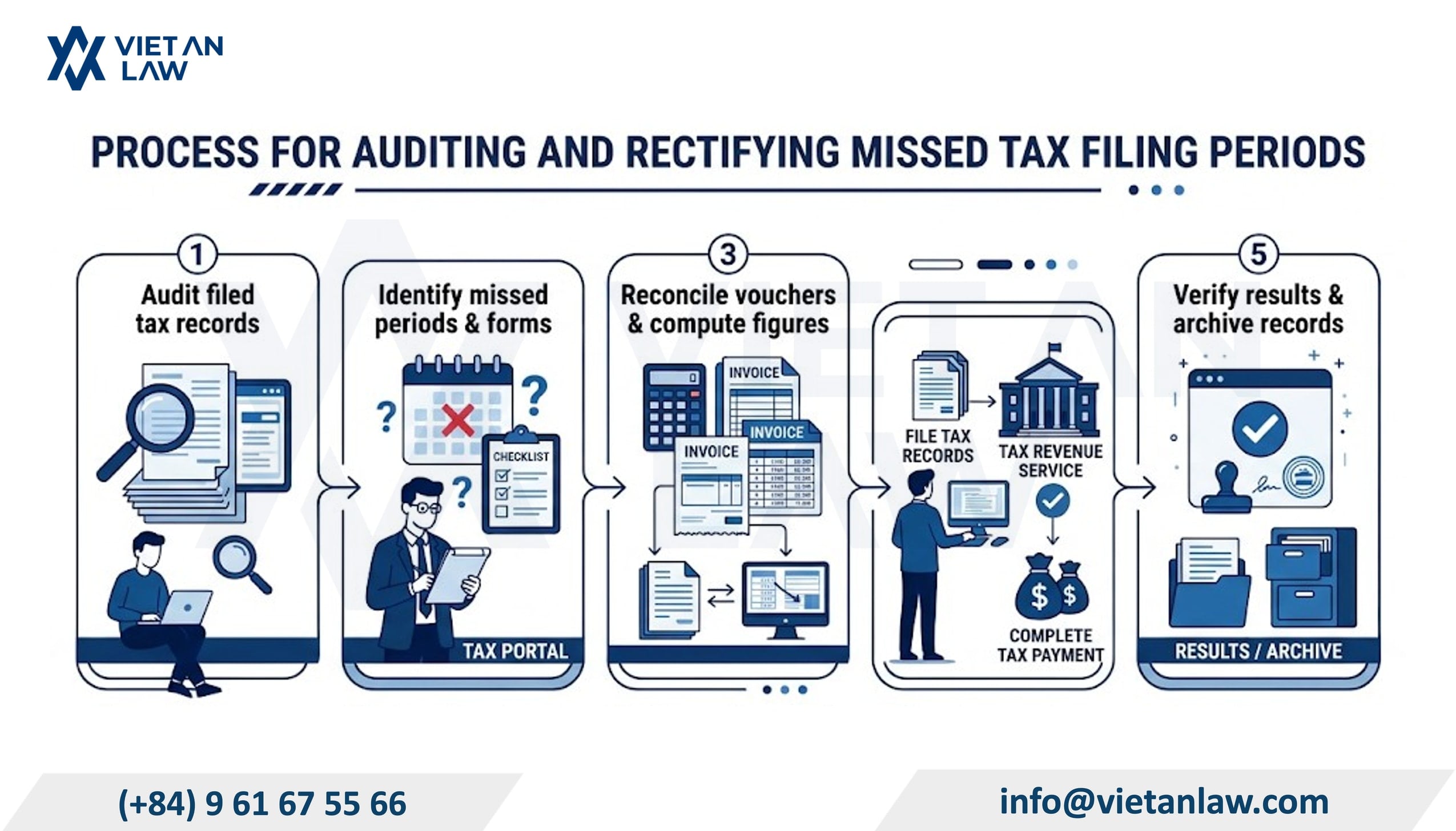
To definitively resolve the issue of unsubmitted tax reports, businesses should follow these steps:
Step 1: Look up submitted tax filings
Enterprises should log in to the electronic tax system to check the status of their filings using their tax identification number (TIN).
It is necessary to verify the type of tax return, the tax period, the submission date, the acknowledgment of receipt, and the processing outcome.
In cases where third-party tax filing software is used, enterprises must still save and review the response notifications issued by the tax authority’s system.
Step 2: Identify the specific periods and types of missing filings
After conducting a search, the business should compile a list of the periods that require attention, categorized by tax type.
It is also necessary to verify the business’s operational status (e.g., whether it is temporarily suspended), its applicable tax calculation method, and any exemptions from filing requirements, in order to avoid preparing tax returns for periods where no tax obligations exist.
Step 3: Reconcile documents and determine figures
The enterprise must compile invoices, payroll records, contracts, payment vouchers, and accounting data pertaining to the omitted period(s).
For periods involving carried-forward balances, it is necessary to reconcile figures from both the preceding and subsequent periods to assess the impact of any adjustments.
Step 4: Submit filings and fulfill tax obligations
Depending on the status of each period, the enterprise must prepare and submit either an original (late) tax return or an amended tax return, in accordance with applicable regulations.
If any unpaid tax arises, the enterprise must determine the outstanding tax amount, late payment interest, and any related financial obligations.
Step 5: Verify outcomes and archive records
Following the submission of filings, the enterprise should monitor notifications from the tax authority, retain proof of payment, and verify the status of its tax obligations.
Should there be a request for clarification or a notice regarding penalties for non-compliance, the enterprise must take action in accordance with the specified requirements, deadlines, and procedures.
Multiple consecutive tax filing periods missed in Vietnam: What is the correct remediation sequence?
When a business fails to file tax returns for multiple consecutive periods, the missing returns must be submitted for each respective period – a step that is particularly important given that data from one period often influences subsequent periods.
Illustrative example: A business files VAT returns on a quarterly basis but fails to submit filings for the first and second quarters, while having already submitted the filing for the third quarter.
| Tax period | Status | Inspection & review guidance |
| Quarter I | Not submitted | Prepare and submit the initial tax return, and determine the tax payable or deductible amount |
| Quarter II | Not submitted | Prepare and submit the initial tax return, and cross-check data related to Quarter I |
| Quarter III | Submitted | Reconcile figures carried forward from prior periods; determine whether a supplementary declaration is required |
In this situation, the enterprise should not simply report the aggregate figures for all three quarters in the third-quarter tax return. Instead, it must determine its tax obligations for each specific period and assess how any unsubmitted filings might affect those that have already been accepted by the tax authorities.
The fact that a third-quarter return has been submitted does not automatically necessitate a supplementary filing for that quarter; such a step should only be taken if errors are identified and the conditions for submitting a supplementary return are met.
Common mistakes to avoid when processing overdue tax returns in Vietnam
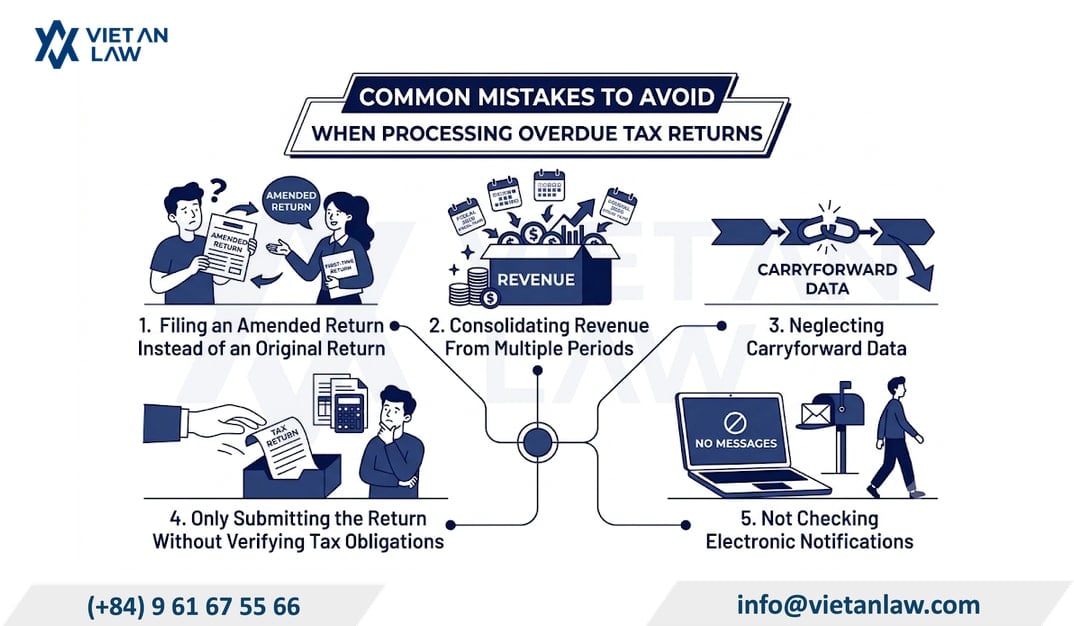
During the rectification process, businesses should avoid the following errors:
- Submitting a supplementary declaration instead of an initial declaration: If no return has ever been filed for a specific tax period, the correct procedure for a late initial declaration must be followed.
- Consolidating revenue from multiple periods: Do not simply shift all transactions from a missed period into the current period; each transaction must be reported in the period to which it belongs.
- Overlooking carry-forward figures: This is particularly critical regarding creditable VAT and other line items that carry over between tax periods.
- Filing a tax return without addressing the underlying tax liability: Submitting a return does not substitute for the actual payment of any outstanding tax due.
- Failing to check electronic notifications: If a submitted return is rejected, further action is required to ensure the filing obligation is properly fulfilled.
For tax returns that have already been submitted but contain errors, the Law on Tax Administration No. 108/2025/QH15 stipulates a five-year period—starting from the deadline for filing the return for the period in which the error occurred—during which a supplementary declaration may be submitted. The law also establishes specific conditions and limitations for various scenarios, particularly when the tax returns are subject to an audit or investigation.
Do enterprises with zero revenue or temporary suspension need to remediate unfiled periods in Vietnam?
Enterprises with no revenue
The absence of revenue does not exempt an enterprise from all tax filing obligations. However, this does not mean that a “nil” (zero-value) tax return must be filed for every type of tax.
Enterprises should review the specific criteria for each tax type and their actual operational status before concluding that a failure to file for a given period constitutes a violation.
Enterprises in temporary suspension of business
For companies that have duly notified the authorities of a temporary suspension of operations, tax filing obligations are determined based on regulations concerning the suspension period and specific exceptional cases.
Enterprises must distinguish between the periods before suspension, during suspension, and after the resumption of operations to avoid incomplete filings or the submission of unnecessary documentation.
Enterprises undergoing dissolution or a change in tax authority
Companies in the process of dissolution, ceasing operations, or changing their tax registration information must verify the status of any outstanding filings and obligations arising from these specific procedures.
Compliance in these cases involves not only periodic tax returns but also final tax settlements, the deactivation of the tax identification number, and adherence to other relevant legal requirements.
Is there a penalty for failing to submit a tax return in Vietnam?
Businesses that fail to file tax returns or submit them late may face administrative penalties, depending on the nature of the violation, the duration of the delay, and other specific circumstances.
It is important to distinguish between missing a filing deadline, filing an incorrect return that results in an underpayment of tax, and tax evasion. Taking corrective action does not automatically exempt a business from penalties.
For further information on the various scenarios and applicable sanctions, businesses may refer to the article: Penalties for failure to file tax returns in Vietnam provided by Viet An Law.
Services for remediating missed tax filing periods at Viet An Tax agency in Vietnam
Viet An Tax Agency provides support services for businesses to review incomplete tax filing periods and prepare the necessary documentation to rectify these issues in accordance with regulations.
The scope of work includes:
- Searching and reconciling the filing status for each period;
- Identifying tax returns that have not been submitted or contain errors;
- Reviewing data, invoices, and supporting documents directly related to the files requiring attention;
- Preparing late initial tax filings;
- Assisting with supplementary (amended) filings, provided that legal requirements are met;
- Determining outstanding tax liabilities, late payment penalties, and any matters requiring clarification;
- Monitoring the status of the files and delivering the final results.
For businesses that wish to maintain regular tax filing after resolving any outstanding periods, Viet An also offers ongoing tax filing and reporting services. businesses may refer to the article: Tax declaration and reporting services in Vietnam by Viet An Law.
Frequently asked questions
If a tax return for one quarter is missed, is it necessary to resubmit returns for other quarters?
Not necessarily. You do not automatically have to resubmit returns for all quarters. The business must complete the filing for the missed period and assess whether it impacts previously filed periods. Supplementary tax returns should only be filed if errors are discovered and specific conditions are met.
Is a company with no revenue required to file a VAT return?
This depends on the tax calculation method, the company’s operational status, and any applicable exemptions from filing requirements. The absence of revenue is not the sole criterion for determining filing obligations.
If a tax return was submitted but rejected by the tax authority, is it considered filed?
The business must check the reason for the rejection and the legal status of the filing. If the submission is not valid, the filing process must be repeated in accordance with regulations, and the impact on filing deadlines must be assessed.
If a tax return has been filed but the tax has not yet been paid, is it necessary to resubmit the return?
Not necessarily. If the tax return itself is accurate, the business simply needs to settle the outstanding tax liability. Supplementary returns are only required if errors are found in the original filing.
Can a business hire a third party to handle past tax reporting periods?
Yes. Viet An Tax Agency can review and assess your filings for specific periods and define the scope of services required. In cases where data has been missing for several years, or if the business is currently under audit by the tax authorities, a separate assessment is required before proceeding.
Assistance with addressing missed tax filing periods in Vietnam
If a business discovers that it has failed to file a tax return or neglected to submit a return for a previous period, it must verify the status of its filings, determine its tax obligations, and take corrective action in accordance with applicable regulations. Proactively addressing these issues helps prevent the persistence of errors and facilitates the process of providing explanations to tax authorities.
Viet An Tax Agency provides support in reviewing and preparing missing tax returns, filing supplementary returns, and resolving related matters within the scope of our services.
For consultations, please contact Viet An Law via our hotline at 0961 571 818 to receive assistance and a price quote.