


Inactive companies in Vietnam that cease operations without completing procedures to terminate the validity of their tax codes are creating a prolonged dissolution tax debt burden and direct legal risks for their legal representatives. Based on the Draft dated November 1, 2026 of the National Assembly Resolution on specific policies for handling tax arrears and granting tax debt relief, the State has established a strict legal framework to waive business license fee and late payment interest upon company dissolution in Vietnam. The following article by Viet An Law provides a detailed analysis of the legal conditions, application boundaries, and dossier preparation strategies to help business owners maximize the benefits of this policy.
Legal context of tax arrears for inactive companies in Vietnam
Under the Law on Tax Administration 2019 and the Law on Enterprises 2020, a company officially ceases to exist only after fulfilling its obligation to pay all dissolution tax debt and having its legal status updated by the business registration authority on the National Enterprise Registration Information System. However, tax administration practice records hundreds of thousands of inactive companies in Vietnam falling into a locked tax code status:
- Enterprises suffer business losses and arbitrarily cease operations at their registered addresses without carrying out procedures to notify temporary suspension or complete the process of closing a company in accordance with the law;
- The tax administration system automatically assesses annual business license fees together with late payment interest at a rate of 0.03% per day, causing tax arrears to continue accruing even though the enterprise generates no actual revenue;
- Legal representatives face coercive measures in the form of temporary exit suspension under Decree No. 49/2025/ND-CP and Article 66 of the Law on Tax Administration 2019, while also being restricted from establishing or managing new enterprises.
Accordingly, implementing the policy on business license fee and late payment interest debt cancellation in Vietnam under the Draft Resolution of the National Assembly represents a breakthrough solution to clean up national enterprise data, provide targeted tax debt relief, and break the deadlock for the business community.
Eligible entities and exclusion boundaries under the draft dated November 1, 2026
The policy on debt cancellation in Vietnam for business license fees and late payment interest upon enterprise dissolution or when closing a company under the Draft dated November 1, 2026 establishes a dual filter comprising conditions on entity status and conditions on the nature of the debt.
Eligible and excluded entities based on taxpayer status
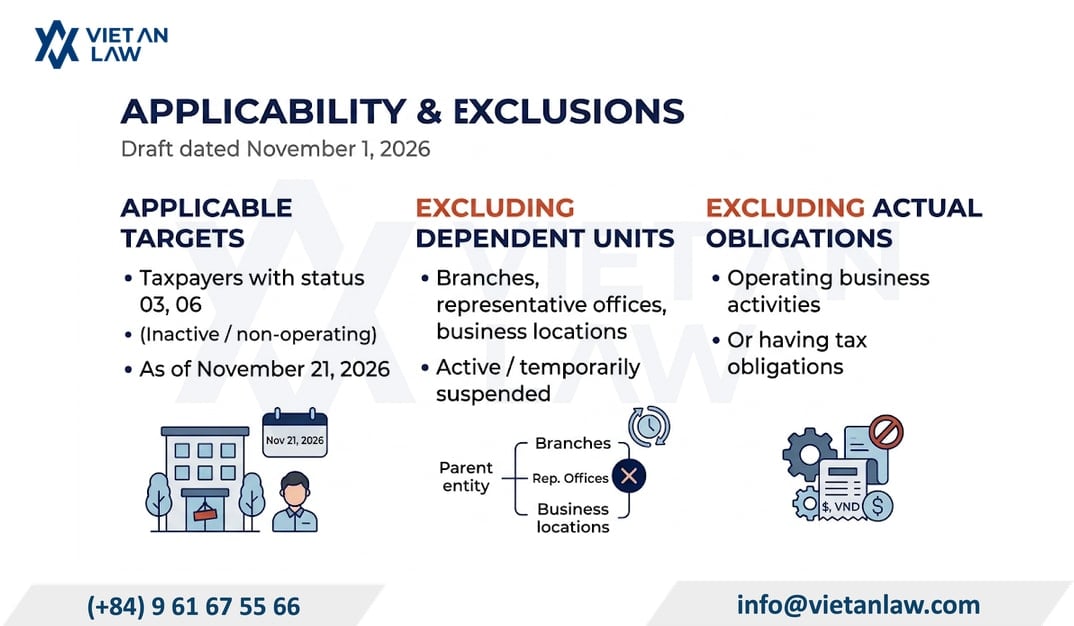
- Eligible entities (the highest-risk group): Taxpayers that are in an inactive status without having completed procedures for tax code deactivation (status 03) or are not operating at their registered address (status 06) as of November 21, 2026 (pursuant to Circular No. 86/2024/TT-BTC);
- Exclusion of dependent units: Branches, representative offices, and business locations of a managing entity that is currently operating or undergoing a fixed-term suspension of operations;
- Exclusion due to actual incurred obligations: The policy does not apply to taxpayers that generated production or business activities or incurred tax obligations during the period they held status 03 or status 06.
Exclusion boundaries by debt category and supervision mechanism
Unlike the criteria excluding the entire taxpayer status above, the provisions under Clause 2 of Article 2, Article 3, and Article 6 of the Draft dated November 1, 2026 set forth specific exclusion criteria for each debt item (subject matter) and implementation control principles that tax advisory specialists particularly emphasize:
- Exclusion of debts involving legal violations: Debt cancellation does not apply to debts related to acts of tax evasion, tax fraud, or the use of illegal invoices and vouchers;
- Exclusion of debts undergoing legal proceedings or inspection: The policy does not apply to debts related to dossiers or cases currently under inspection, investigation, prosecution, or adjudication (excluding only the specific debt tainted by the violation, without revoking the right to resolve other valid debts of the same enterprise);
- Implementation and supervision principles: Debt handling must follow the principle of “publicity and transparency” (the draft does not stipulate the public disclosure of a list of cancelled debts), and the Government is assigned to strictly handle acts of policy profiteering (the draft contains no provision for the automatic recalculation of late payment interest).
Comparison table of entity and debt filters under the draft dated November 1, 2026
| Criteria group | Eligible | Excluded |
| By entity status | Enterprises, cooperatives, business households, and business individuals in status 03 or status 06 as of November 21, 2026, with no incurred business operations or tax obligations | Branches, representative offices, and business locations of active or temporarily suspended managing entities; entities with incurred tax obligations |
| By nature of debt | Valid tax debts, administrative fines, and other state budget revenues (Point b, Clause 1, Article 38 of the Law on Tax Administration); unpaid late payment interest | Debts related to tax evasion, fraud, or illegal invoices; debts currently under inspection, investigation, prosecution, or adjudication; amounts already paid |
Mechanism for business license fee and late payment interest cancellation in Vietnam under Article 4 of the Draft dated November 1, 2026
Automatic cancellation of business license fees and late payment interest
Article 4 of the Draft dated November 1, 2026 does not expand the scope of application beyond taxpayers in status 03 and status 06 specified in Article 1 and Article 2, providing a streamlined handling mechanism as follows:
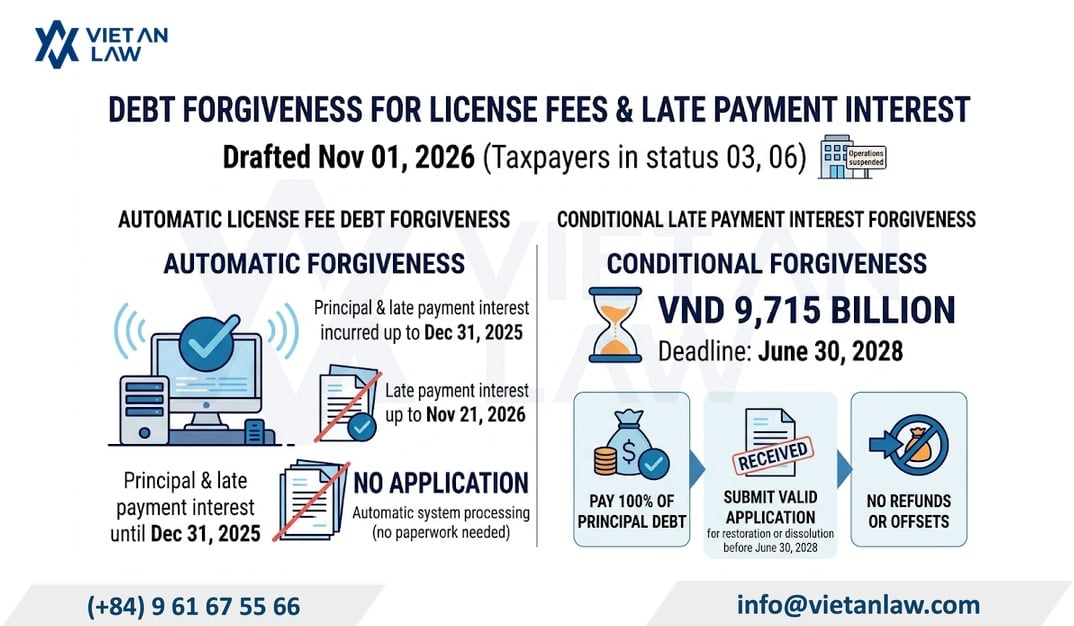
- Scope of cancelled debts: Cancellation of business license fee debts (including “business license tax” before 2017) incurred up to December 31, 2025, together with the late payment interest on those amounts; cancellation of unpaid late payment interest on business license fees accrued up to November 21, 2026; and exemption from declaration and payment for portions not yet declared and not yet accounted for on the tax system;
- Implementation procedures: The tax authority automatically processes the cancellation based on data in the tax administration system, and taxpayers are not required to submit an application dossier.
Conditions for late payment interest cancellation until June 30, 2028
According to the Ministry of Finance’s submission dossier, the total late payment interest for status 03 and status 06 groups amounts to approximately VND 9,715 billion. Pursuant to Article 3 and Article 5 of the Draft dated November 1, 2026, to qualify for the cancellation of late payment interest (including late payment fines incurred before July 1, 2013), taxpayers must fully satisfy the following conditions no later than June 30, 2028:
- Full payment of 100% of principal debt: Including tax amounts, administrative violation fines, and other revenues under Point b, Clause 1, Article 38 of the Law on Tax Administration No. 38/2019/QH14 (excluding business license fees);
- Receipt of a valid dossier: Dossiers requesting tax code restoration or deactivation (for enterprise dissolution or closing a company) must be complete, valid, and officially received by the tax authority no later than June 30, 2028;
- Non-refund principle: Only unpaid late payment interest is cancelled; amounts already paid into the state budget will not be refunded or offset.
Expected effective timeline for implementing debt cancellation in Vietnam
- Before November 21, 2026: Conduct internal reviews and refrain from submitting tax code restoration dossiers;
- From November 21, 2026: The Resolution takes effect; submit dossiers to close or reopen tax codes and settle principal debts;
- Until the end of June 30, 2027: Benefit from a reduced 30% penalty rate for late tax return filings;
- Until the end of June 30, 2028: Late filing penalties increase to 50%–70%, marking the final deadline for the receipt of dossiers requesting late payment interest cancellation;
- After June 30, 2028: Continue processing valid dossiers that were received prior to the deadline.
Recommended actions for Vietnamese enterprises
To optimize the draft tax debt relief policy, enterprises must pay close attention to the tasks to be prepared and the dossiers to be submitted across each specific milestone:
Phase before November 21, 2026: Internal review and resource preparation
- Procedural note: Do not submit a dossier to restore the tax code yet in order to preserve status 03 or status 06 through November 21, 2026 (Clause 1, Article 2 of the Draft dated November 1, 2026);
- Dossier preparation: Engage a tax and accounting service to reconstruct accounting books, review missing tax declarations, and consolidate the legal representative structure;
- Financial preparation: Reconcile and prepare sufficient funds to settle the principal dissolution tax debt in accordance with Clause 2, Article 3 of the Draft dated November 1, 2026.
Phase from November 21, 2026 to June 30, 2027: Dossier submission and maximum incentives
- Fulfilling obligations: Pay 100% of the principal debt together with the dossier to close or reopen the tax code starting from the expected effective date of November 21, 2026 (Article 6 of the Draft dated November 1, 2026);
- Reduction of late return penalties (Draft Resolution of the Government): Enjoy a 30% penalty rate until June 30, 2027; full penalty exemption for presumptive tax households; and a 50% penalty reduction for declaration-based business households and individuals submitting complete dossiers;
- Submission of commitment (Draft Resolution of the Government): Submit a written commitment to be exempted from filing tax returns for periods in which no tax obligations arose (for status 06 or revoked enterprise registration);
- Submission of tax finalization (Draft Resolution of the Government): Mandatory submission of tax finalization dossiers up to the date of registration revocation (not eligible for exemption).
Phase from July 1, 2027 to June 30, 2028: Fulfilling conditions before the deadline
- Penalty rate note: Penalties for late submission of tax returns increase to 50% and 70% under the separate Draft Resolution of the Government;
- Submission of valid dossiers: Complete payment of the principal debt and ensure a valid dossier is officially received by the tax authority no later than June 30, 2028 (Article 3 and Article 5 of the Draft dated November 1, 2026).
Phase after June 30, 2028: Transitional processing and legal finalization
- Transitional resolution: Monitor the continued processing of valid dossiers that were received before the June 30, 2028 deadline (Article 6 of the Draft dated November 1, 2026);
- Legal finalization: Retain the notice of late payment interest cancellation, maintain the locked tax code status for final closure, and complete enterprise dissolution procedures.
FAQs on waiving business license fees and late payment interest cancellation in Vietnam
Does a normally operating enterprise with unpaid 2025 business license fees qualify for automatic debt cancellation?
No. The draft policy’s scope is strictly limited to taxpayers in inactive status who have not yet closed their tax codes (status 03) or are not operating at their registered address (status 06) as of November 21, 2026. Normally operating enterprises are not eligible for debt cancellation under this draft.
If a branch has its tax code locked under status 06 while its parent company remains active, does the branch qualify for late payment interest cancellation?
No. Dependent units, including branches, representative offices, and business locations, of a managing entity that is currently operating or undergoing a fixed-term suspension of operations fall under the group of entities excluded from the policy.
Should an enterprise in status 06 submit an application to restore its tax code before November 21, 2026?
No, it should not. Because Clause 1, Article 2 of the Draft dated November 1, 2026 requires taxpayers to hold status 03 or status 06 as of November 21, 2026, completing tax code restoration before this date will disqualify the enterprise from benefiting from the debt cancellation policy.
Tax and accounting service and company dissolution advisory at Viet An Law
Viet An Law provides comprehensive legal solutions and a full-package tax and accounting service to help taxpayers definitively resolve tax codes in status 03 and status 06 in accordance with the regulatory roadmap:
- Verify entity eligibility and audit each debt item under Article 2 of the Draft dated November 1, 2026, to accurately segregate the principal debt payable under Clause 2, Article 3;
- Draft and prepare tax finalization dossiers and optimize the 30% penalty rate before June 30, 2027 under the separate Draft Resolution of the Government;
- Represent clients in submitting valid tax code deactivation dossiers after November 21, 2026 and execute full-package company dissolution procedures before the June 30, 2028 deadline.
If you require tax advisory support, principal debt calculation, or dossier preparation ahead of the policy to waive business license fee and late payment interest upon company dissolution in Vietnam, taking effect in November 2026, please contact Viet An Law immediately for timely assistance from our team of lawyers and tax accounting specialists.