


From July 1, 2026, the assessment of risks and the classification of taxpayers’ compliance will officially enter a new phase of strict control. The Ministry of Finance has issued Circular 94/2026/TT-BTC on tax compliance and risk management in Vietnam, detailing the approach to tax compliance management Vietnam-based enterprises must now follow. Failing to keep up with these criteria in time may put an enterprise on the tax authority’s inspection and audit “blacklist”. So what is new in Circular 94/2026/TT-BTC? Together with the tax & accounting team of Viet An Law Firm, let’s analyze in detail how the tax authority assesses risks and what enterprises should note to keep their compliance status as safe as possible in the article below.
Overview of Circular 94/2026/TT-BTC on tax compliance and risk management in Vietnam
| Criteria | Details |
| Issuing authority | Ministry of Finance |
| Effective date | July 1, 2026 |
| Purpose | To assess and classify the risk and compliance status of taxpayers |
| Subjects of application | Taxpayers, tax authorities, tax officials and relevant organizations/individuals |
Breakthrough changes introduced by Circular 94/2026/TT-BTC in Vietnam
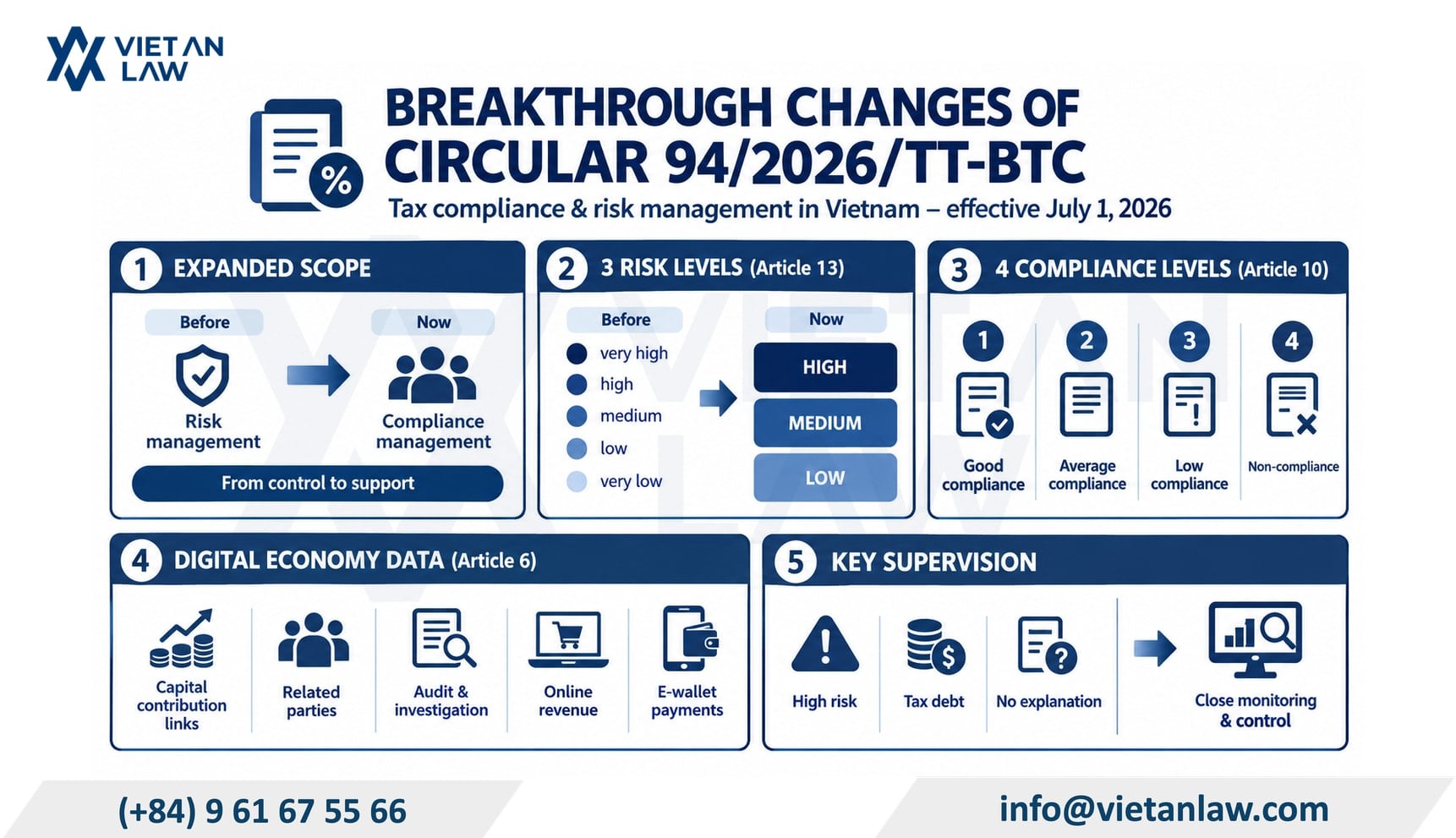
Expanding the scope to include “compliance management” under Circular 94/2026/TT-BTC
The legal basis for this change in scope and in the management model is set out in the scope of regulation (Article 3) and the general provisions of Circular 94/2026/TT-BTC (replacing Circular 31/2021/TT-BTC).
- While the old circular (Circular 31/2021/TT-BTC) confined its scope entirely to “risk management” in tax operations, the new circular has officially brought “compliance management” into its very name and scope of regulation. This creates a legal framework for the tax authority to both measure risks and assess taxpayers’ compliance with the law.
- This adjustment marks a strategic shift for the tax sector and for the tax compliance management Vietnam is pursuing: moving from a model of “control and post-audit inspection” to a model of “risk governance combined with accompanying and supporting compliance”.
Tax risk classification reduced to only 03 levels (Article 13)
- The old regulation spread risk classification across 5 levels (very high, high, medium, low and very low risk).
- Meanwhile, under Article 13 of Circular 94/2026/TT-BTC, the risk level of taxpayers is reduced to only 03 levels: high risk, medium risk and low risk.
- This streamlining simplifies the classification framework and makes it much easier to apply automation on the tax authority’s system. Based on these 3 levels, the tax authority will channel its management; for example, the high-risk group will be subject to inspections at its head office, refusal of registration to use e-invoices or suspension of e-invoice use.
Standardizing 04 tax compliance levels (Article 10)
Pursuant to Article 10 of Circular 94/2026/TT-BTC, the results of assessing and classifying the compliance of enterprises/taxpayers are clearly set out in 4 levels:
- Level 1: Good compliance
- Level 2: Average compliance
- Level 3: Low compliance
- Level 4: Non-compliance
For cases classified at the good, average and low tax compliance levels, the tax authority will apply measures to improve the enterprise’s compliance with tax laws in subsequent periods.
Adding data sources and “digital economy” criteria (Article 6)
- Old regulation: Circular 31/2021/TT-BTC mainly assessed risks based on traditional data sources such as business registration information, tax debts, tax payment information, and tax incentives, exemptions or reductions.
- New point: Article 6 of Circular 94/2026/TT-BTC requires the collection of additional in-depth data sources, including information on capital contribution relationships, related-party relationships, and audit and investigation results. In particular, to keep up with the digital economy, the criteria in the appendices now include assessment data on income from online business and income paid via international e-wallets (such as PayPal, Google, YouTube…).
Adding the “key supervision” measure
A completely new provision aimed at tightening management is the addition of the “key supervision” mechanism. The tax authority will apply professional measures to closely monitor and control the activities of enterprises showing signs of high risk or of violating tax laws for a certain period of time. For example, high-risk tax debtors or taxpayers who fail to proactively provide explanations may be placed under key supervision.
Comparing Circular 94/2026/TT-BTC on tax compliance and risk management in Vietnam with the old Circular 31/2021/TT-BTC
| Comparison criteria | Circular 31/2021/TT-BTC (old) | Circular 94/2026/TT-BTC (new – from July 1, 2026) |
| Scope of regulation | Focuses mainly on applying risk management in tax administration operations. | Expands the scope, comprehensively adding the “compliance management” component and the risk management subsystem. |
| Operational risk classification | Divided into more detailed levels (may include very high and very low levels depending on the operation). | Reduced to 3 levels: high risk, medium risk, low risk (optimized for system automation). |
| Assessment data sources | Business registration information, tax payment history, tax debts, basic tax incentives. | Significantly expanded: related-party relationship data, audit/investigation results, and especially digital economy criteria (e-wallets, online business). |
| Specific management mechanisms | In-depth, real-time compliance monitoring subsystems were not yet clearly defined. | Adds clear provisions on key supervision of taxpayers with risks or delayed explanations. |
Tax risk management and e-invoice compliance in Vietnam
Violations of e-invoice regulations are among the top criteria leading to an enterprise being assessed as high risk under Circular 94/2026/TT-BTC. However, all detailed regulations on the operation and use of e-invoices are currently governed by Decree 254/2026/ND-CP.
In business practice, the group of violations most likely to lead to being classified as “Level 4: Non-compliance” and “high risk” is invoice-related issues. To avoid being placed on the key supervision list under Circular 94/2026/TT-BTC, enterprises must strictly ensure e-invoice compliance in all invoicing operations, as detailed in: Decree No. 254/2026/ND-CP on e-invoices.
Issuing invoices in the wrong period not only results in administrative penalties but also lowers the enterprise’s compliance ranking on the tax system. To prevent this risk, accountants should regularly reconcile transactions against the regulations on the time of issuing VAT invoices currently in force.
In addition, Circular 94/2026/TT-BTC is only a guiding document on risk assessment operations. The core foundations of taxpayers’ rights and obligations, as well as the fundamental inspection and audit procedures, must still be based on Decree 252/2026/ND-CP guiding the Law on Tax Administration. Enterprises need to understand these documents together in order to build a safe legal and accounting framework for themselves.
Impact of Circular 94/2026/TT-BTC on e-invoicing and VAT refund services in Vietnam
Pursuant to Article 20 of Circular 94/2026/TT-BTC, enterprises classified in the high-risk group will be subject to the strictest control measures on the use of e-invoices:
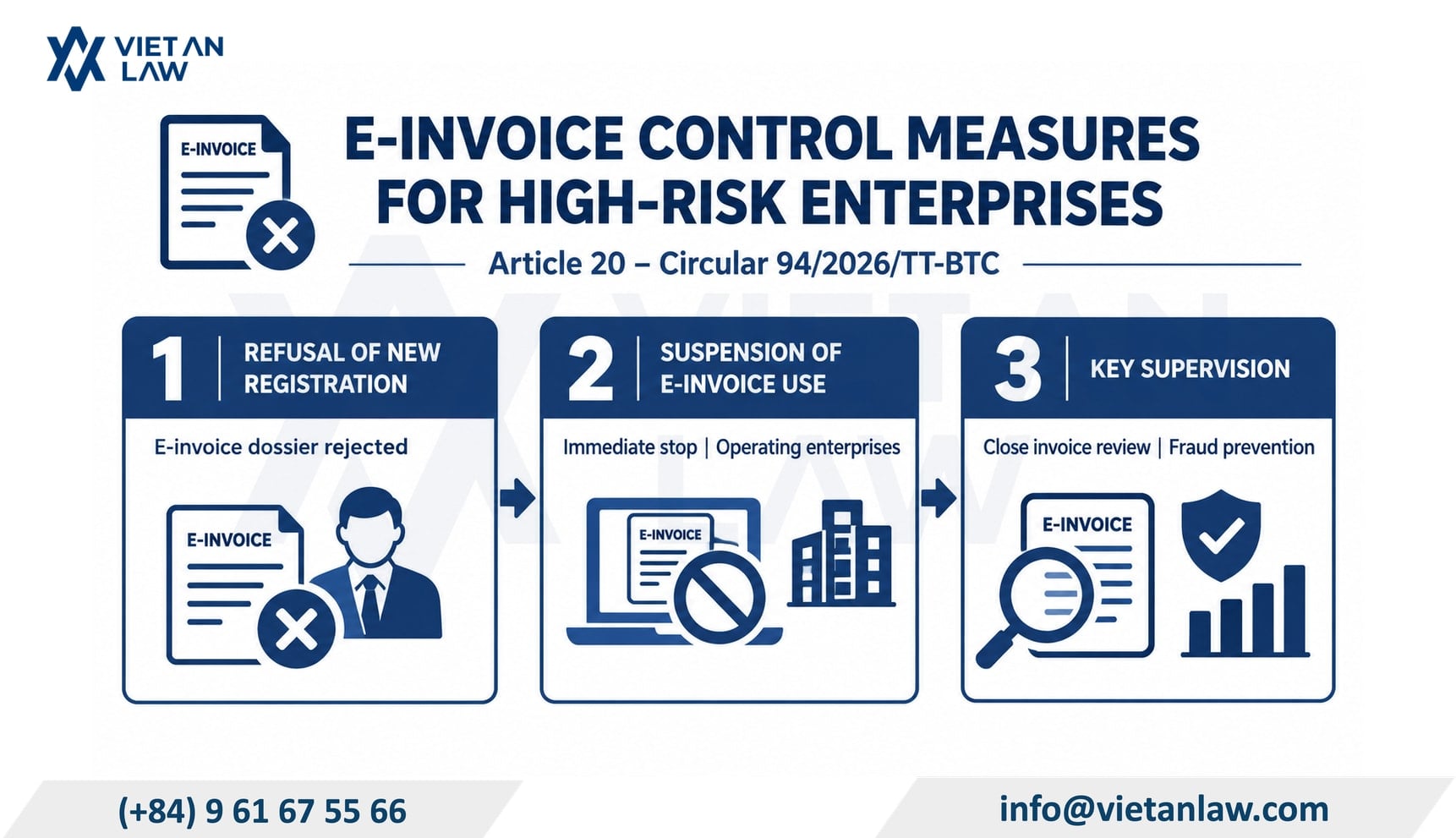
- Refusal of new registration: The tax authority firmly refuses to accept the enterprise’s dossier for registration to use e-invoices.
- Suspension of e-invoice use: For operating enterprises, the competent tax authority may suspend and require the immediate cessation of e-invoice use.
- Key supervision: Other specific invoice management and review measures are applied as prescribed to closely monitor the enterprise and prevent the risk of tax fraud.
How are the “refund first, check later” and “check first, refund later” procedures applied?
The routing of dossiers for value-added tax refunds and other refundable amounts is determined directly by the taxpayer’s risk ranking as well as the nature of each dossier:
- High-risk group: The “check first, refund later” procedure is mandatory for all dossiers. The tax authority will thoroughly examine the supporting documents before deciding on the refund.
- Medium-risk and low-risk groups:
- Applying “refund first, check later”: The refund is processed quickly if no risk signs have been detected in the tax amount requested for refund in the dossier.
- Refund suspension: Even if the enterprise has a good compliance record (low/medium risk), if the specific amount requested for refund shows signs of risk, the tax authority will immediately suspend the refund process to collect additional information, review and inspect it in detail.
What should enterprises in Vietnam prepare before July 1, 2026?
Systematizing the review and reconciliation of invoice data
- Proactively detect discrepancies: The tax authority now applies AI and Big Data to automatically scan for discrepancies between value-added tax returns and the e-invoice database. Enterprises should reconcile periodically (monthly/quarterly) instead of waiting until the end of the year.
- Control partner risks: Regularly check the operating status of suppliers on the tax authority’s system to promptly detect input invoices from “absconding enterprises” or businesses that have suspended operations, so that explanations can be prepared early.
Standardizing internal control procedures to protect your compliance ranking
- Clear division of duties: Clearly separate the responsibilities of the purchasing department (which receives the services/goods), the accounting department (which records and checks invoices) and the payment department.
- Risk assessment criteria: An enterprise’s tax compliance profile (low, medium, high) determines how often it is inspected and audited. Internal procedures should include mandatory checkpoints before figures are finalized for reporting, ensuring there are no basic arithmetic errors or wrong invoice issuance timing.
Using professional tax and accounting advisory services
- Timely updates: Tax decrees and circulars are continuously amended and supplemented. Advisory experts help enterprises keep up with the latest tax incentives as well as the risks the tax authority has just put “in its sights”.
- Legally optimizing costs: Rather than only handling problems as they arise, professional services help structure expenses, commercial contracts and supporting documents from the outset so that expenses are recognized as valid and reasonable.
Additional recommendation: upgrade accounting software and support tools
- Besides process and people, enterprises should consider using accounting software that can automatically download, synchronize and reconcile invoices directly from the tax authority’s system. This minimizes errors from manual operations (human error) and saves time for the finance department.
Viet An Law Firm’s tax & accounting services – a professional, reputable tax agent in Vietnam
Viet An Law Firm will help you set up a sound accounting and tax system from the very first steps:
- Advising on tax code registration and completing the initial tax declaration dossier.
Registering the tax calculation method and the depreciation method for fixed assets.
- Supporting the notification of e-invoice issuance and registration for electronic tax payment.
- Registering bank accounts and online transactions with the tax authority
- Tax consulting for FDI enterprises: Resolving tax policy issues for foreign investors and ensuring compliance with transfer pricing and related-party transaction regulations.
- Payroll services: Building salary scales and payrolls, social insurance and personal income tax calculation.
- Audit support services: Coordinating the review of financial statements for enterprises subject to mandatory independent audits.
For in-depth legal advice and professional, safe tax consulting services, including VAT refund services, clients are kindly requested to contact Viet An Law Firm via:
- Hotline (Zalo/Viber): 0961 67 55 66 – 0933 11 33 66
- Email: luatsu@vietanlaw.com
- Hanoi office: 3rd Floor, Hoang Ngan Plaza Building, 125 Hoang Ngan Street, Cau Giay, Hanoi.
- Ho Chi Minh City office: Room 2.26 – 2.27, Charmington La Pointe Building, 181 Cao Thang Street, Ward 12, District 10, Ho Chi Minh City.
Frequently asked questions
What levels does tax risk classification include under the new regulations?
The risk classification framework has been reduced to 3 levels: high risk, medium risk and low risk.
Does Circular 94/2026/TT-BTC add any criteria for the digital economy?
Yes. The new circular adds criteria that keep up with the digital economy, such as income from online business and e-wallets (PayPal, Google, YouTube, etc.).
What disadvantages do enterprises with tax debts classified in the high-risk group face?
High-risk tax debtors will be subject to enhanced monitoring, may have their exit from Vietnam temporarily suspended, will have their tax debt information publicly disclosed and will face stricter control in tax refund/tax registration procedures.
How does the tax authority manage groups with “medium” and “low” invoice risks?
The tax authority does not immediately suspend invoice use but selects samples for review and inspection. At the same time, it strengthens monitoring and automated analysis of invoice data to prevent risks and support taxpayers’ compliance.