


Company dissolution is the procedure for terminating the operation and legal existence of an enterprise in accordance with the law. However, the dissolution process may encounter many obstacles when the company still has outstanding tax debts, has not fulfilled its financial obligations, is not operating at the registered address, or has a tax code in status 06. In particular, the legal changes in 2026 regarding tax administration, tax finalisation and temporary exit suspension impose important requirements on enterprises and their managers. Viet An Law guides the conditions, dossiers, company dissolution procedures in Vietnam and how to handle common cases, helping enterprises close the company lawfully and minimise arising risks.
What is company dissolution in Vietnam?
Company dissolution is the process of terminating the existence of an enterprise after completing the legal procedures and fulfilling asset obligations under the Vietnamese Law on Enterprises.
Pursuant to Article 207 of the Law on Enterprises 2020 (as amended and supplemented), an enterprise may only be dissolved when it ensures full payment of all debts and other asset obligations and is not in the process of dispute resolution at a Court or Arbitration.
Company dissolution must be distinguished from two other cases:
- Temporary suspension of business: The enterprise temporarily ceases operations but maintains its legal status.
- Bankruptcy: An enterprise that has lost the ability to pay is resolved under the bankruptcy legal process.
Voluntarily closing the company, returning its headquarters, returning the premises, generating no revenue or actually ceasing business does not mean the enterprise has been lawfully dissolved.
Cases of company dissolution under 2026 regulations in Vietnam
Pursuant to clause 1, Article 207 of the Law on Enterprises, enterprises fall into the following dissolution cases:
Dissolution pursuant to a decision of the owner, members or shareholders
This is voluntary dissolution when the owner or the competent body of the enterprise decides to terminate operations.
Decision-making authority depends on the type of enterprise:
- Private enterprise: The owner decides.
- Single-member limited liability company: The company owner decides.
- Limited liability company with two or more members: The Members’ Council decides.
- Joint-stock company: The General Meeting of Shareholders adopts a resolution.
- Partnership: The Members’ Council decides.
Adoption of the dissolution resolution or decision must comply with the regulations on authority, sequence and voting ratio.
Dissolution upon expiry of the operating term
An enterprise is subject to dissolution when the operating term stated in the Charter ends without a decision on extension.
If the enterprise wishes to continue operating, it must consider extension and carry out the corresponding legal procedures.
Dissolution due to insufficient minimum number of members
An enterprise that no longer has the minimum number of members prescribed by law for a continuous period of 06 months and fails to carry out the procedure for conversion of enterprise type falls into the dissolution case.
Example: A joint-stock company has only two shareholders for a continuous period of 06 months but does not convert to a suitable type.
Dissolution due to revocation of the Enterprise Registration Certificate or pursuant to a Court decision
This is compulsory dissolution under point d, clause 1, Article 207 of the Law on Enterprises.
The procedure is carried out under Article 209 of the Law on Enterprises and Article 65 of Decree 168/2025/ND-CP.
Cases in which the Enterprise Registration Certificate is revoked at the request of the tax authority to implement enforcement measures must be considered under specific regulations and are not identical to ordinary revocation cases.
Depending on the type of enterprise, dissolution also has separate requirements on authority and legal obligations. Enterprises may refer to Viet An Law’s guidance on joint-stock company dissolution, limited liability company dissolution and FDI company dissolution in Vietnam.
Requirements for company dissolution in Vietnam 2026
Pursuant to clause 2, Article 207 of the Law on Enterprises, to complete dissolution the enterprise must satisfy the following conditions:
First, full payment of all debts and other asset obligations. This includes obligations to employees, the tax authority, creditors, partners and other subjects with legitimate interests.
Second, not being in the process of dispute resolution at a Court or Arbitration. The enterprise must determine the dispute status before completing the procedure.
Third, proper exercise of authority and sequence of dissolution. The dissolution resolution or decision must be lawfully adopted and the obligations of notification, payment and registration must be performed in accordance with regulations.
If the enterprise is unable to pay its debts, the conditions for application of bankruptcy law should be considered instead of carrying out dissolution when the statutory conditions have not been met.
Company dissolution according to tax code status in Vietnam
The tax code status affects the performance of tax obligations and completion of the company dissolution procedure.
Pursuant to Circular 90/2026/TT-BTC, tax code statuses reflect the tax administration status of the taxpayer. These statuses must be distinguished from the legal status of the enterprise in the National Database on Enterprise Registration.
Dissolution of a company with tax code status 06
Tax code status 06 reflects the situation in which the enterprise is not operating at the registered address under tax administration regulations.
This situation often arises when the company has ceased business, returned the premises or changed location but has not fully completed the notification procedures.
A company with status 06 may still proceed with dissolution procedures, but must identify and resolve the corresponding legal obstacles and tax obligations before completion.
The enterprise needs to:
- Check the tax code status and enterprise registration status.
- Determine the time and basis on which the tax authority notified that the enterprise is not operating at the registered address.
- Cross-check declaration obligations, tax debts and outstanding dossiers.
- Determine the appropriate procedure for handling the tax code status for the purpose of dissolution.
- Complete the necessary obligations to carry out the termination procedure.
Illustrative example: Company A ceased business from 2022, returned the head office but did not carry out notification procedures. In 2026, when wishing to dissolve, the company discovers that its tax code is in status 06. The enterprise needs to check the tax authority’s notice, identify missing declaration periods, cross-check debts and implement an appropriate tax code handling plan.
Tax code status 06 does not mean the enterprise has already been dissolved or is automatically exempt from remaining tax obligations.
Dissolution of a company with tax status 03
Status 03 reflects the situation in which the taxpayer has ceased operations but has not completed the procedure for termination of tax code validity.
Pursuant to Circular 90/2026/TT-BTC, the tax authority may update this status after issuing Notice Form No. 17/TB-ĐKT on the taxpayer ceasing operations and undergoing the procedure for termination of tax code validity.
The enterprise needs to check the dossiers already submitted, identify unfinished obligations and continue the corresponding procedures.
Note: Status 03 does not mean the enterprise has completed dissolution or that tax debts necessarily remain. The dossier may still be under examination and processing by the tax authority.
Dissolution of a company that is operating or temporarily suspending business
For enterprises operating normally, the dissolution procedure is usually more straightforward when accounting records are complete, there are no outstanding debts and no legal obstacles arise.
An enterprise that is temporarily suspending business may still decide to dissolve if it meets the statutory conditions. However, temporary suspension does not replace the dissolution procedure and does not automatically eliminate obligations that have already arisen.
Can a company with outstanding tax debts be dissolved in Vietnam?
An enterprise with outstanding tax debts may begin the preparatory work and dissolution notification in accordance with regulations. However, to complete dissolution, the enterprise must ensure that financial obligations are paid or lawfully resolved under the mechanisms permitted by law.
For debts outstanding for many years, a distinction must be made between principal tax, late payment interest, penalties and amounts already paid but not yet accurately accounted for.
Handling outstanding tax debts before dissolution in Vietnam
The enterprise needs to determine tax obligations by period, check the vouchers already submitted and cross-check figures with the managing tax authority.
In case of discrepancies, the enterprise carries out explanations, reconciliation and requests for adjustment in accordance with regulations.
For dossiers and specialised work, refer to the article Tax Services for Dissolution Company in Vietnam.
Can companies with status 03 or 06 have business licence fees and late payment interest waived?
For enterprises that have ceased operations for many years, especially those with tax codes in status 03 or 06, outstanding business licence fees and late payment interest may be an obstacle to dissolution.
The Ministry of Finance has drafted a National Assembly Resolution on special policies for handling tax debts, proposing the waiver of business licence fees arising up to 31 December 2025, related late payment interest and late payment interest on tax for certain cases meeting the prescribed conditions.
However, enterprises in status 03 or 06 are not automatically entitled to debt waiver. Application must be based on the subject, the debt, specific conditions and the effective date of the official instrument. As of the November 2026 update, this content remains a proposal in draft form.
For details, refer to Viet An Law’s article on: Waive Business License Fee and Late Payment Interest upon Company Dissolution in Vietnam.
Companies with tax debts: Who may be subject to temporary exit suspension in Vietnam 2026?
Pursuant to the Law on Tax Administration No. 108/2025/QH15 and Article 28 of Decree 252/2026/ND-CP, certain individuals related to an enterprise that has tax debts or is not operating at the registered address may be subject to temporary exit suspension when the statutory conditions are met.
When are the legal representative and beneficial owner subject to temporary exit suspension?
Pursuant to point b, clause 1, Article 28 of Decree 252/2026/ND-CP, the legal representative and beneficial owner of an enterprise may be subject to temporary exit suspension when the enterprise:
- Is subject to enforcement of an administrative decision on tax administration;
- Has tax debt of VND 500 million or more;
- The debt has been overdue for 120 days or more.
Not every shareholder, capital-contributing member or enterprise manager is automatically subject to temporary exit suspension.
For foreign individuals with overdue tax debts, additional specific conditions under point d, clause 1, Article 28 of Decree 252/2026/ND-CP must also be considered.
Is temporary exit suspension applied to companies with status 06?
Pursuant to point c, clause 1, Article 28 of Decree 252/2026/ND-CP, the legal representative and beneficial owner may be subject to temporary exit suspension if the enterprise has been notified by the tax authority that it is not operating at the registered address and, after 120 days from the date of the notice, still fails to carry out the procedure for restoration or termination of tax code validity in accordance with regulations.
This case does not automatically apply the VND 500 million debt threshold of enterprises subject to tax enforcement.
Therefore, enterprises with status 06 need to check the date on which the tax authority issued the notice and the status of obligation performance.
How are notice and cancellation of temporary exit suspension carried out?
For the cases prescribed at points a, b and c, clause 1, Article 28 of Decree 252/2026/ND-CP, the tax authority issues a prior notice of intended temporary exit suspension 30 days in advance in accordance with the legal sequence.Cancellation of temporary exit suspension is carried out when the corresponding conditions are met:
- Tax enforcement case: The enterprise reduces the tax debt below VND 500 million or the debt is waived under regulations.
- Non-operation at registered address case: The taxpayer meets the conditions for restoration of the tax code, completes related obligations or has the tax code validity terminated in accordance with regulations.
When the conditions are determined to have been met, the tax authority issues a notice of cancellation of the temporary exit suspension measure to the immigration authority.
A change of legal representative does not automatically terminate tax obligations that have already arisen..
Company dissolution procedures in Vietnam 2026
For dissolution under points a, b and c, clause 1, Article 207 of the Law on Enterprises, the sequence is carried out under Article 208 of the Law on Enterprises and Article 64 of Decree 168/2025/ND-CP in the following 05 (five) steps.
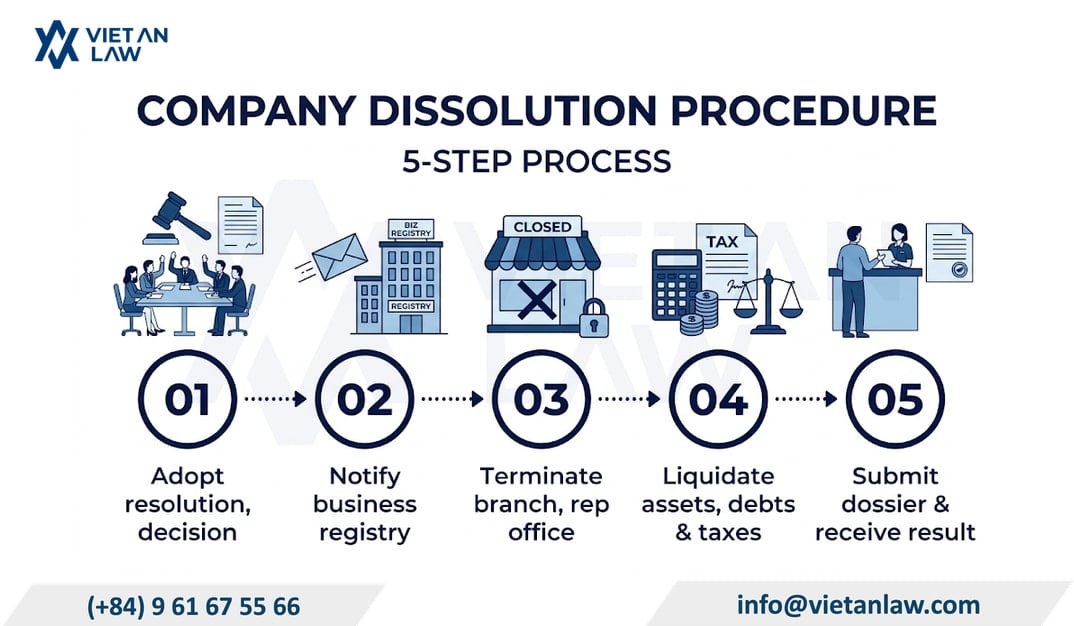
Step 1. Adoption of the company dissolution resolution or decision
The enterprise adopts the dissolution resolution or decision in accordance with the authority of each type of enterprise.
Main contents include:
- Name and head office address of the enterprise;
- Reason for dissolution;
- Time limit and procedure for liquidation of contracts and payment of debts, not exceeding 06 months from the date of adoption of the dissolution decision;
- Plan for handling obligations arising from labour contracts;
- Full name and signature of the person with authority as prescribed.
Step 2. Notification of company dissolution to the business registration authority
Within 07 working days from the date of adoption of the dissolution resolution or decision, the enterprise submits the notification dossier to the provincial-level business registration authority where the head office is located.At the same time, the enterprise performs the obligation to notify employees, creditors and related parties under Article 208 of the Law on Enterprises.Within 03 working days from the date of receipt of the dissolution resolution or decision, the business registration authority publishes the information, updates the enterprise status as undergoing dissolution procedures and transfers the information to the tax authority and other related authorities in accordance with regulations.
Step 3. Termination of operations of branches, representative offices and business locations
Pursuant to clause 4, Article 64 of Decree 168/2025/ND-CP, before submitting the final dissolution registration dossier, the enterprise must complete the procedures for termination of operations of:
- Branches;
- Representative offices;
- Business locations.
The enterprise carries out the procedures at the competent business registration authority where the dependent unit is located.
Termination of dependent unit operations may be implemented in parallel with asset liquidation and debt settlement, but must be completed before submission of the final dissolution dossier.
Step 4. Asset liquidation, debt settlement and completion of tax obligations
This is the critical stage that determines the ability to complete the dissolution procedure.
Liquidation of enterprise assets
The private enterprise owner, Members’ Council, company owner or Board of Directors directly organises asset liquidation, unless the Charter provides for the establishment of a separate liquidation organisation.
After payment of dissolution costs and debts, the remaining assets are distributed in accordance with regulations.
Payment of debts in order of priority
Pursuant to clause 5, Article 208 of the Law on Enterprises:
- Salary debts, severance allowances, social insurance, health insurance, unemployment insurance and other employee benefits;
- Tax debts;
- Other debts.
Completion of tax obligations and tax finalisation before dissolution
The enterprise must perform tax declaration obligations, tax finalisation, invoice handling and payment of taxes, late payment interest and penalties still payable in accordance with regulations.
Pursuant to point b, clause 5, Article 10 of Decree 252/2026/ND-CP, the deadline for submission of tax finalisation dossiers upon dissolution is no later than the 45th day from the date the taxpayer has the dissolution decision, for dossiers subject to finalisation.
For personal income tax, in cases where the month or quarter in which dissolution occurs has no tax withholding and is not subject to finalisation under the guidance of the Minister of Finance, the enterprise must still submit the personal income tax declaration dossier for the final month or quarter under Article 10 of Decree 252/2026/ND-CP.
Confirmation of completion of tax obligations and termination of tax code validity is carried out under Circular 90/2026/TT-BTC.
Step 5. Submission of the company dissolution dossier and receipt of results
Within 05 working days from the date of full payment of all debts, the enterprise submits the dissolution registration dossier to the provincial-level business registration authority where the head office is located.
Pursuant to clause 5, Article 64 of Decree 168/2025/ND-CP:
- Within 02 working days from the date of receipt of information, the tax authority sends its opinion on the status of completion of tax obligations.
- Within 05 working days from the date of receipt of the dissolution registration dossier, the business registration authority processes the change of legal status to “Dissolved” when the statutory conditions are met.
- If the tax authority issues a refusal opinion due to incomplete tax obligations, the business registration authority notifies the enterprise to continue handling the matter.
For dissolution due to revocation of the Enterprise Registration Certificate or pursuant to a Court decision, the procedure is carried out under Article 65 of Decree 168/2025/ND-CP.
What do company dissolution documents include in Vietnam?
Pursuant to Article 210 of the Law on Enterprises and Article 64 of Decree 168/2025/ND-CP, the company dissolution dossier is prepared according to each stage of implementation.
Dossier for notification of company dissolution
- Resolution or decision on enterprise dissolution.
- Minutes of the meeting for enterprise types that must hold a meeting.
- Debt settlement plan, if any.
Dossier for tax finalisation and termination of tax code validity
Theo Thông tư 90/2026/TT-BTC, việc chấm dứt hiệu lực mã số thuế được thực hiện khác nhau giữa doanh nghiệp đăng ký thuế theo cơ chế liên thông với đăng ký kinh doanh và tổ chức đăng ký thuế trực tiếp.
Đối với doanh nghiệp đăng ký thuế theo cơ chế liên thông
After the enterprise notifies dissolution, the business registration authority transfers information to the tax authority for processing in accordance with regulations.
During this process:
- The tax authority issues Notice Form No. 17/TB-ĐKT on the taxpayer ceasing operations and undergoing the procedure for termination of tax code validity.
- The tax authority examines and cross-checks tax obligations, identifies missing tax declaration and finalisation dossiers.
- The tax authority coordinates with the authorities managing collection items and the customs authority to confirm arising obligations, if any.
- The enterprise performs the declaration and tax finalisation dossiers that are required to be submitted; handles invoices, tax debts and excess tax paid in accordance with regulations.
- When the enterprise meets the conditions, the tax authority issues Notice Form No. 28/TB-ĐKT on completion of tax obligations for submission of the dissolution dossier at the business registration authority.
After the business registration authority confirms that the enterprise has been dissolved, the information is transferred to the tax authority to update the tax code status under the interconnected mechanism.
Note: Notice 28/TB-ĐKT confirms the status of completion of tax obligations for the dissolution dossier; it is not a notice confirming that the enterprise has been officially dissolved.
For organisations registered for tax directly
Organisations subject to direct tax registration submit the dossier requesting termination of tax code validity according to Form No. 24/ĐKT and corresponding documents under Circular 90/2026/TT-BTC.
After completing obligations in accordance with regulations, the tax authority issues a notice of termination of tax code validity according to the applicable form, including Notice Form No. 18/TB-ĐKT.
For enterprises registered for tax under the interconnected mechanism, a separate Form 24/ĐKT dossier must not be automatically required as for organisations registered for tax directly.
Dossier for registration of company dissolution
Pursuant to Article 210 of the Law on Enterprises, the final dissolution registration dossier comprises:
- Notice of enterprise dissolution according to Form No. 30 prescribed in Circular 68/2025/TT-BTC, as amended and supplemented by Circular 121/2026/TT-BTC;
- Report on enterprise asset liquidation;
- List of creditors and debts already paid, including tax and insurance obligations as prescribed, if any.
For joint-stock companies: A joint-stock company that is not a listed company or a company registered for securities trading must enclose a copy of the shareholder register as guided in Form No. 30.
The dossier is submitted at the provincial-level business registration authority under the Department of Finance where the enterprise has its head office by the methods permitted by law.
Time and costs of company dissolution in Vietnam
The time for dissolution depends on the status of the dossier, debts and tax obligations of the enterprise. Companies with complete dossiers, no remaining debts and no legal obstacles are usually more straightforward than enterprises with tax code status 06 or that have ceased operations for many years.
Pursuant to clause 6, Article 64 of Decree 168/2025/ND-CP, there is a mechanism for updating legal status after a period of 180 days from the date the business registration authority receives the dissolution resolution or decision, if all statutory conditions are met and there is no objection in accordance with regulations.
The 180-day period is not a compulsory dissolution period for every enterprise, nor does it automatically cancel tax debts.
Regarding costs, the enterprise needs to distinguish financial obligations that must be paid, costs of completing accounting dossiers and fees for advisory and representation services if any.
For enterprises wishing to engage a representative unit, refer to Company dissolution services in Vietnam at Viet An Law for advice on the scope of work and quotation according to the actual situation.
Important notes when dissolving a company in Vietnam
When carrying out enterprise dissolution, in addition to the legal conditions and dossiers, owners and managers need to note the truthfulness of documents, preservation of assets and acts prohibited by law during the termination of operations.
Mistakes to avoid when dissolving a company
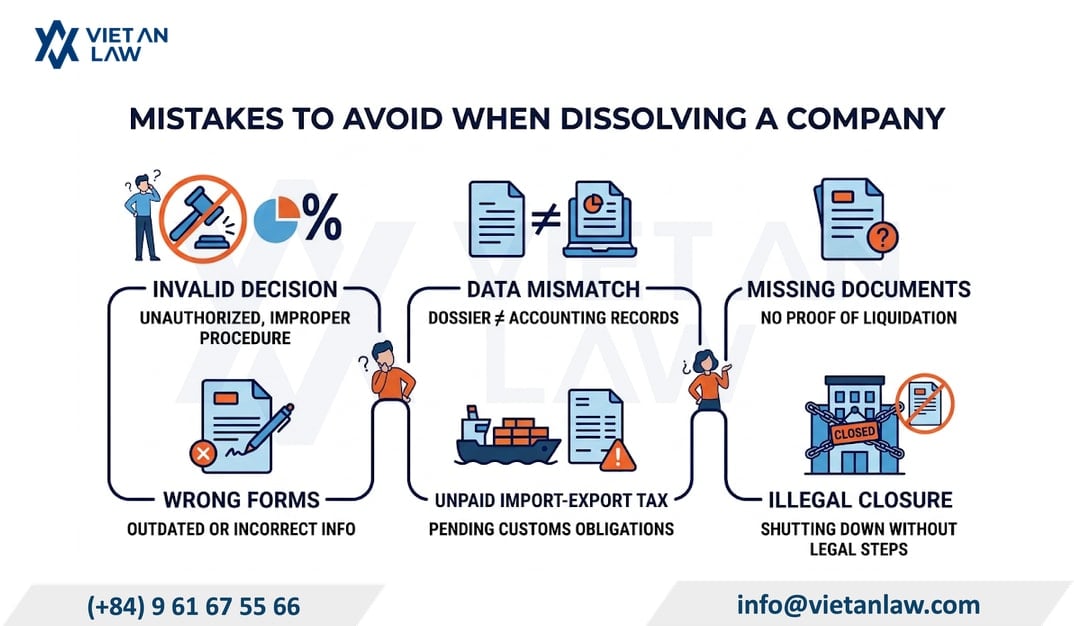
Some mistakes that may affect the handling of the dossier include:
- Dissolution resolution or decision adopted without proper authority, sequence or voting ratio.
- Information in the dissolution dossier inconsistent with enterprise registration data and accounting books.
- Failure to retain complete documents proving asset liquidation and completion of financial obligations.
- Use of forms that are no longer appropriate or incorrect declaration of enterprise information.
- Incomplete import-export tax obligations: For enterprises with import-export activities, tax and financial obligations with the customs authority must be checked. Pursuant to Circular 90/2026/TT-BTC, the tax authority coordinates with the customs authority to confirm the status of related obligations.
- Closing the enterprise on one’s own initiative and actually ceasing operations without completing the legal procedures.
Legal responsibility of managers upon dissolution
Pursuant to Article 210 of the Law on Enterprises, individuals within the scope of responsibility must ensure the truthfulness and accuracy of the dissolution dossier.
In cases where the dossier is inaccurate or forged, the related individuals within the statutory scope may be jointly liable for unpaid debts and bear other personal responsibilities under regulations.
For enterprises whose Enterprise Registration Certificate is revoked or that are dissolved pursuant to a Court decision, additional responsibilities under Article 209 of the Law on Enterprises must be determined.
In particular, pursuant to Article 211 of the Law on Enterprises, from the time the dissolution decision is made, the enterprise and its managers must not perform prohibited acts such as:
- Concealing or dissipating assets;
- Waiving or reducing debt claims;
- Converting unsecured debts into debts secured by enterprise assets;
- Entering into new contracts, except those serving the dissolution;
- Other prohibited acts under regulations.
Depending on the nature and severity of the violation, related individuals may bear civil, administrative or other legal responsibilities under regulations.
Frequently asked questions on company dissolution in Vietnam
Can a company that has lost its accounting books be dissolved?
The enterprise needs to review, restore or supplement dossiers and vouchers that must be retained and complete declaration and tax finalisation obligations. Lack of books does not automatically eliminate the right to dissolve but may affect the ability to prove completion of financial obligations.
What should a company that has ceased operations for many years but has not yet carried out dissolution procedures do?
The enterprise needs to check the business registration status, tax code, notices of the tax authority and remaining obligations. On that basis, determine an appropriate remedial plan before completing the procedures.
What if the dissolution dossier has been submitted but the tax authority issues a refusal opinion?
The enterprise needs to identify the reason for refusal, cross-check unfinished tax obligations or dossiers and carry out remedies in accordance with regulations. After resolving the obstacles, the enterprise continues the dissolution registration procedure under the applicable sequence.
Can an enterprise that has decided to dissolve continue doing business?
Pursuant to clause 7, Article 64 of Decree 168/2025/ND-CP, within 180 days from the date the business registration authority receives the dissolution resolution or decision, if the enterprise has not yet been transferred to dissolved status, it may carry out the procedure for notice of cancellation of the dissolution resolution or decision in accordance with regulations.
Legal advice on company dissolution in Vietnam at Viet An Law
Viet An Law assists enterprises in reviewing dissolution conditions, identifying legal obstacles and advising on appropriate handling plans, especially for companies with tax code status 06, outstanding tax debts or that have ceased operations for many years.
Clients wishing to authorise the preparation of dossiers, handling of tax obligations and completion of enterprise closure procedures may refer to Company dissolution services in Vietnam 2026 of Viet An Law for advice and quotation according to the actual situation.
Contact information of Viet An Law
- Telephone, Zalo, WhatsApp: (+84) 961 571 818
- Email: info@vietanlaw.com
- Website: luatvietan.vn
- Service coverage: Hanoi, Ho Chi Minh City and nationwide.
Article information
- Author: Apprentice Lawyer Do Quynh Trang – Viet An Law.
- Professional review: Lawyer Trung Thi Lieu – Tax agent expert Nguyen Thi Ngoc Diep
- Field: Enterprise law, enterprise dissolution and legal obligations upon termination of operations.
- Updated: November 2026.
Legal bases
- Law on Enterprises No. 59/2020/QH14, as amended and supplemented by Law No. 76/2025/QH15.
- Law on Tax Administration No. 108/2025/QH15.
- Decree No. 168/2025/ND-CP on enterprise registration, particularly Articles 64 and 65.
- Decree No. 252/2026/ND-CP, particularly Article 10 on the deadline for submission of tax declaration dossiers and Article 28 on completion of tax payment obligations in exit cases.
- Circular No. 90/2026/TT-BTC on tax registration.
- Circular No. 68/2025/TT-BTC on forms used in enterprise registration, as amended and supplemented by Circular No. 121/2026/TT-BTC.
- Current legal instruments on labour, insurance, bankruptcy and related asset obligations.