


In a highly competitive business environment, intellectual property assets, including trademarks, copyrights, and industrial designs, represent the core value driving corporate success. Upon detecting signs of infringement, issuing a formal warning serves as the fastest, most effective preliminary legal measure prior to entering any dispute resolution in Vietnam. In the article below, Viet An Law provides a comprehensive guide on the statutory requirements and procedures for implementing this critical enforcement tool.
Cease and desist letter for intellectual property infringement in Vietnam
A cease and desist letter regarding intellectual property infringement is a formal legal notice issued by a rights holder (or their legal representative) to an organization or individual engaging in infringing activity; it serves as the initial step in the process of intellectual property dispute resolution in Vietnam. The document aims to notify the infringing party that they are unlawfully infringing upon protected intellectual property. This is a pre-litigation step that takes place prior to filing a lawsuit or requesting state intervention and provides an opportunity for the parties to negotiate, conciliate, and terminate the infringement without resorting to time-consuming enforcement measures.
Legal bases for handling intellectual property infringement in Vietnam
The issuance of a warning document is not merely a spontaneous act but one explicitly authorized by law.
The right of self-protection of rights holders under the Vietnamese Law on Intellectual Property
Pursuant to Article 198 of the Vietnamese Law on Intellectual Property, an intellectual property right holder has the full right to take the initiative in protecting their assets against infringing acts. Specifically, the intellectual property right holder (or an authorized party) has the right to demand that the infringing organization or individual:
- Immediately cease the infringing act.
- Remove and delete the infringing content from telecommunications networks and the Internet.
- Issue a public apology and rectification, and pay compensation for damages.
Recognizing common infringement behaviors
To ensure the warning letter is persuasive, Clients need to clearly specify the infringing acts committed by the other party. Some typical examples include:
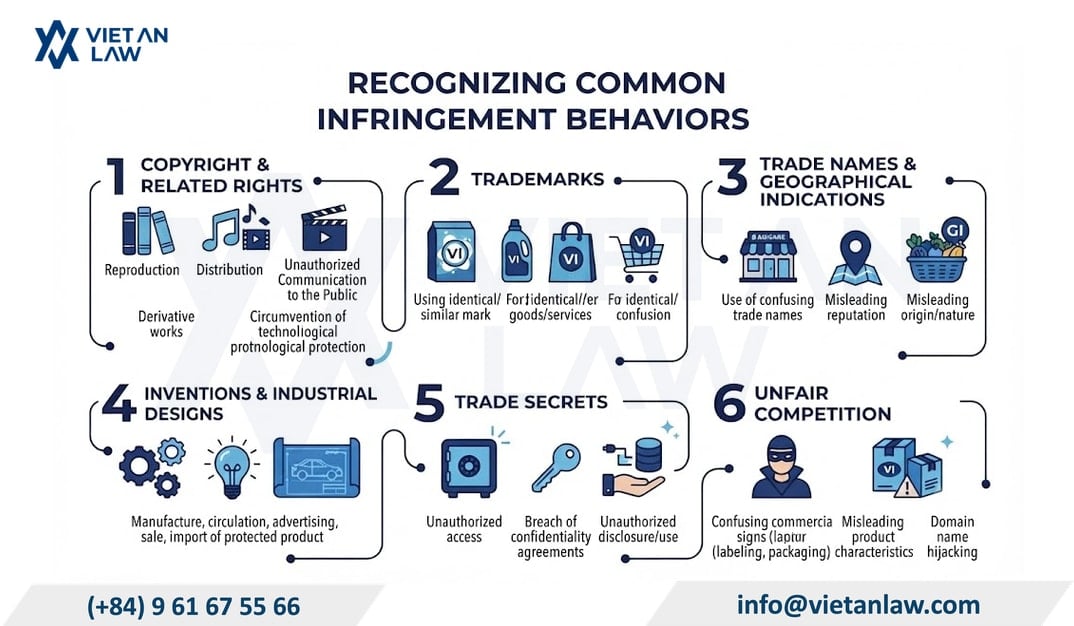
- Regarding copyright and related rights: Reproducing, distributing, creating derivative works, or communicating works to the public without permission, or intentionally disabling technological measures that protect rights (Pursuant to Articles 28 and 35 of the Vietnamese Law on Intellectual Property).
- Regarding trademarks: Using signs identical or similar to protected trademarks for identical or similar goods or services, thereby confusing their origin (Pursuant to Clause 1, Article 129 of the Vietnamese Law on Intellectual Property).
- Regarding trade names and geographical indications: Using commercial indications that confuse the business entity; using geographical indications in a manner that misrepresents their nature or exploits the reputation of protected geographical indications (Pursuant to Clauses 2 and 3, Article 129 of the Vietnamese Law on Intellectual Property).
- Regarding inventions and industrial designs: Unauthorized manufacture, circulation, advertising, offering for sale, or importation of products incorporating the protected subject matter without the owner’s permission (Pursuant to Clause 1, Article 126 of the Vietnamese Law on Intellectual Property).
- Regarding trade secrets: Unauthorized access to or collection of information, breach of confidentiality agreements, or intentional disclosure or use of trade secret information without permission (Pursuant to Clause 1, Article 127 of the Vietnamese Law on Intellectual Property).
- Regarding unfair competition: Using commercial indications (labels, packaging) that cause confusion regarding the origin or characteristics of goods or registering domain names identical or like trademarks or trade names for profiteering (Pursuant to Clause 1, Article 130 of the Vietnamese Law on Intellectual Property).
Comparative table between sending a cease and desist letter and filing a lawsuit in court in Vietnam
To provide our clients with an overview for selecting intellectual property protection measures, Viet An Law presents a comparison between the two most common methods:
| Criteria for analysis | Sending an infringement cease and desist letter | Filing a civil lawsuit in court |
| Nature | A self-defense measure that is non-litigious, negotiated, and serves as a pre-litigation deterrent. | A judicial measure that leverages state power to resolve disputes. |
| Resolution timeframe | Very swift (typically requiring a response within 7 to 15 days). | Prolonged (usually taking several months to years under standard litigation procedures). |
| Cost | Low (incurring costs only for dossier review, bailiff record compilation, and document drafting). | High (including court fees, judicial charges, and ongoing legal counsel fees). |
| Enforceability | Depends on the goodwill and cooperation of the infringing party. | Highly enforceable through compulsory execution by the Civil Judgment Enforcement Agency. |
| Relational impact | Preserves goodwill and may open opportunities for business cooperation. | Easily leads to intense confrontation and a complete severance of commercial partnerships. |
Core contents required in a sample cease and desist letter for copyright and trademark infringement in Vietnam
A legally sound warning letter, with sufficient weight to compel the infringing party to cooperate, must include the following elements:
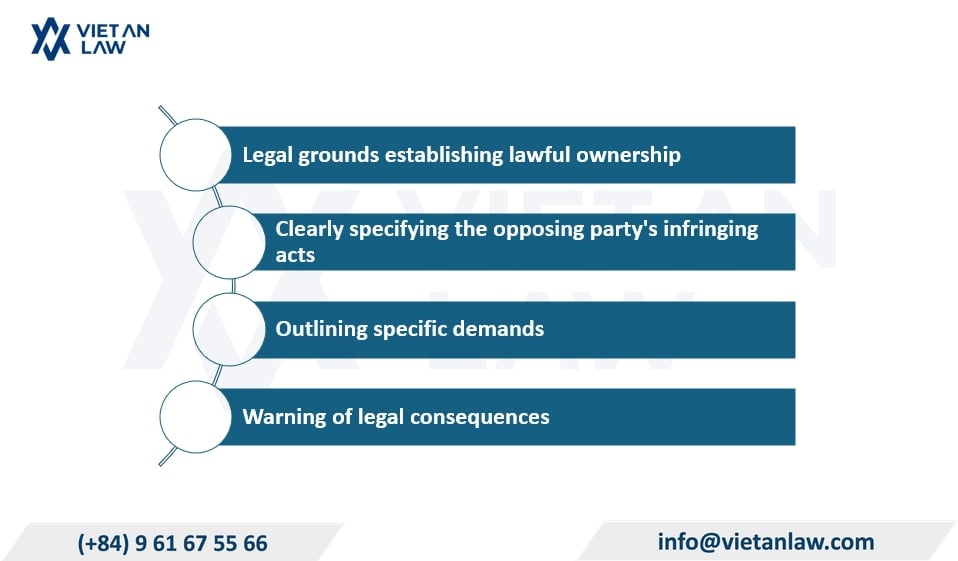
- Legal grounds establishing lawful ownership: Please attach a copy of the protection title (Trademark Registration Certificate, Copyright Registration Certificate, etc.) to prove your legal rights.
- Clearly specifying the opposing party’s infringing acts: Clearly specify the infringing party’s actions (e.g., printing a logo on packaging, using an article without permission) and provide concrete evidence (such as images or links to the infringing content that have been formally notarized/certified via a bailiff’s record).
- Outlining specific demands: Demand the immediate cessation of the infringing activity, the recall of infringing products, and the removal of online posts within a specified timeframe (typically seven working days).
- Warning of legal consequences: Clearly state that if the other party fails to cooperate, you will resort to more stringent measures. Specifically, this includes requesting state authorities to impose administrative sanctions for violations (in accordance with the latest regulations on administrative penalties regarding industrial property, such as Decree 100/2026/ND-CP) or filing a lawsuit in court to claim damages.
Frequently asked questions about handling intellectual property infringement in Vietnam
Is sending a warning letter a mandatory procedure prior to filing a lawsuit?
Pursuant to Article 189, Clause 1 of the Vietnamese Law on Intellectual Property, you have the right to directly request state authorities to handle the matter or to file a lawsuit in court. However, sending a warning letter is always recommended as a first step to save time and costs, provided the parties are willing to cooperate in resolving the issue.
What should be done if the infringing party ignores the warning letter?
If the infringing party fails to cease the infringing activity by the deadline specified in the request, you have the right to submit a request for handling the infringement to competent authorities (such as the Science and Technology Inspectorate, Market Surveillance authorities, or the Police) or to file a lawsuit with a competent court to safeguard your legitimate rights and interests.
Which agencies have the authority to handle intellectual property infringement?
Pursuant to Article 200, Clause 1 of the Vietnamese Law on Intellectual Property, competent agencies include: Courts, Inspectorates, Market Surveillance authorities, Customs authorities, the Police, and People’s Committees at various levels, depending on the nature of the case and the measures to be applied.
How is compensation for damages calculated in a lawsuit?
According to Articles 204 and 205 of the Vietnamese Law on Intellectual Property, damages include property losses, loss of income, costs incurred to prevent infringement, and mental anguish. If the specific amount cannot be determined, the Court may set a maximum level of material compensation not exceeding 500 million VND.
Do I need to prove ownership when requesting action against an infringement? Pursuant to Article 203, Clause 2 of the Vietnamese Law on Intellectual Property, you are required to prove your status as the rights holder by providing documents such as a copy of the Copyright Registration Certificate, a Protection Title, or an extract from the National Register of Industrial Property.
With extensive expertise, Viet An Law is always ready to accompany clients in protecting their intellectual property assets. Should you require detailed consultation, please contact the intellectual property lawyer in Vietnam at Viet An Law directly for timely legal support.