


In today’s growing knowledge economy, intellectual property has become the core value of any business. However, infringement and copyright piracy are becoming increasingly sophisticated. When negotiation fails, IP owners can request administrative enforcement from competent authorities or file a lawsuit in court to protect their legitimate rights and interests. In the article below, Viet An Law provides a detailed analysis of the legal aspects surrounding IP litigation and dispute resolution in Vietnam.
Common types of Intellectual Property disputes in Vietnam
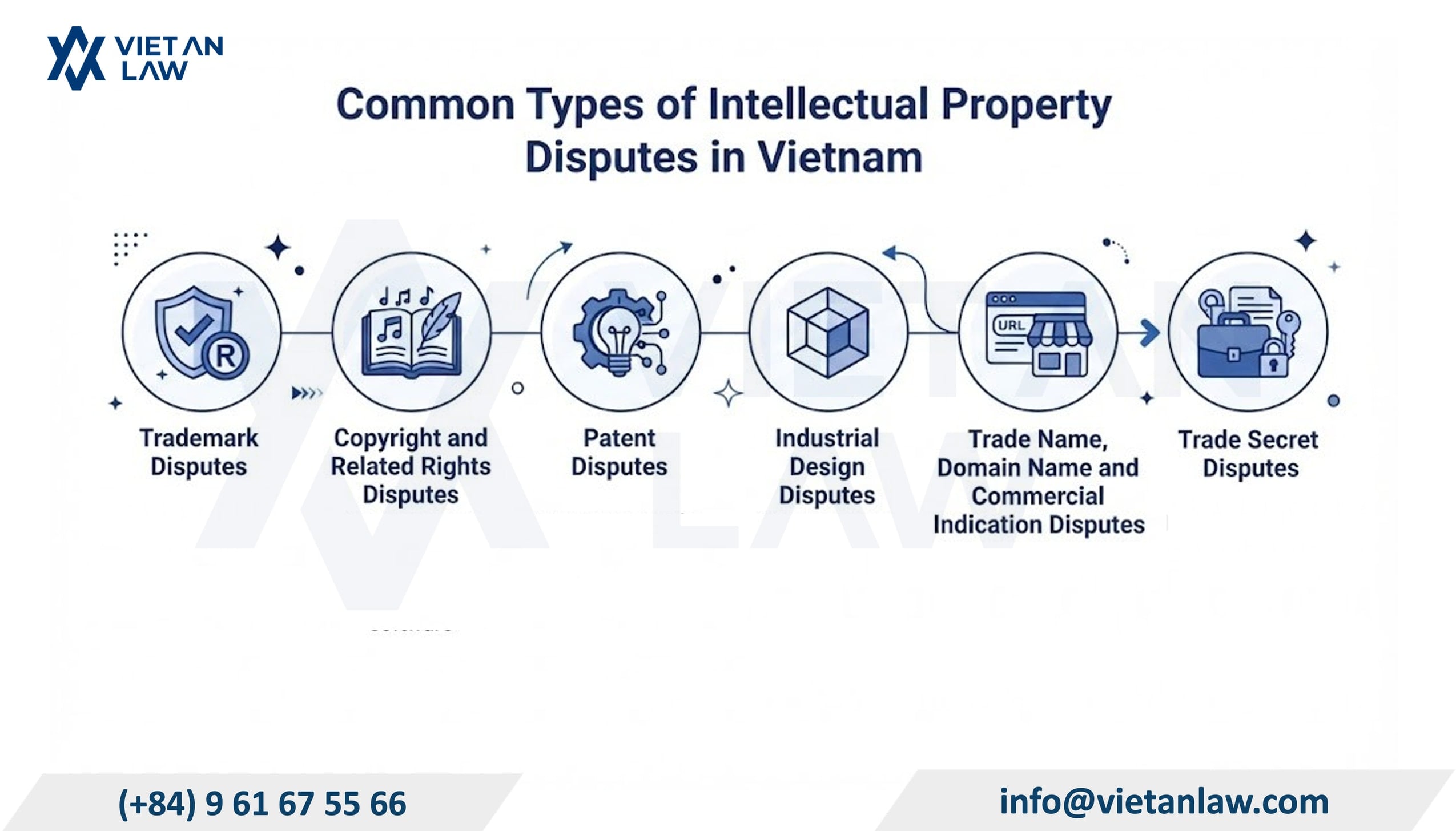
Intellectual property disputes may arise during the establishment, exploitation, transfer, or enforcement of intellectual property rights. Some common types of disputes in Vietnam include:
- Trademark disputes: disputes regarding registration rights, ownership rights, or the use of signs identical or similar to a protected trademark;
- Copyright and related rights disputes: involving the unauthorized copying, use, distribution, or exploitation of a work;
- Patent disputes: disputes concerning patent ownership, the right to use a patent, or the exploitation of a protected patent;
- Industrial design disputes: arising when a third party uses a protected design—or a design that is not significantly different—without authorization;
- Trade name, domain name, and trade indication disputes: typically arising when the signs used are likely to cause confusion regarding the business entity or commercial origin;
- Trade secret disputes: involving the unauthorized access, disclosure, or use of business information possessing commercial value.
Accurately identifying the type of intellectual property dispute is crucial for selecting the appropriate competent authority and dispute resolution method, as well as for devising a suitable strategy to protect one’s rights.
Methods for intellectual property dispute resolution in Vietnam
Depending on the nature of the dispute, the extent of the infringement, and the objectives of the rights holder, intellectual property disputes may be resolved through one or a combination of methods:
Negotiation
The parties directly communicate to halt the infringing activity and determine liability, compensation amounts, or arrangements for the exploitation of intellectual property rights.
Negotiation is often suitable when the parties seek a quick resolution, wish to maintain confidentiality, and intend to continue their business relationship.
Mediation
The parties may select an intermediary organization or individual to facilitate the negotiation process and assist in finding a dispute resolution solution.
Commercial Arbitration
For disputes arising from commercial activities where a valid arbitration agreement exists, the parties may choose arbitration to resolve the matter.
This method is particularly suitable for intellectual property disputes arising from technology transfer agreements, licensing agreements, franchising contracts, or commercial transactions involving a foreign element.
Requesting administrative action
In cases involving IP infringement, rights holders may request competent authorities to apply administrative measures to promptly halt and address the infringing conduct.
Filing a lawsuit in court
Litigation is a key method for rights holders to compel the infringing party to cease the infringement, pay damages, or fulfill other civil obligations.
For complex cases or those involving high-value disputes, selecting the appropriate intellectual property dispute resolution method from the outset can significantly impact the effectiveness of rights protection.
Comparison of IP dispute resolution via Courts vs. Administrative Authorities in Vietnam
To help our clients better understand the advantages of court litigation, Viet An Law has prepared the comparison table below:
| Criteria | Resolution via Court | Resolution via Administrative Authority |
| Legal Basis | Article 202 of the 2025 Law on Intellectual Property | Article 211 and Article 214 of the 2025 Law on Intellectual Property |
| Nature of enforcement | Applying civil remedies to handle organizations or individuals committing acts of IP infringement. | Imposing administrative penalties for acts of infringement that cause damage, manufacturing counterfeit goods, or infringing upon geographical indications. |
| Claims for compensation | Rights holders may request the Court to compel the infringer to pay compensation for material and moral damage, as well as pay reasonable attorney fees pursuant to Article 205 of the 2025 Law on Intellectual Property. | Administrative enforcement does not resolve compensation claims for losses suffered by rights holders. |
| Accompanying remedies | Compelling the termination of the infringement; compelling a public apology and correction; compelling the performance of civil obligations. | Applying remedial measures such as compelling the non-commercial distribution or use of counterfeit goods. |
Documents and evidence to prepare for IP dispute resolution in Vietnam
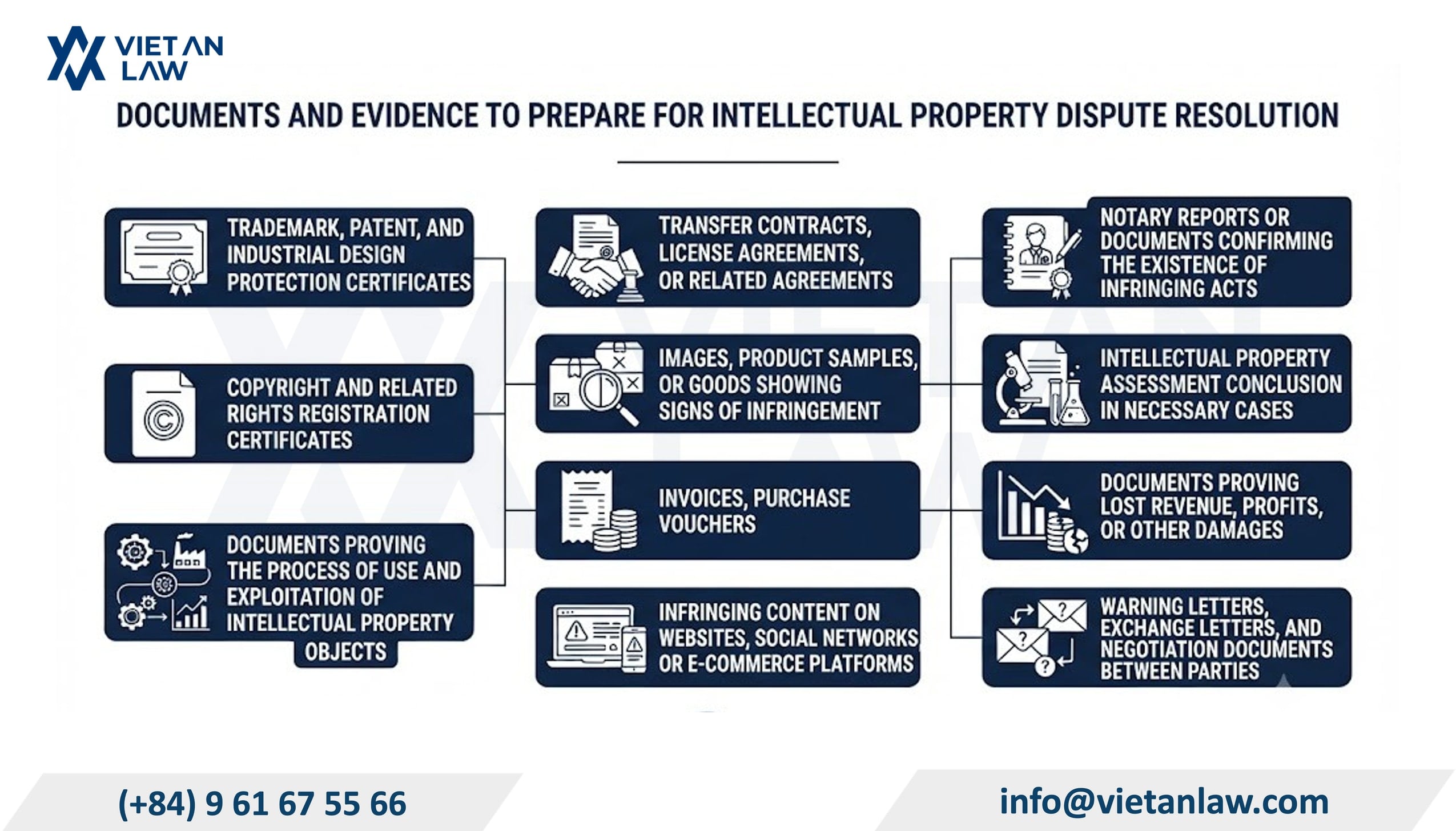
Evidence is a crucial factor during negotiations, requests for administrative action, or the filing of intellectual property lawsuits in court.
Depending on the specific case, rights holders should prepare:
- Protection titles for trademarks, patents, or industrial designs;
- Certificates of registration for copyright and related rights;
- Documents proving the use and exploitation of the intellectual property subject matter;
- Assignment contracts, licensing agreements, or related arrangements;
- Images or samples of products or goods bearing signs of infringement;
- Invoices or purchase receipts;
- Evidence of infringing content on websites, social media, or e-commerce platforms;
- Notarized records (vi-bang) or documents confirming the existence of the infringing act;
- Intellectual property expert assessment conclusions, where necessary;
- Documents proving lost revenue, lost profits, or other damages;
- Cease-and-desist letters, correspondence, and negotiation documents exchanged between the parties.
Evidence collection should be carried out immediately upon detecting signs of infringement to minimize the risk of evidence being deleted or altered, or infringing goods being disposed of or hidden.
Time frame and costs for IP dispute resolution in Vietnam
The time required to resolve an intellectual property dispute depends on the chosen resolution method, the complexity of the case, the volume of evidence, any requirements for expert assessment, and the parties’ conduct throughout the process.
Negotiation or administrative proceedings may be suitable for cases requiring the rapid cessation of infringing activities. Conversely, court litigation typically requires more time due to the various stages involved—such as case acceptance, evidence gathering, conciliation, and trial—as well as the potential for appellate proceedings.
Costs may include:
- Court fees or administrative charges;
- Intellectual property expert assessment fees;
- Costs for the formal recording of facts and evidence gathering;
- Translation and document legalization fees for cases involving foreign elements;
- Legal fees;
- Other reasonable expenses incurred in the protection of rights.
Conducting a preliminary assessment of the dispute resolution strategy enables rights holders to balance time, costs, and the likelihood of achieving their legal objectives.
Intellectual Property Lawyers services for dispute resolution by Viet An Law in Vietnam
Leveraging extensive experience in advising on and protecting intellectual property rights for businesses, organizations, and individuals in Vietnam, Viet An Law provides comprehensive IP lawyers in Vietnam services throughout the dispute resolution process, including:
- Assessing intellectual property rights and signs of infringement;
- Analyzing evidence and formulating dispute resolution strategies;
- Investigating, collecting, and substantiating evidence;
- Assisting with sample purchases, notarized records (vi-bang), and requests for expert assessment;
- Drafting cease-and-desist letters and demands to halt infringing activities;
- Representing clients in negotiations with the infringing party;
- Advising on dispute resolution via mediation or arbitration;
- Representing clients before market surveillance agencies, inspectorates, customs authorities, and other competent bodies;
- Drafting litigation documents and claims for damages;
- Requesting the Court to apply provisional measures when necessary;
- Providing legal counsel and representation in intellectual property litigation to protect clients’ legitimate rights and interests;
- Advising on and assisting with the enforcement of judgments and decisions following dispute resolution.
For cases involving foreign elements, Viet An Law assists foreign rights holders in verifying infringing activities, preparing documentation, and executing procedures to protect intellectual property rights in Vietnam.
Some frequently asked questions
Should a warning letter be sent before filing a lawsuit for IP Infringement?
Sending a warning letter prior to litigation is not mandatory in every case. However, such a letter can alert the infringing party to the rights holder’s rights, offering an opportunity to cease the infringing activity or negotiate a settlement before litigation ensues.
For each specific case, the rights holder should consider the risk that the infringing party might destroy evidence or dispose of infringing goods before the warning letter is sent.
Should trademark disputes be resolved in court or through administrative measures?
The choice depends on the rights holder’s objectives.
If the primary goal is to quickly halt and address infringement in the marketplace, administrative measures may be appropriate. If the rights holder seeks compensation for damages or requires a comprehensive resolution of the parties’ rights and obligations, filing a lawsuit in court is generally the more suitable approach.
Can foreign rights holders initiate intellectual property litigation in Vietnam?
Foreign rights holders have the right to employ appropriate legal measures to protect their intellectual property rights in Vietnam, provided they meet the conditions stipulated by Vietnamese law and relevant international treaties.
In practice, foreign rights holders may authorize a lawyer or a qualified representative organization in Vietnam to assist in the process of protecting their rights.
Can provisional measures be requested in intellectual property cases?
Where legal conditions are met, rights holders may request the Court to apply provisional measures to preserve evidence, prevent the disposal of goods suspected of infringement, or limit further damages.
Contact Intellectual Property lawyers in Vietnam
When intellectual property disputes arise, evaluating evidence and selecting the appropriate resolution strategy at the initial stage are crucial for effectively protecting one’s rights.
Viet An Law provides services covering consultation, negotiation, infringement handling, and intellectual property litigation in Vietnam—spanning the entire process from case assessment and evidence gathering to representing clients before competent authorities and in court proceedings.
If you are seeking Intellectual Property lawyers or require assistance IP Litigation and Dispute Resolution in Vietnam, please contact Viet An Law for advice on appropriate strategies to protect your rights.