


In the context of global economic integration, intellectual property has become the core competitive advantage for every business. However, infringement, copying, and counterfeiting tactics are becoming increasingly sophisticated. Proactively conducting IP infringement monitoring and investigation in Vietnam is not only an urgent measure to safeguard intangible assets, but also essential for maintaining brand reputation in the market. In this article, Viet An Law provides a comprehensive legal perspective on the procedure, competent authorities, and enforcement measures for handling IP violations in accordance with the Law on Intellectual Property and the latest guiding regulations.
Identifying common factors of intellectual property infringement in Vietnam
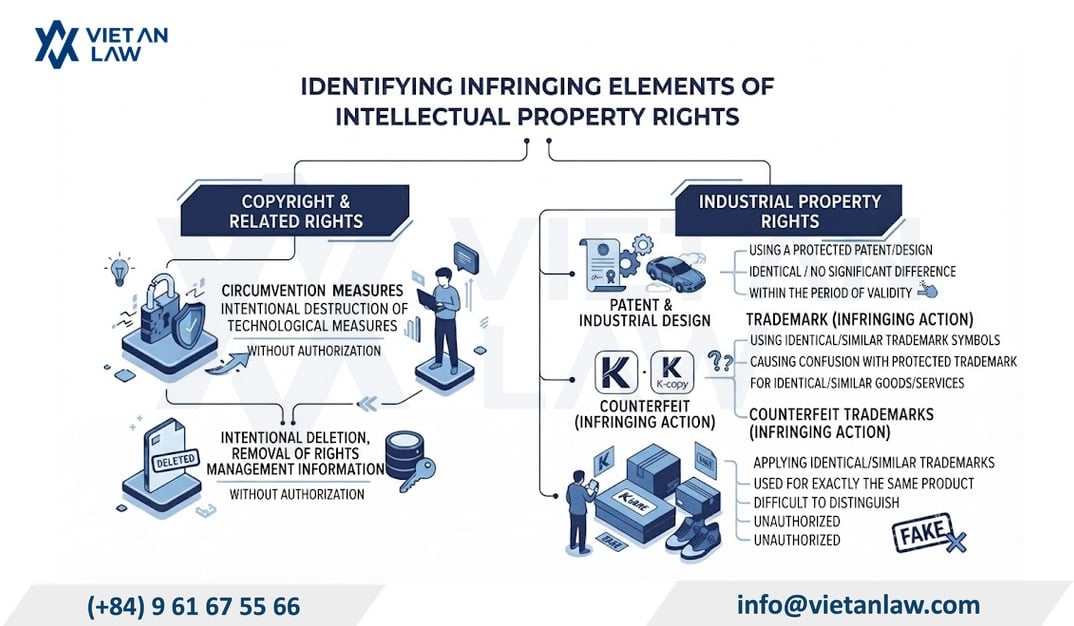
To effectively enforce intellectual property rights, rights holders must accurately identify the subject matter and the infringing acts based on statutory definitions.
Regarding copyright and related rights
Pursuant to Clauses 4 and 6, Article 28 of the Vietnamese Law on Intellectual Property 2005 as amended in 2025, acts of copyright infringement include:
- Intentionally circumventing or rendering ineffective effective technological measures implemented by the author or copyright owner to protect the copyright of their work;
- Intentionally deleting, removing, or altering rights management information without the permission of the author or copyright owner.
Regarding industrial property rights
Elements constituting an infringement of industrial property rights typically manifest in the following forms:
Firstly, regarding inventions and industrial designs:
Pursuant to Article 126, Clause 1 of the Law on Intellectual Property, the use of a protected invention or a protected industrial design – or an industrial design not significantly different from such a design – during the validity period of the protection title without the owner’s permission constitutes an act of infringement.
Secondly, regarding trademarks:
Pursuant to Article 129, Clause 1 of the Law on Intellectual Property, the use of a sign identical or confusingly similar to a protected mark for identical or similar goods or services constitutes a trademark infringement.
Furthermore, under Article 213, Clause 2 of the Law on Intellectual Property, goods or their packaging bearing a mark, sign, stamp, or label containing signs that are identical or confusingly similar to a protected mark used for the same goods – without the permission of the mark owner – are considered counterfeit goods.
IP infringement monitoring and investigation in Vietnam
Monitoring and investigation activities regarding intellectual property rights infringements in Vietnam have now been systematized, with an increased application of digital technology to enhance the effectiveness of prevention.
Application of automation in online IP Infringement monitoring
Pursuant to Article 9d of Decree 65/2023/ND-CP (as amended by Article 12 of Decree 100/2026/ND-CP), intellectual property enforcement agencies, acting within their assigned functions and duties, shall invest in, develop, and implement systems to automate processes and operations for controlling, detecting, and handling acts of intellectual property rights infringement.
The objectives of this activity include the automated detection, monitoring, and tracking of Intellectual Property infringement on websites and in cyberspace through the application of digital technologies, big data analytics, and behavioral analysis; as well as the handling of infringing acts in cyberspace within their jurisdiction, including requesting the removal of infringing content and the suspension or restriction of infringing accounts.
The role of databases on intellectual property rights protection
Pursuant to Clauses 1 and 2, Article 9e of Decree 65/2023/ND-CP (as amended by Article 13 of Decree 100/2026/ND-CP), the database on intellectual property rights protection comprises data regarding resolved disputes and infringements of intellectual property rights, the types of intellectual property rights infringed, the resolution outcomes, the status of the enforcement of such outcomes, relevant information arising during the resolution process (if any), and details regarding intellectual property rights protection agencies.
The establishment of this centralized database aims to collect, standardize, manage, and utilize information to support the monitoring, assistance, and coordination of intellectual property rights protection efforts; simultaneously, it leverages digital data as a foundation and applies digital technologies to enhance the efficiency, transparency, and traceability of intellectual property rights protection activities.
IP enforcement authorities and investigation & handling powers in Vietnam
Upon detecting signs of infringement, the rights holder may request the intervention of intellectual property enforcement agencies. Pursuant to Article 200, Clause 1 of the Law on Intellectual Property, the following agencies – within the scope of their respective duties and powers – are authorized to handle acts of intellectual property infringement: Courts, Inspectorates, Market Surveillance agencies, Customs authorities, the Police, and People’s Committees at all levels. Specifically, this authority is delineated as follows:
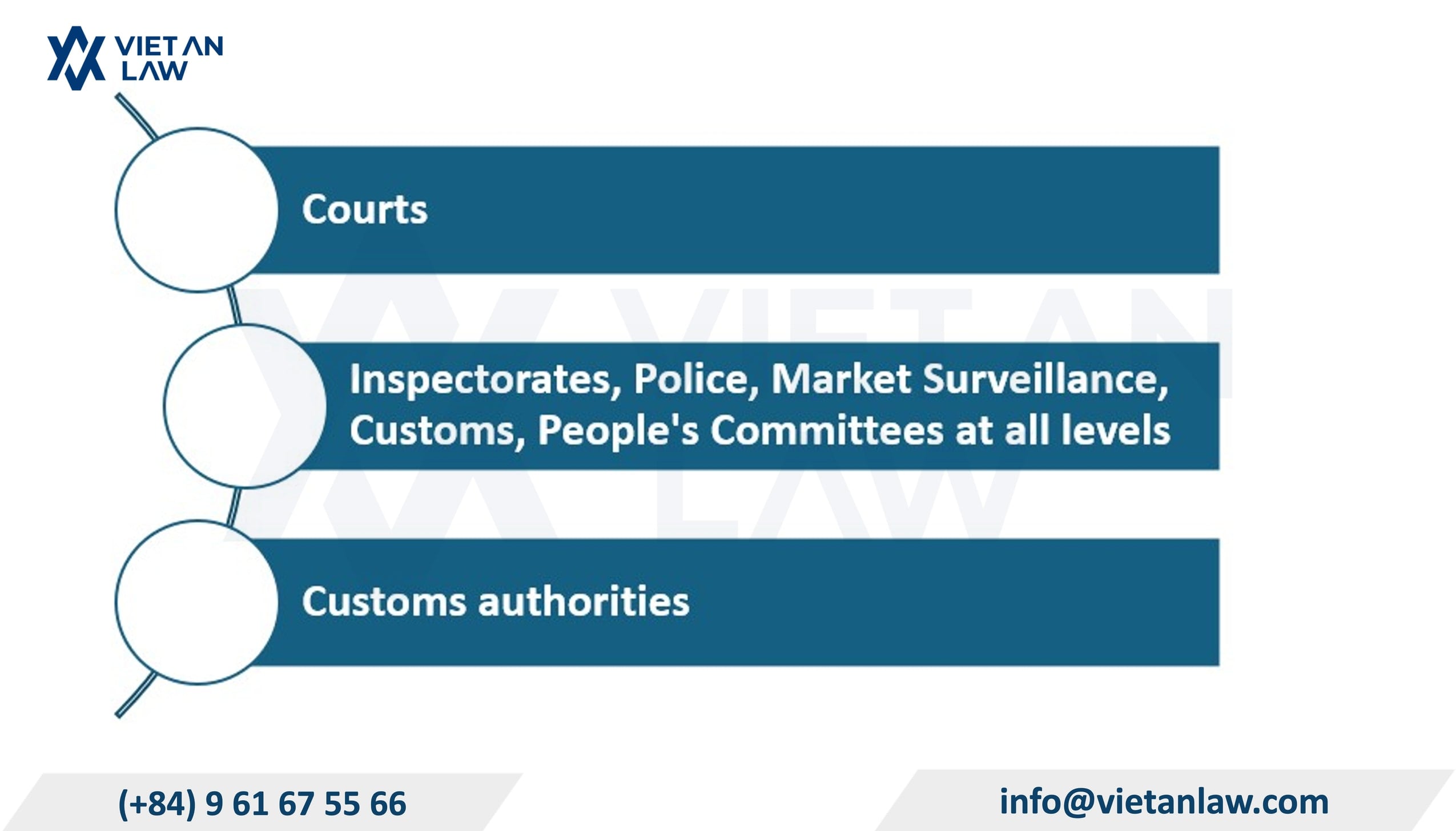
Courts:
Pursuant to Article 200, Clause 2 of the Law on Intellectual Property, the application of civil and criminal measures falls within the jurisdiction of the Court. Where necessary, the Court may apply provisional urgent measures in accordance with the law (such as the seizure, distraint, or sealing of infringing goods).
Inspectorates, Police, Market Surveillance, Customs, People’s Committees at all levels:
Pursuant to Article 200, Clause 3 of the Law on Intellectual Property, the application of administrative measures falls within the competence of these agencies. Where necessary, these agencies may apply measures to prevent violations and ensure the enforcement of administrative sanctions in accordance with the law.
Customs authorities:
Pursuant to Article 200, Clause 4 of the Law on Intellectual Property, the application of measures to control exports and imports related to intellectual property (such as suspending customs procedures, inspecting, and monitoring to detect infringing goods) falls within the jurisdiction of customs authorities.
Comparison table of measures for handling IP infringement
The choice of enforcement measure depends on the nature and severity of the infringement under the Law on Intellectual Property.
| Criteria | Civil measures | Administrative measures | Criminal measures |
| Legal basis | Article 202, Law on Intellectual Property | Article 211 & Article 214, Law on Intellectual Property | Article 212, Law on Intellectual Property |
| Enforcing authority | People’s Court | Inspectorates, Police, Market Surveillance, Customs, People’s Committees at all levels | People’s Court |
| Applicable targets | Organizations and individuals committing acts of infringement | Organizations and individuals committing IP infringement causing damage to authors, owners, consumers, or society; or manufacturing/trading counterfeit goods | Individuals and commercial legal entities committing IP infringement that meet all constituent elements of a crime |
| Primary forms of handling | Compulsory cessation of infringement; Public apology and rectification; Compensation for damages | Administrative fines and application of remedial measures | Criminal prosecution in accordance with the Criminal Code |
| Handling of infringing goods | Compulsory destruction or distribution/use for non-commercial purposes of infringing goods, raw materials, materials, and facilities used primarily for production | Compulsory distribution or use for non-commercial purposes of IP counterfeit goods, raw materials, materials, and facilities used primarily for production/business | Confiscation, destruction of evidence, or forfeiture to the state budget (under Criminal Procedure Law) |
Procedure for requesting assessment and handling infringement goods in Vietnam
Organization of industrial property appraisal activities
To strengthen the legal case proving an infringement, the rights holder may initiate industrial property expert assessment proceedings. Pursuant to Article 201, Clause 1 of the Law on Intellectual Property, an intellectual property expert assessment involves a qualified organization or individual using specialized knowledge and professional expertise to evaluate and draw conclusions regarding matters related to intellectual property rights.
Under Article 201, Clause 5 of the Law on Intellectual Property, the expert assessment conclusion serves as a source of evidence for competent authorities to handle and resolve the case. However, the expert assessment conclusion does not constitute a final determination regarding the act of intellectual property infringement or the resolution of the dispute itself.
Measures for handling counterfeit goods
When competent authorities conduct an investigation and determine the presence of goods bearing counterfeit trademarks or counterfeit geographical indications, strict enforcement measures will be applied in accordance with the latest regulations:
First, forcing distribution or use for non-commercial purposes:
Pursuant to Article 97, Clause 1 of Decree 65/2023/ND-CP (as amended by Decree 100/2026/ND-CP), this measure shall be applied if:
- The goods have utility value, and their use does not harm human health, livestock, crops, or the environment;
- The infringing element has been removed from the goods;
- The recipients or users are not potential customers of the trademark right holder, and the distribution or use does not unreasonably affect the normal exploitation of the right holder’s rights;
- The distribution or putting into use prioritizes humanitarian or charitable purposes or serves the public interest.
Secondly, mandatory destruction:
Pursuant to Clause 1, Article 98 of Decree 65/2023/ND-CP (as amended by Decree 100/2026/ND-CP), the measure of compulsory destruction applies to goods bearing counterfeit trademarks or geographical indications, goods infringing upon industrial property rights or plant variety rights, as well as the raw materials, supplies, and means primarily used for their production or trading, in cases where the conditions for compulsory distribution or putting the goods into non-commercial use are not met.
Clause 2 of this Article also explicitly stipulates that the destruction method must not harm the environment or adversely affect public health.
In the current article, the conclusion merely features a general call-to-action (CTA) inviting readers to contact Viet An Law for assistance with investigating and handling intellectual property rights infringements. I propose adding a dedicated service section as follows to enhance professionalism and support SEO efforts:
IP infringement monitoring and investigation in Vietnam of Viet An Law
Viet An Law assists individuals, businesses, and rights holders in detecting, gathering information on, and addressing intellectual property rights infringements in Vietnam. Our scope of services includes:
- Monitoring and detecting copyright infringements, infringements of trademarks, industrial designs, and other intellectual property rights;
- Investigating and gathering information and evidence regarding infringing activities in the marketplace;
- Monitoring for intellectual property infringement on websites, social media, e-commerce platforms, and other online channels;
- Assessing signs and the extent of trademark infringement;
- Assisting with sample purchases, the preparation of notarized records of facts, and the collection and strengthening of evidence;
- Advising on and facilitating intellectual property expert assessments when necessary;
- Drafting cease-and-desist letters demanding the termination of infringing activities and the removal of infringing content;
- Representing clients in dealings with the Inspectorate, Market Surveillance authorities, Customs, the Police, and other competent agencies;
- Advising on the application of administrative, civil, or criminal measures against infringing activities;
- Representing clients during negotiations, dispute resolution, and court litigation.
Frequently asked questions about IP infringement monitoring and investigation
Who has the authority to handle intellectual property infringement cases in Vietnam?
Pursuant to Article 200, Clause 1 of the Law on Intellectual Property, depending on the severity of the case, the authority to handle the matter lies with the following agencies:
- Courts;
- Administrative management agencies, such as Inspectorates, Market Surveillance authorities, Customs authorities, the Police, and People’s Committees at various levels, within the scope of their respective duties and powers.
Can Customs authorities unilaterally handle import/export goods that bear counterfeit trademarks?
According to Article 216, Clause 2, Point b of the Law on Intellectual Property, Customs authorities may proactively suspend customs procedures if, during inspection, supervision, and control, they discover clear grounds to suspect that the imported or exported goods are counterfeit regarding intellectual property.
Is an industrial property expert assessment mandatory when filing a lawsuit?
Such an assessment is not mandatory; however, under Article 201, Clause 5 of the Law on Intellectual Property, the conclusion of the expert assessment serves as a key source of evidence for the competent authority handling and resolving the infringement case.
How is the level of compensation for material damage calculated in civil intellectual property cases?
Pursuant to Article 205, Clause 1 of the Law on Intellectual Property, if the plaintiff proves that an act of intellectual property infringement has caused them material damage, the compensation amount may be determined based on one of the following factors:
- The total material damage plus the profit gained by the defendant;
- The transfer price for the right to use the corresponding intellectual property subject matter;
- Material damage calculated using other methods proposed by the rights holder, provided they are consistent with the law.
Note: In cases where the amount of compensation for material damage cannot be determined based on the aforementioned grounds, the Court shall fix the compensation amount – depending on the extent of the damage – but it shall not exceed five hundred million VND.
Must trademark-infringing goods be completely destroyed after seizure?
Pursuant to Clause 1, Article 97 of Decree 65/2023/ND-CP (as amended by Decree 100/2026/ND-CP), if the goods remain usable and harmless, the infringing elements have been removed, the recipients are not potential customers of the rights holder, and the distribution or use serves humanitarian, charitable, or social welfare purposes, the competent authority shall mandate their distribution or use for non-commercial purposes.
According to Clause 1, Article 98 of the same Decree, the measure of compulsory destruction applies only when these conditions are not met.
Do you need assistance in handling intellectual property rights infringement in Vietnam?
Viet An Law provides advisory, monitoring, investigation, and enforcement support services regarding acts of intellectual property infringement, including copyright infringement, trademark infringement, and intellectual property infringement on websites, social media networks, and online platforms.
Contact Viet An Law to have a lawyer assess your case, advise on evidence-gathering strategies, and select appropriate enforcement measures to best protect your legitimate rights and interests.