


Trademark registration in Vietnam is the legal procedure for obtaining protection for a brand name, logo or other eligible sign in relation to specified goods and services. The process generally involves a trademark search, classification of goods and services, application filing, formal examination, publication, substantive examination and issuance of a Trademark Registration Certificate if the application meets the legal requirements.
Vietnam generally follows the first-to-file principle, making early filing important when competing applications concern identical or confusingly similar marks. A trademark search helps identify potential conflicts before filing, while accurate applicant information and goods and services classification help reduce avoidable application errors. Filing an application does not guarantee registration.
Although businesses commonly use terms such as “brand registration,” “brand protection” and “logo registration,” the relevant legal procedure is trademark registration. In this guide, Viet An Law explains the requirements, documents, procedures, estimated costs and timelines for trademark registration in Vietnam, together with relevant legal updates for 2026.
Key changes of special importance to trademark applicants in Vietnam 2026
- The trademark registration application must use Form No. 04 in Appendix I of Circular 10/2026/TT-BKHCN;
- Publication of the application takes place within one month from the date the application is deemed valid;
- The time limit for substantive examination of the trademark application is five months from the date of publication;
- The time limit for third parties to oppose the trademark application is three months from the date of publication;
- Certain eligible applications may request expedited substantive examination within three months;
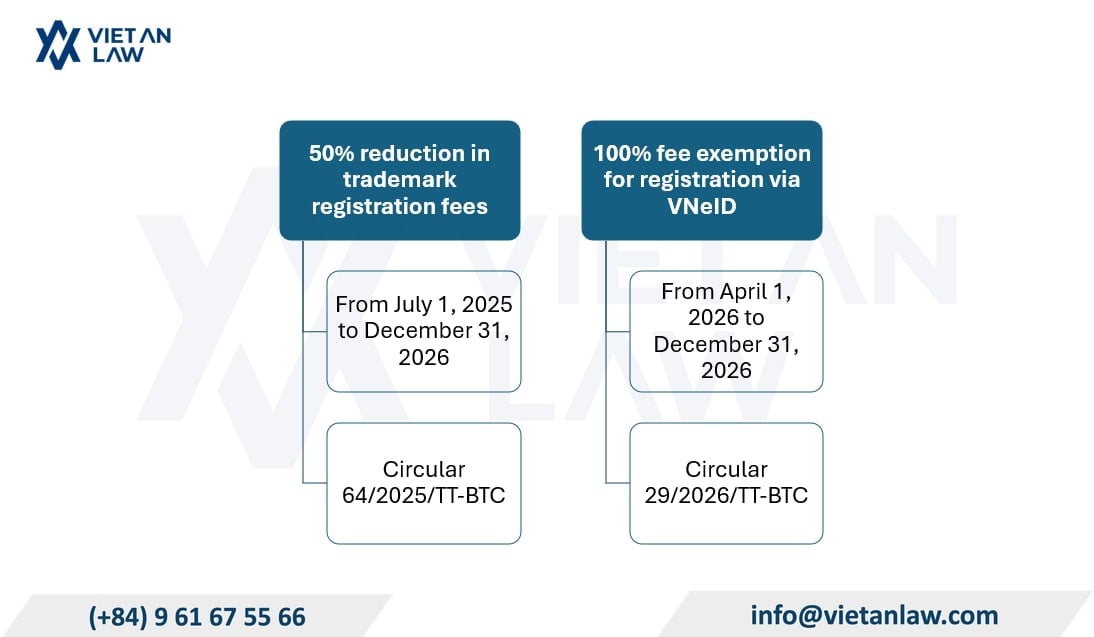
- From April 1, 2026, to December 31, 2026, certain industrial property fees are waived when using public services via the VNeID application.
Summary of the procedure for trademark registration in Vietnam 2026
| Relevant content | Specific details |
| Receiving authority | One-stop service division – Ministry of Science and Technology of Vietnam |
| Specialized examining authority | Vietnam National Office of Intellectual Property (NOIP) |
| Filing method | In-person / Online / By post |
| Application form | Form No. 04, Appendix I, Circular 10/2026/TT-BKHCN |
| Classification | Nice Classification 13-2026 |
| Formality examination | 01 month |
| Application publication | 01 month from the date of application acceptance as valid |
| Substantive examination | 05 months from the publication date |
| Application opposition | 03 months from the publication date |
| Accelerated examination | 03 months if eligible |
| Protection term | 10 years from the filing date, renewable every 10 years |
| Renewal | Multiple consecutive times, 10 years each time |
| Filing principle | “First-to-file” principle |
| Processing timeframe | 210 days |
| Accelerated examination | 03 months if conditions are met |
The timeframes are those prescribed by law for each stage of application processing. The actual processing time for a file may be longer if the application requires amendment or clarification, faces opposition, encounters a citation for refusal, or involves other legal issues.
3 key considerations before trademark registration in Vietnam
Before filing an application, the applicant should clearly determine the registrability, the named applicant, and the scope of goods and services. These three factors directly influence the likelihood of obtaining a registration certificate and the future scope of protection for the trademark.
1. Is the trademark eligible for protection?
Not every name, logo, or sign currently in use is eligible for registration and the granting of a trademark protection title.
Under Article 72 of the Vietnamese Law on Intellectual Property, a trademark must meet specific requirements regarding protectable signs and distinctiveness. Therefore, before filing an application, the following factors should be considered:
- Is the trademark descriptive or does it lack distinctiveness?
- Is it identical or like a previously filed or registered trademark?
- Are the goods or services associated with the trademarks identical or related?
- Does it conflict with trade names, geographical indications, well-known trademarks, or other intellectual property rights?
Conducting a search prior to filing does not guarantee the grant of a protection title, but it helps identify potential risks early and allows for necessary adjustments to the trademark before the official application is submitted.
2. Who should be named as the trademark applicant?
The person or entity named in the application will become the trademark holder if a protection certificate is granted.
For trademarks used in business operations, careful consideration should be given to whether the applicant should be the company or an individual. Registering under the name of a shareholder, founder, or representative can lead to complications regarding changes in ownership structure, fundraising, transfers, franchising, or internal disputes.
Therefore, the named applicant should be determined based on long-term plans for brand ownership and exploitation, rather than merely on convenience at the time of filing.
3. For which products and services should a trademark be registered?
Trademark rights are established within the scope of the goods and services specified in the application.
From January 1, 2026, the classification of goods and services in Vietnam will apply the 13th edition (2026) of the Nice Classification, comprising 45 classes.
When selecting classes, consider the following:
- Trademark classes are not the same as business registration industry codes;
- A single trademark may need to be registered across multiple classes;
- Consider products and services planned for development in the near future;
- Avoid registering for an overly broad scope if there is no actual need, as this increases application costs;
- Incorrect classification can lead to reclassification, additional fees, or application rejection.
Accurately determining the appropriate classes ensures the scope of trademark protection aligns with business operations and minimizes unnecessary costs.
Conditions for trademark protection in Vietnam
To be granted a trademark registration certificate, a trademark must meet the requirements regarding protectable signs and distinctiveness under intellectual property law.
The trademark must be distinctive
A trademark must enable consumers to distinguish the goods or services of one entity from those of another. During the application examination process, the Intellectual Property Office evaluates the trademark, considering its pronunciation, meaning, visual presentation, and the associated goods or services.
A trademark may be refused registration if it is identical or confusingly like:
- A trademark with an earlier filing or priority date;
- A well-known trademark;
- A trade name, geographical indication, or prior right belonging to another entity.
Therefore, merely altering a few letters, colors, or the layout may not be sufficient to establish the distinctiveness required for the trademark to be granted a Certificate of Trademark Registration.
Signs ineligible for protection
A trademark may be refused registration if it contains or consists of signs excluded by law, such as:
- National flags, national emblems, or the names or symbols of agencies or organizations without authorization;
- Signs that are misleading or likely to cause confusion regarding the origin, quality, or intended use of goods or services;
- Signs that directly describe the characteristics, intended use, or quality of the product;
- Signs that infringe upon the copyright or intellectual property rights of others.
Promotional terms such as “best”, “high quality”, or “premium”, when used in isolation, typically possess low distinctiveness and are prone to refusal.
Practical experience from Viet An Law: Before filing an application, the applicant should simultaneously assess distinctiveness, search for prior marks, and define the scope of goods or services requiring protection. Thoroughly verifying these conditions prior to filing helps minimize the need for amendments, clarifications, or responses to notifications from the NOIP during the examination process, while also reducing the risk of the application being rejected.
Application dossier for trademark registration in Vietnam
To carry out the procedure for registering exclusive trademark protection in Vietnam, the applicant needs to prepare the following basic documents:
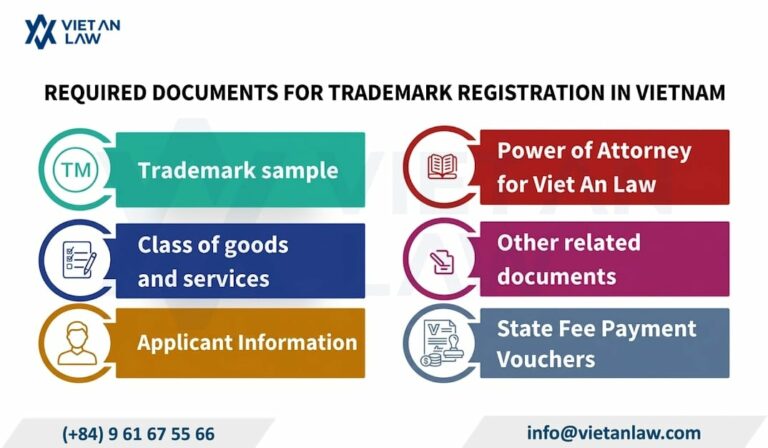
Trademark sample
- 05 specimens of the trademark in the prescribed size (80 mm x 80 mm) for paper-based applications;
- For sound marks: provide an audio file and a graphic representation.
Class of products and services
- Provide a comprehensive list of the products/services on which the trademark is intended to be used so that Viet An Law can classify them and avoid formal rejection;
- Classification according to the International Nice Classification (13th Edition – 2026) – Viet An Law assists clients.
Applicant information
- Name of individual or business entity;
- Address, nationality;
Power of Attorney (if filing via a representative)
- Signed according to the industrial property representative’s template (Luat Viet An template) – No notarization or consular legalization of the Power of Attorney is required.
Proof of state fee payment
Transfer receipt or proof of fee payment as prescribed.
Important notes when applying
Foreign individuals not residing in Vietnam, as well as foreign organizations or individuals without production or business establishments in Vietnam, must carry out procedures through a legal representative in Vietnam (i.e., by authorizing an intellectual property representative organization such as Viet An Law).
How long does trademark registration take in Vietnam 2026?
Under current administrative procedures, the processing time for trademark registration is 210 days. This includes one month for the formality examination, one month for the publication of the application (starting from the date it is deemed valid), and five months for the substantive examination (starting from the publication date). Provided that all requirements are met and the relevant fees and charges are paid, the decision to grant the registration certificate is issued within one month of the date full payment is made in accordance with the notification.
However, the actual duration may be longer if the application requires amendments or supplements, faces opposition, is subject to a notice of intended refusal, or involves issues related to priority rights.
Step-by-step trademark prosecution in Vietnam 2026
Starting April 1, 2026, trademark registration procedures in Vietnam will undergo notable changes, particularly regarding application publication, substantive examination, and the opposition period. The basic process consists of: trademark search → application filing → formality examination → application publication → substantive examination → issuance of the trademark registration certificate or refusal.
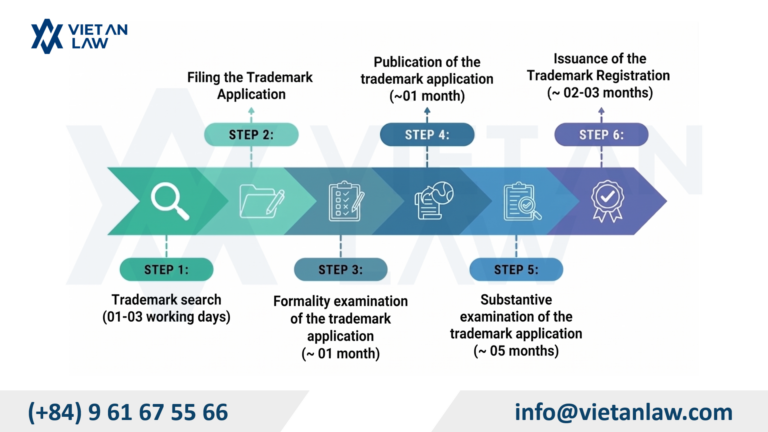
Step 1: Trademark search in Vietnam prior to filing
Trademark search in Vietnam is not a mandatory procedure, but it is advisable to do so before filing an application.
Such a search helps to:
- Identify identical or similar trademarks that have already been filed;
- Make a preliminary assessment of distinctiveness;
- Correctly determine the relevant classes of goods and services;
- Adjust the name, logo, or scope of protection if necessary;
- Mitigate the risk of a lengthy examination process ending in the trademark being denied protection.
When conducting a search, one should not merely check for identical names but must simultaneously analyze the trademark sign, the goods/services, and the likelihood of confusion due to similarity.
Search results are for reference purposes only and do not replace the examination decision of the NOIP.
See more: Trademark search in Vietnam: https://vietanlaw.com/trademark-search-in-vietnam/
Step 2: Filing the trademark application
After determining that the trademark is eligible for registration, the applicant prepares the dossier and submits it to the One-stop service division of the Ministry of Science and Technology – either in person, online, or via postal service.
The list of goods and services must be accurately classified. Selecting inappropriate classes may result in the application being rejected on formal grounds or incurring additional examination fees due to incorrect classification or a scope of protection that does not properly cover the products or services the business deals in.
For foreign organizations or individuals required by law to carry out procedures through an industrial property representative in Vietnam, the application must be filed via a qualified representative organization.
Step 3: Formality examination
Time limit for formal examination: 01 month from the filing date.
The NOIP examines details such as applicant information, the trademark specimen, the right to file, classification, and application documents.
A new feature effective from April 1, 2026, is that for applications determined to be valid, the NOIP proceeds to publish the application; the processing mechanism has changed compared to the previous procedure regarding the issuance of a decision on the acceptance of a valid application.
Step 4: Publication of the trademark application
Starting April 1, 2026, trademark applications will be published within one month from the date they are deemed valid. This marks a notable change from the previously applicable timeframe.
Once the application is published, third parties may monitor it and exercise their right to file an opposition in accordance with regulations.
The current opposition period for trademark applications is three months from the date of publication for applications subject to the new regulations effective from April 1, 2026.
Step 5: Substantive examination
This is the most critical stage for determining whether the trademark qualifies for protection.
For trademark applications published on or after April 1, 2026, the timeframe for substantive examination is reduced to five months from the date of publication.
The NOIP will conduct an assessment covering:
- The distinctiveness of the trademark;
- Potential identity or confusing similarity with prior rights;
- The scope of goods and services for which protection is sought;
- Grounds for refusing trademark protection.
In practice, a trademark need not be identical to a prior mark to risk refusal. Similarities in layout, pronunciation, meaning, or visual presentation – combined with the relevant goods and services – can also impact the likelihood of obtaining an exclusive trademark registration certificate.
From 2026, eligible trademark applications may also qualify for expedited substantive examination within a three-month period, in accordance with Decree 100/2026/ND-CP.
Đây là giai đoạn quan trọng nhất để xác định nhãn hiệu có đủ điều kiện được bảo hộ
Step 6: Issuance or refusal of the Trademark Registration Certificate
If the trademark meets the protection criteria, the applicant must pay the required fees and charges as notified to obtain the Trademark Registration Certificate. If the criteria are not met, the application will be refused.
The Trademark Registration Certificate is valid from the date of issuance until the end of the 10-year period starting from the filing date and may be renewed consecutively for 10-year terms. Consequently, trademark rights can be maintained indefinitely provided the owner renews the registration on time.
Note: The aforementioned timeframes of one month and five months represent the processing periods under the new regulations. The actual total duration may be extended if the application requires amendment or clarification, or if it faces opposition, a notice of intended refusal, or other legal issues during the examination process.
If you wish to register a trademark, conduct a registrability search, or handle a notice of refusal, please contact Viet An Law for assistance from our lawyers and industrial property representatives.
Trademark registration fees in Vietnam 2026
Trademark registration fees are not fixed and vary by case.
Fees depend on:
- The number of trademarks;
- The number of classes of goods and services;
- The quantity of goods and services within each class;
- Classification requirements;
- Claims for priority rights;
- Requests for expedited examination (if applicable);
- Any amendment or additional procedures;
- Representation service fees (if an industrial property representative is engaged).
Government charges may include fees and levies related to application filing, publication, search for examination purposes, substantive examination, registration, and certificate issuance, in accordance with the current fee schedule.
| Fee item | Current rate in 2026 |
|---|---|
| Filing fee | 75,000 VND /application |
| Application publication fee | 120,000 VND |
| Examination fee | 550,000 VND/class ≤ 6 products/services |
| Search fee for examination | 180,000 VND/class ≤ 6 products/services |
| Classification fee (if classified by IP Viet Nam) | 100,000 VND/class ≤ 6 products/services |
| Registration fee for grant decision | 120,000 VND |
| Publication fee for grant decision | 120,000 VND |
| Certificate issuance fee | 60,000 VND – exempted if eligible under the VNeID policy until Dec 31, 2026 |
Fee exemption policy for 2026
From April 1, 2026, through December 31, 2026, Circular 29/2026/TT-BTC mandates an exemption for the following fees when using public services via the VNeID application:
- Fees for filing applications for industrial property rights protection, including divisional applications and conversion applications;
- Fees for the issuance of protection titles.
The NOIP has issued an official announcement regarding the implementation of this policy.
It should be noted that this policy applies only to specific fees; it does not mean that the entire trademark registration process in 2026 is exempt from all state fees.
From January 1, 2027, the fees will once again be payable in accordance with the
See more: https://vietanlaw.com/fee-for-grant-of-trademark-protection-titles-in-vietnam/
Expedited trademark examination in Vietnam 2026: Reduced to 3 Months
Effective April 1, 2026, intellectual property regulations introduce a mechanism for the expedited substantive examination of trademark applications. Under Article 14a of Decree 65/2023/NĐ-CP (as supplemented by Decree 100/2026/NĐ-CP), eligible applications may undergo substantive examination within three months of their publication date, rather than the standard five-month period.
However, this mechanism does not apply to all trademark applications. Applications must simultaneously meet specific statutory conditions, namely:
- The request for expedited examination must be submitted using Form No. 14, accompanied by documentation proving eligibility, and filed concurrently with the trademark application itself;
- The application must be filed directly in Vietnam (i.e., not an international trademark application under the Madrid System);
- The mark must not be a collective mark, certification mark, three-dimensional mark, or sound mark;
- The full fee for expedited substantive examination must be paid.
- If the application becomes subject to opposition, disputes, or complaints, or ceases to meet the eligibility criteria for expedited examination, it will revert to the standard examination timeline.
Therefore, applicants seeking expedited examination should verify eligibility at the time of filing, rather than waiting until the substantive examination stage to request expedited processing.
Common mistakes when prosecuting trademark applications in Vietnam
During the examination process, trademark applications often encounter issues regarding the following points:
Failure to fully respond to a notification regarding formal deficiencies
When the NOIP requests amendments, the applicant must provide a response addressing each point raised in the notification and include all necessary details – such as applicant information, the trademark specimen, the list of goods/services, classification, or supporting documents.
A response that is incomplete or fails to meet the requirements may result in the application being refused.
Responses to a Notice of intention to refuse a trademark must be focused
When the Office cites a prior mark, one should not simply argue that “the two marks are different”.
A specific comparison is required regarding:
- Layout, pronunciation, and meaning;
- Dominant elements;
- Degree of similarity;
- The goods and services associated with the two marks;
- The scope of protection of the cited mark.
Arguments must be well-founded, include specific comparative references, and directly address the grounds for refusal cited by the Office.
Failure to properly address elements excluded from individual protection
While a trademark may be protected as a whole, certain descriptive or non-distinctive components may not be eligible for individual protection.
Applicants need to clearly determine which elements should be excluded and which should remain protected to avoid unnecessarily narrowing their rights.
Amendments exceeding the original scope
After filing an application, the applicant may not amend it in a way that:
- Alters the identity of the mark;
- Adds new elements that change the mark’s identity compared to the original;
- Expands the list of goods or services.
If the scope of protection changes significantly, the applicant should consider filing a new application rather than amending the existing one.
Consideration of application division
If only a portion of the goods or services encounters a conflicting mark or faces refusal, the applicant may consider splitting that portion into a separate application.
This approach allows the unaffected portion to continue processing independently, preventing delays to the entire application.
Failure to respond within the prescribed time limit
This is a common error encountered by applicants in practice.
Upon receiving a notification from the Intellectual Property Office, the applicant must closely monitor:
- Deadlines for amendments or supplements;
- Deadlines for responding to a notice of intended refusal;
- Deadlines for paying the certificate issuance fee.
Failure to complete procedures within the set time limits will result in the loss of the right to continue the application process, even if the trademark is otherwise eligible for protection.
Trademark prosecution in Vietnam for foreign individuals and entities
Foreign individuals and organizations have the right to register trademarks in Vietnam in accordance with the Law on Intellectual Property.
Pursuant to Article 89 of the Law on Intellectual Property:
- Foreign individuals permanently residing in Vietnam, or foreign organizations and individuals with production or business establishments in Vietnam, may file applications either directly or through a lawful representative;
- Foreign individuals not permanently residing in Vietnam, and foreign organizations or individuals without production or business establishments in Vietnam, must carry out procedures through a lawful representative in Vietnam (such as Viet An Law).
The application dossier requirements are essentially the same as those for domestic applicants, comprising Declaration Form No. 04 (pursuant to Circular 10/2026/TT-BKHCN), a trademark specimen, a list of goods/services, a power of attorney, and documents claiming priority rights (if applicable).
Foreign applicants may also choose to register directly in Vietnam or seek protection via the Madrid System, depending on their registration strategy for each country.
See more: Trademark prosecution in Vietnam for foreign individuals and entities: https://vietanlaw.com/trademark-prosecution-in-vietnam/
Frequently asked questions about trademark registration in Vietnam
Is it necessary to register a trademark if the company name has already been registered?
Yes. A business name and a trademark are distinct legal entities. Being issued a Business Registration Certificate does not mean the name is automatically protected as a trademark.
Does registering a domain name or a fanpage grant trademark rights?
No. Owning a domain name, website, or social media account is not a substitute for trademark registration. Businesses should establish separate intellectual property rights for their key brands.
Can the brand name and logo be registered in a single application?
Yes, they can be registered as a combined word-and-device mark. However, the scope of protection will be tied to the specific mark specimen submitted. If both the brand name and logo hold independent value, it is advisable to register them separately to ensure the broadest possible protection during use and enforcement against infringement.
Can the logo be changed or products/services added after the application has been filed?
Applicants have the right to request amendments during the processing stage, provided the changes do not alter the nature of the mark or expand the scope of protection beyond the original application. Significant changes to the mark specimen or the addition of new categories may require a separate application. Regulations also permit amendments and the recording of application transfers prior to the decision to grant or refuse the registration certificate.
Can a trademark be registered before the product is launched on the market?
Yes. Businesses can register a trademark before commencing operations or launching products. In fact, early filing reduces the risk of another party registering the intended brand name first.
Can a trademark application be transferred before the registration certificate is granted?
Yes. During the application processing stage, the right to file the application may be transferred, and the applicant may request the Intellectual Property Office to record the change of applicant in accordance with regulations.
How should one handle a situation where they are using a trademark but discover that another party has filed an application for it first?
One should not automatically assume that the party who filed first will certainly be granted protection. It is necessary to examine the date of use, prior rights, the degree of identity or similarity, the possibility of bad-faith registration, and the application’s processing status in order to choose the appropriate course of action—such as filing an opposition, submitting observations, or initiating other legal procedures.
Does a trademark registered in Vietnam receive protection abroad?
No. Trademark rights are territorial in nature. If a business intends to conduct operations or export to foreign markets, it should consider registering the trademark directly in the relevant countries or filing an international application under the Madrid System.
Is it necessary to re-register a trademark if the logo is changed?
If the adjustments are minor, each case must be assessed individually. However, if the new logo differs significantly in appearance or identifying elements, the business should consider filing a new application to ensure the scope of protection aligns with the trademark actually in use.
Is there still a chance of protection for a trademark facing a notice of intended refusal?
Yes. The applicant has the right to review the grounds for refusal and provide explanations, supporting documents, comparative evidence, and permissible amendments, or to pursue appropriate legal procedures. This is a stage where comparative analysis and legal argumentation significantly influence the outcome of the application.
Do the new regulations apply to trademark applications filed before April 1, 2026?
In principle, applications filed prior to the effective date of the amended Law are processed in accordance with the laws in effect at the time of filing. However, certain transitional provisions apply the new regulations – including those regarding formality examination for applications not yet accepted as valid, as well as opposition periods and substantive examination timeframes for applications published on or after April 1, 2026.
New legal basis for trademark registration in Vietnam 2026
Trademark registration procedures must now be aligned with the new legal framework, specifically:
- Consolidated Document No. 67/VBHN-VPQH dated March 23, 2026, consolidating the Law on Intellectual Property;
- Law No. 131/2025/QH15, effective from April 1, 2026;
- Decree 65/2023/NĐ-CP and amending documents, particularly Decree No. 100/2026/NĐ-CP dated March 31, 2026;
- Circular 10/2026/TT-BKHCN dated March 31, 2026, effective from April 1, 2026;
- Circular 20/2026/TT-BKHCN dated May 20, 2026, amending Circular No. 10/2026/TT-BKHCN;
- Circular 29/2026/TT-BTC dated March 27, 2026, regarding fee and charge policies applicable in 2026;
- The Nice Classification (Version 13-2026), applicable in Vietnam from January 1, 2026.
Trademark registration regulations underwent significant changes in 2026, particularly regarding forms, timelines for publication and opposition, substantive examination, and the expedited examination mechanism. Therefore, businesses should not continue using outdated trademark registration forms or declarations, as this could lead to the application being rejected on formal grounds.
Trademark registration services at Viet An Law
With nearly 20 years of experience in the field of intellectual property, Viet An Law assists clients with trademark registration in Vietnam and internationally, covering the entire process from the initial search to the granting of the protection certificate.
Our scope of services includes:
- Conducting searches and assessing trademark registrability;
- Advising on the selection of the applicant and the scope of registration;
- Classifying goods and services according to the Nice Classification (13th Edition – 2026);
- Drafting Form No. 04 and the registration dossier;
- Representing clients in filing and monitoring applications with the Intellectual Property Office of Vietnam and relevant international authorities;
- Responding to examination notifications and notices of intended refusal;
- Handling issues regarding conflicting marks and oppositions;
- Managing procedures for the issuance, renewal, assignment, and administration of protection certificates.
For foreign individuals and organizations required to proceed through a legal representative in Vietnam, Viet An Law acts as the representative throughout the entire trademark registration process in Vietnam and assists with international trademark registration procedures based on client needs.
Industrial Property Representative Organization: Representative Code 83 – National Office of Intellectual Property
Person in Charge: Lawyer Do Thi Hong Hanh– Industrial Property Representative, Head of Intellectual Property Department
Technical Reviewer: Dr. Do Thi Thu Ha (Lawyer) – Director
Hotline/Zalo/WhatsApp: 09 61 57 18 18
Email: info@vietanlaw.com
You may submit the trademark specimen and the list of products and services intended for registration so that Viet An Law can conduct a preliminary review and advise on a suitable filing strategy.
See more: Trademark Registration Service at Viet An Law