


Trademark prosecution in Vietnam is the legal procedure of monitoring, managing, and handling issues that arise from the time a trademark application is filed until the trademark is granted a protection title by the National Office of Intellectual Property in Vietnam (NOIP Vietnam/IP Vietnam). This is not just a standard trademark registration procedure. Instead, this process includes all the work that must be performed from the time of filing, formality examination, publication of the application, substantive examination, handling of office actions from IP Vietnam, response to refusal notices, handling of oppositions, and amendment of the application, up to the grant of the trademark protection title, reflecting the complete journey of trademark prosecution in Vietnam: from filing to examination and grant.
Trademark prosecution for foreign applicants in Vietnam, or for foreign trademark lawyers wishing to file and prosecute trademark applications for clients in Vietnam, is particularly important because many applications may encounter practical issues during the examination process, such as incorrect classification of goods and services, incomplete trademark descriptions, conflicts with prior filed or registered trademarks, lack of distinctiveness, presence of misleading elements, opposition by a third party, or requests for explanation and clarification by IP Vietnam.
A good filing strategy is crucial, but the prosecution phase is when the application is reviewed and evaluated. Timely responses, preparation of rigorous arguments, and proper handling of the dossier can make the difference between being granted a trademark registration certificate and refusal.
What is trademark prosecution in Vietnam?
Trademark prosecution in Vietnam encompasses all legal work performed before IP Vietnam to protect and advance a trademark application until a final result is reached. These actions may include tracking the application status, responding to notices from IP Vietnam, correcting formal or substantive deficiencies, arguing against notices of intended refusal, narrowing the scope of goods or services, submitting evidence, handling third-party observations or oppositions, and paying the granting fee.
In practice, trademark prosecution begins when the application is filed and lasts until the trademark is granted a protection title or refused protection.
Trademark prosecution may include:
- Monitoring the IP Vietnam trademark examination process;
- Reviewing notices issued by IP Vietnam;
- Preparing legal arguments to respond to grounds for refusal;
- Amending the list of goods or services;
- Clarifying the applicant’s right to register the trademark;
- Supplementing documents and texts proving priority rights;
- Responding to third-party oppositions or observations;
- Monitoring the application publication and granting phases;
- Advising on appeal options or refiling if the application is refused.
Trademark prosecution services in Vietnam are specialised legal services that require an intellectual property lawyer with practical experience in trademark registration and protection. Unlike standard filing services, trademark prosecution includes monitoring the examination process at IP Vietnam, handling official correspondence, responding to refusal notices, amending the dossier, explaining legal grounds, and supporting the client until the trademark is granted a protection title. Therefore, choosing a trademark consulting law firm in Vietnam with deep expertise, practical dossier-handling experience, and reasonable costs will help clients to optimise the efficiency of trademark registration, limit the risk of refusal, and enhance brand protection capabilities in Vietnam.
Madrid trademark prosecution in Vietnam
Madrid trademark prosecution in Vietnam is the process of handling an international trademark application after Vietnam has been designated as a country where protection is requested. Unlike a trademark application filed directly with IP Vietnam, a Madrid application is filed through the international registration system but must still undergo an examination process under Vietnamese intellectual property law.
During the examination process of an international trademark application designating Vietnam, IP Vietnam may accept protection or issue a provisional refusal notice if the trademark does not meet the protection conditions in Vietnam. Common grounds for refusal include a trademark being identical or confusingly similar to a prior trademark, a trademark lacking distinctiveness, a trademark being descriptive, containing misleading elements, or having a list of goods and services that needs to be clarified.
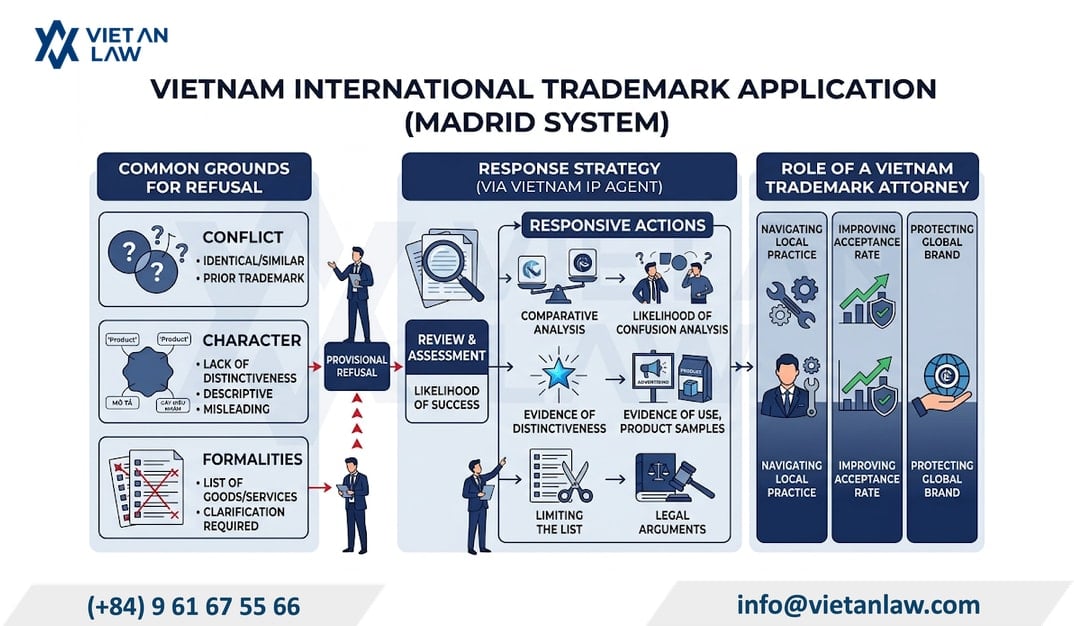
Strategy for international trademark applications designating Vietnam under the Madrid system
When receiving a provisional refusal notice for an international trademark application designating Vietnam, the foreign applicant must work through an industrial property representation organisation in Vietnam to review the grounds for refusal, assess the likelihood of overcoming the refusal, and develop an appropriate response strategy. Responding to a refusal notice is not just explaining the reasons for protecting the trademark, but may also include comparing the cited trademark, analysing the likelihood of confusion, proving distinctiveness, narrowing the list of goods and services, submitting evidence of trademark use, or presenting legal arguments under Vietnamese law.
For foreign applicants and international trademark law firms, prosecuting a Madrid application in Vietnam is significant in a global brand protection strategy. A trademark that has been accepted in its home country or in many other markets may still be refused protection in Vietnam if it does not meet the examination practices of IP Vietnam. Therefore, selecting a Vietnamese trademark lawyer with experience in handling provisional refusal notices, responding to trademark office actions, and prosecuting international trademark applications is a necessary factor to improve the chances of being accepted for protection.
Viet An Law supports foreign applicants, foreign industrial property representation organisations, and international businesses in monitoring, reviewing, and handling international trademark applications designating Vietnam. The service includes advising on the registrability, analysing provisional refusal notices, preparing response arguments, submitting evidence, amending or limiting the list of goods and services when necessary, working with IP Vietnam, and monitoring the results until the trademark is accepted for protection in Vietnam.
Trademark registration vs trademark prosecution in Vietnam
Trademark registration and trademark prosecution are closely related, but they are not the same.
Trademark registration is generally understood as the overall process to obtain trademark protection in Vietnam, including preparing documents and filing the application. This is often the content that businesses that have not yet filed an application search for when they want to know how to register a trademark.
Meanwhile, trademark prosecution focuses on the issues that occur after the application has been filed. This content is more relevant to an applicant who has a pending application, has received a notice from IP Vietnam, is facing a refusal notice, or needs support from a specialised trademark lawyer to ensure the application is granted a title of protection.
| Criteria | Trademark registration in Vietnam | Trademark prosecution in Vietnam |
| Main focus | Filing the application and requesting trademark protection | Processing the application during the examination phase |
| Client need | I want to register a trademark | My application is pending, opposed, or refused |
| Core issues | Required documents, fees, filing procedures | Office actions, refusals, amendments, oppositions |
| Timing | Before and at the time of filing | Entirely or after filing until granted or refused |
| Legal work | Preparing and filing the application | Legal arguments, evidence, responses, and handling strategies |
| Commercial value | Basic filing service | Highly specialised legal service, higher value |
Therefore, an applicant or a law firm assisting foreign clients with filing should not only care about how to file a trademark application in Vietnam, but must also know how the trademark application will be prosecuted and handled if IP Vietnam raises an objection or refusal.
Stages of trademark prosecution in Vietnam
The stages of trademark prosecution in Vietnam span from filing to the issuance of the trademark registration certificate. In terms of regulations, the process includes formality examination, publication of the application, substantive examination, handling of office actions or refusal notices if any, payment of the granting fee, and issuance of the protection title. However, the actual time may be longer than the standard time limit if the application contains deficiencies, is opposed by a third party, or if IP Vietnam requires the applicant to amend, explain, or supplement evidence.
| Stage | Main purpose | Estimated time |
| Filing | The application is filed with IP Vietnam | Date of filing |
| Formality examination | IP Vietnam checks whether the application meets formal requirements | About one month from the filing date |
| Publication of the application | The valid application is published so the public and third parties can monitor and submit observations | Within about two months from the date of the decision accepting the valid application |
| Substantive examination | IP Vietnam evaluates whether the trademark meets protection conditions | About nine months from the publication date; in practice, it may take longer |
| Office action or refusal notice | IP Vietnam may raise an objection, or request amendments or explanations | Arises during the formality examination or substantive examination process |
| Response from the applicant | The applicant submits arguments, evidence, or amends the application | Usually within the time limit stated in the notice from IP Vietnam |
| Decision to grant the title | IP Vietnam issues a notice of intended grant if the trademark is accepted | After the substantive examination concludes and the application meets protection conditions |
| Payment of granting fee | The applicant pays the official fees and charges as prescribed | According to the deadline stated in the notice of intended grant |
| Protection title | The trademark registration certificate is issued | After the applicant fully pays the granting fees and charges |
Formality examination of trademark applications in Vietnam
The formality examination is the first official examination stage after filing. In this stage, IP Vietnam checks whether the application complies with formal requirements.
The issues typically considered during the formality examination stage include:
- Whether the registration declaration is completed correctly;
- Whether the trademark specimen is clear;
- Whether the applicant information is consistent;
- Whether the goods and services are classified correctly;
- Whether the mandatory documents are fully submitted;
- Whether the power of attorney is valid or if the original has been provided;
- Whether the filing fees have been paid;
- Whether the documents proving priority rights, if any, are valid.
If the application meets the formal requirements, IP Vietnam will issue a decision accepting the valid application. After that, the application will move to the publication stage.
If the application has formal deficiencies, IP Vietnam may issue a notice requesting corrections. The applicant must respond within the prescribed time limit. If a proper response is not made, the application may be refused right at the formality examination stage.
For foreign applicants, common formal errors include incorrect translation of the applicant name, inconsistent addresses, incorrect Nice classification, overly broad descriptions of goods or services, or missing authorization documents and documents claiming priority rights.
Publication and third-party observations in Vietnam
After the application is accepted as formally valid, it will be published in the Industrial Property Official Gazette. The publication allows the public and third parties to review the pending trademark application.
This stage is very important because competitors, owners of prior registered trademarks, or parties with related interests may submit observations or oppositions against the application.
Third-party observations or oppositions may be based on various grounds, including:
- The filed trademark is identical or confusingly similar to a prior trademark;
- The trademark lacks distinctiveness;
- The trademark is descriptive or is a common sign;
- The trademark is likely to mislead concerning the origin, quality, or nature of the goods or services;
- The applicant does not have the legal right to register the trademark;
- The application was filed in bad faith;
- The trademark conflicts with trade names, geographical indications, or other prior rights.
A third-party observation or opposition does not mean the application will definitely be refused. However, this content can affect the IP Vietnam trademark examination process of the substance and generate additional legal work for the applicant.
Substantive examination by NOIP Vietnam
The substantive examination is the core stage in the Vietnam trademark examination process. In this stage, IP Vietnam considers whether the filed trademark meets the conditions for protection under Vietnamese intellectual property law.
The examiner typically considers:
- Whether the trademark is capable of distinguishing the applicant goods or services;
- Whether the trademark falls under absolute grounds for refusal;
- Whether the trademark is identical or confusingly similar to a previously registered or filed trademark;
- Whether the trademark contains prohibited or misleading elements;
- Whether the trademark conflicts with a well-known trademark;
- Whether the goods and services are classified and described;
- Whether third-party observations or oppositions affect the registrability of the trademark.
This is the stage where many trademark applications encounter objections or refusals. A trademark that seems appropriate at the time of filing may still be refused if IP Vietnam discovers a conflict with a prior trademark or considers the trademark to be descriptive, non-distinctive, or misleading.
For foreign applicants, the substantive examination stage requires detailed legal analysis because Vietnam applies its own examination practices. A trademark that has been accepted in the United States, the European Union, China, Japan, or Singapore may still face opposition or be refused in Vietnam.
Office actions and refusal notices in Vietnam
An office action from IP Vietnam or a refusal notice is an official document issued by IP Vietnam to raise issues related to the application. In Vietnam, these notices may be issued during the formality examination or substantive examination stages.
Common types of official correspondence during trademark prosecution include:
| Content | Common cases |
| Formal deficiencies | Incorrect classification, missing documents, inconsistent applicant information |
| Descriptiveness | The trademark directly describes the goods or services and lacks distinctiveness |
| Lack of distinctiveness | The trademark is too simple, common, or incapable of functioning as a trademark |
| Confusing similarity | The trademark is similar to a previously registered or filed trademark |
| Misleading elements | The trademark may mislead consumers about the origin, quality, nature, or utility of the products or services |
| Prohibited signs | The trademark contains a sign that is not permitted to be registered |
| Request for explanation | IP Vietnam requests an explanation or the submission of supplementary documents |
| Issues related to opposition | A third party opposes the registrability of the trademark |
A refusal notice should not be seen as the end of the line for an application. In many cases, a well-prepared response document can help overcome the examiner’s objections, and the trademark application can once again proceed to grant. This work requires handling by a local IP representative in Vietnam with expertise and experience. Viet An Law, with Representative Code 83 in Vietnam, believes it will be the best choice for clients wishing to register a trademark in Vietnam.
How to respond to trademark refusals in Vietnam?
An IP Vietnam office action response requires more than a short explanation. The response document must directly address the examiner’s legal arguments, provide supporting arguments, and, when appropriate, submit evidence or propose amendments.
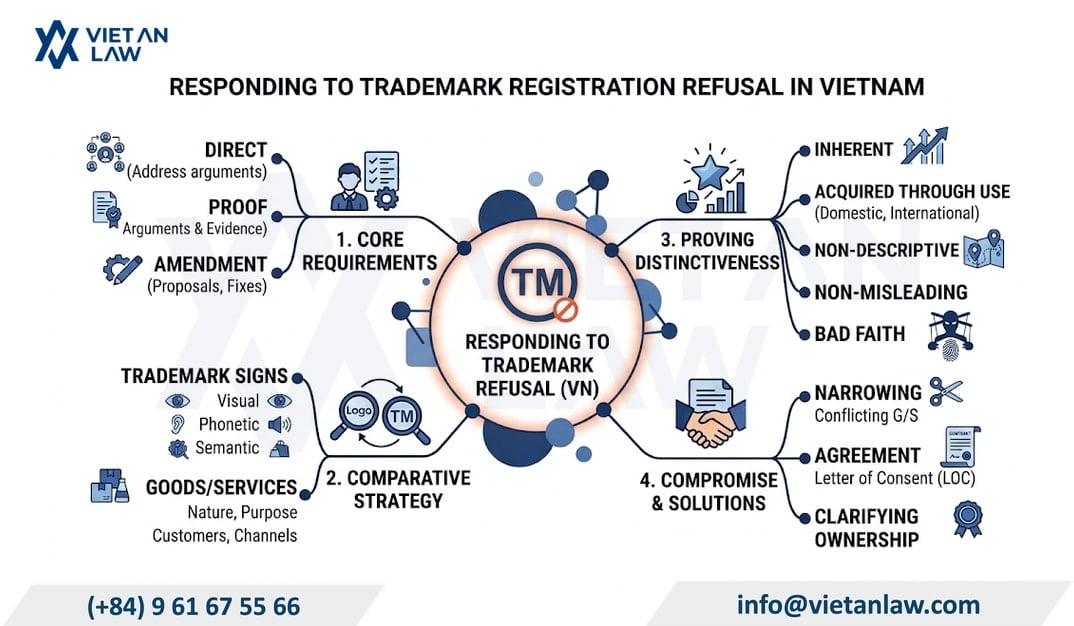
The response strategy may include:
- Finding an appropriate legal basis and analysing the cited reference trademarks to oppose the IP Vietnam decision of intended refusal;
- Comparing the visual, phonetic, and conceptual differences between the trademarks;
- Comparing the nature, purpose, consumers, and distribution channels of the goods or services;
- Proving that the trademark was widely used in other countries before filing in Vietnam;
- Finding a basis to prove the “bad faith” of the cited parties when they preemptively registered the trademark in Vietnam;
- Arguing that the trademark possesses inherent distinctiveness;
- Providing evidence of acquired distinctiveness through use;
- Explaining why the trademark is not descriptive or misleading;
- Narrowing or deleting potentially conflicting goods or services;
- Submitting a letter of consent, coexistence evidence, or documents clarifying ownership rights when appropriate;
- Citing Vietnamese law, examination practices, and similar precedents.
For a refusal based on confusing similarity, the response to a trademark refusal in Vietnam should not assert that the trademarks are different. It is necessary to explain why consumers are unlikely to be confused, considering the overall impression of the trademarks and the connection between the goods or services.
For a refusal based on descriptiveness, the response document should focus on the distinctive elements of the trademark, unusual combinations, stylised elements, meanings, consumer perception, and actual commercial use.
If the grounds for refusal are strong and difficult to overcome, the applicant may need to consider alternative strategies, such as amending the application, refiling the application with an adjusted trademark, negotiating with the owner of the prior trademark, requesting the invalidation of the cited trademark, or developing a new brand strategy for the Vietnamese market.
Amendments during trademark prosecution in Vietnam
Amending an application can be an important tool during trademark prosecution. However, not all amendments are permitted. Generally, an amendment must not alter the nature of the filed trademark or expand the scope of protection beyond the original content.
Amendments may include:
- Correcting the applicant information;
- Amending the list of goods or services;
- Deleting potential conflicting goods or services;
- Clarifying unclear descriptions;
- Correcting translation or classification errors;
- Amending non-material details if permitted by law;
- Submitting supplementary supporting documents.
In some cases, narrowing the list of goods or services can help overcome a refusal notice based on similarity to a prior trademark. For example, if the examiner cites a prior trademark with similar goods, the applicant may consider removing or limiting certain goods to reduce the conflict.
However, amendments must be executed carefully. An improper amendment may be rejected or may reduce the scope of trademark protection.
Grant of trademark protection title in Vietnam
If IP Vietnam concludes that the trademark meets the conditions for protection, the Office will issue a notice of intended grant of the trademark registration certificate. The applicant must pay the granting charges, as well as the publication fee, within the prescribed time limit.
After the payment is completed, IP Vietnam will issue the trademark registration certificate and record the trademark in the National Register of Industrial Property.
A trademark that has been granted a title provides the owner with the exclusive right to use the trademark for the registered goods and services in Vietnam. The trademark owner can use this title to prevent unauthorised use, oppose subsequent potentially conflicting applications, request customs supervision, license the trademark, assign the trademark, or enforce rights against infringement.
However, the issuance of the certificate is not the end of trademark management. The owner should continue to monitor the market and the trademark database to detect infringement or subsequent applications that may conflict with their rights.
Why do foreign applicants need local IP counsel in Vietnam?
For foreign applicants, registering a trademark in Vietnam through an industrial property representation organisation is not only a mandatory requirement under the law, but also a necessary solution to ensure that the trademark prosecution process is executed professionally, on time, and effectively. Because the trademark examination process at IP Vietnam requires deep legal knowledge, experience in handling official correspondence, responding to refusal notices, and practical understanding of examination methods, foreign applicants should choose an intellectual property law firm in Vietnam with expertise in trademark registration, prosecution, and protection for comprehensive support.
A local IP counsel in Vietnam for trademark prosecution can assist in:
- Reviewing official correspondence and refusal notices from IP Vietnam;
- Explaining the actual risk level of a refusal notice;
- Preparing legal arguments in Vietnamese;
- Communicating and working with IP Vietnam;
- Advising on strategies to amend or limit the scope of goods or services;
- Handling third-party oppositions or observations;
- Monitoring response deadlines;
- Preventing the application from being deemed abandoned due to missed deadlines;
- Advising on appeal options, refiling, or rights enforcement.
For international companies, a trademark application in Vietnam is often part of a regional or global trademark portfolio. Local prosecution counsel ensures that the application in Vietnam remains consistent with the applicant’s international brand protection strategy while meeting the legal requirements and practices in Vietnam.
FAQs about trademark prosecution in Vietnam
When is it necessary to use trademark prosecution services?
When the trademark applicant is a foreign individual, enterprise, or organisation. In addition, an applicant should use trademark prosecution services when the application is undergoing examination, receives an office action from IP Vietnam, faces a notice of intended refusal, is opposed by a third party, or requires amendments and supplementary documents to increase the chances of being granted a trademark registration certificate.
Does an office action from IP Vietnam mean the application is refused?
Not every office action from IP Vietnam means the application is refused. Many notices are simply requests to amend, supplement, explain, or clarify the dossier. However, if an appropriate response is not submitted on time, the trademark application may be refused.
Can a trademark application facing a notice of intended refusal still be granted a title?
Yes. If the applicant prepares suitable legal arguments, provides evidence of distinctiveness, analyses the differences from the cited trademark, or makes reasonable amendments to the list of goods and services, the trademark application still has a chance of being accepted for protection.
Can a trademark application be amended during prosecution?
Certain contents can be amended during trademark prosecution, such as applicant information, the list of goods and services, classification errors, or supplementary documents. However, the amendment must not change the nature of the trademark or expand the scope of protection compared to the original application.
What should an applicant do if a third party opposes the trademark application?
When a third party opposes a trademark application, the applicant must review the grounds for opposition, evaluate the prior rights of the opposing party, prepare response arguments, and submit evidence of use or evidence of the right to register to defend the likelihood of being granted a protection title in Vietnam.
How to handle a provisional refusal of an international trademark application designating Vietnam?
For an international trademark application designating Vietnam under the Madrid system, if IP Vietnam issues a provisional refusal notice, the foreign applicant must work through an industrial property representation organisation in Vietnam to review the grounds for refusal, prepare a response document, submit evidence, and execute procedures in accordance with Vietnamese law.
Do foreigners need a Vietnam trademark prosecution lawyer?
Yes. Foreign applicants are required to work through an industrial property representation organisation in Vietnam to interact with IP Vietnam. A Vietnam trademark prosecution lawyer can help monitor the dossier, handle official correspondence, respond to refusal notices, address oppositions, and advise on a trademark protection strategy tailored to examination practices in Vietnam.
Viet An Law trademark prosecution services in Vietnam
Viet An Law supports Vietnamese and foreign applicants throughout the entire trademark prosecution process in Vietnam. Our services do not stop at filing the trademark application but also include managing, monitoring, and handling the application throughout the entire cycle of trademark prosecution in Vietnam: from filing to examination and grant.
Our trademark prosecution services in Vietnam include:
- Reviewing pending trademark applications in Vietnam;
- Monitoring application status before IP Vietnam;
- Advising on official correspondence and refusal notices;
- Preparing responses to formal deficiencies and substantive refusal opinions;
- Handling refusals related to similarity, descriptiveness, and distinctiveness;
- Advising on amendments to the list of goods and services;
- Responding to third-party observations or oppositions;
- Submitting legal arguments and supporting evidence;
- Advising on appeal or refiling strategies;
- Assisting with title granting, recordation, and post-registration management.
With practical experience in intellectual property and foreign investment, Viet An Law assists clients in protecting their brands in Vietnam effectively, strategically, and in compliance with Vietnamese law.
For businesses that have filed a trademark application in Vietnam or have received a notice from IP Vietnam, an early legal review is essential. A prepared prosecution strategy can enhance the ability to overcome objections and secure trademark protection in Vietnam.
Contact Viet An Law
If you need advice on trademark registration in Vietnam, trademark prosecution in Vietnam, handling official correspondence, responding to refusal notices, trademark oppositions, or international trademark registration designating Vietnam under the Madrid system, please contact Viet An Law for prompt and professional support from an intellectual property lawyer.
Lawyer in charge:
Trademark Lawyer Mr. Dong Van Thuc – 20 years of experience. Hotline/Zalo/WhatsApp: +84 961 675 566
Trademark Lawyer: Mr. Duong Xuan Thang (Tommy Duong). Hotline/Zalo/WhatsApp: +84 966 995 988
Email: info@vietanlaw.com
Hanoi Office: 3rd Floor, Hoang Ngan Plaza Building, No. 125 Hoang Ngan, Yen Hoa Ward, Hanoi City
Ho Chi Minh City Office: Room 04.68, 4th Floor, Hall A, RiverGate Residence Building, 151-155 Ben Van Don, Khanh Hoi Ward, Ho Chi Minh City