As foreign direct investment from Taiwan into Vietnam across manufacturing, technology, commerce, consumer goods, and service sectors rapidly increases, securing intellectual property rights has become an urgent priority for businesses. Many investors ask: how can Taiwanese companies register trademarks in Vietnam? Trademark registration for Taiwanese companies in Vietnam is a crucial legal step that helps Taiwanese enterprises protect their brands, logos, product names, services, and corporate identity systems when investing, conducting business, or expanding their market in Vietnam. Early trademark registration helps enterprises mitigate the risk of other parties filing prior applications, appropriating, or illegally using their brands. Because the nation applies the first-to-file trademark system in Vietnam, Taiwanese companies must proactively conduct a trademark search, classify goods and services, prepare dossiers, and submit applications in accordance with regulations. The following article by Viet An Law will guide the conditions, dossiers, procedures, timelines, and important notes for businesses seeking trademark protection in Vietnam.
A protected trademark must be a visible sign (such as letters, words, drawings, images, or 3D geometry) or a sound sign (capable of being represented in the form of a musical score), and must be expressed in one or more colors. Most importantly, that sign must be capable of distinguishing the goods and services of the Taiwanese enterprise from the goods and services of other subjects on the market.
To save time and costs, enterprises should avoid using signs that fall under exclusion cases (which are absolutely not eligible for protection), including:
Under current regulations, a Taiwanese legal entity without a commercial presence (no subsidiary, branch, or representative office) in Vietnam is mandatorily required to carry out the procedures through an industrial property representation organization licensed by the National Office of Intellectual Property in Vietnam.
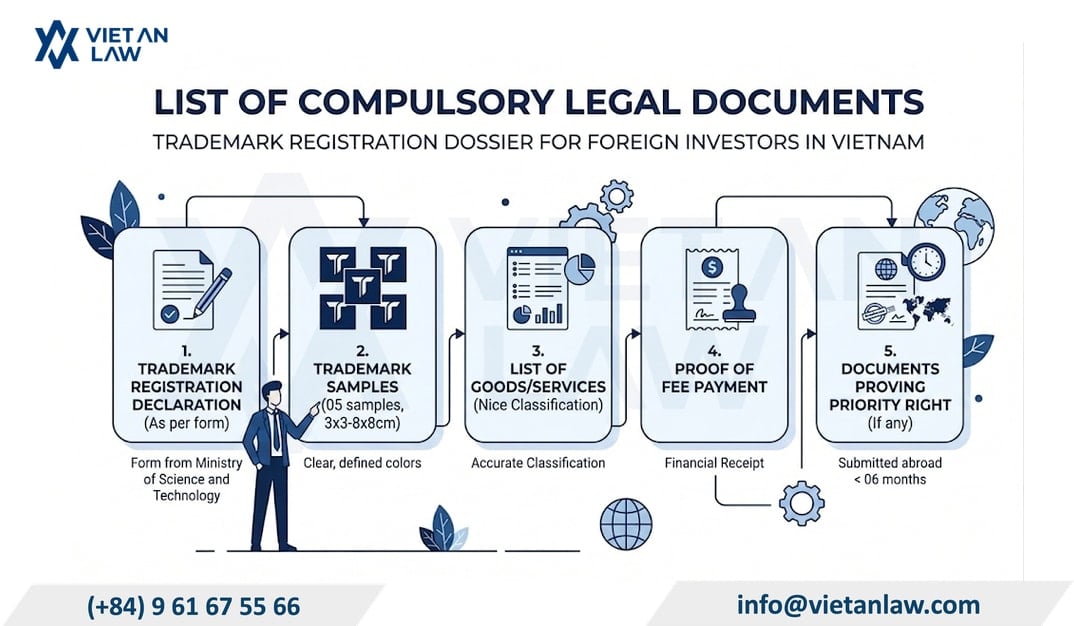
A standard and compliant dossier for Vietnam trademark registration for foreign investors includes:
Because the submission must be made through a representative, the power of attorney is an indispensable document.
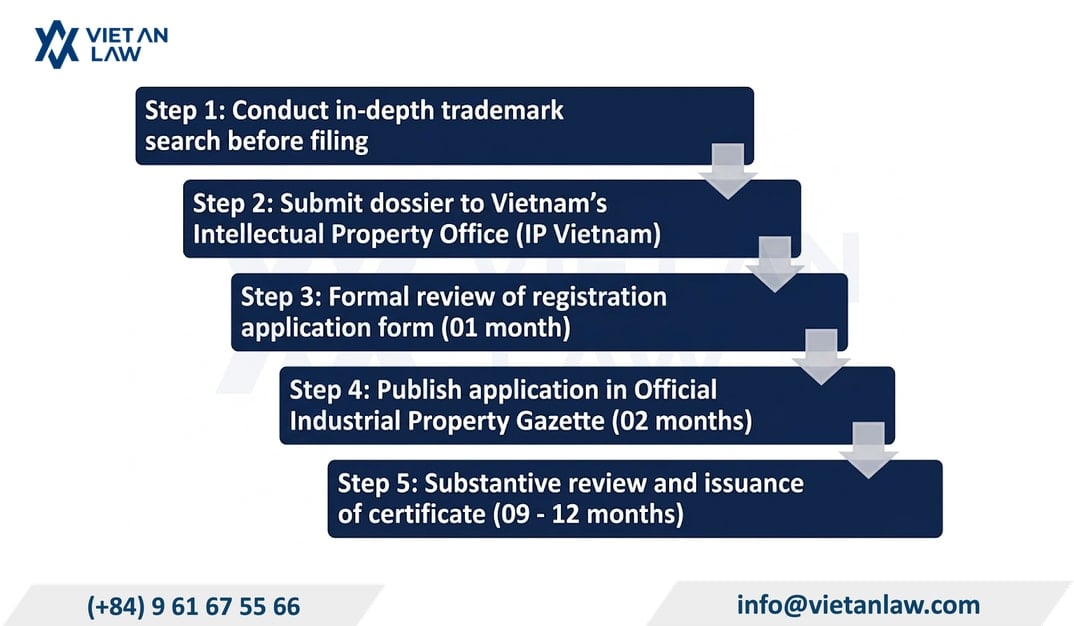
Although not mandatory, conducting a trademark search for a Taiwanese enterprise is the most important strategic step. Through national and international database networks, the intellectual property representative will evaluate the success rate of the trademark. If duplication is detected, the enterprise will be advised to redesign or adjust its strategy promptly.
Once completed, the dossier will be submitted by the representative organization directly, by post, or online via the public service portal to the headquarters of the National Office of Intellectual Property in Vietnam (in Hanoi) or its representative offices (in Ho Chi Minh City or Da Nang). Upon receipt, the competent authority will issue an application number and record the filing date.
Within 01 month, the National Office of Intellectual Property in Vietnam will check the validity of the dossier in terms of formalities. If valid, the office will issue a decision accepting the valid application.
Valid applications will be publicly published in the industrial property gazette within 02 months. This phase opens an opportunity for any third party (competitors or other rights holders) to file an application opposing the grant of a protection title if they believe this trademark infringes on their rights.
This is the core step. An examiner will conduct an in-depth evaluation to determine whether the trademark meets the protection standards (not being duplicated and possessing distinctiveness).
If the requirements are met, the enterprise will be notified to pay the granting fee and will subsequently officially receive the trademark registration certificate.
The cost of trademark protection in Vietnam in 2026 is not fixed at a general price level but depends entirely on:
State fees will include: the filing fee, substantive examination fee, search fee serving the examination, publication fee, and granting fee. When utilizing a trademark registration service through an intellectual property representative, the enterprise will pay a comprehensive service fee, whereby the representative organization will be fully responsible for all stages from application submission and monitoring until the handover of the protection title.
As mentioned, although the statutory timeline is approximately 12 to 15 months, Taiwanese enterprises should mentally prepare for a waiting period of 1.5 to 2 years to complete the entire process. Immediately upon receiving the notice of acceptance of a valid application (about 1 to 2 months after filing), the enterprise already possesses a solid foundation to affix the trademark symbol onto products and confidently deploy marketing campaigns in Vietnam.
Viet An Law is proud to be one of the industrial property representation organizations officially licensed to operate by the National Office of Intellectual Property in Vietnam. For Taiwanese investors, language barriers and differences in legal systems are often major obstacles. Choosing Viet An Law brings outstanding advantages:
Yes, absolutely. Vietnamese law allows foreign legal entities that do not yet have a commercial presence in Vietnam to file trademark registration applications. However, the procedure is mandatorily required to be carried out through a licensed industrial property representative in Vietnam (such as Viet An Law).
A trademark is protected for a period of 10 years calculated from the valid filing date. Whenever expiration approaches (within 06 months prior), the enterprise can carry out renewal procedures consecutively for multiple times, with each renewal adding another 10 years. This implies that the brand can be protected perpetually if full renewals are maintained.
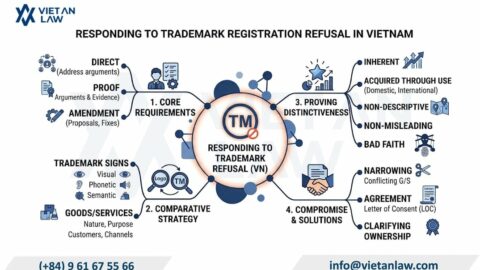
During the substantive examination process, if it is discovered that the trademark fails to meet the standards (for example: being deemed confusingly similar to another trademark), the National Office of Intellectual Property in Vietnam will issue a notice of intended refusal. At that time, through their representative organization, the enterprise has the right to submit a response letter, presenting legal arguments to rebut the examiner’s opinion, or providing evidence demonstrating differences to request the office to continue considering and granting the title.
The above contains the consulting advice of Viet An Law regarding how can Taiwanese companies register trademarks in Vietnam. If clients require consulting related to a trademark registration service in Vietnam, please contact Viet An Law for the best support.