


Maintaining a business that is no longer profitable creates immense financial pressure. At this point, many owners often wonder whether they should proceed with company dissolution or transfer a company in Vietnam to a third party to continue operations. In reality, when a company is inactive, deciding whether to close it or transfer it is not just an economic puzzle; it also entails numerous consequences for tax obligations and property liabilities. From a legal perspective, this article analyzes in detail the pros and cons of each option, helping investors answer the question: “company dissolution or company transfer in Vietnam: which option is better?” to optimize costs and prevent legal risks.
Comparison between company dissolution and company transfer
| Company dissolution | Company transfer | |
| Legal nature | Terminating the existence of the company | Changing the owner |
| Financial obligation | Mandatory full settlement | The new owner inherits all |
| Implementation process | Complex and prolonged | Fast |
Inactive company in Vietnam: should you choose company dissolution vs company transfer?
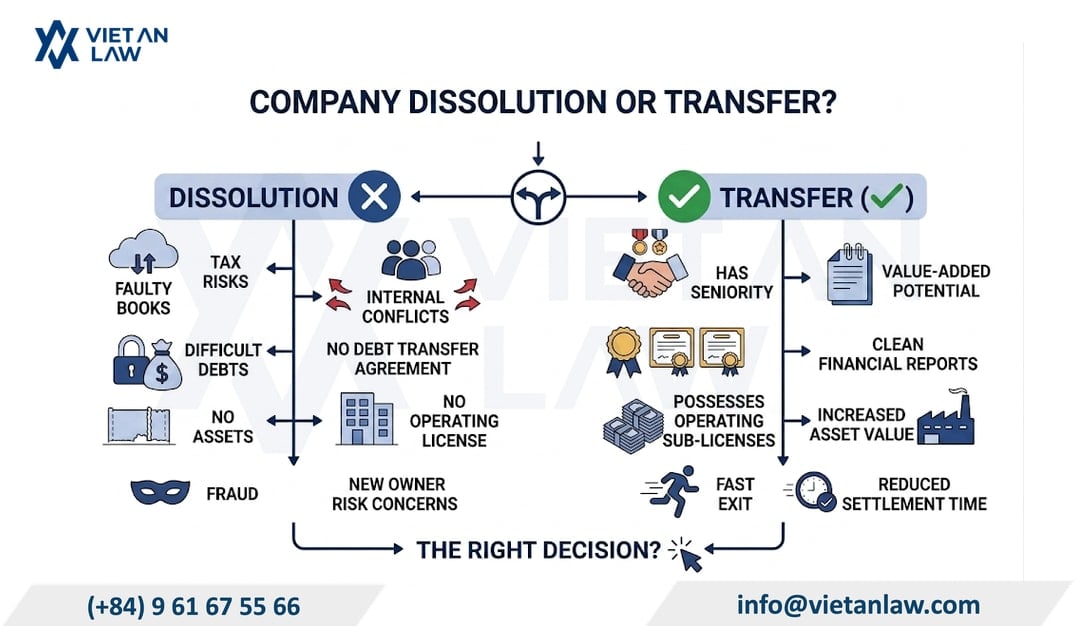
To make a major decision such as whether to dissolve a company in Vietnam or transfer it, the business owner needs to clearly understand the nature, pros, and cons of each option to make the most suitable decision for the current situation of the company.
When should an enterprise proceed with company dissolution procedures?
Company dissolution is a legal procedure aimed at completely terminating the existence of the company.
Pros:
- Permanently terminates all legal, tax, and debt risks arising in the future.
- The owner has complete peace of mind, without worrying about joint liability.
Cons:
- The procedure is complex and prolonged (usually from six months to years, especially at the stage of finalizing financial obligations).
- It is costly (paying debts, tax penalties if any) and the initial investment cost cannot be recovered.
Cases where the enterprise should choose company dissolution:
- Accounting books lack transparency and have serious errors: If the company has a history of late tax payments, lost invoices and vouchers, or falsified books for many years leading to the risk of heavy penalties by the tax authority. These companies usually cannot be transferred because new investors are very concerned about bearing hidden debts.
- Risks from new buyers are hard to control: If the business owner is worried about selling the company to a third party, but the third party uses the name of that company (still carrying the old name or customer file) to buy and sell fake invoices or commit fraud to appropriate property. Dissolution will help the old owner completely cut off these concerns, without fearing joint liability.
- The company does not have any added value: A newly established enterprise with no assets, no brand, no sub-licenses (such as a travel license, clinic license, security and order license), and no seniority in beautiful financial reports for bidding. The transfer value is almost zero, so processing dissolution procedures will finish faster than finding a buyer.
- Severe internal conflicts that cannot be healed: When shareholders or capital-contributing members have serious disagreements, no one is willing to transfer their capital portion to another and no one wants to sell to outsiders. Dissolution is the fairest option to liquidate assets and redistribute the remaining value.
- Inability to negotiate debt transfer: The company is bearing many debts from partners and these partners do not agree to allow the transfer of debt repayment obligations to the new owner. It is mandatory to implement dissolution and pay off all these debts.
Is company transfer Vietnam more beneficial than dissolution?
Company transfer in Vietnam is inherently the act of changing the owner’s name, while the legal entity of the company continues to exist normally.
- Pros:
- Fast administrative procedures (only three to five working days).
- Helps the old owner recover a portion of the capital from selling the company or the company brand.
- Avoids the complex tax finalization procedure of dissolution.
- Cons: Harbors potential joint legal risks if the contract and the handover minutes of books and seals do not strictly nail down the boundary of responsibility before and after the name change.
Cases where you should choose company transfer:
This option is optimal when the company has long-term operational seniority, transparent financial reports, possesses an attractive tax code, holds conditional business licenses that are difficult to apply for, or the old owner wants to withdraw quickly from the market without wanting to waste a lot of time on the tax finalization stage.
Which option is more cost-effective?
From a financial perspective, transferring a company is usually much more cost-effective. Specifically as follows:
- Company dissolution costs: Include the cost of hiring accounting services to declare books, paying fines for administrative tax violations (if any), settling outstanding debts, and the prolonged waiting time.
- Company transfer costs: Primarily include state fees (which are very small) when submitting the dossier for a change of business registration, legal service fees if hiring a lawyer to draft the contract, and personal income tax according to regulations.
Does company dissolution require tax finalization? Financial obligations to fulfill?
According to the provisions of Clause 2, Article 207 of the Law on Enterprises 2020, an enterprise is only allowed to dissolve when it guarantees the full payment of all debts and other property obligations, and is not in the process of resolving a dispute at a court or arbitration.
Therefore, the enterprise is obligated to finalize taxes. This is the most difficult and time-consuming step in the dissolution process. The tax authority will come to inspect all books from the time of establishment until the request to close the tax code.
Regarding financial obligations, according to Clause 5, Article 208 of the Law on Enterprises 2020, the debts of the enterprise are paid in the following priority order:
- Debts for salaries, severance allowance, social insurance, health insurance, unemployment insurance according to the provisions of law and other benefits of employees according to the collective labor agreement and signed labor contracts.
- Tax debts.
- Other debts.
Is a company transfer subject to tax?
A company transfer is essentially the act of the company owner (the capital contributor) transferring their contributed capital portion or shares to another person.
According to the provisions of Article 3 of the Law on Personal Income Tax 2025 and Article 3 of the Law on Corporate Income Tax 2025, income from capital transfer belongs to the group of taxable income.
Therefore, when executing a company transfer in Vietnam, the owner must pay personal income tax (if the transferor is an individual) or corporate income tax (if the transferor is an enterprise) in accordance with the law.
Legal risks clients need to know before conducting a company transfer transaction in Vietnam
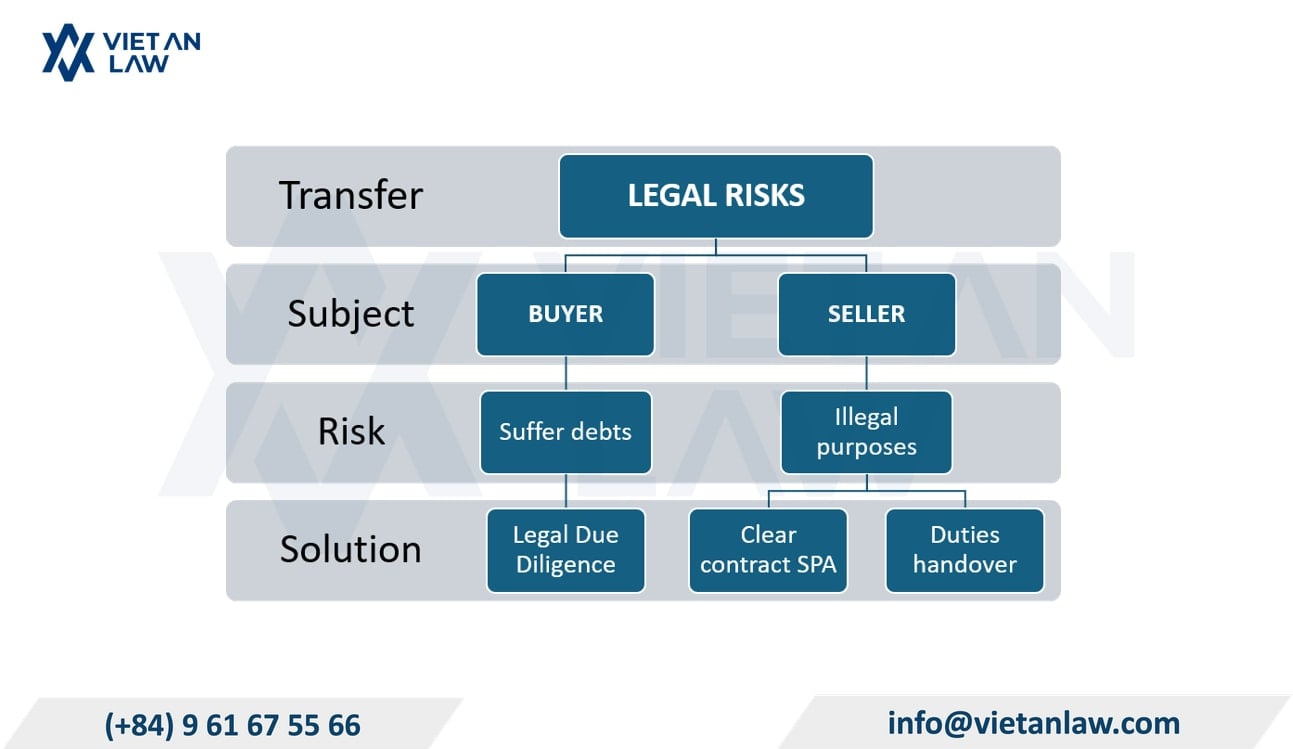
Risks when transferring or receiving a company transfer:
For the seller:
The biggest risk is that the new buyer uses the company for illegal purposes (such as buying and selling fake invoices, fraud) before completing the name change procedures, or the parties do not have clear handover minutes. Therefore, when transferring, it is necessary to have a transfer contract and strict handover minutes for assets, books, and seals, clearly pinning down the point in time when the legal liability of the seller is cut off.
For the buyer:
The buyer may have to bear hidden debts that the seller intentionally conceals, including:
- Tax debts, penalties for late tax payment due to accountants falsifying books.
- Debts for salaries and social insurance of former employees.
- Disputes with partners or lawsuits that have not been resolved.
Therefore, before receiving the transfer, the buyer should hire a lawyer unit or independent auditor to conduct a legal due diligence before signing the contract to eliminate the risks mentioned above.
Should you buy an old company instead of establishing a new one?
Buying back an old company is highly favored if the buyer needs:
- Bidding capacity: Many projects require contractors to have an operating period of three to five years.
- Hard to obtain licenses: Saves time on reapplying for sub-licenses (for example: travel business license, clinic license).
- Credit limit: Companies with beautiful financial reports over the years find it easier to borrow bank capital than newly established companies.
Does selling a company require dissolution?
Selling a company is inherently the procedure to change the owner, legal representative, and/or capital structure on the Enterprise Registration Certificate. The legal entity status of the company is preserved and continues to operate under the management of the new owner.
Therefore, selling a company does not mean you dissolve a company.
Frequently asked questions
How long does a company transfer take?
According to current regulations, after the parties have agreed on the transfer, business registration procedures are needed to change the company owner, capital-contributing members, and shareholders.
This procedure is usually resolved within a period of 03 to 05 working days at the business registration authority under the Department of Finance.
Is company dissolution allowed while owing taxes?
As analyzed above, the core principle of dissolution is that the enterprise must not have any remaining debts. The enterprise is strictly obliged to fulfill tax payment obligations before the tax authority issues a notice closing the tax code to complete the process of company dissolution Vietnam.
Does changing the owner (transfer) change the tax code? Is selling a single-member limited liability company more complex than a joint-stock company?
According to the provisions at Point a, Clause 3, Article 30 of the Law on Tax Administration 2019, the tax code of an enterprise is unique and exists for a lifetime from the time of establishment until dissolution. Changing the representative, owner, or changing the company name does not change this tax code.
Viet An Law provides consulting services for enterprise dissolution, company transfer, change of owner, and enterprise restructuring nationwide. Contact us immediately to receive advice from a lawyer on the most suitable option, optimizing costs and time, and maximally limiting any arising legal risks. Ultimately, the choice between company dissolution or company transfer in Vietnam: which option is better? depends entirely on your specific business compliance status and strategic goals.