


France, one of the world’s leading economies and a member of the European Union (EU), opens the door to a vast single market with more than 500 million consumers. France’s strategic geographical location is also an important gateway to access other markets in Europe, the Middle East and Africa. The French government has been implementing many reforms to create a more friendly and attractive business environment for businesses. Measures include tax reductions, simplification of administrative procedures, and increased support for small and medium-sized enterprises (SMEs). France’s transparent and stable legal system protects the interests of investors and businesses, creating favorable conditions for business activities. In addition, the French government has many programs to support and encourage investment for businesses, including concessional loans, subsidies, tax breaks and consulting services. Government agencies such as Business France and Invest in France provide information and support to foreign investors who want to set up a company in France. With the above outstanding advantages, France is an attractive destination for businesses looking to expand their business and develop in the international market. However, investors need to find out in advance some information related to the establishment of a company in France, one of which is the forms of companies that can be established, Viet An Law would like to provide customers with the above information through the article below.
Forms of company that can be set up in France if you want to set up your own company
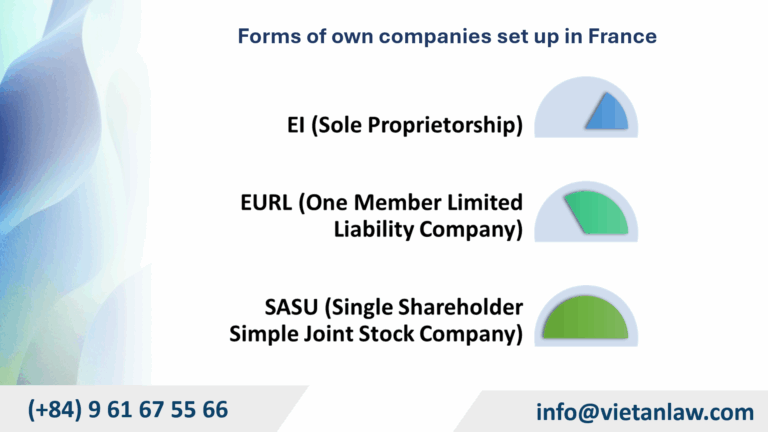
- Sole proprietorship (EI), including micro-entrepreneurship. This is the simplest form, suitable for small or self-employed people.
- Single-member Limited Liability Company (EURL). This form is suitable for those who want to have a separate legal status and have limited liability for the company’s debts.
- Single Shareholder Simple Joint Stock Company (SASU). This is a more flexible form than EURL, which allows a single shareholder to establish and run the company. SASU also has many tax and management advantages.
Distinguishing the above types of companies
| Character | EI (Sole Proprietorship) | EURL (One Member Limited Liability Company) | SASU (Single Shareholder Simple Joint Stock Company) |
| Number of Members | 1 | 1 | 1 |
| Financial Responsibility | Unlimited (the owner is responsible for the entire property) | Limited (within the scope of contributed capital) | Limited (within the scope of contributed capital) |
| Charter capital | Not required | Minimum of 1 euro (should have a reasonable amount of capital to operate) | Minimum of 1 euro (should have a reasonable amount of capital to operate) |
| Shares/Capital | Without | Divide into capital portions | Split into shares |
| Manager | Owner | Managing member (can be the owner or someone else) | Chairman (can be the owner or other person) |
| Taxes payable | Personal income tax (simple tax regime may apply for micro-enterprises) | Corporate income tax (personal income tax optional) | Corporate income tax (personal income tax optional) |
Forms of company that can be established in France if you want a joint venture
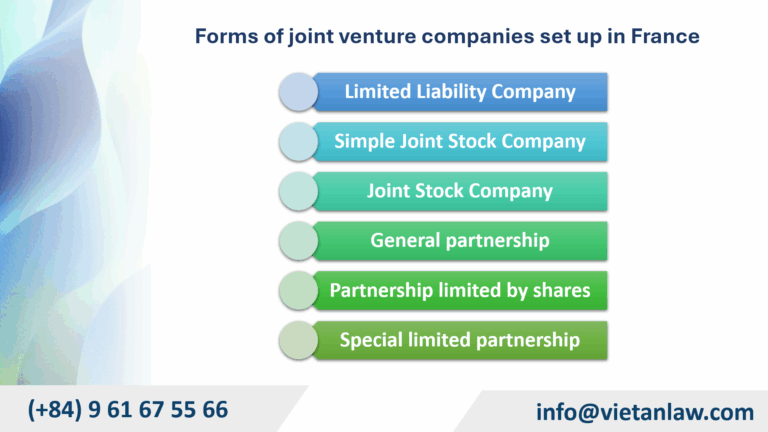
- Limited Liability Company (SARL, or “société à responsabilité limitée”)
- Simple Joint Stock Company (SAS, or “société par actions simplifiée”)
- Joint Stock Company (SA, or “société anonyme”)
- General partnership (SNC)
- Partnership limited by shares (SCA)
- Special limited partnership (SCS)
Differences between types of SARL, SAS, SA
| Character | SARL (Limited Company) | SAS (Simple Joint Stock Company) | SA (Joint Stock Company) |
| Number of Members | From 2 to 100 | Minimum 2 | Minimum 2 (or 7 if listed) |
| Financial Responsibility | Limited (within the scope of contributed capital) | Limited (within the scope of contributed capital) | Limited (within the scope of contributed capital) |
| Charter capital | Free, at least 20% of contributed capital upon establishment | Free, at least 50% of the contributed capital upon establishment | Minimum €37,000 (or €225,000 for IPO), minimum 50% of capital contribution upon incorporation |
| Shares/Capital | Capital portion | Stock | Stock |
| Listing | Not allowed | Not allowed | Allowed |
| Manager | One or more directors | President | Board of Directors and CEO, or Board of Supervisors and Board of Directors |
| Taxes payable | Corporate income tax (PIT can be selected for family SARL and SARL less than 5 years) | Corporate income tax (PIT can be selected) | Corporate income tax (PIT can be selected) |
| Transfer | Freedom for relatives, need approval for outsiders | Free | Free |
Differences between SNC, SCA and SCS types of companies
SNC (Partnership) is a type of business in which all members are managers at the same time. The special feature of SNC is that the members are personally responsible for all the debts of the company. The company’s profits will be taxed in the name of each member. The advantage of SNC is that it can operate in almost all fields, except for some specific industries with its own regulations.
SCA (Capital Partnership) and SCS (Limited Partnership Company) have a more complex organizational structure, with two types of members: general partners and capital contributing members. A general partner is a person who is directly involved in the management and administration of the company, while a capital contributor only acts as a financial investor. This structure allows investors to participate in business activities but only have limited liability within the scope of their contributed capital. In contrast, general partners are subject to unlimited financial liability, similar to the SNC model.