


What should you do when a tax code is locked? Here are the 6 fastest steps to reopen it in 2026. A locked tax code means that an enterprise, household business, or organization has its tax code invalidated or its operations temporarily suspended on the tax management system. When a tax code is locked, the enterprise cannot issue invoices, file tax returns, conduct transactions with state agencies, or continue normal business activities. The legal representative may even be banned from exiting the country. To restore the tax code, enterprises need to accurately identify the cause of the lock and follow the procedures regulated by the tax authority. If you need assistance, using a professional tax code reactivation service can streamline this process. This article provides detailed guidance on how to reactivate a locked tax code in Vietnam: 6 fastest steps (2026).
What is a locked tax code in Vietnam?
Concept of a locked tax code
In reality, the term “locked tax code” is not a specific legal status regulated in legal documents, but is commonly used by enterprises to refer to a situation where a tax code is no longer operating normally. Therefore, before performing the procedure to restore tax code statuses, enterprises need to look up the legal status of their tax code on the tax authority’s system or work directly with the managing tax authority to accurately determine the case they are facing and have an appropriate handling plan.
Distinguishing between a locked tax code, invalidation of a tax code, and temporary suspension of operations with uncompleted tax obligations
Many enterprises often use the term “locked tax code” to refer to all cases where they cannot perform tax transactions. However, legally and in terms of tax management, it is necessary to clearly distinguish between a locked tax code, invalidation of a tax code, and a temporary business suspension where tax obligations have not been completed.
| Criteria | Locked tax code | Invalidation of a tax code | Temporary suspension of operations with uncompleted tax obligations |
|---|---|---|---|
| Nature | Common term used by enterprises when the tax code is no longer operating normally on the tax system | Legal status issued by the tax authority according to regulations | The enterprise has registered for a temporary business suspension but still has uncompleted tax obligations |
| Status on tax system | May be suspended from operation or has been invalidated | The tax code is determined to be no longer valid for use | The tax code is still valid, but the enterprise is in a period of temporary suspension |
| Invoicing capability | Not allowed to use e-invoices | Not allowed to use e-invoices | Not allowed to issue invoices during the suspension period, unless permitted by law |
| Common causes | Not operating at the registered address, violating tax obligations, under special management by the tax authority | Dissolution, bankruptcy, revocation of the business registration certificate, or by decision of a competent state agency | The enterprise actively registers for a temporary suspension of business but still owes taxes, tax declaration dossiers, or other financial obligations |
| Ability to recover | Can be recovered if meeting the conditions of the tax authority | Can only be recovered in certain cases according to legal regulations | No need to restore tax code, just complete the outstanding tax obligations and resume operations when the suspension period ends or register to resume operations early |
| Handling procedure | Work with the tax authority to determine the cause and perform recovery procedures | Perform the tax code reactivation procedure according to regulations | Complete outstanding tax obligations, pay taxes, fines (if any), and perform procedures to resume operations when needed |
Signs of an enterprise having a locked tax code in Vietnam
According to experience handling dossiers at Viet An Law Firm, most enterprises only discover that their tax code is locked when they need to issue invoices or perform procedures to change business registration:
| Sign | Description |
|---|---|
| Cannot issue e-invoices | The system reports an error or refuses to issue invoices because the tax code is locked or invalidated. |
| Tax code lookup displays an abnormal status | Lookup results show announcements such as: “The taxpayer does not operate at the registered address”, “Suspended from operation”, “Invalidation of tax code”. |
| Cannot perform electronic tax procedures | Cannot submit tax returns, financial statements, tax refund dossiers, or other online tax procedures. |
| Receiving notifications from the tax authority | The enterprise receives requests for explanation, address verification, or notices of tax obligation violations. |
| Legal representative is temporarily suspended from exiting the country | This can happen when an enterprise has prolonged tax debts or has not completed tax obligations according to regulations. This shows the critical need to unlock tax code Vietnam issues immediately. |
| Tax obligations cannot be certified | Facing difficulties when performing company dissolution, changing business registration, or other administrative procedures. |
When the above signs appear, the enterprise should quickly look up the tax code status and contact the managing tax authority to determine the cause, avoiding impacts on business operations and legal procedures.
7 common causes of a locked tax code in Vietnam
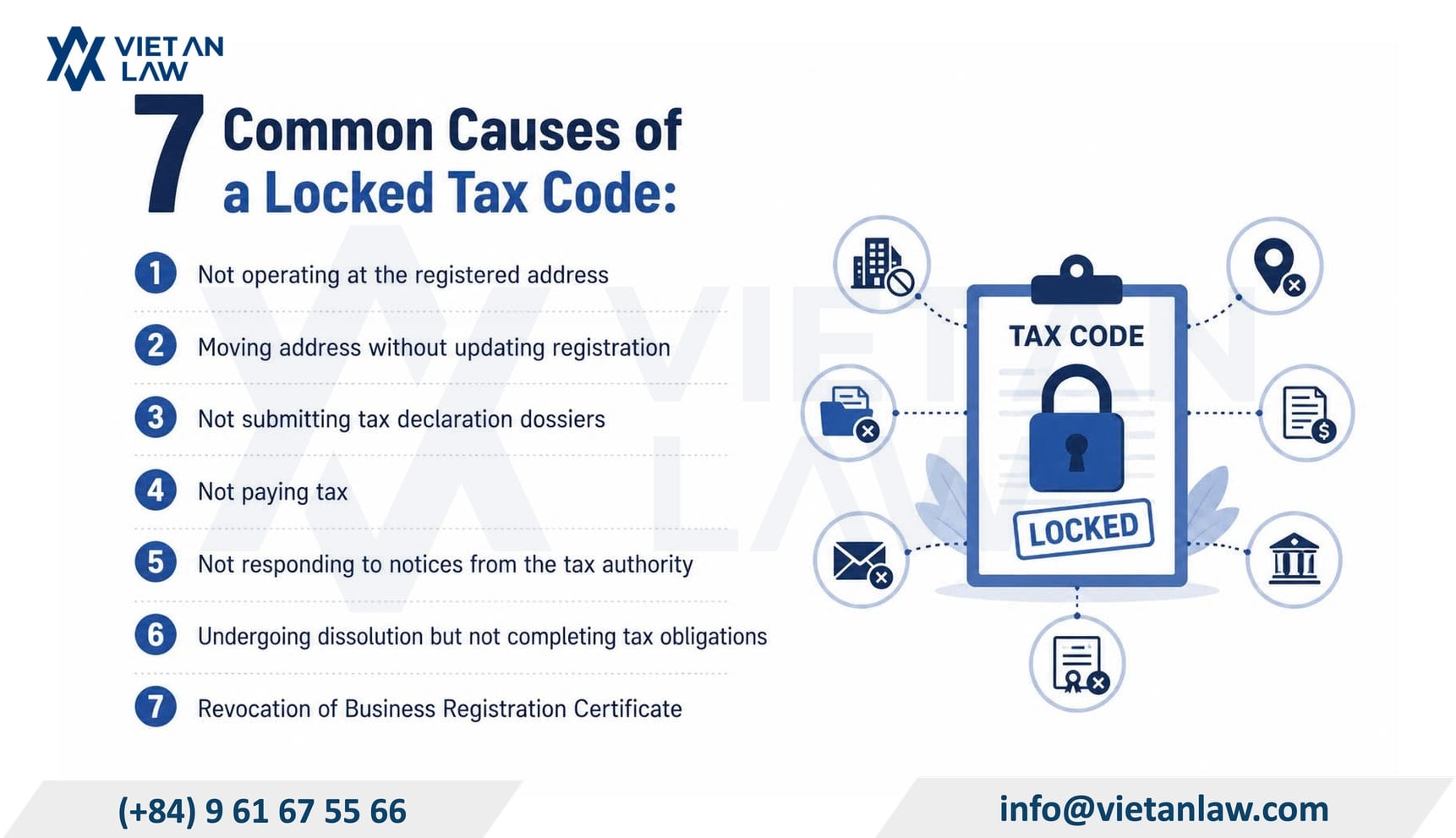
7 common causes of a locked tax code
An enterprise having a locked tax code not only disrupts business operations but also directly affects invoicing, tax declaration, and other legal procedures. Below are 7 common causes leading to the invalidation of a tax code or a temporary lock by the tax authority.
| Cause | Sign | Impact Level | Handling Direction |
|---|---|---|---|
| Not operating at the registered address | The tax authority inspects and does not find the enterprise operating, there is no signage, or the representative cannot be contacted | Very high | Submit supplementary dossiers to prove actual operations, re-verify the address with the tax authority to execute the process to reactivate locked tax code statuses |
| Moving address without updating registration | The enterprise has moved its headquarters but has not performed procedures to change information | High | Register to change company address and request the tax authority to update the data |
| Not submitting tax declaration dossiers | Failing to submit VAT, CIT, or PIT tax returns for many consecutive periods | High | Submit all missing dossiers and complete declaration obligations |
| Not paying tax | Prolonged tax debt, arising late payment interest and fines | High | Pay fully the taxes, fines, and late payment interest according to regulations |
| Not responding to notices from the tax authority | Failing to participate in meetings, provide explanations, or verify as requested | Medium to High | Actively contact the tax authority to explain and supplement dossiers |
| Undergoing dissolution but not completing tax obligations | Dissolution dossiers have been submitted but there are still tax debts or unfinalized tax | High | Complete tax obligations and supplement missing dissolution dossiers |
| Revocation of Business Registration Certificate | There is a revocation decision from the business registration agency | Very high | Perform procedures to restore the legal status of the enterprise before requesting to unlock tax code Vietnam systems for the business |
Important notes when an enterprise has a locked tax code
Through the practical experience of supporting many dossiers for tax code recovery, Viet An Law Firm realizes that more than 80% of cases where an enterprise has a locked tax code stem from three main causes:
- Tax code not operating at the registered address;
- Not submitting tax declaration dossiers on time;
- Not completing tax payment obligations.
Therefore, enterprises should regularly look up a suspended tax code in Vietnam, check the operational status on the electronic tax system, and timely update changes regarding head office address, legal representative, and business lines to avoid being subject to tax code invalidation measures by the tax authority.
To resolve these issues, you must learn how to reactivate a locked tax code in Vietnam: 6 fastest steps (2026).
How to check the status of an enterprise’s tax code in Vietnam?
When suspecting that an enterprise’s tax code is locked or invalidated, the enterprise should actively check the legal status of the tax code for timely handling. Currently, there are 3 popular lookup methods:
Looking up on the Portal of the Tax Authority
This is the fastest way to check the operational status of an enterprise’s tax code. Just enter the tax code or enterprise name, and the system will display basic information such as:
- Operational status of the tax code;
- Directly managing tax authority;
- Registered headquarters address;
- Date of tax code issuance;
- Status of the taxpayer.
If statuses like “Suspended from operation”, “Not operating at the registered address”, or “Invalidation of tax code” appear, the enterprise needs to contact the tax authority for guidance.
Looking up on the National Business Registration Portal
In addition to the tax system, enterprises can look up information on the National Business Registration Portal to check:
- Information of the legal representative;
- Status of dissolution, temporary suspension, or active operation.
Cross-checking data simultaneously from the tax authority and the business registration agency helps accurately determine the cause leading to the locked tax code.
Contacting the managing tax authority directly
In case the lookup results do not clearly show the cause or the enterprise needs to handle a suspended tax code in Vietnam, they should directly contact the managing tax authority to be provided with detailed information regarding:
- Cause of the locked tax code;
- Outstanding tax dossiers;
- Tax debts, fines, or late payment interest;
- Conditions and procedures to recover the tax code.
This is the most accurate option to help enterprises determine the full obligations to perform before requesting to reopen the tax code.
6-step process to handle and recover a locked tax code in Vietnam
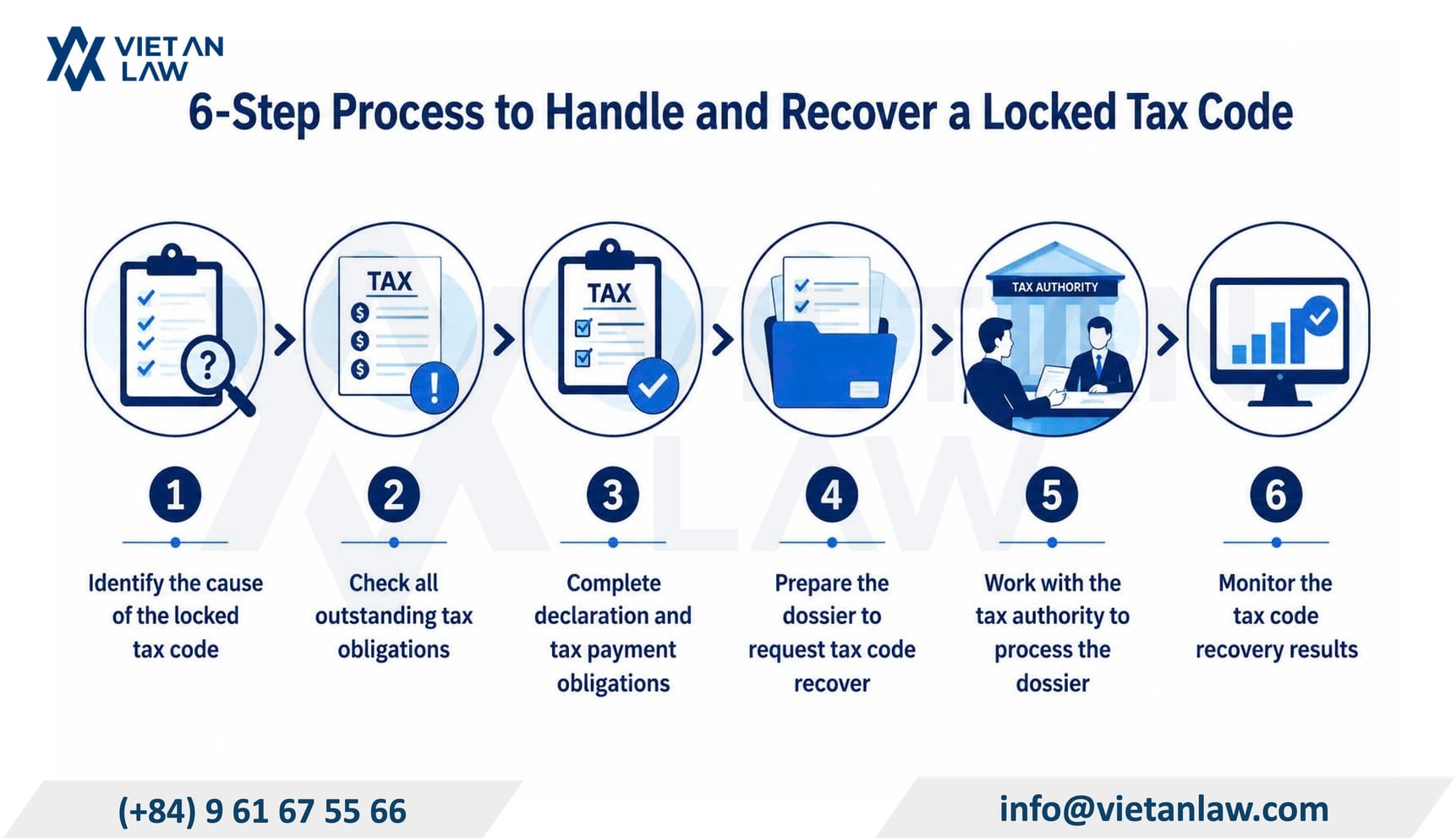
6-step process to handle and recover a locked tax code
According to the experience of supporting enterprises by Viet An Law Firm when a tax code is locked or invalidated, the enterprise needs to implement appropriate handling steps: (1) identify the cause of the lock; (2) check the tax code status; (3) submit missing tax dossiers; (4) pay taxes, fines, and late payment interest; (5) submit the recovery application dossier; (6) work with the tax authority to reopen the tax code. This guide details how to reactivate a locked tax code in Vietnam: 6 fastest steps (2026).
Step 1: Identify the cause of the locked tax code
The enterprise needs to directly contact the managing tax authority or look up information on the tax system to accurately determine the status of the tax code.
Contents to check include:
- The timing when the tax authority locked or invalidated the tax code.
- The reason leading to the locked tax code.
- Tax declaration dossiers that are missing or not yet submitted.
- Tax debts, late payment interest, and administrative violation fines.
- Other obligations that the enterprise must complete before being considered for tax code recovery.
Accurately identifying the cause will help the enterprise choose the right handling option and limit further violations.
Step 2: Check all outstanding tax obligations
After identifying the cause, the enterprise needs to review its entire tax compliance status.
The review content usually includes:
- Missing VAT, CIT, and PIT tax declaration dossiers.
- Unsubmitted financial statements.
- Reports on invoice usage status.
- Outstanding tax obligations that have arisen.
- Administrative violation fines and late payment interest.
This is an important step to ensure no obligations are missed, which could cause the tax code recovery dossier to be rejected.
Step 3: Complete declaration and tax payment obligations
The enterprise rectifies the violations as required by the tax authority. Depending on each case, rectification may include:
- Submitting missing tax returns.
- Submitting financial statements or other mandatory reports.
- Fully paying outstanding tax debts.
- Paying late payment interest and administrative violation fines.
- Rectifying violations related to e-invoices or headquarters address.
The enterprise should only move to the next step when all arising obligations have been completed.
Step 4: Prepare the dossier to request tax code recovery
After completing the rectification of violations, the enterprise prepares the dossier according to the tax authority’s requirements. Depending on each case, the tax code reactivation procedure requires a dossier that may include:
- Official dispatch requesting the reactivation of tax code validity.
- Written explanation of the cause of the violation.
- Documents proving that the enterprise is operating at the registered address.
- Vouchers of tax payment, fines, and late payment interest.
- Other dossiers and documents as required by the tax authority.
Step 5: Work with the tax authority to process the dossier
After submitting the dossier, the enterprise needs to coordinate with the tax authority during the examination and verification process. In some cases, the tax authority may:
- Request supplementary dossiers or explanatory documents.
- Conduct a physical inspection at the enterprise’s headquarters.
- Verify the business operations of the enterprise.
- Cross-check the performance of tax obligations.
Full and timely cooperation with the tax authority will help shorten the dossier processing time.
Step 6: Monitor the tax code recovery results
After the dossier is received and processed, the enterprise needs to regularly monitor the resolution status on the tax system or work directly with the managing tax authority.
When approved, the tax authority will issue a decision or notice to restore the validity of the tax code according to regulations. From that moment, the enterprise can continue to perform business activities, declare taxes, use e-invoices, and perform other administrative transactions normally.
Notes after having the tax code reactivated
To avoid having the tax code locked again, the enterprise needs to:
- Maintain actual operations at the registered address. If you need to move, remember to change company address officially.
- Fully perform periodic tax declaration obligations.
- Pay taxes on time.
- Monitor and promptly respond to notices from the tax authority.
- Update enterprise information when there are changes in address, legal representative, or business lines.
Common mistakes when handling a locked tax code in Vietnam
When a tax code is locked or invalidated, many enterprises rush to handle it but do not resolve the correct cause, leading to prolonged dossiers or rejection of recovery by the tax authority. Below are common mistakes to avoid.
Only paying tax without supplementing tax declaration dossiers
Many enterprises assume that just paying off all outstanding tax debts is enough to reopen the tax code. However, the tax authority usually requires the enterprise to complete both declaration obligations and tax payment obligations. If tax returns, financial statements, or tax dossiers remain unsubmitted, the tax code may not be recovered despite full tax payment.
Moving the headquarters address without updating registration information
This is the cause that makes many enterprises identified as not operating at the registered address. When the tax authority checks the actual site and does not find the enterprise at the headquarters, the tax code may be placed under risk management or locked. Therefore, when changing the business address, the enterprise needs to perform procedures to update business registration and tax registration information on time.
Not actively working with the tax authority
After receiving notices from the tax authority, many enterprises do not respond or are slow to explain. This can cause the handling process to be prolonged, create further violations, and increase the risk of tax code invalidation. In case a tax code is locked, the enterprise should actively contact the managing tax authority to determine the cause and be guided on the appropriate rectification plan.
Not checking all outstanding tax obligations
Some enterprises only handle the notified violations without reviewing all missing tax obligations. Missing tax returns, financial statements, invoice reports, or fines can cause the tax code recovery dossier to be returned multiple times.
Self-suspending operations without registering for a temporary business suspension
Many enterprises stop actual operations but do not perform procedures for a temporary suspension of business according to regulations. During this time, tax declaration obligations still arise, leading to fines and the risk of a locked tax code.
Waiting until needing to issue invoices to handle it
This is the most common mistake. Many enterprises only discover that their tax code is locked when they need to issue e-invoices or sign contracts with clients. At that time, recovering the tax code usually takes more time and can directly affect business operations.
Frequently asked questions
Can a locked tax code issue invoices?
No. When a tax code is locked or invalidated, the enterprise is not allowed to use e-invoices. The enterprise needs to complete tax obligations and perform procedures to recover the tax code before issuing invoices again.
Is an enterprise fined for having a locked tax code?
Possibly. Depending on the cause leading to the locked tax code, the enterprise may be subject to administrative fines on tax, late payment interest, or must submit missing declaration dossiers according to regulations.
How long does it take for a locked tax code to be reopened?
There is no fixed time limit. The time to recover a tax code depends on the cause of the violation, the degree of completion of tax obligations, and the processing time of the dossier by the tax authority. If the dossier is complete and the enterprise has rectified the violation, reopening the tax code is usually done in a shorter time.
Is a tax finalization required before reopening a tax code?
Not every case requires tax finalization. However, the enterprise must complete outstanding tax obligations, submit sufficient tax declaration dossiers, taxes, fines, and documents as requested by the tax authority before being considered for tax code recovery.
Does a locked tax code affect the legal representative?
Yes. In some cases where an enterprise has prolonged tax debts or seriously violates tax obligations, the legal representative may be subject to coercive measures according to regulations, including temporary suspension from exiting the country.
How to check if a tax code is locked or not?
Enterprises can look up on the tax authority’s system, the National Business Registration Portal, or contact the managing tax authority directly to determine the operational status of the tax code.
Can a business undergo dissolution if its tax code is locked?
Yes. However, the enterprise must recover the validity of the tax code (if the tax code is being locked or invalidated) and complete all tax obligations before the tax authority certifies it to perform procedures for dissolution.
Can an enterprise change its business registration if the tax code is locked?
Normally, an enterprise with a locked tax code will face difficulties or cannot perform certain procedures to change business registration, such as changing the address, legal representative, or undergoing dissolution. The enterprise should reopen the enterprise’s tax code before proceeding with change procedures.
Can a locked tax code issue e-invoices?
No. When a tax code is locked or its validity is terminated, the e-invoice system will refuse to issue invoices. The enterprise must complete the tax code recovery procedure before continuing to use e-invoices.
Is the legal representative banned from exiting the country if the tax code is locked?
Not every case results in an exit ban. However, if the enterprise has prolonged tax debts and is subject to tax enforcement measures according to regulations, the legal representative may be temporarily suspended from exiting the country until tax obligations are fulfilled.
Can an enterprise that does not operate at the registered address reopen its tax code?
Yes. This is a common case of a tax code not operating at the registered address. The enterprise can perform the method to reopen the tax code by providing dossiers proving actual operations, updating the address (if there is a change), and working with the tax authority to be considered for restoring the validity of the tax code according to regulations.
If the enterprise needs to continue business operations or undergo a company dissolution, they can refer to the procedures and the professional tax code reactivation service at Viet An Law Firm.