


Software copyright registration has become a critical need for individuals, tech companies, startups, and developers of applications, websites, digital platforms, and software products in an era where intellectual property holds immense commercial value. When software is utilized for business operations, technology transfer, capital contribution, franchising, or client delivery, possessing a clear legal record helps owners proactively prove their rights, mitigate disputes, and protect their creative achievements. To assist authors and software owners in properly understanding current legal regulations, Viet An Law has compiled this comprehensive guide on the required dossiers, procedures, timelines, competent registries, and critical notes regarding software copyright registration in Vietnam 2026.
Quick summary of software copyright registration procedure 2026
Software copyright registration in Vietnam 2026 is a procedure for registering copyright and ownership rights over computer programs at the Copyright Office of Vietnam. The application typically includes a declaration form, author and owner information, a printed copy of the source code, a printed copy of the software interface, and documentation describing the software and the artificial intelligence system used (if any); and a declaration from the author.
| Content | Summary |
|---|---|
| Subject matter of registration | Computer software, computer programs, source code, user interface, and descriptive documentation. |
| Dossier to be prepared | Application form, author/owner information, source code, software user interface, descriptive documentation, and power of attorney (if any). |
| Receiving authority | Copyright Office of Vietnam or competent authorities receiving the dossier. |
| Processing timeline | 37 working days from the date of receipt of a valid dossier. |
| Legal value | Serves as the basis to prove copyright and software ownership during exploitation, transfer, or disputes. |
What is computer software copyright registration?
Registering computer software copyright is a procedure for recording information about the author, copyright owner, and software at the competent state agency for copyright. Registration does not create copyright but provides the owner with clear legal evidence when exploiting, transferring, raising capital, or resolving software disputes. According to the Intellectual Property Law, copyright registration is the process by which the author or owner submits an application and accompanying documents to record information about the work, the author, and the copyright owner.
Legal basis for software copyright registration
The legal basis for registering copyright for computer software includes:
- The amended Law on Intellectual Property 2025.
- Government Decree 17/2023/ND-CP dated April 26, 2023, detailing certain provisions and implementation measures of the Law on Intellectual Property on copyright and related rights.
- Decree 134/2026/ND-CP amending and supplementing certain provisions of Decree 17/2023/ND-CP on copyright and related rights.
- Relevant guiding documents on the dossier, procedures, and process for registering copyright for computer programs at the Copyright Office of Vietnam.
Why should computer software copyright be registered?
Registering copyright for computer software is not a mandatory procedure, but it is an important basis for individuals and businesses to protect their copyright, ownership, and commercial value. Software owners should register copyright for the following reasons:
- Provides legal proof of software ownership: A software copyright certificate is an important document to prove ownership of the source code, machine code, interface, technical documentation, and the software development process.
- Limits disputes over software authorship and ownership: Registration clarifies the rights of the company, employees, freelancers, outsourcing partners, or programming teams involved in software development.
- Protects software from unauthorized copying and use: When there is unauthorized copying of source code, exploitation of software without permission, or misuse, the owner has grounds to seek legal action against the infringer.
- Advantages in software transfer, licensing, and commercialization: Copyrighted software is easier to contract for transfer, licensing, business cooperation, or product distribution.
Increased intellectual property value and business reputation: Software copyright registration certificates support businesses in raising capital, valuing intellectual property, contributing capital in the form of property rights, and building trust with customers, investors, and partners.
When should software copyright be registered?
Individuals and businesses should register software copyrights in the following cases:
- Before launching software, applications, websites, or digital platforms to the market.
- Before transferring, licensing, franchising, or commercializing the software.
- When the software is developed by employees, freelancers, or outsourcing companies.
- When the software uses open-source code, third-party libraries, or AI tools.
- When proof of software ownership is needed for fundraising, intellectual property valuation, or partner engagement.
- When unauthorized copying of source code, interface, or software usage is detected.
Required software copyright documents in 2026
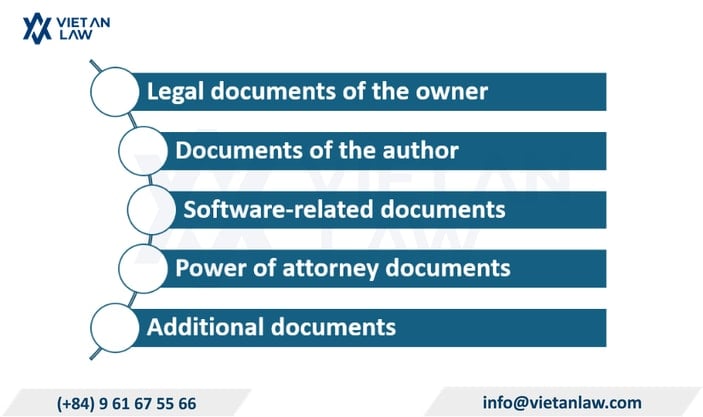
| Document type | Required documents to be prepared |
| Legal documents of the owner | Enterprise Registration Certificate, Citizen Identity Card/Passport if the owner is an individual, contact information of the owner. |
| Documents of the author | Author information, Citizen Identity Card/Passport, software creation commitment statement, written consent of co-authors (if any). |
| Software-related documents | Software name, completion time, main functions, programming language, printout of the source code, printout of the user interface, and software descriptive documentation. |
| Power of attorney documents | Power of Attorney for the representative organization to perform software copyright registration procedures. |
| Additional / Arising documents | Software outsourcing contract, task assignment decision, rights transfer agreement, open-source code documentation, or priority documents (if any). |
According to the Law on Intellectual Property, a copyright application includes a declaration form, a copy of the work, a power of attorney if submitted through an authorized representative, documents proving the right to file the application, and written consent from co-authors or co-owners, if any.
Pre-filing software copyright registration dossier checklist
| Items to check | Purpose |
| The software name must be consistent throughout the entire dossier | Avoid discrepancies between the application form, source code, user interface, and descriptive documentation. |
| Authors and owners must be clearly identified | Minimize disputes between the company, employees, freelancers, or outsourcing parties. |
| Source code and user interface must accurately represent the registered software | Help clearly define the subject matter protected under copyright. |
| Comprehensive and sufficient documents proving ownership rights | Required when the software is outsourced, transferred, or co-developed. |
| Components of open-source code, AI, or third-party elements must be clarified | Reduce risks regarding source code usage rights and the originality of the software. |
| Power of attorney, commitment statements, and consent of co-authors/owners (if any) | Ensure a valid dossier and minimize requests for amendments or supplements. |
Software copyright registration in specific cases according to new regulations
When registering copyright for computer software, owners need to prepare not only the source code, software interface, and technical documentation, but also clarify the softwar’s origin, copyright owner, open-source components, or whether the software uses AI tools. These are important requirements under the new regulations of the amended Law on Intellectual Property 2025 and Decree 134/2026/ND-CP.
How to submit software source code and interface during copyright registration
For software copyright registration applications, the owner needs to prepare documents showing that the software has been created and defined in a specific form. Typically, the application should include:
- Printed source code: Showing the main parts of the program, processing structure, important functions, or code representing the software being registered.
- Printed software interface: Showing the main screen, software name, main functions, basic usage flow, and identifying characteristics of the software.
- Software description document: Stating the software name, intended use, functions, programming language, operating procedures, and information about the author and owner.
- Note on technical secrets: The owner is not required to disclose all source code secrets if a suitable presentation method is available, but the submitted documents must still be sufficient to identify the subject of copyright registration.
Software developed by employees, freelancers, or companies on a hire
For software developed by multiple parties, correctly identifying the author and copyright owner is crucial before filing a software copyright registration application.
- Software created by employees: If an employee programs on a company assignment, the company is usually the owner of the intellectual property rights and publishing rights to the software, unless the employment contract or internal agreement stipulates otherwise.
- Software developed by freelancers: The client should only be named as the owner if the service contract clearly includes a clause regarding the transfer of copyright, intellectual property rights, or ownership of the software.
- Software developed by outsourcing companies: It is necessary to review the software outsourcing contract, acceptance report, source code handover clauses, technical documentation, and intellectual property rights.
- Documents to prepare: Employment contract, job assignment decision, service contract, subcontracting contract, acceptance report, commitment to transfer rights, and documents proving the software development process.
Open-source software
Software using open-source code can still be considered for copyright registration for the parts directly created by the author or business. However, the owner needs to clarify the scope of use of the open-source code to avoid disputes over software exploitation rights.
- Identify open-source components: It is necessary to distinguish between open-source code and code developed by the business itself.
- Check open-source licenses: It is necessary to review the conditions of use, modification, distribution, commercialization, and disclosure obligations, if any.
- Only register the original creative part: The application should focus on clarifying the source code, structure, interface, technical documentation, or functionality created by the owner.
- Limit legal risks: Clearly explaining the open-source components helps avoid misunderstandings that the copyright registration is for parts not owned by the owner.
Software development using AI
According to the new regulations, software that uses AI tools in its development process must clearly demonstrate the human creative role. AI can be a supporting tool, but the owner should prove that humans made a significant and decisive contribution to the software’s creation.
- Clarify the human-created aspects: This includes design ideas, software architecture, technical documentation, algorithm selection, source code editing, testing, and final outcome decisions.
- Clarify the AI support aspects: Describe how AI was used for code suggestions, interface prototyping, test support, content optimization, or technical documentation support.
- Prepare documentation demonstrating the development process: This may include requirements descriptions, revision history, design documents, work assignments, development logs, acceptance reports, and the completed source code.
- Avoid registering content that is entirely AI-generated: Without proving human creative input and control, such content may be at risk when establishing and protecting copyright.
Can websites, apps, and SaaS platforms register software copyrights?
| Digital product | Can it be registered for software copyright? | Notes |
|---|---|---|
| Mobile application | Registration is possible if there is source code, a user interface, and descriptive documentation. | The app name, functions, and author/owner should be clearly clarified. |
| Website | Registration is possible for the computer program part if the website has source code and software functions. | The website name/logo should be considered for separate trademark registration. |
| SaaS software | Registration is possible for the source code, user interface, and technical documentation. | Ownership rights, operating platforms, and third-party components must be clearly clarified. |
| Plugin/module | Registration is possible if it is independent software or a component with its own creativity. | The scope of the registered functions should be described. |
| AI platform/AI-powered software | Registration can be considered for the part created and controlled by humans. | The role of AI and the imprint of human creativity must be clearly explained. |
Procedures for registering computer software copyright at the Copyright Office
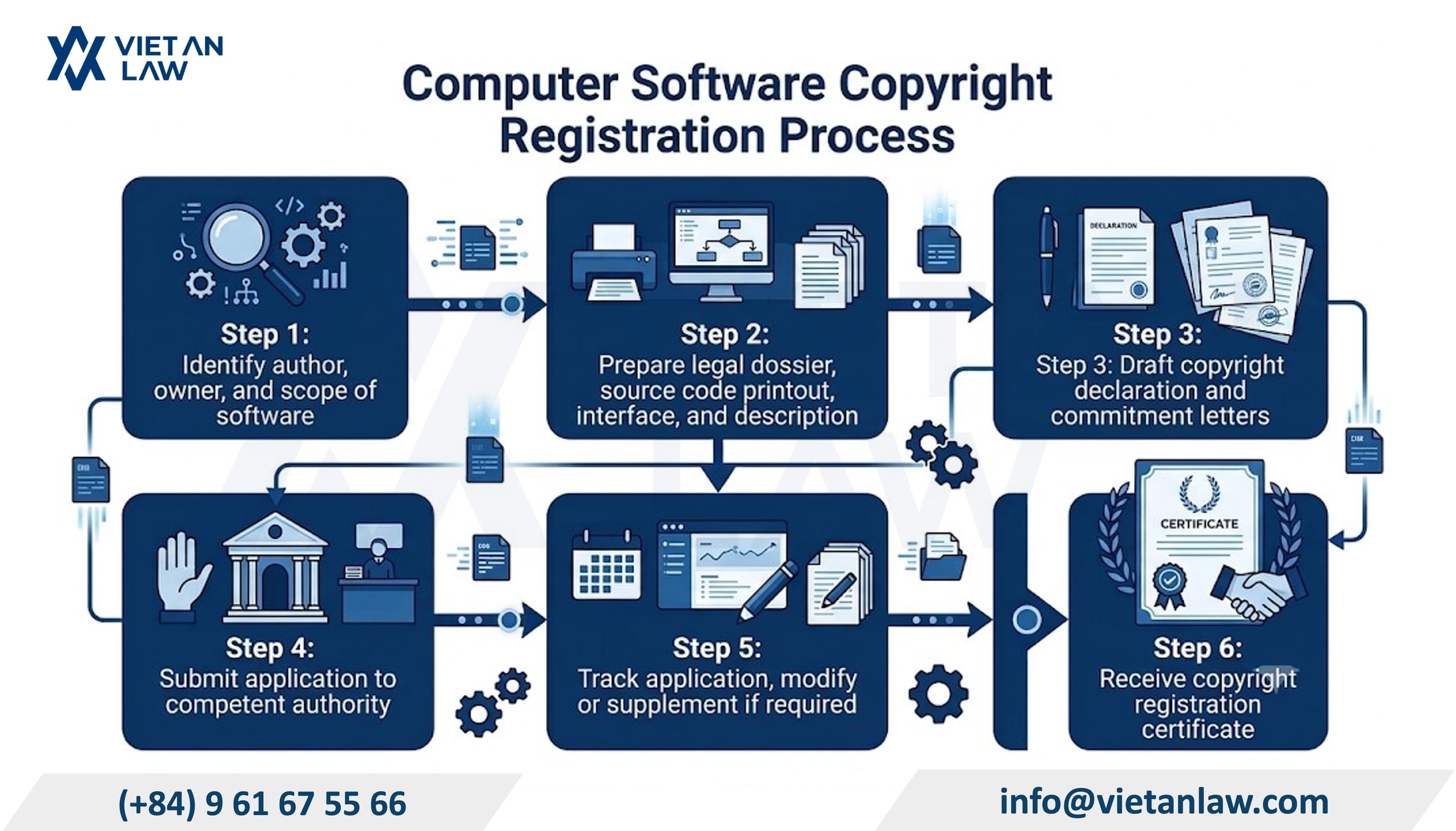
| Step | Implementation content |
| Step 1 | Identify the authors, owners, and scope of the computer software requiring copyright registration. |
| Step 2 | Prepare legal documents, printouts of the source code, user interface, and software descriptive documentation. |
| Step 3 | Draft the copyright registration application form and commitment statements, power of attorney, or consent documents (if any). |
| Step 4 | Submit the software copyright registration dossier to the competent authority. |
| Step 5 | Monitor the dossier status, amend or supplement documents if requested. |
| Step 6 | Receive the software copyright certificate for the software if the dossier is valid. |
The agency that receives software copyright registration applications
The agency receiving software copyright registration applications is the Copyright Office under the Ministry of Culture, Sports and Tourism, or other designated agencies and locations. Owners can submit applications directly, by mail, or through authorized representatives. Submitting through a consulting firm allows for pre-review of the application, minimizing errors regarding authorship, ownership, source code, interface, and technical documentation.
Timeframe for issuing Software copyright registration certificate
According to the new regulations in Decree 134/2026/ND-CP and the Intellectual Property Law, the processing time for computer software copyright registration applications is as follows:
- Application review time: The competent authority reviews, classifies, and considers the validity of the copyright registration application within 22 working days from the date of receipt.
- Certificate issuance time: Within 15 working days from the date of receipt of a valid application, the state management agency for copyright and related rights is responsible for issuing the software copyright registration certificate.
- Refusal to issue a certificate: If the application does not meet the requirements for issuing a software copyright registration certificate, the competent authority must notify the applicant in writing.
- Method of receiving results: The copyright registration certificate may be issued in electronic form. Paper copies are issued upon request from organizations or individuals. Electronic certificates have the same legal validity as paper copies.
- In cases of extended processing time: In practice, the time taken to issue a software copyright registration certificate can be extended if the application requires amendments, additions, clarification of ownership, source code, software interface, technical documentation, or if there are disputes, complaints, or accusations related to software copyright.
Therefore, to shorten the software copyright registration time, owners should prepare complete application forms, source code, software interface, documents proving ownership, and power of attorney before submitting the application.
How to handle a software copyright registration dossier if amendments or supplements are requested?
| Scenario | Handling direction |
|---|---|
| Missing author/owner information | Supplement legal documents, commitment statements, agreements, or documents proving the right to file the application. |
| Unclear source code/user interface | Supplement printouts of the source code, user interface, or software function descriptive documentation. |
| Elements involving employees, freelancers, or outsourcing parties | Supplement contracts, acceptance minutes, task assignment decisions, or rights transfer commitments. |
| Elements involving open-source code or AI | Explain the part created by the owner and the part utilizing third-party, AI, or open-source code. |
| Inconsistent information within the dossier | Adjust the software name, completion time, author information, or owner information to ensure consistency. |
Comparing software copyright registration with patent registration and trademark registration
| Criteria | Software copyright | Patent registration | Trademark registration |
| Subject matter of protection | Source code, object code, user interface, software descriptive documentation | Technical solutions featuring novelty, inventive step, and industrial applicability | Signs used to distinguish goods or services |
| Protection mechanism | Copyright | Industrial property rights | Industrial property rights |
| Main purpose | Prove ownership rights over the created software | Protect technical/technological solutions | Protect trade names, logos, and brands |
| Timing of rights generation | From the moment the software is created and expressed | According to the protection title if conditions are met | According to the protection title if conditions are met |
| When to use | When needing to protect source code, software products, mobile applications, websites, or systems | When the software is integrated with a new technical solution | When needing to protect the app name, logo, or software brand |
Copyright protection period for software
According to the current Law on Intellectual Property, as amended in 2025, the copyright protection period for software is determined according to each group of rights:
- Moral rights: The right to name the software, to be the author, and to protect the integrity of the software is protected indefinitely.
- Right to publish the software: Protected for the duration of the property rights to the software.
- Property rights to the software: Protected for the author’s lifetime and 50 years after the author’s death.
- Software with co-authors: The protection period ends 50 years after the death of the last remaining co-author.
- End date of protection: The protection period ends at 24:00 on December 31st of the year the protection period ends.
Determining the correct duration of copyright protection for software helps authors and owners understand the scope of their rights when registering software copyrights, commercially exploiting, transferring, or resolving disputes.
Common errors encountered when registering software licenses in 2026
| Common mistakes | Arising risks |
| Failure to clearly identify authors and owners | High risk of disputes between the company, employees, freelancers, or outsourcing partners. |
| Lack of rights transfer agreements | Difficult to prove that the business is the lawful owner of the software. |
| Inconsistent information within the dossier | Mismatches in the software name, author name, owner name, or completion time. |
| Inappropriate submission of source code or user interface | The dossier may be subject to requests for amendments, supplements, or explanations. |
| Failure to clarify open-source code components | Risk of violating open-source licenses or commercial exploitation rights disputes. |
| Failure to retain development process evidence | Difficult to prove that the software was created prior to the occurrence of a dispute. |
| Confusing software copyright with trademark registration | Only the source code/user interface is protected, while the trade name or software logo remains unprotected. |
Frequently asked questions about computer software copyright registration
Is computer software protected by copyright?
Yes. Computer software, or computer programs, is one of the types of works protected by copyright under the Intellectual Property Law. Computer programs are protected like literary works, whether expressed in source code or machine code.
Who has the right to register software copyright?
The author who directly created the software or the copyright owner of the software has the right to register the software copyright. The owner can be an individual, a company, an organization that commissioned employees to create the software, or a contractor who hired programmers under contract, unless otherwise agreed upon by the parties.
Is software copyright registration mandatory?
No, it is not mandatory. Copyright in software arises from the moment the software is created and expressed in a certain form. However, software copyright registration provides authors and owners with clear legal evidence when exploiting, transferring, or in case of disputes.
Can unpublished software be copyrighted?
Yes. Unpublished software can still be copyrighted if it has been created and expressed in a recognizable form. When submitting the application, the owner needs to provide information about the completion date and publication status of the software.
Can a company be the owner of software written by employees or freelancers?
Yes, if the software was created as part of a company assignment or under a contract that includes an agreement to transfer ownership to the company. Businesses should prepare employment contracts, work assignment decisions, software development contracts, or acceptance reports to prove ownership.
Is it necessary to submit the entire software source code when registering copyright?
Software copyright registration applications usually require printed copies of the source code and the software interface. If the software contains confidential technical information, the owner should prepare appropriate documentation to meet the application requirements while minimizing the disclosure of important information.
Does software copyright registration protect the software name?
Software copyright registration primarily protects the visual representation of the computer program, such as source code, machine code, interface, and related documentation. If a business wants to protect the software name, logo, or identifying symbol, it should consider registering a trademark.
What makes Viet An Law’s software copyright registration service different?
Viet An Law Firm provides in-depth computer software copyright registration services, not only assisting with application submission but also reviewing ownership rights, technical documentation, and legal risks before registration.
| Key differentiators of Viet An Law | Value to customers |
| Advise on the correct software owner | Minimize disputes between the company, employees, freelancers, or software outsourcing parties. |
| Review source code and software user interface | Help ensure the software copyright registration dossier is appropriate and clearly defines the subject matter of protection. |
| Advise on software involving open-source code, AI, or third-party participation | Reduce risks regarding copyright, source code usage rights, and intellectual property ownership. |
| Draft dossiers on a case-by-case basis | Suitable for software independently developed by individuals, assigned by companies, or outsourced for programming. |
| Represent clients in working with the Copyright Office of Vietnam | Customers save time during the process of filing, monitoring, and receiving dossier results. |
| Support after being granted the Certificate | Advise on commercial exploitation, transfer, licensing, and handling of software copyright infringements. |
Viet An Law’s commitment when providing software copyright registration services
When providing software copyright registration services, Viet An Law commits to accompanying individuals and businesses throughout the entire process of copyright protection for computer software:
• Honest advice on the possibility of registering software copyright, evaluating documents, owners, authors and software objects before implementation.
• Review source code, interfaces and technical documents, ensure documents accurately represent registered software and limit errors when submitted.
• Secure software information, source code and technical data of customers throughout the consulting and procedure implementation process.
• Prepare, submit and track software copyright registration dossiers, update processing progress and support modifications and additions when required.
• Hand over the Copyright Registration Certificate and provide post-registration advice on exploitation, transfer, licensing and protection of software when disputes arise.
With experience in the field of intellectual property, Viet An Law supports customers in registering software copyright registration, protecting source code, interfaces, digital products and legal rights of software owners.