


Corporate governance extends beyond internal organization and management; it is a critical legal framework that dictates decision-making authority, the processes for passing resolutions, corporate representation, and liability in cases of violations or disputes. Through corporate governance legal advisory in Vietnam, businesses can avoid the pitfalls of an unsuitable governance structure—such as invalid resolutions, ultra vires transactions, shareholder/member disputes, and legal exposure for corporate managers.
Legal framework relating to corporate governance in Vietnam
The Law on Enterprises 2020 and its amending and supplementing documents; regulations on enterprise registration and beneficial owners under Decree 168/2025/ND-CP, as amended and supplemented by Decree 296/2026/ND-CP.
What is corporate governance from a legal perspective in Vietnam?
From a legal perspective, corporate governance constitutes a system of legal regulations that establishes and strictly governs the relationships among:
- Owners, members, and shareholders;
- The Board of Members or the Board of Directors;
- The Company President, the Chairperson of the Board of Members, or the Chairperson of the Board of Directors;
- The Director/General Director;
- The legal representative;
- Beneficial owners of the enterprise;
- The Supervisory Board, the Audit Committee, and other governance bodies;
- Interested parties (stakeholders).
The objective of corporate governance is not merely to ensure the enterprise has the requisite statutory positions filled; more importantly, it aims to clearly delineate the powers, responsibilities, decision-making processes, and control mechanisms among the various corporate entities. This serves to minimize legal risks, provide a basis for resolving internal disputes, and protect the legitimate rights and interests of shareholders or capital-contributing members.
Key legal aspects of corporate governance in Vietnam
Organizational and management structure suited to the type of enterprise
Each type of business entity has a distinct governance structure and decision-making mechanism. Therefore, it is essential to design a suitable governance system right from the time of incorporation or whenever there are changes regarding shareholders, investors, or the scale of operations.
- For a single-member limited liability company, the governance focus lies in the relationship between the owner and the management team, as well as the scope of authority delegated to the Company President, the Members’ Council, the Director/General Director, and the legal representative.
- For a limited liability company with two or more members, particular attention must be paid to capital contribution ratios, voting rights, the authority of the Members’ Council, meeting quorum requirements, and the thresholds for passing important resolutions.
- For a joint-stock company, the governance system is more complex due to the division of power among the General Meeting of Shareholders, the Board of Directors, the Director/General Director, and internal oversight mechanisms.
Corporate charter standardization needs to accurately reflect the ownership structure and control mechanisms desired by investors, rather than simply relying on a standard template.
Delineating authority and responsibility within the enterprise
A common legal issue in corporate governance is the failure to clearly define which level of authority has the power to approve a transaction.
Depending on the business entity type, the company charter, and the nature of the transaction, decision-making authority may rest with:
- The company owner;
- The Members’ Council;
- The General Meeting of Shareholders;
- The Board of Directors;
- The Company Chairman;
- The Director/General Director;
- The legal representative; or
- An authorized person.
Enterprises should clearly stipulate the delegation mechanism in their charter and internal regulations. They may establish a Delegation of Authority (DOA) matrix to specifically define authorized personnel, approval limits, and decision-making scopes regarding contracts, investments, borrowing, asset procurement, senior personnel appointments, banking transactions, and other critical matters.
Clear delegation of authority helps prevent the signing of contracts beyond one’s authority and avoids internal disputes concerning the validity of decisions.
Legal representatives and the machanism for controlling presentation rights
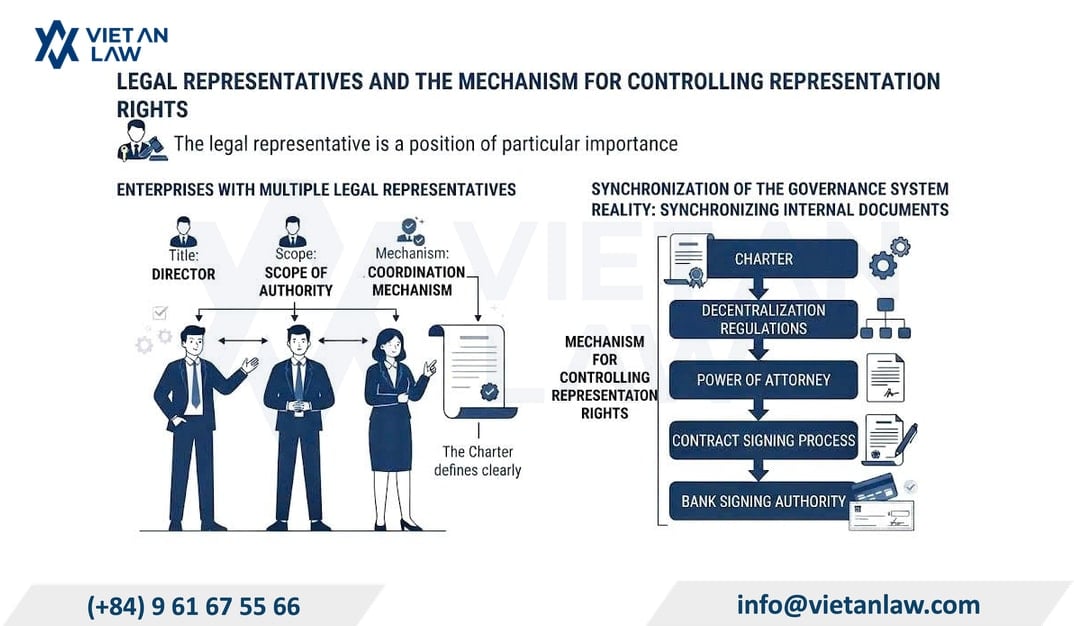
The legal representative holds a critically important position, as they represent the enterprise in exercising rights and fulfilling obligations arising from transactions, while also representing the entity before state agencies, arbitration bodies, and courts within the scope prescribed by law.
For enterprises with multiple legal representatives, the company charter must clearly define the specific titles, scope of authority, and coordination mechanisms for each individual.
In practice, enterprises should ensure alignment across the following:
Charter → Delegation of Authority policy → Powers of Attorney → Contract signing procedures → Banking signing authority
Inconsistencies among these documents can expose the enterprise to risks regarding signing authority and the liability of management personnel.
Develop and standardize the processes for conducting meetings and issuing resolutions and decisions
Many corporate disputes arise not from the substance of a decision itself, but from a flawed decision-making process.
Enterprises need to manage aspects such as:
- Authority to convene meetings;
- Meeting notices and agendas;
- Quorum requirements;
- Voting thresholds;
- Voting rights of members/shareholders;
- Circumstances requiring the exclusion of voting rights;
- Meeting minutes;
- Content and form of resolutions;
- Effective date of resolutions;
- Retention of corporate governance records.
For high-value transactions, transactions with related parties, changes to capital structure, or matters significantly affecting shareholder interests, verifying the requisite authority prior to adopting a decision is particularly crucial.
Managing relationships with shareholders and investors
For companies with multiple investors—particularly FDI enterprises or joint ventures—the Law on Enterprises establishes only a basic legal framework. Relationships among investors often require more detailed regulation through:
- The company charter;
- Regulations of the Board of Directors or Board of Members;
- Shareholders’ Agreements;
- Joint Venture Agreements;
- Internal regulations on decentralization and approval authority.
The parties may need to reach prior agreement on matters such as the right to nominate management personnel, veto rights, issues requiring special approval, rights of first refusal, transfer restrictions, anti-dilution provisions, governance deadlock resolution mechanisms, and exit strategies.
Agreements among shareholders or investors must be drafted to ensure consistency with the Company Charter and applicable laws, thereby minimizing conflicts between contractual arrangements and the enterprise’s formal governance mechanisms.
Control of transactions with related parties and conflicts of interest
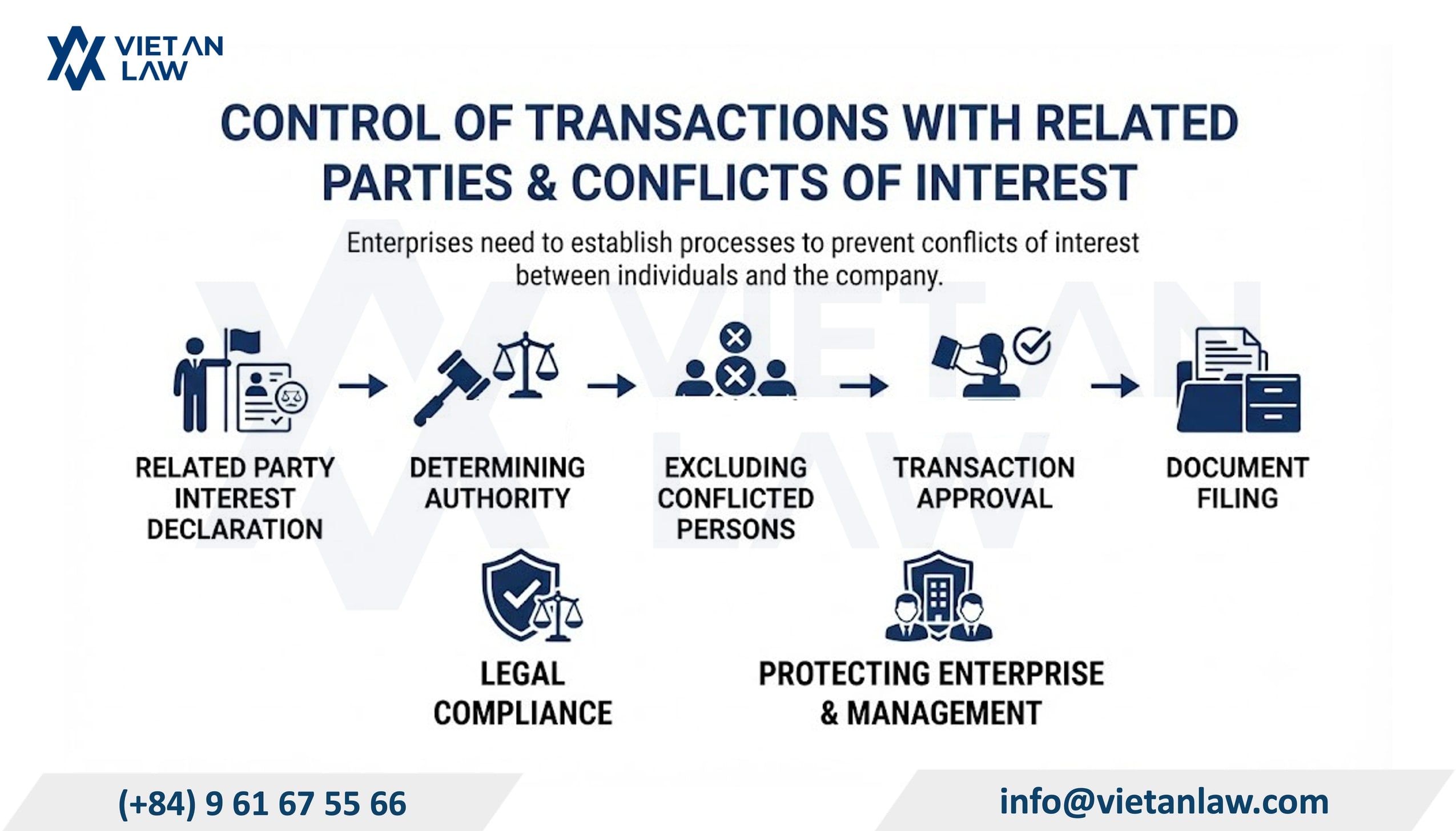
Transactions between an enterprise and its members, shareholders, managers, or related parties can give rise to conflicts between the enterprise’s interests and personal interests.
Therefore, the governance system needs to establish a process comprising:
Declaring related interests → Determining approval authority → Excluding individuals with conflicts of interest where necessary → Approving the transaction → Maintaining records.
Controlling transactions with related parties is significant not only for legal compliance but also for protecting managers and the enterprise should such transactions be scrutinized later by shareholders or competent authorities.
Management of beneficial owners’ information
Law No. 76/2025/QH15, amending the Law on Enterprise, has introduced provisions regarding the beneficial ownership of companies, thereby imposing an additional layer of information transparency obligations in corporate governance effective July 1, 2025.
Consequently, enterprises must pay attention to identifying, updating, and managing information regarding their actual ownership structure, going beyond the lists of members or shareholders reflected in official corporate records.
For groups with multi-tiered ownership, FDI enterprises, or investment structures involving intermediary legal entities, the review of beneficial owners should be conducted concurrently with the review of corporate governance structures.
Which companies need corporate consultancy on governance in Vietnam?
Corporate legal advice on governance is not only necessary for large companies or enterprises with many shareholders, but also highlights the importance of having an in-house lawyer for enterprises.
- For single-member limited liability companies owned by an individual, establishing a clear governance mechanism remains essential to distinguish the owner’s legal status from the company’s independent legal status.
- For single-member limited liability companies owned by an organization, governance requirements are even more critical due to the need to clearly define the relationships, authority, and responsibilities among the owner, authorized representative, Company President or Board of Members, Director/General Director, and legal representative.
- For multiple-member limited liability companies, joint-stock companies, joint ventures, and enterprises with multiple investors, establishing a legal governance system is particularly essential. Charters, internal regulations, and decentralization mechanisms must specifically stipulate voting rights, nomination rights, veto rights, approval authority, the responsibilities of each party, and control mechanisms for significant transactions.
A well-designed governance system not only helps enterprises prevent conflicts of rights and interests but also establishes mechanisms to handle disagreements, governance deadlocks, conflicts between members or shareholders, and disputes regarding the management and operation of the enterprise.
Recommended internal corporate governance documents in Vietnam
Depending on the scale and type of business, the governance system may include:
- Corporate charter;
- Regulations on the operation of the Members’ Council/Board of Directors;
- Regulations on the operation of the Director/General Director;
- Financial regulations;
- Regulations on decentralization and authorization;
- Regulations on contract signing and management;
- Regulations on the management of seals and signatures;
- Regulations on the management of related-party transactions;
- Labor and human resources regulations;
- Procedures for investment and procurement approval;
- Regulations on the management of records, documents, and internal information.
Enterprises do not necessarily need to establish an overly complex regulatory system. The key is for these documents to align with the actual organizational structure, remain consistent with the corporate charter, and be applicable to daily operations.
When should enterprises review their corporate governance system in Vietnam?
A legal review of corporate governance is particularly essential when a business:
- Welcomes new investors or shareholders;
- Undergoes M&A activities;
- Increases or decreases capital;
- Converting business types in Vietnam;
- Changes its legal representative;
- Has multiple legal representatives;
- Establishes a subsidiary;
- Faces shareholder disputes;
- Prepares for fundraising;
- Prepares to sell the business;
- Undergoes restructuring;
- Discovers decisions or transactions executed without proper authority.
In such cases, the business should simultaneously review its charter, business registration documents, capital structure, resolutions, decisions, powers of attorney, and internal regulatory system.
Viet An Law Firm’s corporate governance legal advisory services in Vietnam
Viet An Law provides corporate consultancy services regarding corporate governance in Vietnam for domestic enterprises, FDI enterprises, and foreign investors, including:
- Advising on the establishment and restructuring of corporate governance models;
- Reviewing, amending, and standardizing corporate charters;
- Developing regulations on the delegation of authority among owners, shareholders, and managers;
- Drafting regulations for the Board of Members or Board of Directors;
- Advising on the rights and obligations of legal representatives;
- Advising on procedures for meetings, voting, and the issuance of resolutions;
- Reviewing the legal validity of corporate resolutions and decisions;
- Advising on transactions with related parties and conflicts of interest;
- Advising on the rights of members and shareholders;
- Developing internal governance regulations;
- Reviewing governance systems during M&A or restructuring processes;
- Advising on the resolution of disagreements and disputes related to corporate governance.
An effective governance system must ensure two parallel factors: the ability of the enterprise to make decisions swiftly, and the assurance that such decisions are issued by the competent authority, follow the proper procedures, and are legally defensible.
Leveraging its experience in corporate and investment advisory in Vietnam, Viet An Law assists clients in establishing governance structures tailored to the specific ownership model, business operations, and development strategy of each enterprise.
Author: Lawyer Dao My Dung
Reviewer: Dr. Lawyer Do Thi Thu Ha
Hotline/ Zalo/ Whatsapp: (+84) 961 675 566
Email: info@vietanlaw.com
Hanoi Office: 3rd Floor, Hoang Ngan Plaza Building, No. 125 Hoang Ngan,
Yen Hoa Ward, Hanoi City.
Ho Chi Minh City Office: Unit 04.68, 4th Floor, Lobby A, RiverGate Residence Building, 151-155 Ben Van Don, Khanh Hoi Ward, Ho Chi Minh City.