


How to identify the beneficial owner of a company in Vietnam stands as one of the most significant amendments issued on July 23, 2026, modifying various business registration regulations previously established in Decree 168/2025/ND-CP. Compared to prior rules, this new framework significantly changes how to identify beneficial owner details and declare a company beneficial owner, shifting towards international information transparency standards and stronger compliance with anti-money laundering laws. Below, Viet An Law provides a comprehensive update on how companies can identify UBO in Vietnam according to the newly implemented decree.
Comparison of regulations on identifying the beneficial owner of an Vietnamese enterprise under Decree 296/2026/ND-CP and Decree 168/2025/ND-CP
| Content | Decree 168/2025/ND-CP | Decree 296/2026/ND-CP |
| Concept | No specific provision, only stipulates that the beneficial owner of an enterprise with legal entity status is an individual meeting one of the criteria. | Provides a specific concept, clarifying: (i) An enterprise may have multiple beneficial owners simultaneously; (ii) Adds the individual with ultimate actual control over that enterprise. |
| Ownership criteria (criterion 1) | Ownership from 25%. | Individual directly or indirectly owning 25% or more of the charter capital or 25% or more of the total voting shares of the enterprise. Adds the case of combined direct and indirect ownership. |
| Group of individuals with family or contractual relationships | No provision. | A group of individuals with a family relationship or contract jointly holding direct, indirect, or both direct and indirect ownership of 25% or more of the charter capital or 25% or more of the total voting shares of the enterprise. |
| General partners of a partnership | No provision. | All general partners are the beneficial owners of the enterprise. |
| Actual controlling power criteria (criterion 2) | Applies independently from clause 1. | In case the individual does not meet criterion 1, or there are grounds indicating the individual determined under criterion 1 is not the beneficial owner, the enterprise determines the beneficial owner through other methods prescribed by law or in reality. Adds cases of control: Deciding financial, investment, and operational policies of the enterprise; reorganizing or dissolving the enterprise. |
| Enterprise manager with highest authority (criterion 3) | No provision. | If no individual meets criteria 1 and 2, the enterprise designates one individual who is the enterprise manager with the highest authority to act on behalf of the enterprise as the beneficial owner. |
The beneficial owner may be the ultimate actual controlling individual over the enterprise in Vietnam
Article 3 of Decree 296/2026/ND-CP amending and supplementing Article 17 of Decree 168/2025/ND-CP stipulates that:
“The beneficial owner of an enterprise with legal entity status is one or more individuals who directly or indirectly hold ultimate actual ownership or control over that enterprise, excluding individuals representing state capital in the enterprise.”
Thus, compared to Decree 168/2025/ND-CP, Decree 296/2026/ND-CP identifies and clarifies that the beneficial owner of an enterprise can be one or more individuals, rather than focusing solely on a single subject. This means an enterprise may concurrently have multiple beneficial owners if several individuals jointly meet the legal criteria.
Notably, Decree 296/2026/ND-CP not only determines the beneficial owner based on direct or indirect ownership rights over the enterprise but also adds the criterion of ultimate actual control. Accordingly, an individual who does not formally hold contributed capital or shares in their name, but through agreements, controlling relationships, or other dominating mechanisms still possesses the final decision-making power over the enterprise’s operations, can still be identified as a beneficial owner.
- The important amendment point reflects a shift from an approach based purely on legal ownership to an approach based on actual control, aligning with FATF Recommendations on beneficial ownership transparency. This provision helps limit the concealment of true owners through using nominees to contribute capital or hold shares, or establishing multi-layered ownership structures designed to hide the ultimate controlling individual.
- This ensures consistency with Article 2 of Resolution 66.23/2026/NQ-CP on anti-money laundering amending and supplementing Clause 7, Article 3 of the 2022 Anti-Money Laundering Law as follows, stating that a beneficial owner is one or more individuals who directly or indirectly hold ultimate actual ownership or control over a customer, including legal arrangements, or the individual on whose behalf a customer conducts a transaction.
It can be seen that the concept of a beneficial owner in business registration law contributes to improving the efficiency of identifying the true controlling subjects of an enterprise; preventing and combating money laundering, tax evasion, and terrorism financing; and meeting international standards for information transparency.
New method to determine beneficial ownership in Vietnam under Decree 296/2026/ND-CP
Article 3 of Decree 296/2026/ND-CP amending and supplementing Article 17 of Decree 168/2025/ND-CP regulates the method to determine the beneficial owner of an enterprise as one or more individuals as follows:
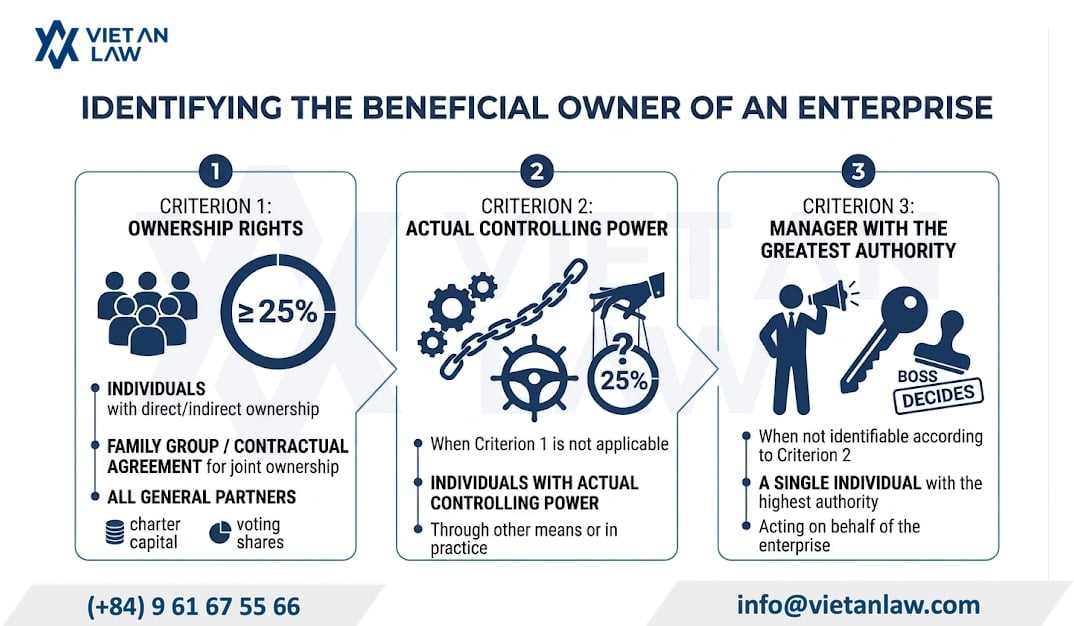
Ownership criteria (Criterion 1)
Individuals directly or indirectly owning 25% or more of the capital in the enterprise.
An individual directly or indirectly, or both directly and indirectly, owning 25% or more of the charter capital or 25% or more of the total voting shares of the enterprise is identified as the beneficial owner of the enterprise.
- Compared to previous regulations, Decree 296/2026/ND-CP has added the case of combining direct ownership and indirect ownership to determine the ownership percentage of an individual.
- Accordingly, the direct ownership percentage and indirect ownership percentage of the same individual are aggregated to consider the 25% threshold, thereby limiting the dispersion of ownership percentages to avoid identifying the beneficial owner.
- Simultaneously, the decree also clearly defines the concept of indirect ownership for the first time, whereby an individual is considered to have indirect ownership when owning 25% or more of the charter capital or 25% or more of the total voting shares of the enterprise through an organization or through other legal arrangements.
- This provision is added to ensure consistency with Resolution 66.23/2026/NQ-CP and Clause 2, Article 7 of Decree 19/2023/ND-CP detailing a number of articles of the Anti-Money Laundering Law (as amended and supplemented by Resolution 66.23/2026/NQ-CP), while also approaching international standards on identifying beneficial owners.
Groups of individuals with family or contractual relationships jointly owning 25% or more of the capital in the enterprise
- Decree 296/2026/ND-CP also adds the case of identifying the beneficial owner for a group of individuals who have family relationships or have an agreement to jointly own the enterprise.
- Accordingly, in cases where a group of individuals with family or contractual relationships jointly holds direct, indirect, or both direct and indirect ownership of 25% or more of the charter capital or 25% or more of the total voting shares of the enterprise, the enterprise must identify all individuals in this group as beneficial owners.
This is an entirely new provision aimed at preventing the situation where multiple related individuals intentionally split their individual ownership percentages below the 25% threshold to evade the declaration obligation, while accurately reflecting the nature of enterprise control through the association between individuals.
General partners of a partnership
- Under the provisions of the Vietnamese Enterprise Law, a partnership includes general partners and may include capital-contributing partners. A general partner is an individual who bears unlimited liability for the company’s obligations, and simultaneously has the right to manage, operate, and conduct business operations on behalf of the company.
- Decree 296/2026/ND-CP stipulates that all general partners are identified as beneficial owners of the partnership, regardless of their capital contribution ratio or voting rights ratio in the enterprise.
This newly added provision accurately reflects the specific characteristics of the partnership model where actual control belongs to the general partners.
Actual controlling power criteria (Criterion 2)
In cases where an individual does not meet criterion 1 regarding the ownership percentage, or there are grounds indicating that the individual identified under the above criterion is not the true beneficial owner of the enterprise, the enterprise determines the beneficial owner through other methods according to the law or in reality. Control is exercised through one or more of the following rights:
- The right to appoint, dismiss, or remove a majority or all members or the chairperson of the board of directors, a majority or all members or the chairperson of the members’ council, the Director, or the General Director;
- Amending and supplementing the charter of the enterprise;
- Changing the organizational structure;
- Deciding the financial, investment, and operational policies of the enterprise;
- Reorganizing or dissolving the enterprise.
This new provision clearly demonstrates the principle of identifying the beneficial owner based on ultimate actual control power, helping accurately identify the individual who genuinely can dominate the operations and critical decisions of the enterprise.
Enterprise manager with the greatest authority (Criterion 3)
In cases where, after applying criterion 1 and criterion 2 mentioned above, the beneficial owner still cannot be identified, Decree 296/2026/ND-CP mandates that the enterprise must identify one individual who is the enterprise manager with the highest authority to act on behalf of the enterprise as the beneficial owner, excluding individuals representing the state capital portion in the enterprise.
This provision creates a fallback mechanism to ensure that all enterprises can identify UBO in Vietnam and declare their beneficial owner, avoiding legal loopholes in providing information while aligning with international practices and anti-money laundering laws.
Order of declaring information of the company beneficial owner in Vietnam
Article 4 of Decree 296/2026/ND-CP amending and supplementing Article 18 of Decree 168/2025/ND-CP stipulates that enterprise founders and enterprises are responsible for determining the beneficial ownership of the enterprise and declaring and notifying the business registration authority of the enterprise’s beneficial owner information. The order of declaring information is implemented as follows:
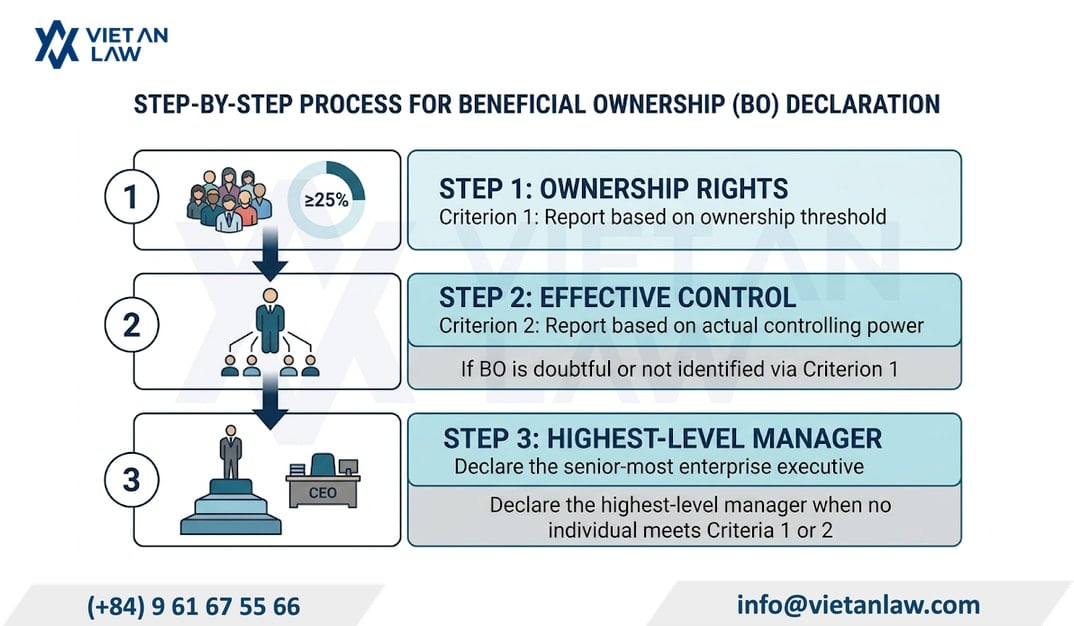
Declaration based on ownership criteria
Declare the information of individuals meeting the ownership criteria under criterion 1. This is the first criterion prioritized for application.
Declaration based on actual controlling power criteria
This applies when the beneficial owner cannot be determined under criterion 1 regarding ownership, or there are grounds showing that the identified individual is not the true beneficial owner. Accordingly, declare the information of one or more individuals meeting the actual controlling power criteria under criterion 2.
Declaration of the enterprise manager with the highest authority
This applies when no individual meets criterion 1 on ownership and criterion 2 on actual controlling power. Accordingly, declare the information of the enterprise manager with the highest authority under criterion 3.
Regulations on the sequence for determining and declaring information in order of priority provide enterprises with a clear basis to correctly identify the company beneficial owner, ensuring consistency with anti-money laundering laws.
Checklist of reviews when declaring an individual as a beneficial owner in an enterprise in Vietnam
Review the ownership structure of the enterprise
- Identify individuals directly owning 25% or more of the charter capital or voting shares.
- Identify the indirect ownership percentage through organizations or legal arrangements.
- Aggregate the direct and indirect ownership percentages of the same individual.
Review related groups of individuals
- Identify individuals with family relationships according to regulations.
- Examine agreements on joint ownership or joint exercise of ownership rights.
- Determine whether the total ownership percentage of the group reaches the 25% threshold.
Review actual controlling power over the enterprise
- The right to appoint or dismiss managers.
- The right to amend and supplement the charter.
- The right to decide the organizational structure.
- The right to decide financial, investment, and operational policies.
- The right to decide on the reorganization or dissolution of the enterprise.
Identify the enterprise manager with the highest authority
- Only applies when the beneficial owner cannot be determined under the ownership criteria and actual controlling power criteria.
- Does not apply to individuals representing state capital in the enterprise.
Execute the declaration in the correct order of priority
- Step 1: Declare according to ownership criteria.
- Step 2: Declare according to actual controlling power criteria.
- Step 3: Declare the enterprise manager with the highest authority.
Prepare supporting documents and records
- Records on the capital and share ownership structure.
- The enterprise charter.
- Contracts and agreements related to controlling rights.
- Decisions on appointing or dismissing managers.
- Other documents proving ownership rights or actual controlling power.
Several related questions
How to declare when an enterprise has multiple individuals jointly owning 25% or more of the capital?
In cases where two or more individuals jointly meet the criteria for identifying a beneficial owner, the enterprise must declare full information for all individuals who meet the conditions. Decree 296/2026/ND-CP determines that the beneficial owner can be one or more individuals, not limited to just one person.
How to identify the beneficial owner if no individual owns 25% or more of the charter capital?
When no individual meets the criteria regarding the ownership percentage, or there are grounds indicating that the person meeting this criterion is not the true beneficial owner, the enterprise must determine the beneficial owner based on the ultimate actual control criteria, such as the right to appoint or dismiss managers, decide financial and investment policies, amend the charter, or decide on the reorganization or dissolution of the enterprise. If it still cannot be determined, the enterprise shall follow the fallback mechanism stipulated in Decree 296/2026/ND-CP.
Is it required to notify changes to the beneficial owner information of the enterprise?
Yes. According to Article 52 of Decree 168/2025/ND-CP on business registration, within 10 days from the date of a change in the enterprise’s beneficial owner information or the ownership percentage declared to the provincial business registration authority, the enterprise shall notify the provincial business registration authority.
Is it required to retain the list of beneficial owners of the enterprise?
Yes, the enterprise must retain the list of beneficial owners of the enterprise that has been declared and notified to the provincial business registration authority in paper or electronic form.
The above are the notable contents on how to determine the beneficial owner of an enterprise in Vietnam under Decree 296/2026/ND-CP. If you need advice on how to determine beneficial ownership, declare, or update compliance information under the new regulations, please contact Viet An Law for timely and accurate support.