


On July 22, 2026, the Government promulgated decree 292/2026/ND-CP guiding the law on foreign trade management to replace Decree 69/2018/ND-CP. Taking effect on September 5, 2026, this decree on foreign trade aims to perfect the legal framework for foreign trade management regulations toward transparency, uniformity, and alignment with development requirements in the new period. For businesses engaged in international trade, securing corporate legal advisory is crucial as the decree focuses on reducing administrative procedures, increasing decentralization and delegation of power, removing obstacles for enterprises, and updating and standardizing the list of managed goods according to AHTN 2022.
Summary of notable new points in Decree 292 on foreign trade management in Vietnam replacing Decree 69/2018/ND-CP
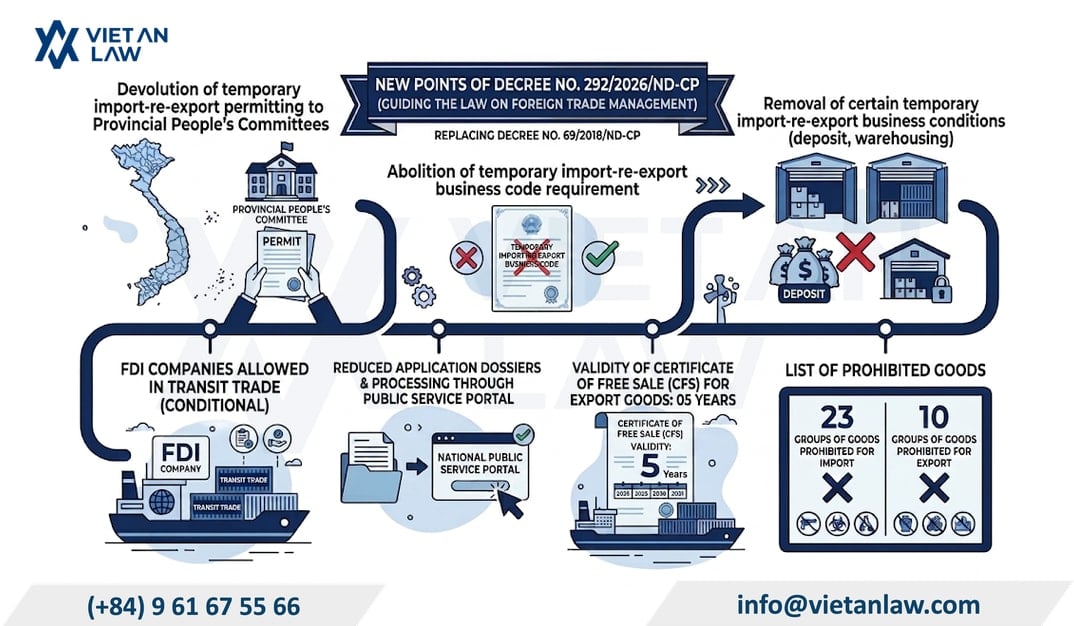
- Licensing authority related to temporary import for re-export is transferred to the provincial People’s Committee;
- Abolishing regulations on temporary import for re-export business codes;
- Abolishing certain business conditions for temporary import and re-export of goods, such as deposits and warehousing;
- Foreign direct investment companies are permitted to conduct merchanting trade business under certain conditions;
- Licensing dossiers are reduced and processed through the National Public Service Portal;
- The validity period of a certificate of free sale for exported goods is 05 years;
- The list includes 23 groups of goods prohibited from import and 10 groups of goods prohibited from export;
- Electronic cigarettes and heated tobacco products are prohibited from export and import;
- Prohibiting the import of goods produced by forced labor practices.
Licensing authority related to temporary import for re-export is transferred to the provincial People’s Committee in Vietnam
Previously, Decree 69/2018/ND-CP stipulated the authority of the Ministry of Industry and Trade in issuing the following types of licenses:
- Temporary import for re-export business license;
- Temporary import for re-export license;
- Temporary export for re-import license;
- Merchanting trade business license;
- Transit license for goods prohibited from export or import; goods temporarily suspended from export or import; and goods prohibited from business.
In practice, the authority to issue the aforementioned licenses was transferred from the Ministry of Industry and Trade to the provincial People’s Committee according to Decree 146/2025/ND-CP, Resolution 19/2026/NQ-CP, and Decree 66.18/2026/NQ-CP.
The regulations promulgated in this decree on foreign trade consolidate the above documents and specifically stipulate the authority of the provincial People’s Committee in issuing types of licenses related to import and export. This regulation aligns with the Government’s policy of decentralization and delegation of power aimed at shortening the distance between management agencies and enterprises.
Abolishing regulations on temporary import for re-export business codes in Vietnam
Previously, Decree 69/2018/ND-CP provided that Vietnamese merchants were permitted to conduct conditional temporary import for re-export business operations upon being granted a temporary import for re-export business code for goods by the Ministry of Industry and Trade. Enterprises granted a temporary import for re-export business code for a specific group of goods were allowed to conduct temporary import for re-export of items within the scope of that goods group. However, Decree 292/2026/ND-CP has abolished the regulation on temporary import for re-export business codes.
Decree 292 has abolished the mechanism of issuing temporary import for re-export business codes, reflecting a shift in management mindset from pre-inspection to post-inspection. Instead of requiring enterprises to be granted a type of sub-license before participating in business activities, the State shifts its focus to inspecting compliance during the operation process.
This regulation contributes to significantly reducing administrative procedures, especially for enterprises newly participating in temporary import and re-export activities. Concurrently, enterprises are no longer required to carry out procedures to apply for, adjust, or extend the codes as before.
Abolishing certain business conditions for temporary import and re-export of goods in Vietnam
Abolishing the deposit obligation when conducting temporary import and re-export of goods
Previously, Articles 23 to 25 of Decree 69/2018/ND-CP stipulated that the business of temporary import and re-export of frozen food goods, goods subject to special consumption tax, and used goods required a deposit ranging from 7 billion VND to 10 billion VND.
However, Decree 292/2026/ND-CP has abolished the deposit regulation when conducting temporary import and re-export of goods. The abolition of the deposit regulation will help release a significant amount of capital for enterprises to serve production, business, warehousing investment, logistics, or market expansion activities. This is considered a solution to improve the investment environment, contributing to enhancing the competitiveness of Vietnamese enterprises.
Abolishing warehousing conditions when conducting temporary import and re-export of goods
Previously, Article 23 of Decree 69/2018/ND-CP stipulated that the business of temporary import and re-export of frozen food goods had to meet warehousing conditions such as minimum capacity, power source, and ownership rights.
However, foreign trade management regulations have been updated by Decree 292/2026/ND-CP to abolish the warehousing condition when conducting temporary import and re-export of goods. This regulation aligns with the current outsourcing trend in the supply chain while contributing to reducing initial investment costs, particularly for small enterprises and startups in the import-export sector.
Nevertheless, enterprises must still ensure that the preservation of goods meets specialized regulations on food safety, quarantine, environment, or other technical requirements if specialized laws so stipulate.
FDI companies are permitted to conduct merchanting trade business in Vietnam under certain conditions from September 5, 2026
- Previously, Clause 2 Article 18 of the decree guiding the law on foreign trade management replacing Decree 69/2018/ND-CP stipulated that foreign-invested economic organizations were not permitted to carry out merchanting trade business activities for goods; this activity was exclusively performed by Vietnamese merchants.
- However, the new regulation in Article 19 of Decree 292/2026/ND-CP has expanded and allowed foreign-invested economic organizations to conduct merchanting trade business in the form of goods being transported directly from the exporting country to the importing country, without passing through Vietnamese border gates.
- Expanding the right to conduct merchanting trade business for foreign-invested enterprises reflects a change in foreign trade management regulations to better suit the realities of international economic integration. The new regulation provides foreign direct investment enterprises with more options in organizing regional supply chains, especially for multinational corporations that need to coordinate goods across multiple countries without necessarily bringing the goods into Vietnamese territory.
Note: Goods for merchanting trade business must be consistent with the registered business lines or the contents of the Investment Registration Certificate for foreign-invested economic organizations falling into cases requiring the procedure for issuance of an investment registration certificate.
Licensing dossiers are reduced and processed through the Public Service Portal in Vietnam
One of the notable new points of Decree 292/2026/ND-CP is the reduction of many administrative procedures in the import-export field. Many licensing procedures are abolished; dossier components are streamlined, not requiring enterprises to provide documents that management agencies can exploit from national databases, while simultaneously not requiring authentication for many types of documents.
Article 12 of Decree 292/2026/ND-CP also stipulates that dossiers shall be submitted through one of the following forms:
- Submitting online via the National Public Service Portal, the National Single Window Portal, or via the public service portal of the licensing agency.
- Submitting directly at the One-Stop Shop of the licensing agency according to regulations.
- Sending via postal service.
Accordingly, licensing agencies are responsible for organizing the implementation of licensing in accordance with regulations and ensuring the provision of online public services for all administrative procedures. In cases where administrative procedures are not carried out through the National Single Window Portal, the licensing agency is responsible for inter-connecting with the National Single Window Portal to connect and share data, or updating and posting the license on the National Single Window Portal so that the customs authority has a basis to resolve goods clearance according to regulations.
The validity period of a certificate of free sale (CFS) for exported goods in Vietnam is 05 years
The provincial People’s Committee is the competent authority to issue a certificate of free sale for exported goods upon the request of the exporting merchant for the issuance of a certificate of free sale for goods, or goods having announced standards, a product announcement receipt, or a circulation registration certificate in accordance with the provisions of current law.
Accordingly, Clause 5 Article 12 of Decree 292/2026/ND-CP stipulates that the certificate of free sale issued for exported goods has a validity period of 05 years from the date of issuance, unless current laws provide otherwise.
Uniformly regulating the validity period of the certificate of free sale as 05 years helps enterprises to be more proactive in export activities, especially for items that regularly require providing a certificate of free sale at the request of the importing country.
List of goods prohibited from export and import in Vietnam from September 5, 2026
Article 5 of Decree 292/2026/ND-CP guiding the law on foreign trade management replacing Decree 69/2018 stipulates that goods prohibited from export and prohibited from import are implemented in accordance with current legal regulations and the List of goods prohibited from export and prohibited from import in Appendix I issued with the Decree, which includes:
- 23 groups of goods prohibited from import;
- 10 groups of goods prohibited from export.
Among them, there are several noteworthy regulations:
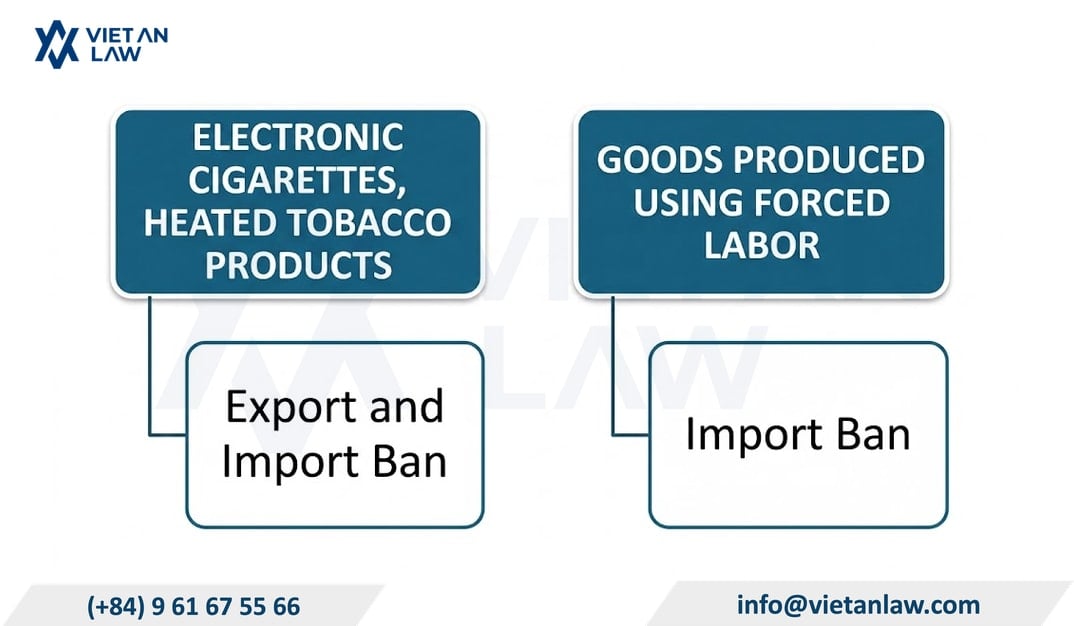
Electronic cigarettes and heated tobacco products are prohibited from export and import in Vietnam
In Appendix I, electronic cigarettes and heated tobacco products are listed in item number 10 of the List of goods prohibited from export and item number 5 of the List of goods prohibited from import, falling under the management authority of the Ministry of Industry and Trade.
Thus, this is a group of goods that is both prohibited from export and prohibited from import according to the new regulations.
Prohibiting the import of goods produced by forced labor practices
One of the notable contents of the Decree is the regulation prohibiting the import of products and goods mined, produced, or manufactured wholly or partially by forced labor practices from enterprises, countries, and territories in accordance with relevant international treaties to which the Socialist Republic of Vietnam is a member.
This regulation is added to perfect the legal basis for managing international trade activities, while contributing to the implementation of Vietnam’s international commitments on labor and trade.
According to the regulations, the identification of enterprises, countries, or territories related to forced labor practices will be carried out on the basis of international treaties to which Vietnam is a member and relevant legal regulations. This is one of the new points of the Decree, supplementing the legal basis to control import activities for groups of goods at risk of violating international labor standards.
Note: The Decree also stipulates an exception mechanism for certain special cases. According to Clause 3, Article 5 of Decree 292/2026/ND-CP, permitting the export and import of goods on the prohibited list is implemented in accordance with the provisions of the foreign trade law guidance and Decree 146/2025/ND-CP on decentralization and delegation of power in the industry and trade sector.
Comparing regulations in Decree 292/2026/ND-CP and Decree 69/2018/ND-CP
| Content | Decree 69/2018/ND-CP | Decree 292/2026/ND-CP |
| Licenses related to temporary import for re-export | Authority of the Ministry of Industry and Trade | Authority of the provincial People’s Committee |
| Temporary import for re-export business codes | Vietnamese merchants are permitted to conduct conditional temporary import for re-export business operations upon being granted a temporary import for re-export business code for goods. | Not stipulated |
| Deposit obligation when conducting temporary import and re-export of goods | The business of temporary import and re-export of frozen food goods, goods subject to special consumption tax, and used goods requires a deposit ranging from 7 billion VND to 10 billion VND. | Not stipulated |
| Warehousing conditions when conducting temporary import and re-export of goods | The business of temporary import and re-export of frozen food goods must meet warehousing conditions such as minimum capacity, power source, ownership rights, etc. | Not stipulated |
| Merchanting trade business of foreign direct investment companies | Foreign direct investment companies are not allowed to carry out merchanting trade business of goods | Foreign direct investment companies are permitted to conduct merchanting trade business under certain conditions |
| Dossiers and procedures | Multi-component dossiers requiring many documents; complex procedures | Dossier components are streamlined, not requiring documents if exploitable from databases; procedures for submission through the Public Service Portal |
| Validity period of a certificate of free sale for exported goods | Not stipulated | 5 years |
| Electronic cigarettes and heated tobacco products | Not stipulated | Prohibited from export and import |
| Goods produced by forced labor practices | Not stipulated | Prohibited from import |
Notes on transitional provisions when applying the new regulations in Decree 292/2026/ND-CP
- Issued temporary import for re-export business codes for frozen food goods, used goods, and goods subject to special consumption tax: Cease to be effective from July 1, 2026.
- Enterprises that have been granted a temporary import for re-export business code are permitted to withdraw the deposited amount at the credit institution where the enterprise deposited to serve the issuance of the temporary import for re-export business code.
- Certificates of free sale for exported goods issued by competent authorities to merchants before September 5, 2026: Shall continue to be implemented according to the validity period of these certificates of free sale or shall be implemented until the end of December 31, 2027, for cases where no validity period is recorded on the certificate of free sale.
Decree 292/2026/ND-CP guiding the law on foreign trade management, replacing Decree 69/2018/ND-CP, introduces many important changes that directly impact the import and export activities of enterprises. Please contact Viet An Law for specific corporate legal advisory and international trade consultation!
Lawyer in charge and editor of the article: Lawyer Trung Thi Lieu.
Hotline/ Zalo/ WhatsApp: (+84) 961 571 818
Email: info@vietanlaw.com
Hanoi Office: 3rd Floor, Hoang Ngan Plaza Building, No. 125 Hoang Ngan, Yen Hoa Ward, Hanoi City
Ho Chi Minh City Office: Room 04.68, 4th Floor, Hall A, RiverGate Residence Building, 151-155 Ben Van Don, Khanh Hoi Ward, Ho Chi Minh City.