In the current era of strong development of science and technology, inventions and innovations – especially in the field of chemistry – play an increasingly important role in improving the quality of life, promoting economic development, and protecting the environment. However, for chemical products created by individuals or research organizations to be legally protected and avoid the risk of being copied, patent registration is an indispensable step. In the article below, Viet An Law will clarify the legal regulations on securing your chemical invention in Vietnam and the necessary notes in the process of preparing this patent registration application.
According to Clause 12, Article 4 of the 2005 Law on Intellectual Property, amended and supplemented in 2009, 2019, and 2022, an invention is a technical solution in the form of a product or process to solve a specific problem by applying natural laws.
Conditions for securing your chemical inventions
Conditions for Securing Your Chemical Inventions
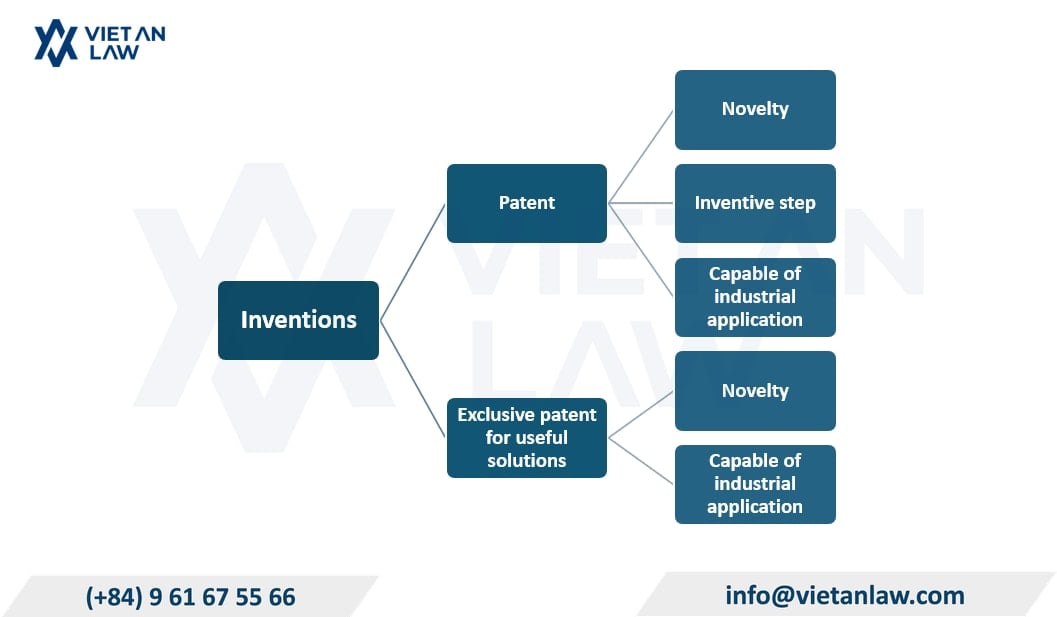
A chemical product invention is protected by the granting of a Patent if it satisfies the following conditions:
Novelty: An invention is considered novel if it does not fall into one of the following cases:
It is publicly disclosed in the form of use, written description, or any other form domestically or abroad before the date of filing the patent application or before the priority date in the case of a patent application enjoying priority;
Disclosed in another patent application with an earlier filing date or priority date but published on or after the filing date or priority date of that patent application;
Inventive step: An invention is considered to be inventive if, based on technical solutions that have been publicly disclosed in the form of use, written description, or in any other form domestically or abroad before the filing date or before the priority date of the patent application in the case of a patent application enjoying priority, the invention is
An inventive step,
Cannot be easily created by a person with average knowledge in the relevant technical field;
Capable of industrial application: An invention is considered to be capable of industrial application if it is possible to carry out the manufacture, mass production of the product, or the repeated application of the process which is the subject matter of the invention, and obtain stable results.
A chemical product invention is protected by the grant of a Utility Solution Patent if it is not common knowledge and meets the following conditions:
Novelty;
Capable of industrial application.
Classification of chemical inventions according to the International Patent Classification (IPC)
Applications for registration of inventions/utility solutions must be classified according to the International Patent Classification (IPC). In case the applicant does not classify or classifies incorrectly, the Intellectual Property Office will classify, and the applicant must pay the classification fee according to regulations. Chemical product inventions are usually classified into the following groups:
C01. Inorganic chemistry
C01B. Non-metallic elements; their compounds;
C01C. Ammonia; cyanogen; their compounds;
C01D. Compounds of alkali metals, i.e., of lithium, sodium, potassium, rubidium, cesium, or francium;
C01F. Compounds of beryllium, magnesium, aluminium, calcium, strontium, barium, radium, thorium, or of rare-earth metals;
C01G. Compounds of metals not classified in subclasses C01D or C01F.
C07. Organic chemistry
C07B. General methods in organic chemistry, apparatus for such methods (preparation of esters of carboxylic acids by telomerization C07C 67/47; processes for the preparation of macromolecular compounds,…, telomerisation C08F, C08G);
C07C. Carbon-alkaline or cyclic compounds (macromolecular compounds C08; production of organic compounds by electrolysis or electrophoresis C25B 3/00, C25B 7/00);
Chemical product patent registration file in Vietnam
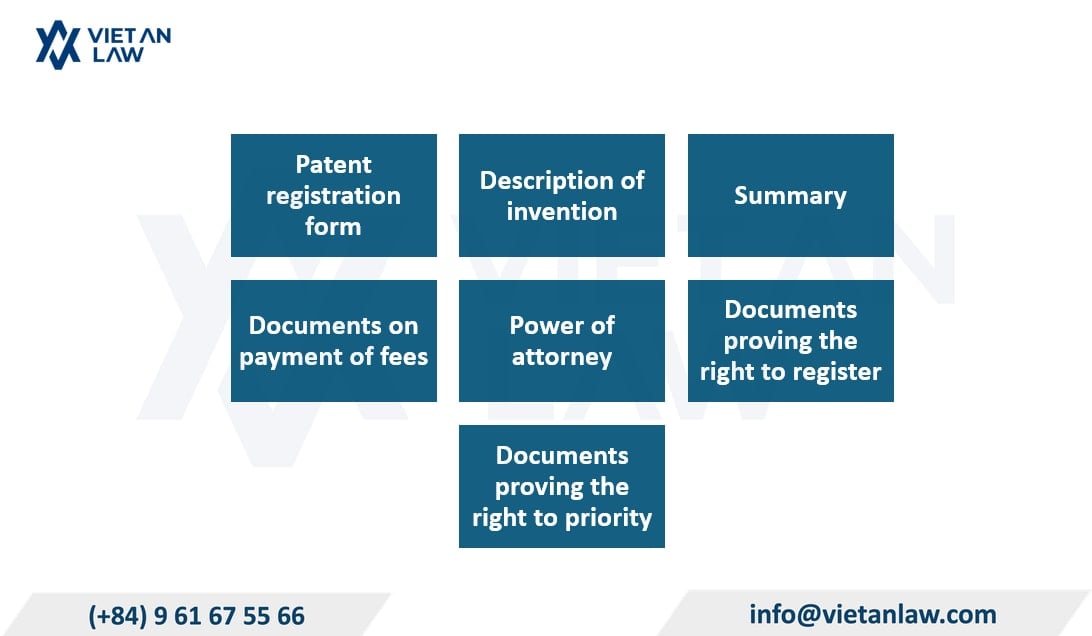
Chemical product patent registration file
Patent registration form, typed according to Form No. 01 Appendix I of Decree No. 65/2023/ND-CP (Attached Form);
Description of invention/utility solution;
Summary of invention/utility solution;
Documents on payment of fees;
Power of attorney (if the application for patent/utility solution is submitted through an industrial property representative service organization);
Documents proving the right to register (if enjoyed by another person). For example: Transfer of the right to apply… (if any);
Documents proving the priority right (if the patent application requires priority).
Notes when preparing a dossier for registration of a chemical product patent
Each application may only request one protection certificate, and the type of protection certificate requested must be appropriate to the technical solution object stated in the application.
All documents of the application must be in Vietnamese. Documents in other languages, as prescribed in Article 100.2 of the Law on Intellectual Property, must be translated into Vietnamese.
All documents must be presented in portrait orientation (except drawings, diagrams and tables can be presented in landscape orientation) on one side of A4 paper (210mm x 297mm), except for documents that are maps of geographical areas that can be presented on A3 paper (420mm x 297mm), with margins on all four sides, each margin 20mm wide, in Times New Roman font, text not smaller than size 13, except for supporting documents whose origin is not intended to be included in the application;
For documents that need to be prepared according to a template, it is mandatory to use those templates and fill in all required information in the appropriate places.
Each type of document, except for a set of photographs or industrial design drawings, if it consists of multiple pages, must have its page number written in Arabic numerals;
The document must be typed or printed with indelible ink, clearly, cleanly, without erasures or corrections; if the document has 02 or more pages, it must be stamped with the seal of the applicant/document issuing agency (if any);
The terminology used in the application must be consistent and common (do not use local dialects, rare words, or self-made words). Symbols, units of measurement, electronic fonts, and spelling rules used in the application must comply with Vietnamese standards.
The application may be accompanied by supporting documents that are electronic data carriers of part or all of the application document content.
Some patented chemical products
A composition comprising cross-linked polysaccharides for improving the efficiency of the alumina hydrate production process
Patent number: 33114
Date of application: 04/08/2011
Patent holder: NALCO COMPANY
Authors: WANG, Jing; Heinrich E.; LI, Xiaojin Harry
Summary: The present invention relates to a method and composition for improving the performance of a process for producing alumina hydrate. The invention relates to the addition of one or more polysaccharides to the condensate or slurry in the liquid cycle of the production process. The one or more polysaccharides may be cross-linked polysaccharides, such as cross-linked dextran or cross-linked dihydroxypropyl cellulose. Different polysaccharides may have several advantages, including at least some of the following: greater coagulation efficiency, increased maximum effective dosage, and faster settling rate. The production process may be a Bayer process.
Process for the production of alumina trihydrate using the Bayer process
Summary: The present invention relates to a process for producing alumina trihydrate by alkali cooking of bauxite using the Bayer process, wherein the aluminate condensate and the insoluble residue are separated using a solid/liquid separator (E; W2; DC) which is distinguished in that at least a portion of the slurry (21a, 41; 230′) is passed through hydroxychloride (H1; H21; H22; H3) to improve and accelerate the separation from the sodium aluminate condensate of the insoluble residue in the slurry (21a; 41; 230′) containing said residue and condensate and the said slurry is fed into or removed from the said solid-liquid separator. In the first method, at least one hydroxyclon is used before the settling-concentrating device, which acts as a condensate clarifier. In the second method, at least one hydroxyclon is used as a sludge insoluble concentrate. In the third method, hydroxyclon is used in conjunction with an alkali settling device.
If Clients need advice on securing your chemical invention in Vietnam, please contact Luat Viet Law for the best support!
Fast & Reliable Legal Assistance
Fill out the form below and get connected with a lawyer quickly.
Learn how Taiwanese companies register trademarks in Vietnam: conditions, procedures, costs, and timelines. Expert guide on Vietnam's first-to-file system and IP protection for foreign investors.
Vietnam abolishes copyright assessment certificate procedures from July 2026 under Decision 1198. Learn how this reform reduces compliance costs and impacts IP organizations.
Can AI receive industrial property protection in Vietnam? Learn the legal requirements, significant human contribution criteria, and registration procedures under Decree 100/2026.