The protection of trade secrets in Spain plays an extremely important role in the success of businesses. Trade secrets are valuable intangible assets, a core factor that creates a unique competitive advantage. When trade secrets are infringed, businesses are prone to facing many risks such as loss of customers, loss of reputation, loss of investment opportunities and even legal issues. To protect this intangible asset, businesses need to build a strict information security system, sign confidentiality agreements with partners and employees, and raise awareness of the importance of protecting trade secrets throughout the company. Viet An Law would like to guide customers on how to protect trade secrets in Spain through the article below.
Preliminary Definition of Trade secrets in Spain
Trade secrets in Spain, as in many other countries, are understood as any information of a proprietary, undisclosed and commercially valuable nature, used by the owner to create a competitive advantage.
Elements that constitute a trade secret:
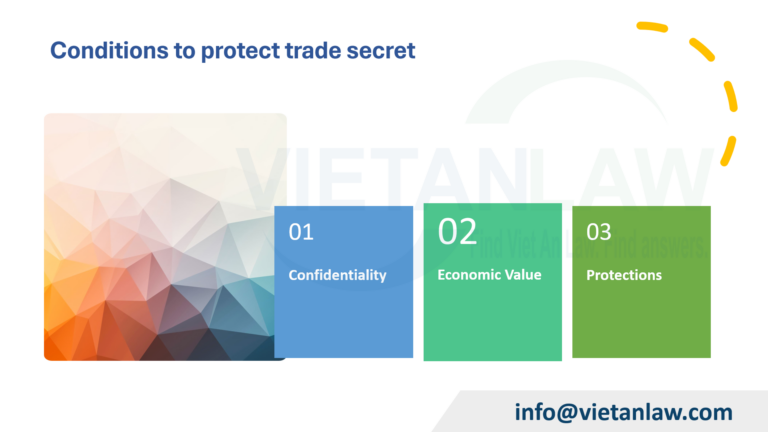
- Exclusivity: The information must be unique, not general knowledge or information that is easily obtained from public sources.
- Confidentiality: The information has not been made public, and the owner has taken the necessary security measures to keep it private.
- Commerciality: Information must provide economic value to the owner, which can help increase revenue, reduce costs, or create new products and services.
Preliminary Acts of Infringement of Trade Secrets in Spain
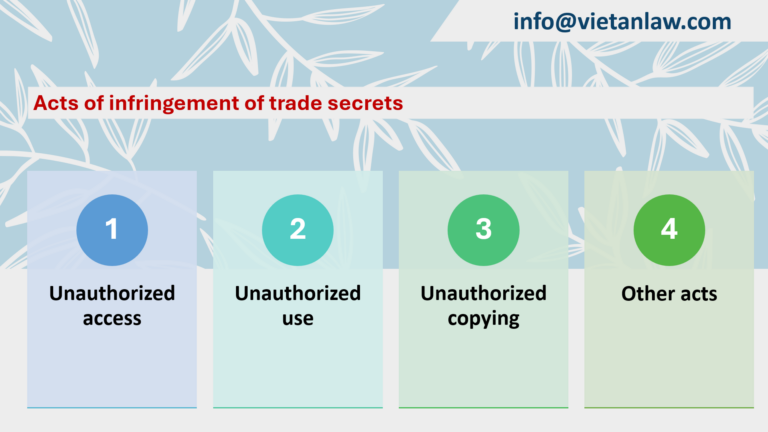
Unauthorized access
- Bribery: Giving bribes to rival employees to gather information.
- Fraud, stealth: Using deceptive tricks to infiltrate computer systems and production facilities of opponents.
- Economic intelligence: Gathering information by intelligence methods.
Unauthorized use
- Copying, imitation: Using confidential information to produce and trade similar products and services.
- Disclosure to third parties: Providing confidential information to competitors or other organizations.
- Breach of confidentiality contract: Disclosure of confidential information that has been committed to confidentiality.
Other acts
- Unfair competition: Using confidential information to damage the reputation and business activities of competitors.
- False propaganda: Spreading false information about competitors’ products and services.
Exceptions
- Lawful use of publicly available information
- Voluntary disclosure: If the owner of a trade secret voluntarily releases that information to the public, then anyone has the right to use it.
- Information that has been copyrighted or patented: While some of the information may be protected by copyright or patent, the rest may still be considered trade secrets. However, the use of the registered part must comply with copyright and patent regulations.
- Use of information to protect legitimate interests
- In the proceedings: The use of trade secrets in the proceedings to prove one’s interests is completely legal.
- To report violations of the law: If a violation of the law related to trade secrets is detected, it is completely legal to provide information to the authorities for investigation.
- Use of information within the scope of the contract
- Technology transfer contracts: In technology transfer contracts, the disclosure of part of confidential information is a necessary condition for the performance of the contract.
- Business Cooperation Contracts: In business cooperation contracts, it is normal for the parties to share some confidential information for the parties to develop together.
- Use of information to protect the public interest:
- In an emergency: If the use of confidential information is necessary to prevent a serious threat to health, safety, or the environment, then such use may be considered lawful.
Basics on how to protect trade secrets in Spain
Building a culture of security
- Raise awareness: Organize training sessions and seminars so that all employees understand the importance of protecting trade secrets and potential risks when disclosing information.
- Build processes: Establish clear procedures for processing, storing, and sharing confidential information.
- Sign a confidentiality pledge: Require all employees to sign a confidentiality pledge when entering the workplace.
Technical measures
- Network security system: Use firewalls, antivirus software, intrusion detection systems to protect the network from external attacks.
- Data encryption: Encrypt sensitive data to prevent unauthorized access.
- Restrict access: Give access to confidential information only to those who really need it.
- Back up your data: Back up your data regularly in case of data loss.
Legal measures
- Sign a confidentiality contract: Sign a confidentiality contract with partners, suppliers, and customers to ensure that information is not disclosed.
- Copyright Registration: Registering copyrights for registrable portions of a trade secret (e.g., software, design).
- Proceedings: When detecting infringement, the owner of a trade secret has the right to initiate a lawsuit in court to protect his or her rights.
Management measures
- Information classification: Classify information according to security level to apply appropriate protection measures.
- Physical Control: Store documents containing confidential information in a safe, locked place.
- Periodic Inspections: Perform periodic inspections to evaluate the effectiveness of protection measures and detect vulnerabilities.