


Company dissolution for an LLC is not merely the procedure to terminate business operations but also directly relates to the liability of the owner or capital-contributing members within the limit of the committed charter capital. For a single-member LLC and a multiple-member LLC, the limited liability company dissolution procedure, decision-making authority, and legal dossier have many differences that require special attention.
To help managers proactively handle the situation, in the article below, Viet An Law Firm will provide a detailed guide on How to Dissolve a Limited Liability Company (LLC) in Vietnam according to the latest regulations.
Specific legal characteristics when you dissolve LLC in Vietnam
Limited liability of company members
When carrying out the limited liability company dissolution procedure, one of the most important legal characteristics is that company members are only liable for the debts and property obligations of the enterprise within the amount of capital contributed to the company. This is a major difference compared to a sole proprietorship or an individual business household. However, before proceeding to close an LLC, it must still fulfill all obligations regarding taxes, social insurance, employee salaries, debts with partners, and other financial obligations as prescribed by law.
The role of the Members’ Council in the dissolution decision
For a multiple-member LLC, the dissolution decision must be approved by the Members’ Council according to the voting ratio stipulated in the Law on Enterprise and the company’s Charter. This body plays a similar role to the General Meeting of Shareholders of a joint stock company but has a simpler and more centralized governance mechanism. Meanwhile, for a single-member LLC, the company owner will directly decide on closing a limited liability company without needing to organize a Members’ Council meeting.
Specifics on transferring contributed capital before dissolution
Prior to dissolution, a member of an LLC can transfer their contributed capital according to the specific mechanism of the LLC type. The transfer is usually restricted and must be prioritized for offering to remaining members before being transferred to outsiders. This is a distinct difference from a joint stock company, where shareholders have the right to transfer shares more flexibly in most cases.
Differences between a single-member LLC and a multiple-member LLC
The procedures and mechanisms for approving the dissolution decision of a single-member LLC and a multiple-member LLC have many differences. For a single-member LLC, the owner has full authority to decide on terminating the enterprise’s operations. Meanwhile, a multiple-member LLC must hold a Members’ Council meeting and vote according to the capital contribution ratio of the members. Therefore, understanding How to Dissolve a Limited Liability Company (LLC) in Vietnam shows that the process for a multiple-member LLC is often more complicated in terms of internal procedures.
An LLC is not allowed to issue shares
Another important legal characteristic is that an LLC does not have the right to issue shares to mobilize capital like a joint stock company. Therefore, the capital structure of an LLC is usually stable, and the number of members is limited according to legal regulations. Upon company dissolution, the enterprise also does not incur legal issues related to shares, common shareholders, or preference shareholders like in a joint stock company. This makes the dossiers and procedures to dissolve LLC in Vietnam simpler in many cases compared to dissolving a joint stock company.
Differences in LLC dissolution requirements between single-member and multiple-member LLCs
Similarities in the legal process
The dissolution of both types of companies above must comply with the dissolution process prescribed by law at the Business Registration Office under the provincial Department of Finance.
Differences in dissolution between the two types of LLCs
| Comparison criteria | Dissolving a single-member LLC | Dissolving a multiple-member LLC |
| Decision-making authority | Company owner or Members’ Council/Company President. | Members’ Council. |
| Voting ratio for approval | Decided unilaterally by the owner when dissolving a single-member LLC. | Must be approved by at least 65% of the total contributed capital of attending members when dissolving a multiple-member LLC. |
| Joint liability | The owner is liable within the limit of the charter capital when dissolving a single-member LLC. | Members bear joint liability according to their capital contribution ratio when dissolving a multiple-member LLC. |
How is dissolving an LLC different from Joint stock company dissolution?
Although both carry out the enterprise termination procedure under the Law on Enterprise, dissolving an LLC and Joint stock company dissolution have many differences in governance structure, voting mechanisms, and responsibilities of members/shareholders.
| Criteria | Limited Liability Company | Joint Stock Company |
| Dissolution decision-making body | Owner or Members’ Council | General Meeting of Shareholders |
| Approval ratio | Usually 65% of contributed capital or more | Usually 65% of total voting shares |
| Member structure | Capital-contributing members are limited in number | Can have multiple shareholders |
| Capital transfer | Restricted, internal priority | Shares are usually transferred more flexibly |
| Capital issuance | Not allowed to issue shares | Allowed to issue shares, bonds |
| Property liability | Within the limit of contributed capital | Within the limit of owned shares |
| Internal dissolution dossiers | Simpler | More complex due to shareholders and shares |
| Common disputes | Uncooperative members, incomplete capital contribution | Shareholder, share, voting right disputes |
In reality, the procedure to dissolve a joint stock company is often more complex due to the large number of shareholders, multi-tiered governance mechanism, and involvement with shares and stocks. Meanwhile, closing a limited liability company usually focuses on settling financial obligations, contributed capital, and the decisions of the owner or the Members’ Council.
Procedure to close an LLC
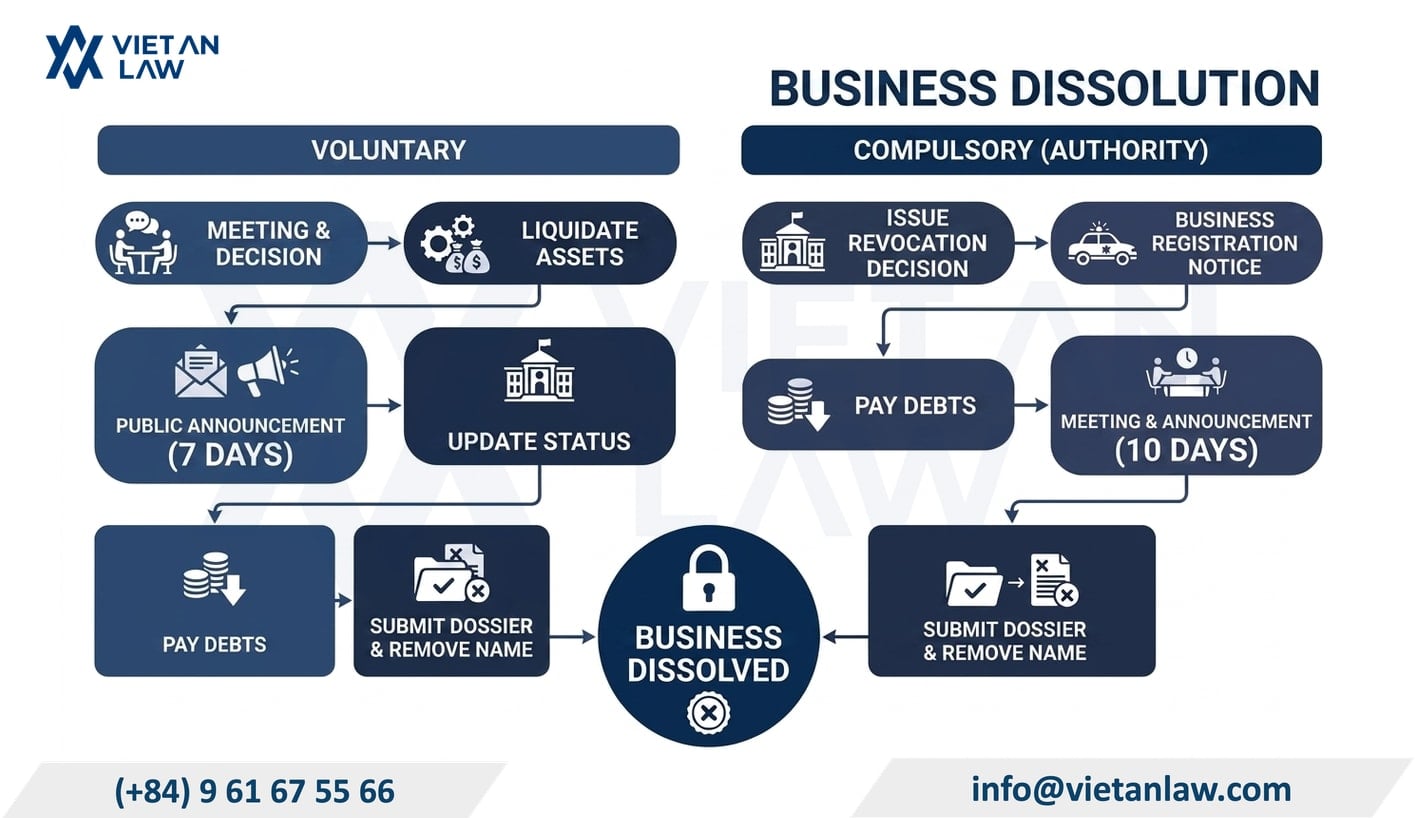
Company dissolution timeframe
| Procedural step | Execution time limit |
| Voluntary dissolution | |
| Notify and publicly post the dissolution decision | Within 07 working days from the date of decision approval. |
| Notify the “undergoing dissolution procedures” status | Immediately after the Business Registration Office (BRO) receives the decision. |
| Submit dissolution dossier to BRO | Within 05 working days from the date of fully paying all debts. |
| Update dissolved status | After 180 days (from the notification date if there is no objection) or within 05 working days (from receiving a valid dossier). |
| Compulsory dissolution | |
| Announce dissolution status on the Information Portal | Concurrently when issuing the revocation decision or immediately upon receiving the Court’s decision. |
| Convene meeting, notify and post the decision | Within 10 days from the date of receiving the revocation decision or the Court’s decision. |
| Publish the dissolution notice on newspapers (if needed) | Publish on at least 01 printed/electronic newspaper in 03 consecutive issues. |
Common practical situations when learning How to Dissolve a Limited Liability Company (LLC) in Vietnam
Uncooperative members in company dissolution
In practice, many LLCs face difficulties when one or several members do not cooperate during the enterprise dissolution process. For a multiple-member LLC, dissolution typically must be approved by the Members’ Council according to the voting ratio stipulated in the company’s Charter or the Law on Enterprise. If a member deliberately fails to attend meetings, does not sign documents, or does not cooperate in handling financial obligations, the enterprise may encounter obstacles in completing the dissolution procedures.
However, if the valid voting ratio according to regulations is still met, the company can still pass the dissolution resolution without the consent of all members. In case of serious disputes arising among members, the enterprise may have to resolve them through negotiation, mediation, or request a Court to settle them before completing the termination procedure.
The owner of a single-member LLC is absent during enterprise dissolution
For a single-member LLC, the right to decide on dissolution belongs to the company owner. If the owner is an individual residing abroad, loses contact, or does not directly carry out the procedure, they can legally authorize another person to handle the dissolution dossier on their behalf according to civil and enterprise laws.
In cases where the owner has died or lost civil act capacity, the dissolution is only carried out after clearly identifying the heir, legal representative, or having a decision from a competent authority. Therefore, the enterprise needs to carefully review the legal status of the owner before submitting the dissolution dossier.
Can a company that has ceased operations for many years be dissolved?
An LLC that has ceased operations for many years can still carry out the dissolution procedure, even if the enterprise has had its tax code locked or has been put into a “not operating at the registered address” status. However, the enterprise must handle unresolved issues such as unsubmitted tax reports, late filing penalties, unfulfilled financial obligations, or the tax code restoration procedure before official dissolution. This is a fairly common practical scenario for long-term “suspended” enterprises.
Internal disputes among company members
Internal disputes are one of the common reasons that prolong the LLC dissolution procedure. Disputes often relate to asset distribution, liabilities, capital contribution responsibilities, or enterprise management rights. If the parties cannot reach an agreement, the enterprise may have to resolve it through mediation or a Court before completing the dissolution procedure. In many cases, the dissolution dossier will be suspended if there is a dispute currently being resolved by a competent authority.
Dissolving an LLC when capital is not fully contributed
An LLC that has not fully contributed its charter capital can still carry out the dissolution procedure if it fully meets the LLC dissolution requirements prescribed by law, especially fully paying off all debts and other property obligations. However, failing to fully contribute capital may give rise to legal liabilities for the members or the company owner.
According to the Law on Enterprise, members who have not contributed or have not fully contributed capital must be liable corresponding to the portion of capital committed to contribute for financial obligations arising during the period the capital is not fully contributed. Therefore, prior to dissolution, the business registration authority or tax authority may inspect the actual capital contribution status to determine related liabilities. This is one of the common legal risks for LLCs operating non-compliantly regarding charter capital.
Errors that prolong the dissolution procedure
Not prioritizing the definitive resolution of employee rights
According to Article 208 of the Law on Enterprise 2020, fulfilling obligations to employees is a prerequisite and top priority for a company to be approved for dissolution. However, many enterprises neglect this note, leading to shortcomings:
- Missing allowance payments: Failing to pay or underpaying severance allowances or job-loss allowances for personnel.
- Incomplete social insurance procedures: Forgetting or delaying the finalization of social insurance books for employees.
This leads to an invalid dissolution dossier, forcing amendments, supplements, and the resolution of personnel disputes/rights before the procedure can continue, consuming a lot of time.
Violating prohibited acts after a dissolution decision is issued
Many enterprises mistakenly believe that when a dissolution decision is issued but the procedure is not yet complete, the company can still conduct normal business operations. Ignoring the prohibitions in Clause 1, Article 211 of the Law on Enterprise 2020 is a very serious error. Specifically:
- Signing new contracts: The enterprise must absolutely not sign new contracts (unless that contract directly serves the dissolution).
- Executing other illegal transactions: Dispersing or hiding assets; pledging, mortgaging, donating, or leasing assets; mobilizing capital; converting unsecured debts into secured debts; or waiving the right to claim debts.
Performing these acts not only stalls the dissolution process but, depending on the severity, enterprise managers may also have to compensate for damages or even face criminal prosecution.
Failure to close company representative office and dependent units first
According to Clause 1, Article 208 of the Law on Enterprise 2020, the dissolution procedure of the parent company can only be carried out after resolving its affiliated units, such as closing a branch, executing to close company representative office, or closing a business location.
However, in reality, enterprises submit the LLC dissolution dossier directly but forget to carry out the procedure to terminate the operations of branches, representative offices, or business locations. This results in the parent company’s dissolution dossier being returned until the dependent units are validly closed.
Incomplete accounting and tax work
Resolving financial obligations with the State is the most time-consuming step if the enterprise is not carefully prepared beforehand.
- Incomplete finalization: Failing to carry out tax finalization procedures with the managing Tax Authority.
- Bookkeeping errors: Accounting data is mismatched, vouchers are incomplete and lack transparency.
In this case, the Tax Authority will request explanations, inspections, and prolonged audits, making the company unable to obtain a confirmation of fulfilling tax obligations to submit to the Business Registration Office.
Frequently asked questions about dissolving an LLC
Who needs to sign for the dissolution of a single-member LLC?
The company owner or a legally authorized person signs the dissolution dossier.
What percentage of contributed capital is needed to approve the dissolution of a multiple-member LLC?
Usually, it must be approved by at least 65% of the total contributed capital, unless the company’s Charter stipulates a higher ratio.
Are capital-contributing members liable after dissolution?
They may be, if they have not fully contributed capital, have violated the law, or have not fulfilled financial obligations prior to dissolution.
Can an LLC that has not fully contributed capital be dissolved?
Yes, but it must still handle liabilities related to the un-contributed capital portion and fully pay all financial obligations.
What is needed to dissolve an LLC?
The company dissolution dossier includes the following basic documents:
- Notice of dissolution;
- Resolution/Decision and Meeting Minutes of the owner regarding the enterprise dissolution;
- Documents proving the completion of property obligations;
- Power of attorney and legal documents of the person submitting the dossier (if not the legal representative of the enterprise directly submitting the dossier).
How long does company dissolution take?
The company dissolution time usually lasts from 03 to 06 months, mainly depending on the time the enterprise liquidates assets and settles all property obligations according to legal regulations.
Viet An Law Firm provides an all-inclusive service to dissolve an LLC, supporting the handling of legal dossiers, tax finalization, tax code termination, and completing procedures at the business registration authority quickly and in compliance with regulations.