


Related rights registration is the formal procedure helping performers, producers of audio/video recordings, and broadcasting organizations establish legal evidence of ownership over their performances, audio/video recordings, or broadcasts. Although related rights arise automatically under the Law on Intellectual Property, registering these rights remains crucial for proving ownership, resolving disputes, and commercially exploiting protected subject matter.
In practice, numerous disputes concerning the unauthorized copying of audio recordings, usage of broadcasts, or exploitation of performances arise because the right holders lack adequate documentation to prove ownership. Therefore, obtaining a Certificate of Registration of Related Rights will significantly facilitate organizations and individuals in protecting their legitimate rights and interests. In the article below, Viet An Law will provide a detailed guide on the application dossier, implementation procedures, term of protection, and the latest regulations for registration of related rights to copyright in Vietnam (2026).
Quick facts about how to register related rights in Vietnam in 2026
| Content | Required Information |
| Procedure | Registration of related rights |
| Protected subject matter | Performances, audio recordings, video recordings, broadcasting programs |
| Entities entitled to register | Performers, producers of audio recordings, producers of video recordings, broadcasting organizations, holders of related rights |
| Related rights registration dossier | Declaration for registration, copies of the protected subject matter, documents proving ownership, power of attorney (if any) |
| Receiving authority | State management authority for copyright and related rights |
| Timeline for Certificate issuance | 20 working days from the date of receipt of a valid dossier |
| Term of protection | 50 years for the rights of performers, producers of audio recordings, producers of video recordings, and broadcasting organizations |
| Is registration mandatory? | Non-mandatory, but recommended to prove ownership and protect rights in case of disputes |
| Benefits of registration | Establish legal evidence, facilitate transfer/assignment, license exploitation, and handle acts of related rights infringement |
| Legal basis | The latest amended and supplemented Law on Intellectual Property and its implementing guidelines. |
What is registration of related rights?
In the arts, entertainment, media, and digital content production industries, performances, sound recordings, video recordings, and broadcasts all possess significant commercial value. To protect the legitimate rights and interests of those investing in, creating, and exploiting these objects, Vietnamese law provides for the protection of related rights alongside copyright.
According to the Law on Intellectual Property, related rights are the rights of organizations and individuals to performances, sound recordings, video recordings, broadcasts, encoded cable signals, and encoded satellite signals. These rights arise from the moment the object is legally created or performed, regardless of registration procedures.
Although not a mandatory condition for protection, registering related rights provides owners with important legal grounds for commercial exploitation, transfer of rights, licensing, or requesting competent authorities to handle infringement. A certificate of registration of related rights is also valuable evidence in resolving disputes regarding ownership rights to performances, sound recordings, video recordings, or broadcasts.
Currently, the entities that commonly carry out the procedure of registering related rights include performing artists, singers, actors, music producers, media companies, digital content producers, and broadcasting organizations, in order to protect their investment results and effectively exploit their intellectual property.
Which subjects are eligible for related rights protection in Vietnam?
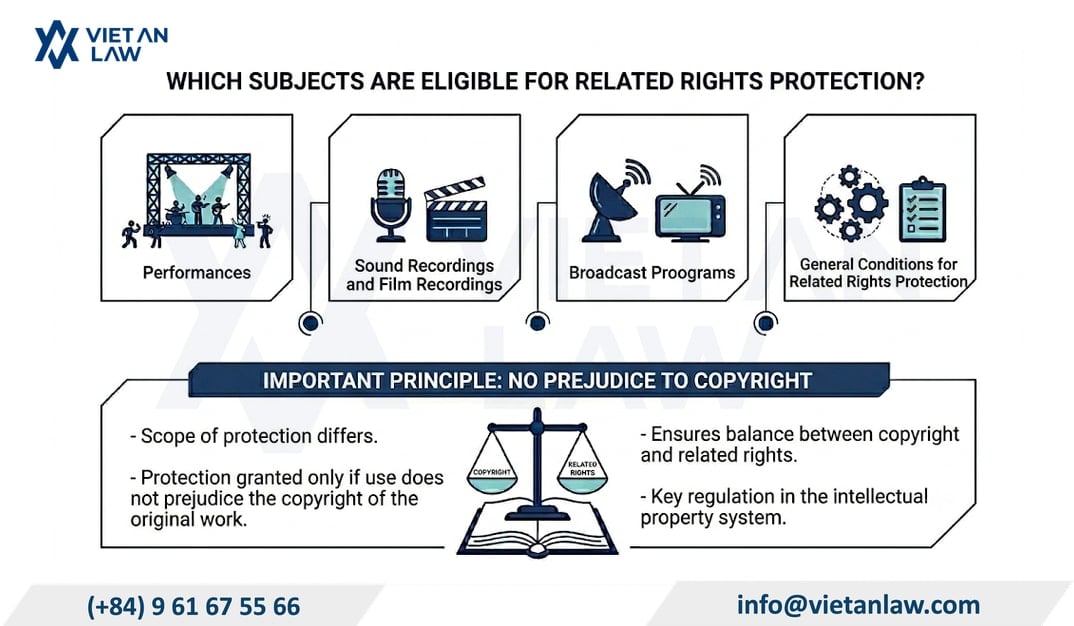
Not all performances, recordings, or broadcasts are automatically entitled to related rights protection. According to the Law on Intellectual Property, protection only applies to objects that meet the conditions regarding the subject, place of performance, or fall within the scope of international treaties to which Vietnam is a signatory. Correctly identifying the protected subject matter is crucial for carrying out the registration procedures for related rights and protecting the legitimate interests of the owner.
Performance
Performance is one of the most common subjects of related rights. This can include singing, playing musical instruments, acting, dancing, reciting poetry, or other forms of artistic performance directly performed by individuals.
According to current regulations, performances are protected when they fall under one of the following cases: performed by Vietnamese citizens in Vietnam or abroad; performed by foreigners in Vietnam; embodied in legally recorded audio or video; legally broadcast; or protected under international treaties to which Vietnam is a party.
Protection of performances provides performers with a legal basis to prevent the unauthorized copying, exploitation, or use of images, voices, or performances for commercial purposes.
Audio and video recordings
A audio and video recording is the result of financial, technical, and technological investment aimed at preserving the sound or image of a performance, program, or specific content.
This object is protected by related rights if it is owned by a producer of audio and video recordings who is a Vietnamese national or is protected under international treaties to which Vietnam is a signatory.
Registering related rights for audio and video recordings helps owners easily prove ownership in case of disputes, and facilitates commercial exploitation, transfer, or licensing.
Broadcast programs
Broadcast programs are products created by radio stations, television stations, or broadcasting organizations and transmitted to the public through various technical means.
According to the law, broadcast programs, encoded cable signals carrying programs, and encoded satellite signals carrying programs are protected by related rights if they are owned by Vietnamese broadcasting organizations or fall within the scope of protection of relevant international treaties.
Protection rights for broadcast programs allow broadcasting organizations to control the replay, copying, distribution, or exploitation of their programs, contributing to the protection of investment value and limiting illegal broadcasting in the digital environment.
General conditions for protection of related rights
Although the scope of protection varies for each subject matter, performances, sound recordings, video recordings, and broadcasts are only protected when their exploitation and use do not infringe upon the copyright of the original work. This is an important principle to ensure a balance between copyright and related rights in the intellectual property law system.
Why pursue copyright and related rights registration when protection is automatic?
According to the Law on Intellectual Property, related rights arise automatically from the moment a performance, sound recording, video recording, or broadcast is legally created or performed. However, registering related rights remains crucial in establishing ownership, protecting legitimate interests, and facilitating commercial exploitation. In practice, a Certificate of registration of related rights is one of the important legal grounds that helps owners effectively protect their intellectual property against infringement.
Easier proof of ownership
In the event of a dispute, owners with a Certificate of Registration of Related Rights will find it easier to prove ownership, the time the right arose, and the scope of the protected right. This is important legal evidence that significantly reduces the time, cost, and risk in the dispute resolution process.
Increased protection of related rights against infringement
In today’s internet and digital platform environment, the unauthorized copying, distribution, or exploitation of performances, sound recordings, video recordings, and broadcasts is increasingly common. Registering related rights provides owners with a solid legal basis to demand the cessation of infringing acts, claim compensation for damages, or request competent authorities to handle the matter according to the law.
Easier transfer and licensing
Registering related rights makes the transfer of rights, licensing of exploitation, or signing of contracts for the use of protected objects more transparent and convenient. This also serves as a basis for determining the entity entitled to economic benefits from the exploitation of intellectual property.
Supporting commercial exploitation and attracting investment
For businesses operating in the entertainment, media, music, film, or broadcasting sectors, the Certificate of Registration of Related Rights contributes to enhancing the commercial value of intellectual property. At the same time, it is also an important document when working with partners, investors, or conducting commercial transactions related to intellectual property rights.
Creating an advantage in other legal procedures
In many cases, having registered related rights makes it easier for the owner to carry out administrative procedures, litigation, or civil transactions related to performances, sound recordings, video recordings, and broadcasts. This is the basis for clearly establishing legitimate rights and interests before state agencies and third parties.
Who has the right to apply for related rights registration?
Not every organization or individual has the right to register related rights. According to the Law on Intellectual Property, the right to register belongs to performers, owners of related rights, producers of sound and video recordings, and broadcasting organizations for objects protected by law. Identifying the correct entity entitled to file an application is a crucial condition for the registration application to be accepted by the competent authority and for the issuance of a Certificate of Registration of Related Rights.
Performers
A performer is an individual who directly presents literary or artistic works through activities such as singing, acting, playing musical instruments, dancing, or other forms of artistic performance. According to the law, actors, singers, musicians, dancers, and those directly involved in performances can be subjects of related rights protection and have the right to register their performances as prescribed.
Owners of related rights
The owner of related rights is an organization or individual who holds the rights to a performance, sound recording, video recording, or broadcast program as stipulated by law or by agreement between the parties. In many cases, the performer is not simultaneously the owner of related rights because the rights have been transferred to another business, production unit, or organization under contract. In such cases, the owner of related rights is the subject entitled to file an application and exercise the related property rights.
Sound and video recording producers
A sound and video recording producer is an organization or individual who initiates and is responsible for the initial recording of the sound and images of a performance or other sounds and images on any storage medium. This entity typically registers related rights for music albums, video recordings, music films, podcasts, or other digital content products to protect its commercial exploitation rights.
Broadcasting organizations
A broadcasting organization is an entity that initiates and directly carries out radio, television, or other forms of broadcasting as prescribed by law. Radio stations, television stations, media businesses, or broadcasting service providers have the right to register related rights for broadcast programs they produce and release.
Transferred or inherited rights
In addition to the above-mentioned entities, the right to register related rights may also belong to organizations or individuals who receive the transfer of rights, inherit them, or are legally transferred the rights under a contract. In this case, the applicant needs to provide documents proving ownership or registration rights as prescribed by law.
The latest dossier for registration of related rights to copyright in Vietnam (2026)
The application for registration of related rights serves as the basis for the competent authority to consider and issue a Certificate of Registration of Related Rights to the rights holder. Depending on whether the subject of registration is a performance, sound recording, video recording, or broadcast program, the components of the application may vary. Preparing a complete application for registration of related rights from the outset will help shorten processing time and reduce the risk of being required to amend or supplement the application.
Application for registration of related rights
The application for registration of related rights must be prepared according to the form issued by the competent state agency. The application must fully reflect the information about the applicant, the owner of the related rights, the subject matter being registered, the time of publication or fixation of the protected subject matter, and other information as prescribed.
Copy of the subject matter for registration of related rights
The applicant must provide a copy of the subject matter for which protection is requested, corresponding to each case, including:
- A fixation of the performance for registration of related rights for a performance;
- A copy of the sound or video recording for registration of related rights for sound or video recordings;
- A copy of the broadcast program for registration of related rights for a broadcast program.
This is an important document for the examining agency to determine the subject matter for which protection is requested.
Documents proving the right to file the application
If the applicant is also the owner of the related rights, documents proving ownership must be provided. If the right is established through a contract, transfer, inheritance, or assignment, corresponding supporting documents must be submitted.
Power of Attorney (if submitted through a representative)
If the registration procedure for related rights is carried out through a representative organization or authorized person, the application must include a valid power of attorney in accordance with the law.
Consent of Co-owners (if any)
In cases where related rights are jointly owned by multiple organizations or individuals, the registration application must include a document showing the consent of all co-owners to the application.
Legal documents of the registering entity
Depending on the case, the applicant may need to provide:
- A copy of personal identification documents for individuals;
- Business registration certificate or equivalent legal document for organizations;
- Other documents proving legal status as required by the competent authority.
- Foreign language documents
Foreign language documents used in the application for registration of related rights must be translated into Vietnamese as required. In some cases, the receiving agency may require the translation to be certified or consularly legalized in accordance with Vietnamese law.
Preparing the application for registration of related rights correctly and completely not only shortens the time for issuing the Certificate of Registration of Related Rights but also creates a solid legal basis for the owner to protect their legitimate rights and interests during the exploitation, transfer, or handling of infringements of related rights.
Procedure to register related rights in Vietnam
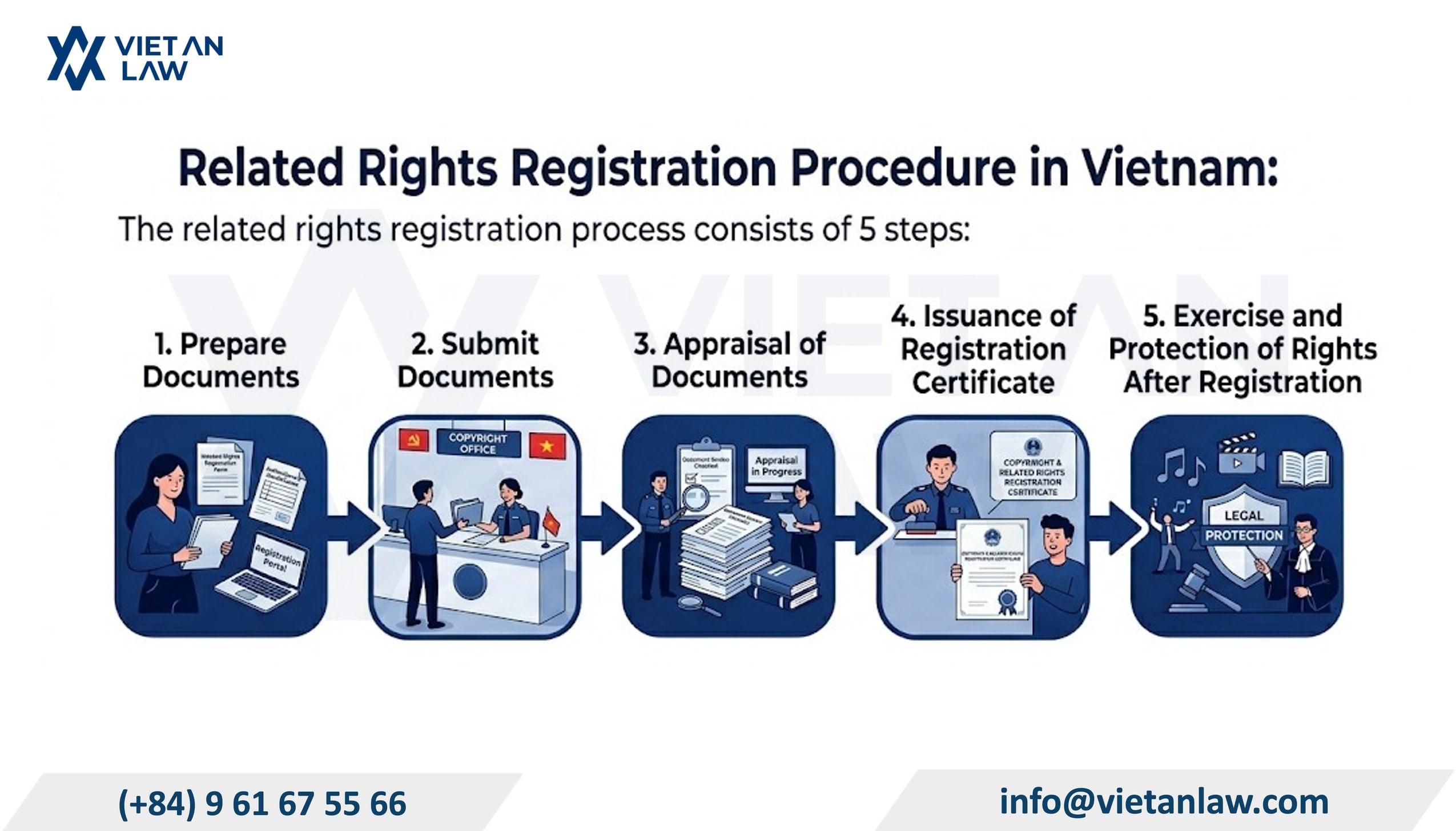
The registration process for related rights consists of 5 steps: Preparing the application → Submitting the application → Examining the application → Issuing the Certificate of Registration of Related Rights → Exploiting and protecting the rights after registration.
Step 1: Prepare the related rights registration dossier
Applicants must prepare a complete dossier in accordance with the Law on Intellectual Property and its implementing regulations. The dossier must clearly state the applicant, the subject matter to be protected, the basis for establishing the right, and supporting documents proving the right to file the application as prescribed.
Step 2: Submit the related rights registration dossier
Organizations and individuals can submit the dossier directly, via postal service, or through a copyright and related rights representative organization recognized by law.
The dossier is submitted to the Copyright Office.
Step 3: Receive and evaluate the dossier
After receiving the dossier, the Copyright Office will check the completeness and validity of the documents in the related rights registration dossier.
If the dossier does not meet the requirements, the applicant will be notified to amend or supplement it within the prescribed time limit. If the application is valid, the competent authority will conduct an assessment and review the protection conditions for the registered subject matter.
Step 4: Issuance of the Certificate of Related Rights Registration
If the application fully meets the conditions stipulated by law, the Copyright Office will issue a Certificate of Related Rights Registration to the applicant.
The Certificate of Related Rights Registration is an important legal basis confirming the owner’s rights to the registered performance, sound recording, video recording, or broadcast program.
Step 5: Exploitation and protection of related rights after issuance of the certificate
After receiving the Certificate of Related Rights Registration, the owner has the right to commercially exploit, transfer, license the use, or request the competent authority to handle acts of infringement of related rights in accordance with the law.
Registering related rights not only helps establish evidence of ownership but also creates a solid legal basis for protecting intellectual property during business operations, content production, and commercial exploitation of protected objects.
Registration fees for related rights as stipulated by Vietnamese regulations
The cost of registering related rights includes the state fees payable when carrying out the procedure for issuing a Certificate of Registration of Related Rights. The current fee rates are applied according to the regulations on fees and charges in the field of copyright and related rights.
Fee schedule for registration of related rights in 2026
| Subject matter of related rights registration | State fee |
| Performances fixed on audio recordings | 200,000 VND |
| Performances fixed on video recordings | 300,000 VND |
| Performances fixed on broadcasting programs | 500,000 VND |
| Audio recordings | 200,000 VND |
| Video recordings | 300,000 VND |
| Broadcasting programs | 500,000 VND |
If you request to re-issue a Certificate of Related Rights Registration, the fee is equal to 50% of the first-time issuance fee corresponding to each registered object.
Actual costs when registering related rights
In addition to state fees, organizations and individuals may incur several other costs such as:
- Costs for preparing and completing the application for registration of related rights;
- Costs for translation, notarization, or consular legalization of foreign documents;
- Costs for authorizing an intellectual property representative organization or law firm;
- Costs for amending or supplementing the application as required by the competent authority (if any).
Therefore, the total actual cost of registering related rights will depend on each specific application, the number of objects being registered, and whether the applicant uses legal services.
Related rights to products using AI
AI is not recognized as a subject of related rights or copyright in Vietnam. The law only protects related rights for organizations and individuals who have made significant creative contributions and controlled the product creation process. Therefore, the use of AI does not negate protection rights, but products using AI must meet the conditions under the Law on Intellectual Property to be registered for related rights.
Conditions for protecting AI-using products
AI-using products are only protected by related rights when humans play a decisive role in the creation, modification, or improvement of the product. Simultaneously, the owner must be able to prove their contribution and that the use of AI does not infringe on the intellectual property rights of third parties.
Related rights for AI-generated audio and video recordings
For audio and video recordings created with the assistance of AI, the producer can still be protected by related rights if the product demonstrates human investment, expertise, and control. Conversely, a product entirely created automatically by AI will not give rise to related rights.
Notes on copyright registration and related rights
When registering related rights for AI-using products, organizations and individuals should retain input data, prompt history, edits, and related documents to prove ownership and the creation process when necessary.
Frequently asked questions about related rights registration
Is related rights registration mandatory?
No. According to the Law on Intellectual Property, related rights arise automatically from the moment a performance, sound recording, video recording, or broadcast is legally created or performed. However, registering related rights provides the owner with a clear legal basis to prove ownership and protect their rights in case of disputes.
Who has the right to register related rights?
Performers, producers of sound and video recordings, broadcasters, and all legally entitled owners of related rights have the right to apply for related rights registration. In addition, organizations and individuals who have been legally transferred, inherited, or received the rights also have the right to carry out the registration procedure.
What documents are required for related rights registration?
The application for registration of related rights usually includes the registration form, a copy of the protected object (performance, sound recording, video recording, or broadcast), documents proving ownership, a power of attorney (if any), and other relevant legal documents as prescribed by law.
How long does it take to receive a certificate of registration of related rights?
Within 15 working days from the date of receipt of a valid application, the competent state agency for authorization and related rights will consider granting a certificate of registration of related rights to the applicant. In case of refusal to grant, the competent authority must notify in writing and state the reasons.
How long are related rights protected?
The current protection period for related rights is 50 years for performers, producers of sound and video recordings, and broadcasting organizations as stipulated in the Intellectual Property Law. The specific duration may depend on the protected object.
Copyright registration services and related rights procedures at Viet An Law Firm
Viet An Law provides all-inclusive copyright registration services and related rights consulting for individuals, enterprises, content creators, audio/video recording producers, and broadcasting organizations nationwide.
Our intellectual property law consulting services for assumptions related rights include:
- Advising on protection conditions and the possibility of registering related rights;
- Advising on identifying the owner of related rights and the scope of protection;
- Drafting registration dossiers for related rights in accordance with legal regulations;
- Representing clients in submitting dossiers to competent authorities;
- Monitoring the assessment and processing of related rights registration dossiers;
- Representing clients in working with, explaining, and responding to requests from state agencies during the assessment process;
- Receiving and handing over the Certificate of Registration of Related Rights to clients;
- Advising on the exploitation, transfer, licensing, and protection of related rights after the protection certificate is granted.
With a team of experienced lawyers and intellectual property experts, Viet An Law is committed to assisting clients in registering related rights quickly, in accordance with regulations, and ensuring maximum protection of the rights of those protected by law.