Vietnam Criminal Record Certificate under Decree 216/2026/ND-CP
The regulation on the Vietnam criminal record certificate under Decree 216/2026/ND-CP, applicable from July 1, 2026, is an important document guiding the amended Law on Criminal Record, directly impacting criminal record certificate procedures in Vietnam. From July 1, 2026, the management, exploitation, and issuance of the Vietnam judicial record certificate are adjusted towards synchronizing population data, enhancing database connection, and creating more favorable conditions for individuals and organizations when carrying out administrative procedures.
These new changes regarding the criminal record certificate in Vietnam not only affect citizens when applying for judicial record card No. 1 and judicial record card No. 2, but also impact businesses during the recruitment process, personnel record management, reception of foreign workers, and review of the legal conditions of personnel. From a practical consulting perspective, Viet An Law summarizes the core new points of Decree 216/2026/ND-CP for clients to identify risks, update internal processes, and execute the criminal record certificate application in Vietnam strictly according to the latest regulations.
Summary table of key changes to the new judicial record procedures
Criteria
Prior to July 1, 2026 (Decree 111)
From July 1, 2026 (Decree 216/2026/ND-CP)
Competent authority
Department of Justice
Provincial-level Police; Ministry of Public Security
Default method
Direct submission; paper copy
Online issuance (VNeID); electronic certificate
Processing time
10 – 15 working days
05 – 15 working days
Requirement for Card No. 2
Organizations have the right to request
Absolute prohibition on forcing individuals to provide
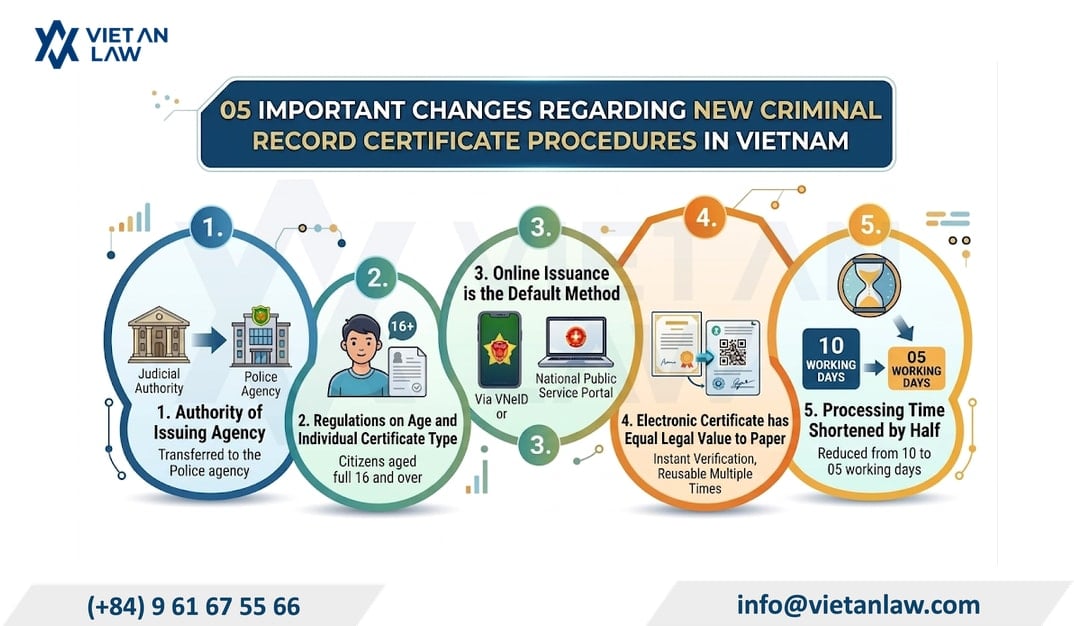
05 most important changes to criminal record certificate procedures in Vietnam
The new regulatory system marks the transfer of the managing authority and the automation of the process, completely changing the way individuals and organizations approach this procedure.
1. Competent issuing authority:
The authority is transferred from the National Center for Criminal Record (Ministry of Justice) and the provincial Departments of Justice to the provincial-level Police agencies and the Department of Professional Records under the Ministry of Public Security.
The database is accordingly built centrally on the principle of no re-collection, including 3 groups of information: (i) personal information for which the judicial record is established; (ii) information on criminal convictions, status of sentence execution, and expungement of criminal convictions; (iii) information on the prohibition from holding certain positions, establishing, and managing enterprises and cooperatives.
The judicial record information is managed and used in accordance with the regulations on personal data protection for sensitive personal data.
2. Regulations on age and types of individual certificates requested:
It is clearly regulated that citizens from a full 16 years of age who have full legal capacity can request the issuance of both numbers of the judicial record certificate on their own, expanding the right compared to previously when they could only request the issuance of judicial record card No. 1.
According to the new regulations, agencies, organizations, and individuals are also not allowed to request individuals to provide judicial record card No. 2.
3. Online issuance is the default form:
According to Law No. 107/2025/QH15, all citizens execute the criminal record certificate application in Vietnam through the VNeID application or the National Public Service Portal.
The submission of application dossiers directly or by sending paper copies via postal service is narrowed down, reserved only for foreigners or individuals who do not yet have an electronic identity.
Foreigners residing in Vietnam shall send to their place of residence; in case they have left Vietnam, they shall send to the competent authority under the Ministry of Public Security (Department of Professional Records).
4. Electronic certificates have equal value to paper copies:
Unlike the previous paper copies, the judicial record results executed online are currently returned both in paper copies (upon request) and returned automatically in the form of electronic judicial record information displayed directly on VNeID, allowing for multiple reuses for different transactions without having to carry out the procedures to apply for re-issuance.
5. Processing time reduced by half:
The police agency applies an automatic mechanism to cross-check the received dossiers automatically within 8 working hours; the certificate issuance time is reduced from 10 days to only 05 working days; the maximum time shall not exceed 15 days for complex cases requiring verification.
Some keynote update regulations for citizens in Vietnam
From the perspective of personal rights, the legal system establishes a stricter security barrier, while simultaneously granting more proactive rights to individuals regarding their own data.
Lowering the age for requesting certificate issuance: Citizens from a full 16 years of age have full legal capacity to request the issuance of both types of judicial record card No. 1 and judicial record card No. 2 on their own;
More flexible authorization mechanism: Citizens are allowed to request the issuance of certificates on behalf of direct family members (father, mother, wife, husband, child) or wards without entirely needing to establish a notarized power of attorney;
Absolute protection of criminal conviction expungement information: No agency, organization, or employer is allowed to force individuals to provide judicial record card No. 2 in order to avoid labor discrimination;
Upgrading security standards: The entire criminal conviction history is now officially classified as sensitive personal data, subject to the adjustment of the most stringent current data protection regulations.
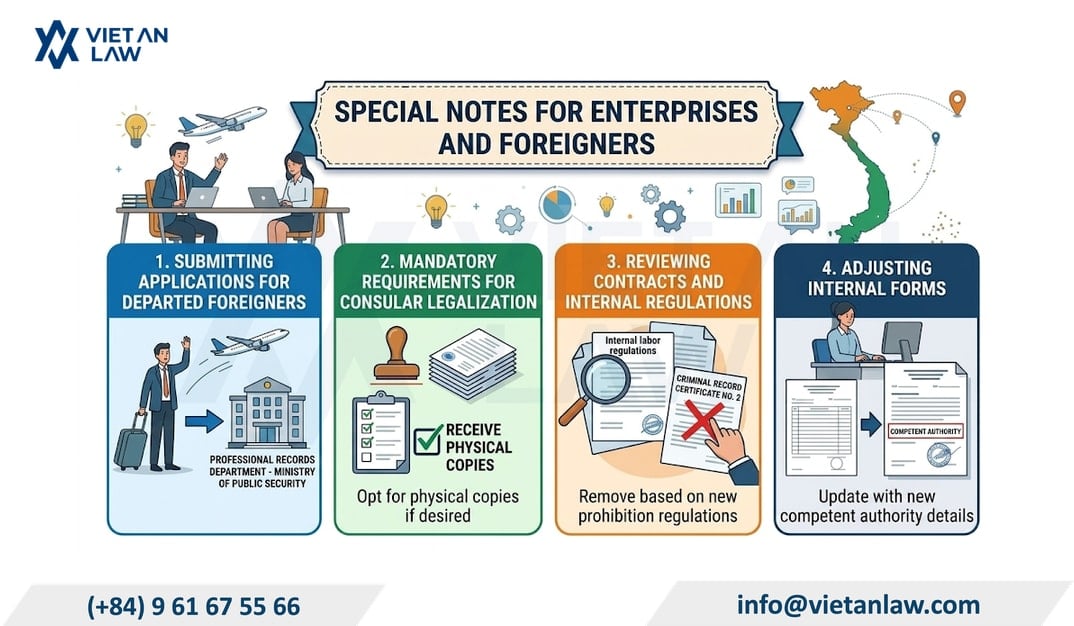
Specific notes for businesses and foreigners in Vietnam
Dossier submission for foreigners who have exited the country: Terminate the sending of dossiers to the Department of Justice; FDI enterprises and experts need to send dossiers for the criminal record certificate for foreigners in Vietnam to the Department of Professional Records under the Ministry of Public Security;
Mandatory requirement for consular legalization: The electronic judicial record certificate in Vietnam only has domestic use value; for dossiers brought to another country for use, the human resources department must proactively choose to receive paper results via postal service right from the dossier submission step;
Reviewing contracts and internal rules if requesting the submission of Card No. 2: The legal department of the FDI enterprise must proceed to review labor contracts and recruitment regulations to immediately eliminate clauses forcing employees to submit judicial record card No. 2;
Adjusting internal forms: Urgently review, conduct contract drafting services, and update internal dossiers to change the phrase designating the competent authority from the Department of Justice to the Provincial-level Police or the Ministry of Public Security.
Frequently asked questions about the new criminal record certificate procedures in Vietnam in 2026
Where is the Vietnam criminal record certificate made in 2026?
According to the new regulations, the procedure is no longer carried out at the Department of Justice. Vietnamese citizens submit dossiers online via VNeID. Foreigners or individuals without an electronic identity submit directly at the provincial-level Police of their residence or the Department of Professional Records of the Ministry of Public Security.
How is the online issuance of the judicial record certificate in Vietnam via VNeID carried out?
Citizens use level 2 VNeID accounts, access the administrative procedures section, and fill out the declaration form. The software automatically checks, provides reception feedback within 8 working hours, and returns the electronic judicial record certificate directly on the application.
What is the biggest change in Decree 216/2026/ND-CP for employers?
The core change is the absolute ban on employers requesting candidates to submit judicial record card No. 2. Any act of violating this regulation on protecting sensitive personal data can lead to severe administrative sanctions.
Legal compliance consulting services in Vietnam at Viet An Law Firm
According to Article 3 of Law No. 107/2025/QH15 on transitional provisions, the initial phase of applying the law will require complex synchronous data coordination among the Supreme People’s Court, the Supreme People’s Procuracy, and the Ministry of National Defense. This is an existing risk that can prolong the actual issuance time of the Vietnam judicial record certificate.
To avoid being passive and disrupting business processes, mastering the regulations in Decree 216/2026/ND-CP on the judicial record certificate applicable from July 1, 2026 is a mandatory requirement. The team of lawyers at Viet An Law is ready to accompany businesses through key services:
Consulting on executing criminal record certificate procedures in Vietnam for foreign experts, notarized translation, and consular legalization;
Supporting clients to establish a 100% FDI company in Vietnam, reviewing contracts, and updating labor regulations to ensure compliance with the requirements for supplementing the judicial record certificate;
Acting as authorized representatives to handle arising legal obstacles, ensuring compliance with work permit for foreigner regulations in the initial phase of data transfer.
Thorough preparation for the Vietnam criminal record certificate under Decree 216/2026/ND-CP applicable from July 1, 2026 will create a tremendous compliance advantage. Contact Viet An Law immediately to be consulted on a safe internal conversion plan, saving time and optimizing the legal risk management system.
Fast & Reliable Legal Assistance
Fill out the form below and get connected with a lawyer quickly.
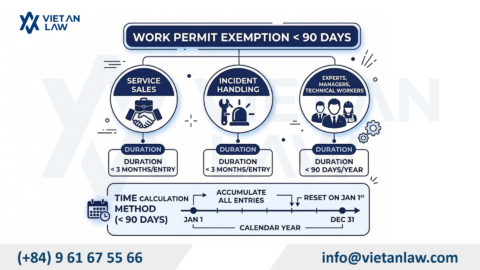
Do foreigners working under 90 days need a work permit in Vietnam? Learn exemption rules, notification requirements, and common mistakes under Decree 219/2025. Expert guide for HR and expats.
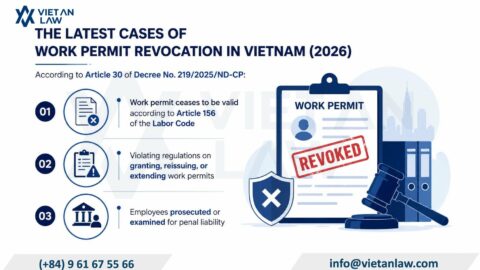
Learn the 2026 cases of work permit revocation Vietnam under Decree 219/2025: contract termination, incorrect job roles, fake documents, and enterprise closure. Essential guide for FDI compliance.
Whether foreigners working remotely in Vietnam need a work permit depends on the nature of their work, their duration of residence, and their labor relationship with entities in Vietnam. In…
Official work permit application form 2026 (Form No. 01) under Decree 219/2025/ND-CP for Vietnam. Download template, filling instructions, and avoid common mistakes.
Legal services for foreigners in Vietnam: visas, work permits, TRC, FDI company setup, marriage, contracts & dispute resolution. 20 years experience, transparent costs.