Patent registration in Vietnam is an important legal step for individuals and businesses seeking to protect intellectual property rights, prevent technology infringement, and enhance commercial value. In practice, more than 60% of applications are rejected for failing to meet the protection criteria or to follow the correct filing procedure.
For foreign investors in Vietnam and foreign companies in Vietnam, understanding the legal framework for patent registration in Vietnam is essential to protect innovation and maintain a competitive advantage in the Vietnamese market.
At Viet An Law, our patent registration services in Vietnam provide the best legal support, from prior art search to filing, prosecution, and enforcement.
Quick overview
- Registration timeline: 18-24 months
- Official state fees: from VND 1.5–3 million
- Service fees: depending on claim complexity
- Requirements: novelty, inventive step, industrial applicability
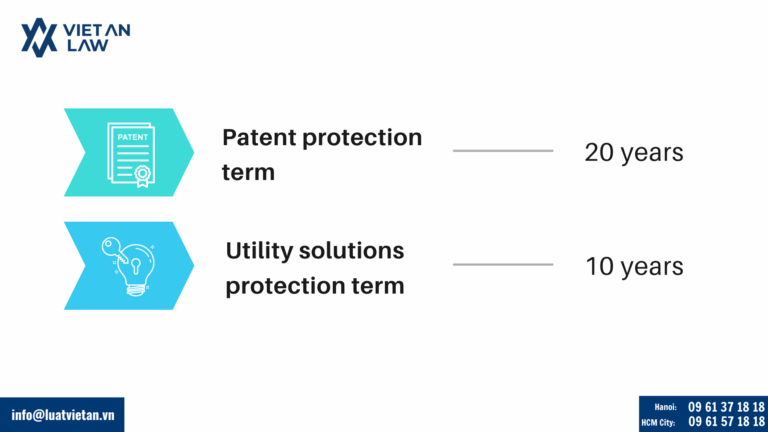
- Protection forms: invention patent (20 years) or utility solution (10 years)
Our intellectual property services in Vietnam are designed to help businesses register a patent in Vietnam efficiently.
Conditions for patent registration in Vietnam
A patent will be granted when all three legal conditions are satisfied under Vietnamese IP law for foreigners and domestic applicants.
Novelty
The invention must not have been publicly disclosed anywhere in the world before the filing date.
This is the most important requirement in patent registration in Vietnam.
Inventive step
- The technical solution must not be easily created by a person with average knowledge in the relevant technical field.
- A qualified patent attorney can help assess whether the invention meets this requirement.
Industrial applicability
- The invention must be capable of repeated production or practical implementation with stable results.
- These three criteria determine whether you can register a patent in Vietnam.
Patent vs utility solution in Vietnam
| Criteria |
Invention patent |
Utility solution |
| Inventive requirement |
High |
Lower |
| Novelty |
Mandatory |
Mandatory |
| Industrial use |
Mandatory |
Mandatory |
| Protection term |
20 years |
10 years |
| Approval difficulty |
Higher |
Easier |
| Commercial value |
Higher |
Moderate |
For foreign companies in Vietnam, choosing the right protection strategy is an important part of patent registration services.
Should you register an invention patent or a utility solution?
Choose an invention patent if:
- The solution is highly innovative
- Long-term protection of inventions in Vietnam is required
- High commercial licensing value is expected
Choose a utility solution if:
- It is a technical improvement
- Faster approval is preferred
- Cost optimisation is important
A skilled IP law firm can help determine the best route for patent registration in Vietnam.
Common reasons patent applications are rejected
After nearly two decades of practice, Viet An Law has found that many businesses fail to register a patent in Vietnam due to common but critical mistakes.
Lack of novelty
- This is the most frequent reason applications fail in patent registration in Vietnam.
- If the invention has already been published in any country, the application is likely to be rejected.
Unclear patent description
- A vague technical description often causes the Intellectual Property Office to misunderstand the invention.
- This directly affects the protection of inventions in Vietnam.
Incorrect scope of claims
- Claims too broad → likely overlap and rejection
- Claims too narrow → weak legal protection
This is where an experienced patent attorney becomes essential.
No prior patent search
Skipping the patent search often leads to:
- duplication with existing patents
- wasted filing costs
- 1-2 years lost in examination
This is why patent registration services in Vietnam always begin with a detailed search.
How to increase the success rate of patent registration in Vietnam
To improve the likelihood of successful patent registration in Vietnam, applicants should:
- Conduct a thorough patent search before filing the application
- Prepare a technically compliant and well-structured patent specification
- Clearly define an appropriate scope of patent protection from the outset
Taking these steps early significantly increases the chances of approval and helps avoid unnecessary delays or rejection.
Subject matter in Vietnam
Under the Vietnamese IP law for foreigners, technical solutions eligible for patent protection may exist in the following common forms:
Technical solutions in the form of products
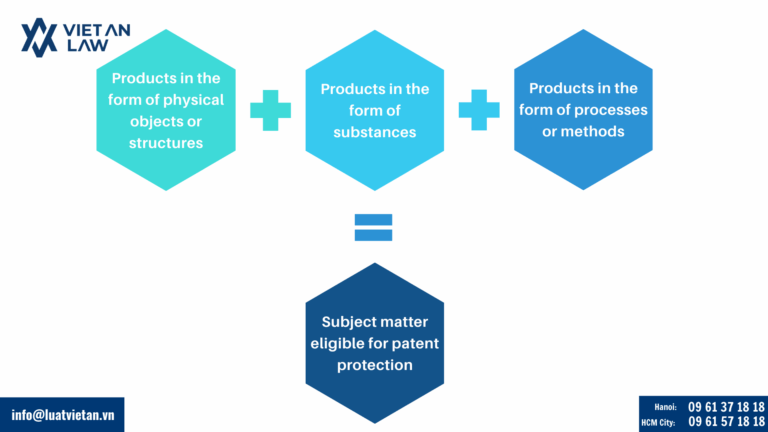
- Products as physical objects or structures: Including tools, machinery, equipment, components, electrical circuits, and technical systems
- Products as substances: Including single substances, compounds, or mixtures such as materials, chemicals, food products, and pharmaceuticals
- Products involving genetic resources or traditional knowledge: Relating to genetic resources and traditional knowledge associated with such resources in accordance with regulations on access and benefit-sharing
Technical solutions in the form of processes/methods
These include:
- manufacturing processes
- diagnostic methods
- testing and inspection methods
- forecasting systems
- technical treatment processes
Such solutions are applied in industry, healthcare, agriculture, and other technical sectors.
Confidential/Secret inventions
A confidential invention refers to an invention that has been classified by the competent authority as a state secret and is protected under separate confidentiality regulations.
These categories are frequently used by foreign investors in Vietnam seeking patent registration.
Excluded subject matter in Vietnam
Not every technical or intellectual solution is eligible for patent protection.
Under Vietnamese law, the following are excluded from patent protection:
- discoveries, scientific theories, and mathematical methods
- plans, rules, and methods for mental activities, business operations, or games; computer programs
- methods of presenting information
- solutions of purely aesthetic nature
- plant varieties and animal breeds
- essentially biological production processes (except microbiological processes)
- methods for the prevention, diagnosis, and treatment of diseases for humans and animals
Therefore, to complete patent registration in Vietnam, the technical solution must be clearly expressed as either a product or a process, capable of practical application, and must not fall within the statutory exclusions.
A clear understanding of the scope of protection helps businesses and individuals avoid rejection and save significant time during the registration process.
A qualified IP law firm can help determine whether your invention qualifies.
Priority rights in patent registration in Vietnam
According to the Vietnamese IP Law for foreigners, where multiple identical or similar patent applications are filed, the patent certificate shall be granted to the application with the earliest priority date or filing date, provided that all protection requirements are satisfied.
This principle is particularly important for applicants seeking to register a patent in Vietnam after first filing in another jurisdiction.
Conditions include:
- Paris Convention member eligibility
- Valid first filing abroad
- Second filing within 6 months
- Proper priority claim documents
This is a key part of patent registration services in Vietnam for multinational businesses.
Patent search before filing (highly recommended)
Before attempting to register a patent in Vietnam, a prior art search is recommended.
A patent search can improve approval chances by 70-80%.
Preliminary Search
Databases include:
- Google Patents
- Vietnam IP Office database
- WIPO database
How to conduct a preliminary patent search
A preliminary search should generally be conducted as follows:
- Search using relevant technical keywords
- Compare your solution with published patents and patent applications
- Pay particular attention to the claims section, which defines the scope of legal protection
Limitations of preliminary patent searches
However, preliminary searches often have certain limitations:
- The database may not be fully updated
- An in-depth analysis is difficult without professional expertise
- Similar patents filed overseas may easily be overlooked
Why a preliminary search alone is not enough
Many individuals and businesses assume that a simple Google search is sufficient.
In practice, this is often not the case because:
- a patent may already have been filed but not yet published
- another invention may share the same technical essence despite being described differently
- non-specialists often find it difficult to assess the inventive step requirement
This is why many applications are rejected after 12-18 months, even though the applicant believed the invention was “not duplicated.”
In-depth patent search before filing (recommended)
An in-depth patent search is an advanced analytical step designed to:
- Assess the likelihood of patent grant
- Identify the novelty and potential weaknesses of the invention
- Recommend adjustments to the scope of protection (claims)
Unlike a standard preliminary search, an in-depth patent search:
- uses more specialised and up-to-date patent databases
- is conducted and analysed by intellectual property professionals
- includes a professional assessment report on patentability
The results of an in-depth search help you to:
- avoid filing a “futile” application
- increase the likelihood of patent approval
- save time and costs
When should an in-depth patent search be conducted?
- You should consider an in-depth patent search if:
- The invention has high commercial value
- You plan to pursue international patent registration
- You want to optimise the scope of protection from the beginning
- You are uncertain whether the invention meets the novelty requirement
This step is particularly recommended before proceeding with registering a patent in Vietnam.
Important notes
- A patent search is for reference purposes only and does not guarantee a 100% grant rate
- The invention should not be publicly disclosed before filing
- For best results, the search should be combined with professional legal and technical advice
Professional recommendation
If you are uncertain about the patentability of your invention, the safest solution is to: Submit the invention description for pre-filing assessment (preferably together with an NDA to ensure strict confidentiality with the consulting party).
This helps you to:
- Understand the estimated success rate in advance
- Adjust the filing strategy
- Avoid the risk of losing ownership rights
Documents clients should prepare when using Viet An Law’s patent registration services
When using patent registration services in Vietnam through Viet An Law, clients should prepare complete initial documents and information to ensure efficient processing, minimise errors, and improve the chances of successful registration.
- Information of the inventor and patent owner
- personal or corporate information of the inventor
- information of the patent owner (which may be the same as or different from the inventor)
- This forms the legal basis for establishing filing rights and lawful ownership.
- Patent specification documents (most important)
- a detailed description of the technical solution
- information clearly demonstrating the novelty and distinguishing features of the invention
This directly determines the possibility of obtaining patent protection.
- Technical drawings and diagrams (if any)
- structural drawings or process illustrations
- technical diagrams clarifying the nature of the invention
These materials help the examining authority understand the invention.
- Documents proving filing rights
(applicable where the filing right has been assigned from another party)
- assignment agreement for the right to file
- related contractual or legal documents
- Priority right documents (if any)
- applicable where the application claims international priority rights
- includes a copy of the first-filed application and relevant supporting documents
This is important for foreign companies in Vietnam and international applicants.
- Power of Attorney for IP representative
- the client signs a power of attorney authorising Viet An Law
- this authorises the representative to handle the entire patent registration procedure in Vietnam on the client’s behalf
This is particularly important for foreign investors in Vietnam and overseas applicants.
Patent filing methods in Vietnam (updated in 2026)
Who is eligible to file a patent application?
The following entities are entitled to apply for patent registration in Vietnam:
- Vietnamese individuals and organizations
- Foreign individuals residing in Vietnam
- Foreign organisations and individuals with manufacturing or business operations in Vietnam
These applicants may register a patent in Vietnam through:
- Direct filing with the Intellectual Property Office of Vietnam
- Or via a licensed representative, such as Viet An Law (an authorised intellectual property representative)
Cases where an IP representative is mandatory
The following applicants are required to file through a licensed IP law firm:
- Foreign individuals not residing in Vietnam
- Foreign organisations or individuals without a commercial presence in Vietnam
In such cases, applications must be submitted through a certified intellectual property representative under Vietnamese IP law for foreigners.
Patent registration process in Vietnam
The process of patent registration in Vietnam consists of the following key stages:
Step 1: Patent search (recommended)
- Assess patentability
- Avoid duplication → reduce risk of rejection
Step 2: Filing the application
- Submit directly or online to the Intellectual Property Office of Vietnam
- Or through an authorised IP representative
Step 3: Formality examination (1 month)
- Verification of application validity
Step 4: Publication of application (18-19 months)
The application is published in the official database
Step 5: Substantive examination (up to 18 months)
- Evaluation of protection criteria
If all requirements are met → a patent will be granted.
This is the standard procedure to register a patent in Vietnam for both domestic applicants and foreign companies in Vietnam.
Official fees for patent/utility solution registration
According to Circular No. 263/2016/TT-BTC, the official fees include:
- Filing fee: VND 150,000
- Formality examination fee: VND 180,000 per independent claim
- Additional formality fee (from page 7 onward): VND 8,000 per page
- Publication fee: VND 120,000
- Additional publication fee (from the second figure): VND 60,000 per figure
- Priority claim examination fee (if any): VND 600,000 per priority application
- Search fee: VND 600,000 per independent claim
- Substantive examination fee: VND 720,000 per independent claim
- Additional substantive fee (from page 7 onward): VND 32,000 per page
Note: Applications must be classified according to the International Patent Classification (IPC). If not properly classified, the authority will conduct classification and charge an additional fee (VND 100,000 per classification).
Total estimated cost of patent registration in Vietnam
- Government fees: approximately VND 3,000,000
- Professional service fees: from VND 15,000,000 (depending on complexity)
- Translation fees (if applicable): VND 3,000,000 – 15,000,000
Our patent registration services in Vietnam are designed to optimise cost efficiency while ensuring compliance.
Practical case studies
Case 1: The technology company was rejected due to international duplication
A Hanoi-based tech company attempted patent registration in Vietnam for a hardware solution but was rejected due to duplication with a Korean patent.
Issues:
- No international patent search conducted
- Claims drafted too broadly
- Risk of losing 12-24 months
Solution by Viet An Law:
- Conducted international search (WIPO, KIPRIS)
- Refined claims to focus on core technical elements
- Improved technical description
Result:
- Application accepted after 12 months
- No need to refile → significant cost savings
- Stronger protection of inventions in Vietnam
Case 2: Startup rejected due to poor description
A manufacturing startup self-filed but failed during substantive examination.
Problems:
- Unclear and illogical description
- No technical drawings
- No proof of industrial applicability
Solution:
- Rewrote the specification to meet patent standards
- Added diagrams and technical examples
- Clarified technical effectiveness
Outcome:
- Application accepted after amendment
- Increased success rate
- Improved understanding of patent registration in Vietnam
Case 3: FDI Company at risk of losing its patent rights
A Singapore-based investor introduced a product at a trade fair before filing in Vietnam.
Risks:
- Loss of novelty
- Possible rejection
- Competitors could file first in Vietnam
Legal strategy:
- Assessed the applicability of the grace period and priority rights
- Adjusted invention content
- Filed promptly to secure priority
Result:
- Patent still granted
- Avoided loss of rights
- Successfully protected core technology
This case highlights the importance of early patent registration in Vietnam for foreign investors in Vietnam.
Frequently Asked Questions (FAQ) in 2026
How long does patent registration in Vietnam take?
- Typically 18-24 months:
- Formality examination: ~1 month
- Publication: month 18-19
- Substantive examination: up to 18 months
How much does it cost?
- Government fees: VND 1.5 – 3 million
- Service fees: VND 10 – 30 million
Should you conduct a patent search first?
Yes, highly recommended.
A search helps:
- Assess patentability
- Avoid duplication
- Save time and cost
Can a rejected patent be amended?
Yes, depending on the case:
- Revise claims
- Supplement documents
- Respond to office actions
However, the lack of novelty is difficult to overcome.
Can foreigners register a patent in Vietnam?
Yes, but must file through a licensed IP law firm in Vietnam.
Should you register a patent or utility solution?
- Patent: stronger protection (20 years)
- Utility solution: easier and faster (10 years)
Should patents and trademarks be registered together?
Yes. Many businesses combine both to protect technology and brand.
Do startups need patent protection?
If they own technical solutions, they should pursue patent registration in Vietnam to protect their intellectual assets.
Why Choose Viet An Law?
With over 19 years of experience, Viet An Law provides comprehensive intellectual property services in Vietnam, including:
- patent registration
- trademark registration
- copyright protection
- industrial design registration
We support both local clients and foreign companies in Vietnam with efficient, reliable legal solutions.
Contact us
- Submit your invention description today for a free patentability assessment within 24 hours.
- All information is strictly confidential under NDA.
- Hotline / Zalo: 09 61 37 18 18