The transition to an electronic employment contract is becoming an inevitable trend in the digitalization of human resource management and corporate operations. To specify the provisions in Decree 337/2025/ND-CP, on May 15, 2026, the Ministry of Home Affairs issued Circular 08/2026/TT-BNV with many notable new contents regarding the conclusion, management, and use of the employment contract in electronic form: key updates under Circular 08/2026/TT-BNV taking effect from July 1, 2026. Not only providing detailed guidance on contract identification codes, access accounts for the eContract platform, or data connection conditions, the Circular also sets out many new requirements for employers, employees, and electronic contract service providers. In the article on labor law consulting below, Viet An Law Firm will update and synthesize the new points of Circular 08/2026/TT-BNV guiding Decree 337/2025 on the Vietnam electronic employment contract.
The electronic employment contract identification code (hereinafter referred to as ID) is a unique number sequence granted by the electronic employment contract platform for each electronic contract and those converted from paper-based contracts. According to Article 4 of Circular 08/2026/TT-BNV, granting an ID must meet the following principles:
Each contract, when sent to the platform, if compliant, will be granted a unique ID that does not duplicate any other.
The ID is granted once and remains unchanged even if the contract is amended, supplemented, suspended, or terminated. Appendices, suspension notices, and termination notices are attached to the ID of that contract.
State agencies use the ID as the digital data management code. Granting the ID does not change the time of conclusion, contents, or effective time of the contract concluded by the parties.
The ID is linked to display codes or search codes (by administrative unit code, employee’s identification code, employer’s tax code) built by the platform to serve data extraction needs, but these codes do not replace the ID.
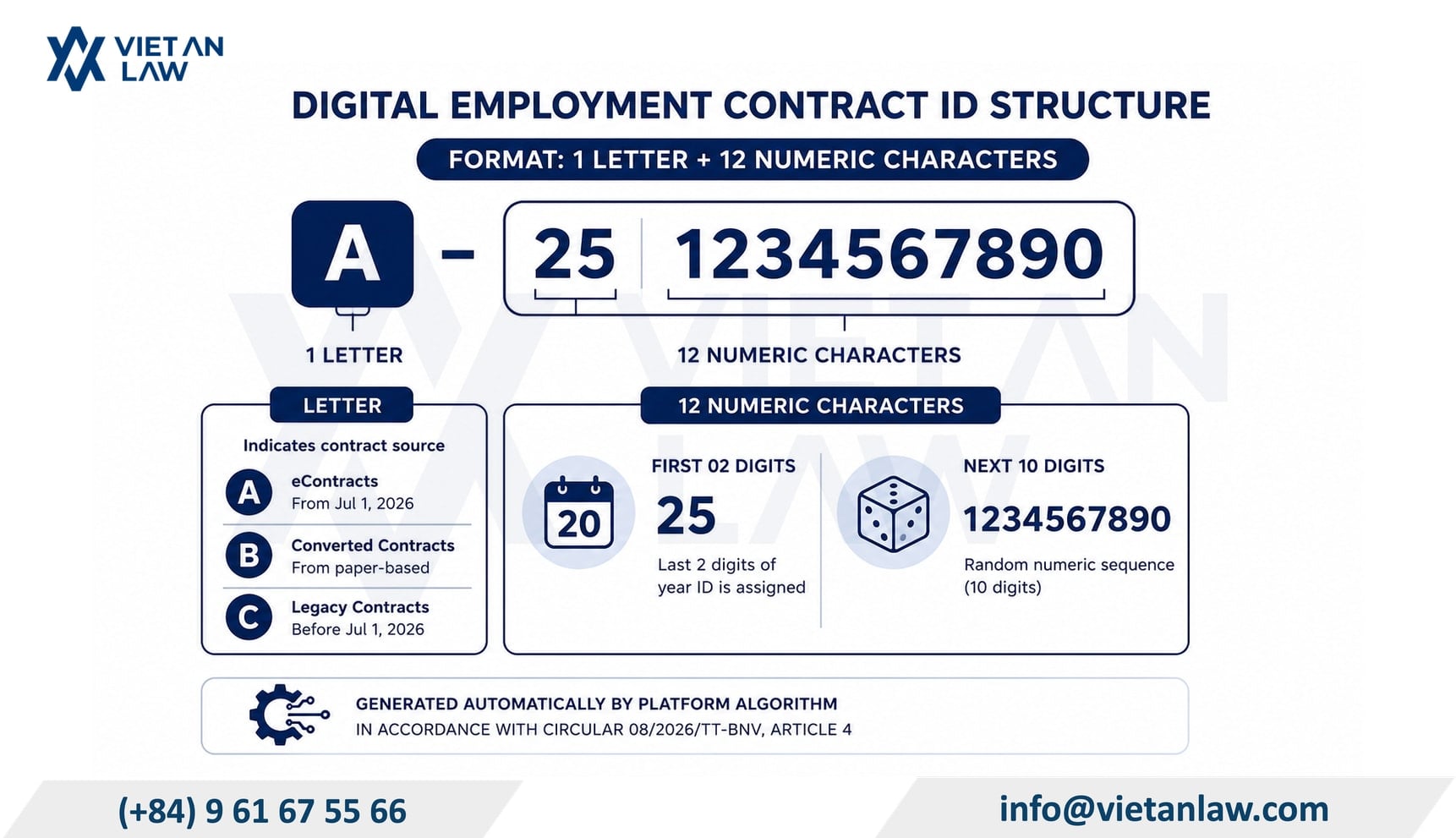
Structure of the ID for a digital employment contract
According to Article 4 of Circular 08/2026/TT-BNV, the ID structure is generated automatically by the platform’s algorithm, including 01 letter character and 12 numeric characters, in which:
The letter character is A, B, or C, where:
The 12 numeric characters are structured as follows:
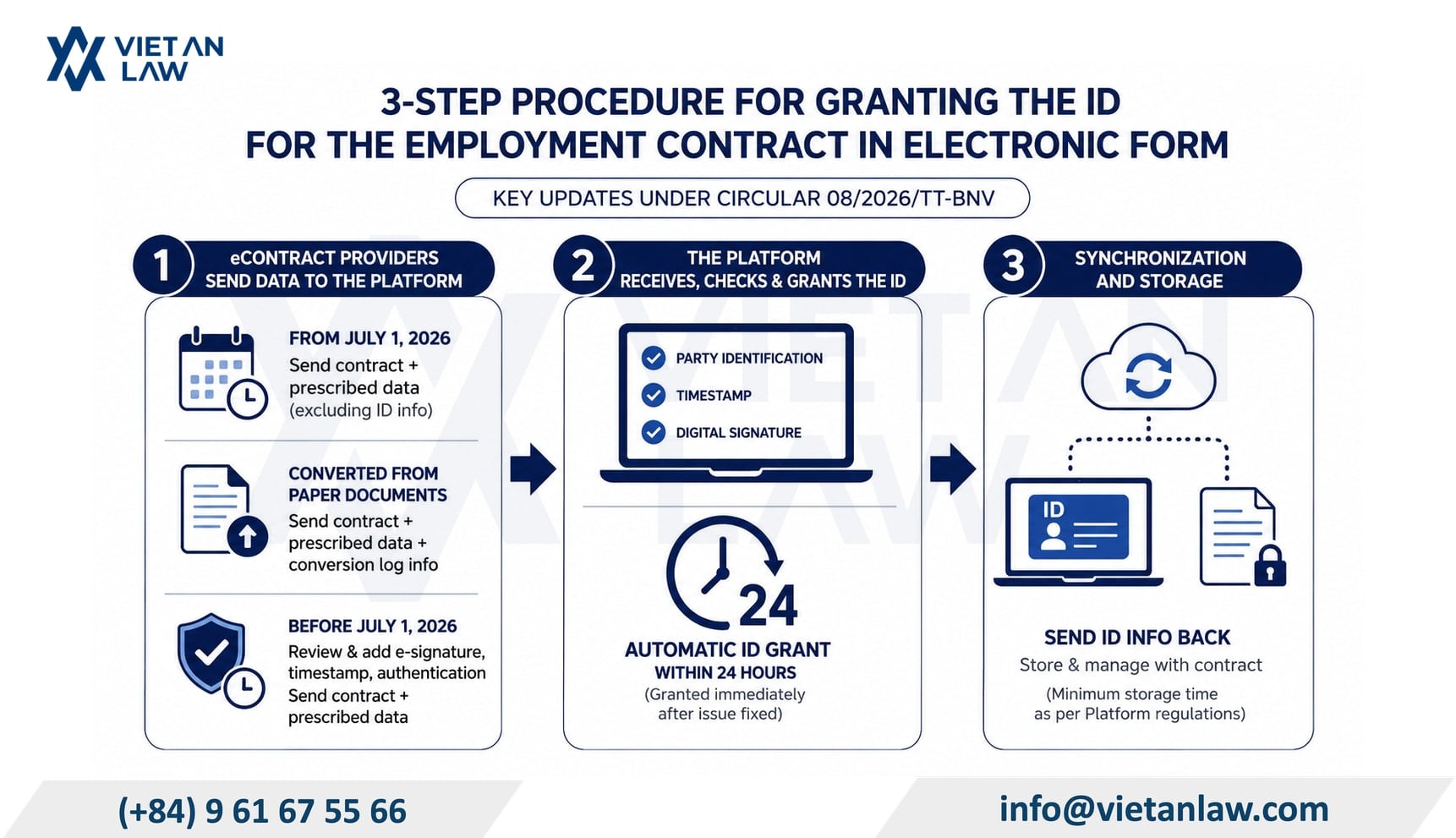
3-step procedure for granting the ID for the employment contract in electronic form
The ID information is sent back to the eContract provider’s system for management and storage alongside the contract (minimum storage time according to the Platform’s regulations).
According to Article 7 of Circular 08, employers and employees use electronic identity accounts issued by the National Electronic Identity and Authentication System (VNeID) in accordance with the law to log into the platform:
If an employer is an organization that cannot register an organizational identity account according to the law on electronic identification and authentication, they shall request the Ministry of Home Affairs to grant an access account.
The platform exploits the validity status of electronic identity accounts provided by VNeID.
If an account is locked or changes status according to the law, the platform will adjust access and usage rights based on the authentication results provided by VNeID.
Based on Articles 9, 10, 11, and 12 of Circular 08/2026/TT-BNV regulating the connection:
According to Article 18 of Circular 08/2026/TT-BNV, open data on the platform is synchronized to the National Data Center.
Based on Article 19 of Circular 08/2026/TT-BNV regulating reporting responsibilities:
Yes. From July 1, 2026, after conclusion, it must be sent to the platform to be granted an ID according to Circular 08/2026/TT-BNV.
Each contract is granted only one unique ID that does not change throughout its existence, even upon amendment, supplementation, suspension, or termination. The ID is used as the digital data management code in the state management system.
Yes. Circular 08/2026/TT-BNV allows this conversion. The eContract provider must attach conversion log data such as: conversion system name, executor, time, data format, sealing digital signature, and status matching the original.
Once sent to the platform and meeting conditions, it will receive an ID starting with the letter “B”.
According to Article 7 of Circular 08/2026/TT-BNV, they use electronic identity accounts issued by VNeID.
Specifically:
If an organization hasn’t registered one, it can request the Ministry of Home Affairs to grant an access account.
Yes. The Circular sets strict requirements on cybersecurity, personal data protection, and data access control.
All data access, exploitation, and sharing must be controlled according to the principles of correct subjects, proper authority, right purposes, and traceability. Additionally, connecting and sharing data with external systems must ensure cybersecurity requirements according to the law.
Yes. According to Article 19 of Circular 08/2026/TT-BNV, employers are responsible for reporting labor changes through the platform in accordance with labor laws.
For labor subleasing enterprises, reporting the labor subleasing situation is also done via this platform.
Above is a summary of the new points of Circular 08/2026/TT-BNV guiding Decree 337/2025 on electronic contracts. If businesses, employees, or organizations have any questions related to the application of regulations on electronic contracts, digital signatures, labor data storage, or contract dispute resolution arising, they can consult with Viet An Law Firm – a unit providing labor law consulting, corporate, and digital transformation services in Vietnam.